Results by title
88 books match the query 'Religion and politics' and 6 start with c
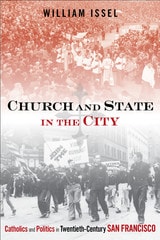
Church and State in the City
Catholics and Politics in Twentieth-Century San FranciscoWilliam Issel
Temple University Press, 2012
Church and State in the City provides the first comprehensive analysis of the city’s long debate about the public interest. Historian William Issel explores the complex ways that the San Francisco Catholic Church—and its lay men and women—developed relationships with the local businesses, unions, other community groups, and city government to shape debates about how to define and implement the common good. Issel’s deeply researched narrative also sheds new light on the city’s socialists, including Communist Party activists—the most important transnational challengers of both capitalism and Catholicism during the twentieth century.
Moreover, Church and State in the City is revisionist in challenging the notion that the history of urban politics and policy can best be understood as the unfolding of a progressive, secular modernization of urban political culture. Issel shows how tussles over the public interest in San Francisco were both distinctive to the city and shaped by its American character.
In the series Urban Life, Landscape, and Policy, edited by Zane L. Miller, David Stradling, and Larry Bennett
Civic and Uncivic Values in Poland
Value Transformation, Education, and CultureSabrina P. Ramet
Central European University Press, 2019
Civil Religion in Political Thought
Ronald Weed
Catholic University of America Press, 2010
Composing Violence
The Limits of Exposure and the Making of MinoritiesMoyukh Chatterjee
Duke University Press, 2023
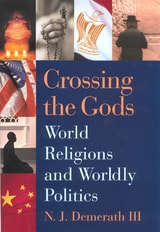
Crossing the Gods
World Religions and Worldly PoliticsDemerath, Jay
Rutgers University Press, 2003
Eminent sociologist of religion Jay Demerath traveled to Brazil, China, Egypt, Guatemala, India, Indonesia, Israel, Japan, Northern Ireland, Pakistan, Poland, Sweden, Turkey, and Thailand to explore the history and current relationship of religion, politics, and the state in each country. In the first part of this wide-ranging book, he asks, What are the basic fault lines along which current tensions and conflicts have formed? What are the trajectories of change from past to present, and how do they help predict the future?
In the book’s second part the author returns home to focus on the United States the only nation founded specifically on the principle of a separation between religion and state and examines the extent to which this principle actually holds and the consequences when it does not. Highlighting such issues as culture wars, violence, globalization, and the fluidity of individual religious identity, Demerath exposes the provincialism and fallacies underlying many of our views of religion and politics worldwide.
Finally, Demerath examines America’s status as the world’s most religious nation. He places that claim within a comparative context and argues that our country is not “more religious” but “differently religious.” He argues that it represents a unique combination of congregational religion, religious pluralism, and civil religion. But the United States also illustrates the universal tendency for the sacred to give way to the secular and for the secular to generate new forms of the sacred.
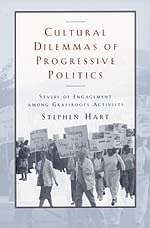
Cultural Dilemmas of Progressive Politics
Styles of Engagement among Grassroots ActivistsStephen Hart
University of Chicago Press, 2001
Through case studies of grassroots movements—particularly the economic justice work carried on by congregation-based community organizing and the pursuit of human rights by local members of Amnesty International—Hart shows how these groups develop distinctive ways of talking about politics and create characteristic stories, ceremonies, and practices. According to Hart, the way people engage in politics matters just as much as the content of their ideas: when activists make the moral basis for their activism clear, engage issues with passion, and articulate a unified social vision, they challenge the recent ascendancy of conservative discourse.
On the basis of these case studies, Hart addresses currently debated topics such as individualism in America and whether strains of political thought strongly informed by religion and moral values are compatible with tolerance and liberty.