Results by title
424 books match the query 'Russian & Soviet' and 12 start with c
Capitalism with a Comrade's Face
Kenneth Murphy
Central European University Press, 1998
Are nations that are journeying away from communism succeeding in becoming free-market democracies? In what ways do decades of totalitarian rule continue to distort the institutional shape of these societies? Which of communism's legacies may remain as permanent features of their landscape? In an effort to answer these questions, Roman Frydman, Kenneth Murphy, and Andrzej Rapaczynski analyze the turbulent transitions that have taken place in the post-Communist world since the revolutions of 1989-1991.
Each of the essays in this collection dissects the institutional upheaval in a particular institution in transition, such as central banking, the trade union movement, capital markets, or corporate govern-ance. In a lively and accessible style, the authors bring out the links between what was and what will be in the social fabric of Eastern Europe and the former Soviet Union. They expose the fragility of political and economic institutions that can easily threaten the region's rebirth, but they also believe that many post-Communist countries are successfully seizing the opportunity to become reunited with the West and the global economy.
With both sweeping perspective and critical depth, Frydman, Murphy, and Rapaczynski show the wide range of institutional improvisations under way. They weigh the advantages and disadvantages of different reform strategies and assess the role of politics in fostering or arresting the process of transformation. Each essay illuminates the pro-found difficulties of reconciling the needs of economic development with the special interests fighting for their survival.
Censorship in Romania
Lidia Vianu
Central European University Press, 1998
Challenging the Bard
Dostoevsky and Pushkin, a Study of Literary RelationshipGary Rosenshield
University of Wisconsin Press, 2013
Charlottengrad
Russian Culture in Weimar BerlinRoman Utkin
University of Wisconsin Press, 2023
By closely examining the intellectual output of Charlottengrad, Roman Utkin explores how community members balanced their sense of Russianness with their position in a modern Western city charged with artistic, philosophical, and sexual freedom. He highlights how Russian authors abroad engaged with Weimar-era cultural energies while sustaining a distinctly Russian perspective on modernist expression, and follows queer Russian artists and writers who, with their German counterparts, charted a continuous evolution in political and cultural attitudes toward both the Weimar and Soviet states.
Utkin provides insight into the exile community in Berlin, which, following the collapse of the tsarist government, was one of the earliest to face and collectively process the peculiarly modern problem of statelessness. Charlottengrad analyzes the cultural praxis of “Russia Abroad” in a dynamic Berlin, investigating how these Russian émigrés and exiles navigated what it meant to be Russian—culturally, politically, and institutionally—when the Russia they knew no longer existed.
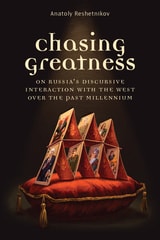
Chasing Greatness
On Russia's Discursive Interaction with the West over the Past MillenniumAnatoly Reshetnikov
University of Michigan Press, 2024
Despite its substantive historical depth, Chasing Greatness is not a book of history. Rather, it is a synthesizing social science work inspired by the continental tradition of the critical history of modernity. As such, the book is more about the present than about the past. Its main aim is to expose and explain the rich conceptual baggage behind Russia’s unceasing great power rhetoric (domestic and international) and how this rhetoric drives the current international crises involving Russia.
Chekhov and Russian Religious Culture
Poetics of the Marian ParadigmJulie de Sherbinin
Northwestern University Press, 1997
Chernyshevskii's "What is to Be Done"
A ReevaluationAndrew Drozd
Northwestern University Press, 2012
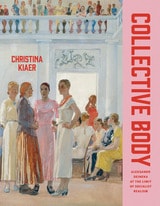
Collective Body
Aleksandr Deineka at the Limit of Socialist RealismChristina Kiaer
University of Chicago Press, 2024
Dislodging the avant-garde from its central position in the narrative of Soviet art, Collective Body presents painter Aleksandr Deineka’s haptic and corporeal version of Socialist Realist figuration as an alternate experimental aesthetic that, at its best, activates and organizes affective forces for collective ends. Christina Kiaer traces Deineka’s path from his avant-garde origins as the inventor of the proletarian body in illustrations for mass magazines after the revolution through his success as a state-sponsored painter of monumental, lyrical canvases during the Terror and beyond. In so doing, she demonstrates that Socialist Realism is best understood not as a totalitarian style but as a fiercely collective art system that organized art outside the market and formed part of the legacy of the revolutionary modernisms of the 1920s. Collective Body accounts for the way the art of the October Revolution continues to capture viewers’ imaginations by evoking the elation of collectivity, making viewers not just comprehend but truly feel socialism, and retaining the potential to inform our own art-into-life experiments within contemporary political art. Deineka figures in this study not as a singular master, in the spirit of a traditional monograph, but as a limit case of the system he inhabited and helped to create.
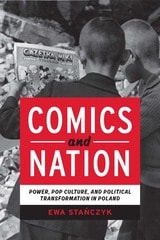
Comics and Nation
Power, Pop Culture, and Political Transformation in PolandEwa Stanczyk
The Ohio State University Press, 2022
Winner, BASEES George Blazyca Award in East European Studies
Comics and Nation offers a fresh perspective on the role of popular culture in the one-hundred-year history of the Polish state, from its foundation in 1918 to the present. Drawing on dozens of press articles, interviews, and readers’ letters, Ewa Stanczyk discusses how journalists, artists, and audiences used comics to probe the boundaries of national culture and scrutinize the established notions of Polishness. Critical moments of Poland’s political transformation ––the establishment of the interwar Polish Republic, the Cold War, the liberalization of the 1970s, the 1989 democratic transition, the turn to memory politics in the 2000s––have all been reflected in the history of Polish comics. Stanczyk offers new insights into how the production of homegrown comics and the influx of foreign works enabled commentators to express their fears, hopes, and disillusionment with political, economic, and cultural changes in Poland and beyond. At its core, Comics and Nation rethinks the impact of popular culture and transnational exchange on Polish nation building, citizenship formation, and the legitimation of power.
Compulsory Happiness
Norman Manea
Northwestern University Press, 1994
Conversations in Exile
Russian Writers AbroadJohn Glad, ed.
Duke University Press, 1993
Glad's introduction situates the three distinct waves of westward emigration in their historical and political framework. Organized by genre, the book begins with discussions with the older generation of writers and then moves on to more recent arrivals: the makers of fantasy and humor, the aesthetes, the moralists, and the realists. Each voice is compelling for its invaluable testimony--some reveal startling insights into the persecution of dissidents under Soviet rule while others address the relationship between creativity, writing, and conditions of exile. Taken together these interviews reveal the range of modern Russian writing and document the personalities and positions that have made Russian writers in emigration so diverse, experimental, and controversial.
The Writers: Vasily Aksyonov, Joseph Brodsky, Igor Chinnov, Natalya Goranevskaya, Frifrikh Gorensetin, Roman Goul, Yury Ivask, Boris Khazanov, Edward Liminov, Vladimir Makisimov, Andrei Siniavsky and Maria Rozanova, Sasha Sokolov, Vladimir Voinovich, Aleksandr Zinoviev
Excerpt
John Glad: You're a Russian poet but an American essayist. Does that bring on any measure of split personality? Do you think you are becoming less and less Russian?
Joseph Brodsky (recipient of 1987 Nobel Prize for Literature): That's not for me to say. As far as I'm concerned, in my inner self, inside, it feels quite natural. I think being a Russian poet and an American essayist is an ideal situation. It's all a matter of whether you have (a) the heart and (b) the brains to be able to do both. Sometimes I think I do. Sometimes I think I don't. Sometimes I think that one interferes with the other.
Corporeal Words
Mikhail Bakhtins Theology DiscourseAlexandar Mihailovic
Northwestern University Press, 1997