Results by title
200 books match the query 'Second Edition' and 15 start with c
Casino Accounting and Financial Management
Second EditionE. Malcolm Greenlees
University of Nevada Press, 2008
Chicane Mental Health, Second Edition
Alma, Mente y CorazónYvette G. Flores
University of Arizona Press, 2026
Chicane Mental Health offers an intersectional and developmental framework for understanding and addressing the mental health needs of Chicane communities. Drawing on over four decades of clinical and academic experience, Yvette G. Flores addresses the entire lifespan from children and youth to emerging adults, adults, and elders.
Foregrounding cultural humility and an understanding of Chicane strengths and community cultural wealth, the author uses vivid vignettes and community-based insights to address how historical trauma, systemic oppression, and sociocultural dynamics shape mental well-being. Flores highlights the cultural strengths and protective factors that foster resilience.
This new edition expands on Flores’s influential work by integrating Indigenous healing practices, decolonial theory, and liberatory models of care. It challenges dominant Western paradigms and calls for culturally affirming, community-engaged approaches to mental health. With a focus on issues such as depression, substance use, intimate partner violence, and intergenerational trauma, the book provides practical tools for scholars, clinicians, and students committed to social justice and healing in Chicane and Latine communities.
Chicano Popular Culture, Second Edition
Que Hable el PuebloCharles M. Tatum
University of Arizona Press, 2017
This edition features:
- Chicanas in the Chicano Movement and Chicanos since the Chicano Movement
- New material on popular authors such as Denise Chávez, Alfredo Vea, Luis Alberto Urrea, and Juan Felipe Herrera
- Suggested Readings to supplement each chapter
- Theoretical approaches to popular culture, including the perspectives of Norma Cantú, Alicia Gaspar de Alba, Pancho McFarland, Michelle Habell-Pallán, and Víctor Sorell
With clear examples, an engaging writing style, and helpful discussion questions, Chicano Popular Culture, Second Edition invites readers to discover and enjoy Mexican American popular culture.
Church and Communion
An Introduction to Ecumenical Theology, Second EditionPhilip Goyret
Catholic University of America Press, 2021
Cite Right, Second Edition
A Quick Guide to Citation Styles--MLA, APA, Chicago, the Sciences, Professions, and MoreCharles Lipson
University of Chicago Press, 2011
Lipson first explains why it is so important to use citations—and to present them accurately—in research writing. He then outlines the main citation styles students and researchers are likely to encounter in their academic work: Chicago; MLA; APA; AAA (anthropology and ethnography); CSE (biological sciences); AMA (medical sciences); ACS (chemistry); physics, astrophysics, and astronomy;and mathematics, computer science, and engineering. New sections have been added on IEEE and ASCE styles, often used in engineering. Each style is presented simply and clearly with examples drawn from a wide range of source types crossing all disciplines, from the arts and humanities to the sciences and medicine. The second edition has also been updated to include a discussion of the merits and pitfalls of citation software, as well as new examples showing proper citation style for video blogs, instant messages, social networking sites, and other forms of digital media.
Based on deep experience in the academic trenches,this thoroughly revised edition is intended to appeal to anyone—student, professional, or academic—who needs an efficient, authoritative guide for citing sources across a wide range of disciplines.
Coaching for the Inner Edge
Practical Sport Psychology for Coaches, Second EditionRobin S. Vealey
FiT Publishing, 2021
Coaches are continually searching for ways to gain the edge over their opponents. They work tirelessly to get their athletes in top physical condition, to develop their physical skills, and to implement successful routines and strategies for their teams. This physical training develops the athlete’s outer edge—the peak physical performance advantage over their opponents. But as most coaches realize, athletes also need an inner edge to perform successfully. This Inner Edge is the advantage that athletes cultivate within themselves by honing their mental skills, by learning to manage their energy in pressure situations and to focus effectively, despite distractions and obstacles.
This much anticipated second edition is a must read for anyone interested in improving sport performance. Dr. Vealey distills and applies the proven methods, updated techniques, and her own experience into a practical, engaging resource for coaches, trainers, and consultants. Drawing from the preeminent research literature of master coaches, innovative sport psychologists, and from her own practical experiences as a college basketball player, coach, sport psychology researcher and consultant, Dr Vealey defines how to develop the Inner Edge in athletes.
Colorado
The Highest State, Second EditionThomas J. Noel
University Press of Colorado, 2011
Each chapter is followed by questions, suggested activities, recommended reading, a "Did you know?" trivia section, and recommended websites, movies, and other multimedia that highlight the important concepts covered and lead the reader to more information. Additionally, the book is filled with photographs, making Colorado: The Highest State a fantastic text for middle and high school Colorado history courses.
Compact Copyright
Quick Answers to Common Questions, Second EditionSara R. Benson
American Library Association, 2026
When faculty, students, and colleagues come to you with legal questions and you suddenly find yourself in the thick of a copyright conundrum, you don’t need pages of historical background information and long-winded legal explanations — you need answers, fast. Previously included in Choice's Top 75 Titles and Resources for Community College Libraries, this bestselling book gives you just that, succinctly addressing common head-scratchers and scenarios in a way that you will lead you to accurate answers quickly. Ideal for on-the-fly reference, staff training, and LIS instruction, Benson’s guide provides excerpts from the law itself alongside tools and suggested additional resources for digging deeper. Compact Copyright
- skillfully explains legal principles in plain language for more than 50 of the most common real-life scenarios library workers face;
- includes new chapters on cutting-edge developments such as AI, separability, and copyright and data;
- provides a primer on contracts and licensing basics, including Creative Commons licensing;
- explores key topics like the First Sale doctrine, Fair Use, public domain, making copies for preservation, the TEACH Act, interlibrary loan, sovereign immunity, and the Digital Millennium Copyright Act (DCMA);
- offers pointers on access to copyrighted material for patrons with disabilities and other concepts related to accessibility;
- discusses select international copyright library issues; and
- includes a Fair Use checklist, copyright and film screening best practices, and additional recommended reading and materials.

Computers and Art
Second EditionEdited by Stuart Mealing
Intellect Books, 2002
Counseling and Psychological Services for College Student-Athletes
Second EditionMary Jo Loughran
FiT Publishing, 2019
Today's college student-athletes face a wide variety of stressors as they enter the increasingly demanding intercollegiate athletic environment. Counseling and Psychological Services for College Student-Athletes, Second Edition, weaves current research findings, practical examples, and best practices to provide undergraduate and graduate student readers with the necessary tools to effectively and ethically address these issues as future practitioners.
Expert chapter authors use their knowledge and experience to address collegiate student-athlete issues such as mental health, injury, race, gender, sexuality, and socioeconomic background, as well as ethical and professional considerations.
This updated second edition includes a case vignette at the beginning of each chapter to illustrate the key concepts and discussion questions to encourage thoughtful interaction with the material. New chapters have been added on student-athlete topics including developmental considerations, trauma, concussions, and internationality to assist in facilitating positive change in the lives of college student-athletes.
Critical Terms for Art History, Second Edition
Edited by Robert S. Nelson and Richard Shiff
University of Chicago Press, 2003
Art history as a field has kept pace with debates over globalization and other social and political issues in recent years, making a second edition of this book not just timely, but crucial. Like its predecessor, this new edition consists of essays that cover a wide variety of "loaded" terms in the history of art, from sign to meaning, ritual to commodity. Each essay explains and comments on a single term, discussing the issues the term raises and putting the term into practice as an interpretive framework for a specific work of art. For example, Richard Shiff discusses "Originality" in Vija Celmins's To Fix the Image in Memory, a work made of eleven pairs of stones, each consisting of one "original" stone and one painted bronze replica.
In addition to the twenty-two original essays, this edition includes nine new ones—performance, style, memory/monument, body, beauty, ugliness, identity, visual culture/visual studies, and social history of art—as well as new introductory material. All help expand the book's scope while retaining its central goal of stimulating discussion of theoretical issues in art history and making that discussion accessible to both beginning students and senior scholars.
Contributors: Mark Antliff, Nina Athanassoglou-Kallmyer, Stephen Bann, Homi K. Bhabha, Suzanne Preston Blier, Michael Camille, David Carrier, Craig Clunas, Whitney Davis, Jas Elsner, Ivan Gaskell, Ann Gibson, Charles Harrison, James D. Herbert, Amelia Jones, Wolfgang Kemp, Joseph Leo Koerner, Patricia Leighten, Paul Mattick Jr., Richard Meyer, W. J. T. Mitchell, Robert S. Nelson, Margaret Olin, William Pietz, Alex Potts, Donald Preziosi, Lisbet Rausing, Richard Shiff, Terry Smith, Kristine Stiles, David Summers, Paul Wood, James E. Young
Critical Terms for Literary Study, Second Edition
Edited by Frank Lentricchia and Thomas McLaughlin
University of Chicago Press, 1995
Critical Terms for Literary Study is an essential handbook and introduction to the work of literary theory. Covering a broad range of key terms that include popular culture, diversity, imperialism, ethics, desire, class, gender, race, canon, representation, and much more through essays by leading scholars, it provides a concise history of each term alongside a critical exploration of the issues and questions for the field that it raises, followed by demonstrations of reading strategies driven by the term.
Exploring the concepts that shape the way we read, the essays combine to provide an extraordinary introduction to the work of literature and literary study, as the nation's most distinguished scholars put the tools of critical practice vividly to use.
Critical Terms for Religious Studies, Second Edition
Edited by Sarah Hammerschlag
University of Chicago Press, 2025
First published nearly thirty years ago, Critical Terms for Religious Studies proved a vital resource for an emerging interdisciplinary conversation. We still use much of the same language in the study of religion, but fresh concerns have both changed the meaning of terms and given rise to new terms altogether. This edition consists of twenty-three entirely new essays that offer students and scholars alike the tools to historicize and evaluate the shifting role of familiar and emerging critical terms in religious studies.
These are “critical terms” both because they are important in our cultural moment and because thinking through them reveals how religions are embedded in and shaped by material, social, economic, and political forces. A shared conviction unites contributors from a range of traditions and methodologies: a recognition that our world is saturated by the persistence of religious traditions as shape-shifting (not static or transcendent) forces of authority, as powerful today as ever before.
Crossing Cultures in the Language Classroom, Second Edition
Andrea DeCapua, Ed.D., and Ann C. Wintergerst, Ed.D.
University of Michigan Press, 2016
Teachers are often in the forefront of today’s cross-cultural contact, whether in the language classroom or in the K–12 or university/college classroom, but they are not always prepared to handle the various issues that can arise in terms of cross-cultural communication. The intent of this book is to make education in cross-cultural awareness accessible to a broad range of teachers working in a variety of educational settings.
Crossing Cultures in the Language Classroom attempts to balance theory and practice for pre-service and in-service teachers in general education programs or in ESL/EFL, bilingual, and foreign language teacher training programs, as well as cross-cultural awareness workshops. This book is unique in that it combines theory with a wide range of experiential activities and projects designed to actively engage users in the process of understanding different aspects of cross-cultural awareness. The goals of the book are to help readers:
- expand cultural awareness of one’s own culture and that of others
- achieve a deeper understanding of what culture is and the relationship between culture and language
- acquire the ability to observe behaviors in order to draw conclusions based on observation rather than preconceptions
- understand and implement observations of cultural similarities and differences
- develop an attitude of tolerance toward cultural differences and move away from the “single story.”
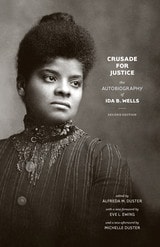
Crusade for Justice
The Autobiography of Ida B. Wells, Second EditionIda B. Wells
University of Chicago Press, 2020
Ida B. Wells is an American icon of truth telling. Born to slaves, she was a pioneer of investigative journalism, a crusader against lynching, and a tireless advocate for suffrage, both for women and for African Americans. She co-founded the NAACP, started the Alpha Suffrage Club in Chicago, and was a leader in the early civil rights movement, working alongside W. E. B. Du Bois, Madam C. J. Walker, Mary Church Terrell, Frederick Douglass, and Susan B. Anthony.
This engaging memoir, originally published 1970, relates Wells’s private life as a mother as well as her public activities as a teacher, lecturer, and journalist in her fight for equality and justice. This updated edition includes a new foreword by Eve L. Ewing, new images, and a new afterword by Ida B. Wells’s great-granddaughter, Michelle Duster.