Results by title
82 books match the query 'Semantics' and 8 start with c
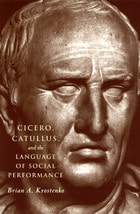
Cicero, Catullus, and the Language of Social Performance
Brian A. Krostenko
University of Chicago Press, 2001
As Krostenko demonstrates, a key feature of this language is its capacity to express both approval and disdain—an artifact of its origins at a time when the "style" and "charm" of imported Greek cultural practices were greeted with both enthusiasm and hostility. Cicero played on that ambiguity, for example, by chastising lepidus ("fine") boys in the "Second Oration against Catiline" as degenerates, then arguing in his De Oratore that the successful speaker must have a certain charming lepos ("wit"). Catullus, in turn, exploited and inverted the political subtexts of this language for innovative poetic and erotic idioms.
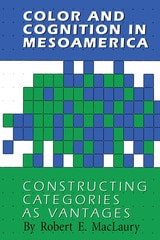
Color and Cognition in Mesoamerica
Constructing Categories as VantagesBy Robert E. MacLaury
University of Texas Press, 1996
More than 100 indigenous languages are spoken in Mexico and Central America. Each language partitions the color spectrum according to a pattern that is unique in some way. But every local system of color categories also shares characteristics with the systems of other Mesoamerican languages and of languages elsewhere in the world.
This book presents the results of the Mesoamerican Color Survey, which Robert E. MacLaury conducted in 1978-1981. Drawn from interviews with 900 speakers of some 116 Mesoamerican languages, the book provides a sweeping overview of the organization and semantics of color categorization in modern Mesoamerica.
Extensive analysis and MacLaury's use of vantage theory reveal complex and often surprising interrelationships among the ways languages categorize colors. His findings offer valuable cross-cultural data for all students of Mesoamerica. They will also be of interest to all linguists and cognitive scientists working on theories of categorization more generally.
Complex Predicates in Japanese
A Syntactic and Semantic Study of the Notion 'Word'Yo Matsumoto
CSLI, 1996
Conceptual Structure, Discourse and Language
Edited by Adele Goldberg
CSLI, 1996
Constraint-Based Syntax and Semantics
Papers in Honor of Danièle GodardEdited by Anne Abeille and Olivier Bonami
CSLI, 2018
Constraints and Resources in Natural Language Syntax and Semantics
Edited by Gosse Bouma, Erhard Hinrichs, Geert-Jan M. Kruijff, and Richard Oehrle
CSLI, 1999
Constructions
A Construction Grammar Approach to Argument StructureAdele E. Goldberg
University of Chicago Press, 1995
Goldberg provides a comprehensive account of the relation between verbs and constructions, offering ways to relate verb and constructional meaning, and to capture relations among constructions and generalizations over constructions. Prototypes, frame semantics, and metaphor are shown to play crucial roles. In addition, Goldberg presents specific analyses of several constructions, including the ditransitive and the resultative constructions, revealing systematic semantic generalizations.
Through a comparison with other current approaches to argument structure phenomena, this book narrows the gap between generative and cognitive theories of language.
Cultural Semantics
Keywords of Our TimeMartin Jay
University of Massachusetts Press, 1998
A selection of Martin Jay's recent writings on contemporary thought and culture, this is a book about ideas that matter—and about why ideas matter. Borrowing from Flaubert's notion of a dictionary of “received ideas” and Raymond Williams's explorations of the “keywords” of the modern age, Jay investigates some of the central concepts by which we currently organize our thoughts and lives. His topics range from “theory” and “experience” to the meaning of “multiculturalism” and the dynamics of cultural “subversion.” Among the thinkers he engages are Bataille and Foucault, Adorno and Lacoue-Labarthe, Walter Benjamin, Christa Wolf, and Jean-François Lyotard.
By looking closely at what “words do and perform,” Jay makes us aware of the extent to which the language we use mediates and shapes our experience. By helping to distance us from much that we now take for granted, he makes it difficult for us to remain comfortably certain about what we think we know.
Elegantly written and richly insightful, this is a work of cultural criticism and intellectual analysis of the first order.