Results by title
254 books match the query 'Sex' and 12 start with c

City of Women
Sex and Class in New York, 1789-1860Christine Stansell
University of Illinois Press, 1987
City of Women delves into the misfortunes that New York City's laboring women suffered and the problems that resulted. Looking at how and why a community of women workers came into existence, Christine Stansell analyzes the social conflicts surrounding laboring women and they social pressure these conflicts brought to bear on others. The result is a fascinating journey into economic relations and cultural forms that influenced working women's lives—one that reveals at last the female city concealed within America's first great metropolis.
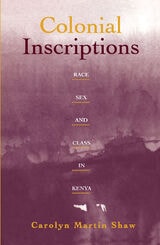
Colonial Inscriptions
Race, Sex, and Class in KenyaCarolyn Martin Shaw
University of Minnesota Press, 1995
In Kenyan colonialist imagery, the Kikuyu were vilified as deceitful servants while the Maasai were romanticized as noble savages in a fashion similar to American representation of the Black slave and the "wild" Indian. Carolyn Martin Shaw examines this imagery in the works of historians and ethnographers, as well as in novels and films.
Through the works of Louis Leakey, Jomo Kenyatta, Elspeth Huxley, and Isak Dinesen, along with her own ethnographic research, Martin Shaw investigates the discourses that shaped inequalities, rivalries, and fantasies in colonial Kenya. She explores narratives of domination and subordination, arguing that Europeans brought to Africa long-established ideas of difference that influenced racial inequalities in the colonial situation. Including discussion of the controversial practice of female genital mutilation, Colonial Inscriptions presents an African American woman's views of how images of African colonialism have been influenced by European and American racism and sexual fantasies.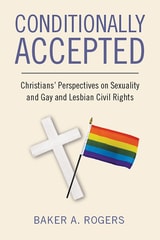
Conditionally Accepted
Christians' Perspectives on Sexuality and Gay and Lesbian Civil RightsBaker A. Rogers
Rutgers University Press, 2020
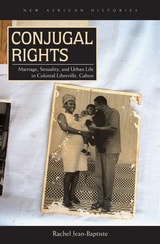
Conjugal Rights
Marriage, Sexuality, and Urban Life in Colonial Libreville, GabonRachel Jean-Baptiste
Ohio University Press, 2014
Connexions
Histories of Race and Sex in North AmericaEdited by Jennifer Brier, Jim Downs, and Jennifer L. Morgan
University of Illinois Press, 2016
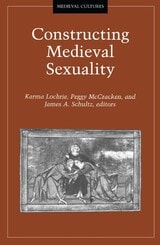
Constructing Medieval Sexuality
Karma Lochrie
University of Minnesota Press, 1997
A groundbreaking examination of sexuality in the Middle Ages.
This collection is the first to be devoted entirely to medieval sexuality informed by current theories of sexuality and gender. It brings together essays from various disciplinary perspectives-literary, theological, philosophical, medical, historical, and art historical-to consider how the Middle Ages defined, regulated, and represented sexual practices and desires.
Always considering sexuality in relation to gender, the body, and identity, the essays explore medieval sexuality as a historical construction produced by and embedded in the cultures and institutions of that period. Examining a range of medieval texts and images, the contributors explore the medieval understanding of sodomy, the historical construction of heterosexuality, the polymorphous erotics of female mysticism, and the intersections of sexuality with race, gender, and religion. This work not only offers new perspectives on the ways in which queer theory might inform our views of sexuality in medieval Europe, but also suggests that medieval constructions of sexuality may offer important contributions to both queer theory and the history of sexuality.These essays, situated in the context of current debates, linger over various definitions of medieval sexuality; they speak to each other in their differences and their similarities to further productive thinking about the sometimes conflicting and always fascinating ways in which the Middle Ages regarded sex and sexuality. Contributors: E. Jane Burns, U of North Carolina; Joan Cadden, U of California, Davis; Michael Camille, U of Chicago; Dyan Elliott, Indiana U; Louise O. Fradenburg, U of California, Santa Barbara; Mark D. Jordan, U of Notre Dame; Steven F. Kruger, CUNY.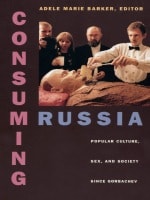
Consuming Russia
Popular Culture, Sex, and Society since GorbachevAdele Marie Barker, ed.
Duke University Press, 1999
The contributors examine how the people of Russia reconcile prerevolutionary elite culture—as well as the communist legacy—with the influx of popular influences from the West to build a society that no longer relies on a single dominant discourse and embraces the multiplicities of both public and private Russian life. Barker brings together Russian and American scholars from anthropology, history, literature, political science, sociology, and cultural studies. These experts fuse theoretical analysis with ethnographic research to analyze the rise of popular culture, covering topics as varied as post-Soviet rave culture, rock music, children and advertising, pyramid schemes, tattooing, pets, and spectator sports. They consider detective novels, anecdotes, issues of feminism and queer sexuality, nostalgia, the Russian cinema, and graffiti. Discussions of pornography, religious cults, and the deployment of Soviet ideological symbols as post-Soviet kitsch also help to demonstrate how the rebuilding of Russia’s political and economic infrastructure has been influenced by its citizens’ cultural production and consumption.
This volume will appeal to those engaged with post-Soviet studies, to anyone interested in the state of Russian society, and to readers more generally involved with the study of popular culture.
Contributors. Adele Marie Barker, Eliot Borenstein, Svetlana Boym, John Bushnell, Nancy Condee, Robert Edelman, Laurie Essig, Julia P. Friedman, Paul W. Goldschmidt, Judith Deutsch Kornblatt, Anna Krylova, Susan Larsen, Catharine Theimer Nepomnyaschy, Theresa Sabonis-Chafee, Tim Scholl, Adam Weiner, Alexei Yurchak, Elizabeth Kristofovich Zelensky
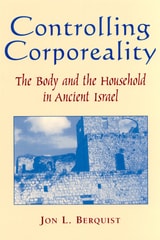
Controlling Corporeality
The Body and the Household in Ancient IsraelBerquist, Jon L.
Rutgers University Press, 2002
Human bodily existence is at the core of the Torah and the rest of the Hebrew Scriptures—from birth to death. From God’s creation of Adam out of clay, to the narratives of priests and kings whose regulations governed bodily practices, the Hebrew Bible focuses on the human body. Moreover, ancient Israel’s understanding of the human body has greatly influenced both Judaism and Christianity. Despite this pervasive influence, ancient Israel’s view of the human body has rarely been studied and, until now, has been poorly understood.
In this beautifully written book, Jon L. Berquist guides the reader through the Hebrew Bible, examining ancient Israel’s ideas of the body, the unstable roles of gender, the deployment of sexuality, and the cultural practices of the time. Conducting his analysis with reference to contemporary theories of the body, power, and social control, Berquist offers not only a description and clarification of ancient Israelite views of the body, but also an analysis of how these views belong to the complex logic of ancient social meanings. When this logic is understood, the familiar Bible becomes strange and opens itself to a wide range of new interpretations.
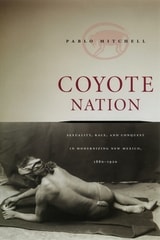
Coyote Nation
Sexuality, Race, and Conquest in Modernizing New Mexico, 1880-1920Pablo Mitchell
University of Chicago Press, 2005
Coyote Nation considers these questions as it explores how New Mexicans evaluated and categorized racial identities through bodily practices. Where ethnic groups were numerous and—in the wake of miscegenation—often difficult to discern, the ways one dressed, bathed, spoke, gestured, or even stood were largely instrumental in conveying one's race. Even such practices as cutting one's hair, shopping, drinking alcohol, or embalming a deceased loved one could inextricably link a person to a very specific racial identity.
A fascinating history of an extraordinarily plural and polyglot region, Coyote Nation will be of value to historians of race and ethnicity in American culture.

Credit, Fashion, Sex
Economies of Regard in Old Regime FranceClare Haru Crowston
Duke University Press, 2013
Credit economies constituted "economies of regard" in which reputation depended on embodied performances of credibility. Crowston explores the role of fashionable appearances and sexual desire in leveraging credit and reconstructs women's vigorous participation in its gray markets. The scandalous relationship between Queen Marie Antoinette and fashion merchant Rose Bertin epitomizes the vertical loyalties and deep social divides of the credit regime and its increasingly urgent political stakes.

Crip Love Onscreen
Representations of Love, Sex, and DisabilitySarah Rainey-Smithback
The Ohio State University Press, 2026
As disability representation increases, though, new possibilities are emerging. Crip Love Onscreen also draws attention to the exceptional through a close reading of screen narratives (such as 50 First Dates,Love and Other Drugs,American Horror Story: Freak Show, and more) that push against neoliberal, heteronormative, and ableist values. Drawing on the work of queer/crip scholars and activists, Rainey-Smithback uncovers glimpses of what Tobin Siebers calls a “sexual culture for disabled people”—a space and way of being that expands sexual access and sexual experience.
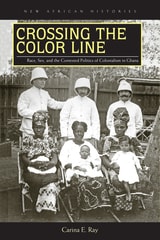
Crossing the Color Line
Race, Sex, and the Contested Politics of Colonialism in GhanaCarina E. Ray
Ohio University Press, 2015
Winner of the 2017 Aidoo-Snyder Book Prize
Winner of the 2016 American Historical Association’s Wesley-Logan Prize in African diaspora
Finalist for the 2016 Fage and Oliver Prize from the African Studies Association of the UK
Interracial sex mattered to the British colonial state in West Africa. In Crossing the Color Line, Carina E. Ray goes beyond this fact to reveal how Ghanaians shaped and defined these powerfully charged relations. The interplay between African and European perspectives and practices, argues Ray, transformed these relationships into key sites for consolidating colonial rule and for contesting its hierarchies of power. With rigorous methodology and innovative analyses, Ray brings Ghana and Britain into a single analytic frame to show how intimate relations between black men and white women in the metropole became deeply entangled with those between black women and white men in the colony in ways that were profoundly consequential.
Based on rich archival evidence and original interviews, the book moves across different registers, shifting from the micropolitics of individual disciplinary cases brought against colonial officers who “kept” local women to transatlantic networks of family, empire, and anticolonial resistance. In this way, Ray cuts to the heart of how interracial sex became a source of colonial anxiety and nationalist agitation during the first half of the twentieth century.