Results by title
150 books match the query 'Social psychology' and 13 start with c

Can Music Make You Sick?
Measuring the Price of Musical AmbitionSally Anne Gross and George Musgrave
University of Westminster Press, 2020
Grant Hutchison (Frightened Rabbit):‘This book should be mandatory reading for every label, booking agent, manager and tour manager in the business of music and touring so we can all better understand what’s really involved in living the life of a professional musician and the role we all have in making that life as liveable as possible’
Tim Shiel (Double J/Triple J Radio, Australia):‘The most important book I’ve ever read about music’
‘An eye-opening must read’ ****
Shaun Ryder (Happy Mondays): ‘Holding on to your mental health in this pressured environment is so important and at times so very difficult, I know that all too well. This book lays bare what it is like to live for your music and how it can feel to be a musician today’
The Wire magazine:‘Poses uncomfortable questions…[and] sheds light on complex issues with compelling thoroughness’
‘Musicians often pay a high price for sharing their art with us. Underneath the glow of success can often lie loneliness and exhaustion, not to mention the basic struggles of paying the rent or buying food. Sally-Anne Gross and George Musgrave raise important questions – and we need to listen to what the musicians have to tell us about their working conditions and their mental health’
Crispin Hunt (Multi-Platinum Songwriter/Record Producer & Chair of the Ivor’s Academy):‘In this important book, Sally Anne Gross and George Musgrave investigate the relationship between the well-being music brings to society and the well-being of those who create. It's a much needed reality-check, deglamorising the romantic image of the tortured artist’
Adam Ficek (Psychotherapist [Music and Mind]/BabyShambles):‘A critical and timely book’
Joe Muggs (DJ, Promoter, Journalist [Guardian, Telegraph, FACT, Mixmag, The Wire]):‘The best guide to what being a musician, and what "the music industry" actually are that I can remember reading’
Andreea Magdalina (Founder of shesaid.so):‘This book is extremely important....The pandemic is forcing our industry to reinvent itself, once again, and this book is a call to ensure these new systems are fairer for everyone and that they foster a healthier lifestyle’
It is often assumed that creative people are prone to psychological instability, and that this explains apparent associations between cultural production and mental health problems. In their detailed study of recording and performing artists in the British music industry, Sally Anne Gross and George Musgrave turn this view on its head.
By listening to how musicians understand and experience their working lives, this book proposes that whilst making music is therapeutic, making a career from music can be traumatic. The authors show how careers based on an all-consuming passion have become more insecure and devalued. Artistic merit and intimate, often painful, self-disclosures are the subject of unremitting scrutiny and data metrics. Personal relationships and social support networks are increasingly bound up with calculative transactions.
Drawing on original empirical research and a wide-ranging survey of scholarship from across the social sciences, their findings will be provocative for future research on mental health, wellbeing and working conditions in the music industries and across the creative economy. Going beyond self-help strategies, they challenge the industry to make transformative structural change. Until then, the book provides an invaluable guide for anyone currently making their career in music, as well as those tasked with training and educating the next generation.
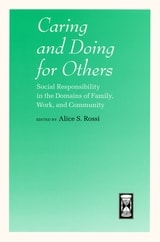
Caring and Doing for Others
Social Responsibility in the Domains of Family, Work, and CommunityEdited by Alice S. Rossi
University of Chicago Press, 2001
The book explores the extent to which adults contribute time to caregiving, social support, and financial assistance to family members; the time given to volunteer work and financial contributions to various causes, charities, and organizations; and how these contributions are affected by job obligations. A major focus is on age and gender differences, which shows midlife to be a transitional time when civic activities increase as family obligations decline. All told, the study adds a hopeful new voice to the overwhelmingly negative debate about the current state of our civic and social lives.
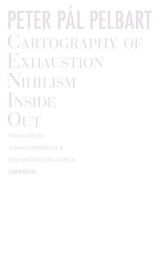
Cartography of Exhaustion
Nihilism Inside OutPeter Pál Pelbart
University of Minnesota Press, 2015
In our current landscape of communicative and connective excess, a very novel contemporary exhaustion exacerbated by our relation to the postdigital terrain is ever present. The Brazilian philosopher and schizoanalyst Peter Pál Pelbart pushes the vital question of our nihililstic age to the limits: how can one learn to be left alone, live alone, and perhaps, by way of a Deleuzian “absolute solitude,” conjure a vitality for living again and, indeed, finding something truly “worthy of saying”? Through various poetic meanderings and meditations and building on the works of Blanchot, Musil, Guattari, and Delingy, among others, Pelbart reestablishes the possibility of fighting off the exhaustion of our current state of affairs. For Pelbart, we must chart the cartography of exhaustion as if it were a sort of molecular symptomology.
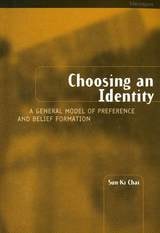
Choosing an Identity
A General Model of Preference and Belief FormationSun-Ki Chai
University of Michigan Press, 2001

Codependent Forevermore
The Invention of Self in a Twelve Step GroupLeslie Irvine
University of Chicago Press, 1999
Codependent Forevermore is thus an insider's look at the world of people "in recovery" and the society that produced them. Through extensive interviews with CoDA members, case studies, and the meetings she attended regularly, Irvine develops a galvanizing perspective on contemporary Americans' sense of self. She explores the idea that selfhood is a narrative accomplishment, achieved by people telling stories to themselves and about themselves. She shows how Alex, Paul, Liz, and many others create a sense of self by combining elements of autobiography, culture, and social structure all within the adopted language of psycho-spirituality.
By following the progress and tribulations of CoDA members, Irvine gets to the heart of widespread American conceptions of relationships, selfhood, and community. Amidst the increasingly shrill criticism of the Twelve Step ethos, her reasoned and considered analysis of these groups reveals the sources of both their power and their popularity.
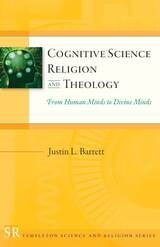
Cognitive Science, Religion, and Theology
From Human Minds to Divine MindsJustin L. Barrett
Templeton Press, 2011
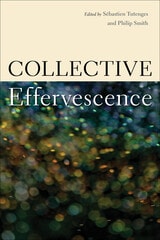
Collective Effervescence
Edited by Sébastien Tutenges and Philip Smith
Temple University Press, 2026
The editors and contributors to Collective Effervescence make a deep dive into new waters. They investigate solo experiences, virtual collectivities, low-intensity effervescence, and negative outcomes. Through studies of drug ceremonies, occupational subcultures, bookshops, online activities, and much more, each chapter discovers and theorizes something previously unknown. Collective Effervescence finds new potentials in a familiar theoretical resource.
Contributors: Sarah H. Awad, Pierre Bouchat, Randall Collins, Silvia da Costa, Scott Draper, Lisa Flower, Romulo Lelis, Heather Margrsion, Sharon Mascall-Dare, Ashley Mears, Margit Anne Petersen, José J. Pizarro, Bernard Rimé, Dario Páez, David Sausdal, Daniel Smith, Femke Vandenberg, Brady Wagoner, David Wästerfors, Brad West, and the editors
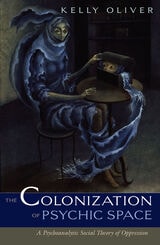
Colonization Of Psychic Space
A Psychoanalytic Social Theory Of OppressionKelly Oliver
University of Minnesota Press, 2004
Reveals the psychic and social costs of racial and sexual oppression
We are, Julia Kristeva writes, strangers to ourselves; and indeed much of contemporary theory, whether psychoanalytic, historical, social, or critical, describes the human condition as one of alienation. Eloquently arguing that we cannot explain the development of individuality or subjectivity apart from its social context, Kelly Oliver makes a powerful case for recognizing the social aspects of alienation and the psychic aspects of oppression.
Oliver’s work shows how existentialist and psychoanalytic notions of alienation cover up specific forms of racist and sexist alienation that serve as the underside of the human condition. She reveals that such notions are actually symptomatic of the subject’s anxiety and guilt over the oppression on which his privileged position rests. Not only does such alienation not embody subjectivity and humanity, it in fact undermines them.Asserting that sublimation and forgiveness—and not alienation—constitute subjectivity, Oliver explores the complex ways in which the alienation unique to oppression leads to depression, shame, anger, or violence; and how these affects, now often misread and misdiagnosed, can be transformed into agency, individuality, solidarity, and community.
Communication and Development
A Study of Two Indian VillagesY.V. Lakshmana Rao
University of Minnesota Press, 1966
Communication and Development was first published in 1966. Minnesota Archive Editions uses digital technology to make long-unavailable books once again accessible, and are published unaltered from the original University of Minnesota Press editions.
What role does communication play in the economic, social, and political development of a community? The results of the study reported here, based on comprehensive field work in two small villages in India, throw considerable light on that question, one which is of fundamental importance to those concerned with rates and patterns of growth in any developing country.
In this study, the term "communication" refers to a social process—the flow of information, the circulation of knowledge and ideas in society, the propagation and internalization of thoughts. It does not refer to the media or means of communication, such as electronics, roads and railways, or vehicles.
The two villages studied, both in South India, were at contrasting stages of development. One was becoming industrialized, while the other still clung to such traditional ways as the barter system. To carry out the field work for his study, Dr. Rao lived in these villages for several months, talking at length with the people, obtaining information about their attitudes, beliefs, and opinions, and observing them and their surroundings with a trained eye. He also checked official records for pertinent information. He analyzes his findings from a psychological and sociological standpoint and, in addition, provides an intimate description of the village life.
The book will be of particular interest to communications specialists, anthropologists, sociologists, political scientists, economists, and others concerned with studies of the developing countries in Asia, Africa, and Latin America.

Contesting Stereotypes and Creating Identities
Social Categories, Social Identities, and Educational ParticipationAndrew J. Fuligni
Russell Sage Foundation, 2007

Creating a Human World
A New Psychological and Religious Anthropology In Dialogue with Freud, Heidegger, and KierkegaardErnest Daniel Carrere
University of Scranton Press, 2006
Carrere elucidates the paradoxical spiritual truth that salvation lies not in an escape from humanity, but in embracing it. An interdisciplinary tour de force, this book will appeal to anyone interested in philosophy, psychology, religion, or cultural anthropology.
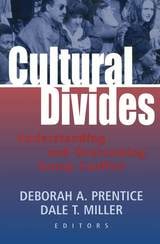
Cultural Divides
Understanding and Overcoming Group ConflictDeborah Prentice
Russell Sage Foundation, 1999
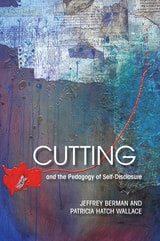
Cutting and the Pedagogy of Self-Disclosure
Jeffrey Berman
University of Massachusetts Press, 2007
Cutting, a form of self-mutilation, is a growing problem in the United States, especially among adolescent females. It is regarded as self-destructive behavior, yet paradoxically, people who cut themselves generally do not wish to die but to find relief from unbearable psychological pain.
Cutting and the Pedagogy of Self-Disclosure is the first book to explore how college students write about their experiences as cutters. The idea behind the book arose when Patricia Hatch Wallace, a high school English teacher, wrote a reader-response diary for a graduate course taught by Professor Jeffrey Berman in which she revealed for the first time that she had cut herself twenty years earlier. At Berman's suggestion, Wallace wrote her Master's thesis on cutting. Not long after she finished her thesis, two students in Berman's expository writing course revealed their own experiences as cutters. Their disclosures encouraged several students in another writing class to share their own cutting stories with classmates. Realizing that so many students were writing about the same phenomenon, Berman and Wallace decided to write a book about a subject that is rarely discussed inside or outside the classroom.
In Part 1, Wallace discusses clinical and theoretical aspects of cutting and then applies these insights to several memoirs and novels, including Susanna Kaysen's Girl, Interrupted, Caroline Kettlewell's Skin Game, and Patricia McCormick's Cut. The motivation behind Wallace's research was the desire to learn more about herself, and she reads these stories through her own experience as a cutter. In Part 2, Berman focuses on the pedagogical dynamics of cutting: how undergraduate students write about cutting, how their writings affect classmates and teachers, and how students who cut themselves can educate everyone in the classroom about a problem that has personal, psychological, cultural, and educational significance.