Results by title
231 books match the query 'Society' and 15 start with c
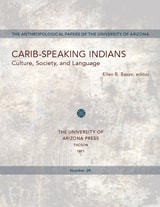
Carib-Speaking Indians
Culture, Society, and LanguageEdited by Ellen B. Basso
University of Arizona Press, 1977

Celebrity Culture and the Entertainment Industry in Asia
Use of Celebrity and its Influence on Society, Culture and CommunicationBy Vivienne Leung, Kimmy Cheng, and Tommy Tse
Intellect Books, 2017
Through first-hand interviews with celebrities and entertainment industry practitioners, the authors discuss the social, cultural, and economic influences of celebrity. Dialogues with celebrities such as Kwok-Leung Kam, Bob Lam, Denise Ho, Hilary Tsui, and Francis Mak provide insider accounts of celebrity formation, management, and marketing in Hong Kong and Mainland China, as well as South Korea and Taiwan.
Celibacy, Culture, And Society
Anthropology Of Sexual AbstinenceElisa J Sobo
University of Wisconsin Press, 2001
This is the first cross-cultural inquiry into the practice of celibacy around the world and through the ages, among groups as diverse as Kenyan villagers and U.S. prisoners, Mazatec Shamans and Buddhist nuns and monks, Shaker church members and anorexic women.
The examples of celibacy described here illustrate the complex relationship between human sexuality and its particular sociocultural context. Ideas about the body, gender, family, work, religion, health, and other dimensions of life come sharply into focus as the contributors examine the many practices and institutions surrounding sexual abstinence. They show that, though celibacy is certainly sometimes a punishment or a deliberate ritual abstinence, it also serves many other social and material functions and in some cases contributes to kin-group survival and well-being. Celibacy, Culture, and Society represents a significant step towards understanding the functions and meanings of sexuality.
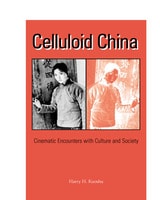
Celluloid China
Cinematic Encounters with Culture and SocietyHarry H. Kuoshu
Southern Illinois University Press, 2002
Celluloid China: Cinematic Encounters with Culture and Society by Harry H. Kuoshu is a lucid introduction to the cinema of mainland China from the early 1930s to the early 1990s. Emphasizing both film contexts and film texts, this study invites film scholars and students to a broad cinematic analysis that includes investigations of cultural, cross-cultural, intellectual, social, ethnic, and political issues. Such a holistic evaluation allows for a better understanding of both the genesis of a special kind of film art from the People’s Republic of China and the culture exemplified in those films.
The fifteen films include: Two Stage Sisters; Hibiscus Town; Farewell My Concubine; Street Angel; Three Women; Human, Woman, Demon; Judou; Girl from Hunan; Sacrificed Youth; Horse Thief; Yellow Earth; Old Well; Red Sorghum; Black Cannon Incident; and Good Morning, Beijing. Discussions of each film have an introduction, passages from the director’s own notes whenever available, and a scholarly article. Discussion questions are found in an appendix. Within its complete bibliography, the book also features a suggested reading list for Chinese film classes. Celluloid China is the first book to provide such an exhaustive study of the art and cultural context of Chinese cinema.
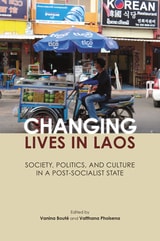
Changing Lives in Laos
Society, Politics, and Culture in a Post-Socialist StateEdited by Vanina Bouté and Vatthana Pholsena
National University of Singapore Press, 2017
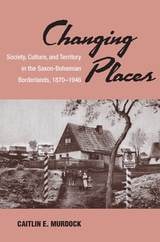
Changing Places
Society, Culture, and Territory in the Saxon-Bohemian Borderlands, 1870-1946Caitlin E. Murdock
University of Michigan Press, 2010
"Changing Places is an interesting meditation on the varying identities and rights claimed by residents of borderlands, the limits placed on the capacities of nation-states to police their borders and enforce national identities, and the persistence of such contact zones in the past and present. It is an extremely well-written and engaging study, and an absolute pleasure to read."
---Dennis Sweeney, University of Alberta
"Changing Places offers a brilliantly transnational approach to its subject, the kind that historians perennially demand of themselves but almost never accomplish in practice."
---Pieter M. Judson, Swarthmore College
Changing Places is a transnational history of the birth, life, and death of a modern borderland and of frontier peoples' changing relationships to nations, states, and territorial belonging. The cross-border region between Germany and Habsburg Austria---and after 1918 between Germany and Czechoslovakia---became an international showcase for modern state building, nationalist agitation, and local pragmatism after World War I, in the 1930s, and again after 1945.
Caitlin Murdock uses wide-ranging archival and published sources from Germany and the Czech Republic to tell a truly transnational story of how state, regional, and local historical actors created, and eventually destroyed, a cross-border region. Changing Places demonstrates the persistence of national fluidity, ambiguity, and ambivalence in Germany long after unification and even under fascism. It shows how the 1938 Nazi annexation of the Czechoslovak "Sudetenland" became imaginable to local actors and political leaders alike. At the same time, it illustrates that the Czech-German nationalist conflict and Hitler's Anschluss are only a small part of the larger, more complex borderland story that continues to shape local identities and international politics today.
Caitlin E. Murdock is Associate Professor of History at California State University, Long Beach.
Jacket Credit: Cover art courtesy of the author
Chicano Politics and Society in the Late Twentieth Century
Edited by David Montejano
University of Texas Press, 1999
The various protest movements that together constituted the Chicano Movement of the 1960s and 1970s urged a "politics of inclusion" to bring Mexican Americans into the mainstream of United States political and social life. This volume of ten specially commissioned essays assesses the post-movement years, asking "what went wrong? what went right? and where are we now?" Collectively, the essays offer a wide-ranging portrayal of the complex situation of Mexican Americans as the twenty-first century begins.
The essays are grouped into community, institutional, and general studies, with an introduction by editor Montejano. Geographically, they point to the importance of "Hispanic" politics in the Southwest, as well as in Chicago wards and in the U.S. Congress, with ramifications in Mexico and Central America. Thematically, they discuss "non-traditional" politics stemming from gender identity, environmental issues, theatre production, labor organizing, university policymaking, along with the more traditional politics revolving around state and city government, the Congressional Hispanic Caucus, and various advocacy organizations.
Church, State, and Society
An Introduction to Catholic Social DoctrineJ. Brian Benestad
Catholic University of America Press, 2011
Church, State, and Society
An Introduction to Catholic Social Doctrine, Second EditionJ. Brian Benestad
Catholic University of America Press, 2025
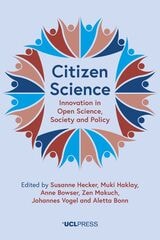
Citizen Science
Innovation in Open Science, Society and PolicyEdited by Susanne Hecker, Muki Haklay, Anne Bowser, Zen Makuch, Johannes Vogel, and Aletta Bonn
University College London, 2018
This book identifies and explains the role of citizen science within innovation in science and society, and as a vibrant and productive science-policy interface. The scope of this volume is global, geared towards identifying solutions and lessons to be applied across science, practice and policy. The chapters consider the role of citizen science in the context of the wider agenda of open science and open innovation and discuss progress towards responsible research and innovation, two of the most critical aspects of science today.
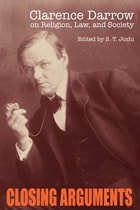
Closing Arguments
Clarence Darrow on Religion, Law, and SocietyClarence Darrow
Ohio University Press, 2005
Clarence Darrow, son of a village undertaker and coffinmaker, rose to become one of America’s greatest attorneys—and surely its most famous. The Ohio native gained renown for his central role in momentous trials, including his 1924 defense of Leopold and Loeb and his defense of Darwinian principles in the 1925 Scopes “Monkey Trial.” Some have traced Darrow’s lifelong campaign against capital punishment to his boyhood terror at seeing a Civil War soldier buried—and no client of Darrow’s was ever executed, not even black men who were accused of murder for killing members of a white mob.
Closing Arguments: Clarence Darrow on Religion, Law, and Society collects, for the first time, Darrow’s thoughts on his three main preoccupations, revealing a carefully conceived philosophy expressed with delightful pungency and clarity. His thoughts on social issues, especially on the dangers of religious fundamentalism, are uncannily prescient. A dry humor infuses his essays, and his reflections on himself and his philosophy reveal a quiet dignity at the core of a man better known for provoking Americans during an era of unprecedented tumult. From the wry “Is the Human Race Getting Anywhere?” to the scornful “Patriotism” and his elegiac summing up, “At Seventy-two,” Darrow’s writing still stimulates, pleases and challenges.
A rebel who always sided intellectually and emotionally with the minority, Darrow remains a figure to contend with sixty-seven years after his death. “Inside every lawyer is the wreck of a poet,” Darrow once said. Closing Arguments demonstrates that, in his case, that statement is true.
Commerce and Society in Sung China
Shiba Yoshinobu; Translated by Mark Elvin
University of Michigan Press, 1969
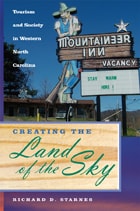
Creating the Land of the Sky
Tourism and Society in Western North CarolinaRichard D. Starnes
University of Alabama Press, 2005
A sophisticated inquiry into tourism's social and economic power across the South.
In the early 19th century, planter families from South Carolina, Georgia, and eastern North Carolina left their low-country estates during the summer to relocate their households to vacation homes in the mountains of western North Carolina. Those unable to afford the expense of a second home relaxed at the hotels that emerged to meet their needs. This early tourist activity set the stage for tourism to become the region's New South industry. After 1865, the development of railroads and the bugeoning consumer culture led to the expansion of tourism across the whole region.
Richard Starnes argues that western North Carolina benefited from the romanticized image of Appalachia in the post-Civil War American consciousness. This image transformed the southern highlands into an exotic travel destination, a place where both climate and culture offered visitors a myriad of diversions. This depiction was futher bolstered by partnerships between state and federal agencies, local boosters, and outside developers to create the atrtactions necessary to lure tourists to the region.
As tourism grew, so did the tension between leaders in the industry and local residents. The commodification of regional culture, low-wage tourism jobs, inflated land prices, and negative personal experiences bred no small degree of animosity among mountain residents toward visitors. Starnes's study provides a better understanding of the significant role that tourism played in shaping communities across the South.
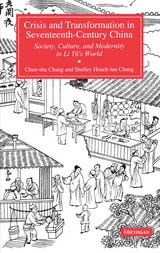
Crisis and Transformation in Seventeenth-Century China
Society, Culture, and Modernity in Li Yu's WorldChun-shu Chang and Shelley Hsueh-lun Chang
University of Michigan Press, 1998
The main thread of the book follows the life and works of a remarkable figure of the period, Li Yü (1611-80), whose vast array of accomplishments and experiences mirror seventeenth-century China in all its complexity and excitement. Li Yü's China was a world of unprecedented changes in almost all spheres of life. A thriving commercial and industrial economy, stupendous population growth, and the emergence of a new age of science and technology were accompanied by intense urbanization, radical views on money, wealth, and luxury, liberal attitudes toward sexuality, and developments that would change the nature of the literary and intellectual world. The Changs' exhaustive exploration of Chinese historical and literary sources of the sixteenth and seventeenth centuries is combined with a selective application of interpretive insights and analytic techniques from the major theoretical schools.
An important resource for scholars in history, literature, and Asian studies, Crisis and Transformation extends its appeal to those interested in the history of science, issues of gender and social transformation, and popular culture movements.
Chun-shu Chang is Professor of History, University of Michigan, and Honorary Professor of Chinese History, China. Shelley Hsueh-lun Chang is Visiting Associate Professor of History and Research Associate, Center for Chinese Studies, University of Michigan.

Culture Wars
School and Society in the Conservative RestorationIra Shor
University of Chicago Press, 1992
"An outstanding work of educational theory and history."—John Coatsworth, University of Chicago