Results by title
77 books match the query 'States' and 8 start with c
CITIZENS AS LEGISLATORS
DIRECT DEMOCRACY IN THE UNITED STATESSHAUN BOWLER
The Ohio State University Press, 1998
COALITION GOVERNMENT, SUBNATIONAL STYLE
Multiparty Politics in Europe’s Regional ParliamentsWilliam M. Downs
The Ohio State University Press, 1998
Coalition Government, Subnational Style examines parliamentary democracy in subnational legislative assemblies. Comparing three different European democracies—Germany, France, and Belgium—William M. Downs provides a powerful account of the ways politicians and political parties negotiate the composition of new governments following elections in which no single party wins a clear majority.
Downs argues that postelection alliance building is a window onto many of the political processes fundamental to representative democracy: the interpretations of electoral verdicts; the compromises of campaign pledges; the trade-offs between policy and power; the temporary cooperation between long-term adversaries; the collective decision making; and the blurring of lines of accountability through collective responsibility.
The study reports findings from an unprecedented collection of information, including cross-national survey responses, interviews with political elites, and three decades of postelection studies of coalition building in the German state parliaments, the French regional assemblies, and the Belgian provincial councils and regional parliaments. Coalition Government, Subnational Style conclusively demonstrates that the struggles for government status at subnational levels are profoundly important to both parties and voters and that the outcomes of these struggles can result in governments of varying political complexions. Downs's findings question key assumptions of democratic theory and raise important concerns about individual and organizational behavior in changing institutional and electoral environments, ultimately allowing for a deeper understanding of representation, power, and cooperation outside the more familiar arena of national parliamentary politics.
Campaign Dynamics
The Race for GovernorThomas M. Carsey
University of Michigan Press, 2001
Choosing State Supreme Court Justices
Merit Selection and the Consequences of Institutional ReformGreg Goelzhauser
Temple University Press, 2016
Since 1940, more than half of all states have switched at least in part from popular election or elite appointment to experiment with merit selection in choosing some or all of their state supreme court justices. Under merit selection, a commission—often comprising some combination of judges, attorneys, and the general public—is tasked with considering applications from candidates vying to fill a judicial vacancy. Ostensibly, the commission forwards the best candidates to the governor, who ultimately appoints them. Presently, numerous states are debating whether to adopt or abolish merit selection.
In his short, sharp book, Choosing State Supreme Court Justices, Greg Goelzhauser utilizes new data on more than 1,500 state supreme court justices seated from 1960 through 2014 to answer the question, Does merit selection produce better types of judges? He traces the rise of merit selection and explores whether certain judicial selection institutions favor candidates who have better qualifications, are more diverse, and have different types of professional experience.
Goelzhauser’s results ultimately contribute to the broader debate concerning comparative institutional performance with respect to state judicial selection.
Citizen Lobbyists
Local Efforts to Influence Public PolicyBrian Adams
Temple University Press, 2006
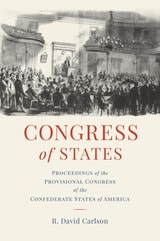
Congress of States
Proceedings of the Provisional Congress of the Confederate States of AmericaR. David Carlson
University of Alabama Press, 2023
A landmark publication of public reports that reveal the founding of the Confederate government
Past publications of the proceedings of the Confederate Congress have focused on the public sessions of the Regular Confederate States Congress that met in Richmond, Virginia from February 1862 to March 1865. Omitted were the formative early sessions of the Montgomery, Alabama and Richmond, Virginia Provisional Congresses of 1861 and 1862. In Congress of States, David Carlson reveals these critical early meetings.
To illuminate this pivot point in American and Southern history, Carlson has drawn on detailed and often verbatim minutes reported in Richmond, Montgomery, Charleston, New Orleans, Savannah, and Augusta newspapers, assembling here a unique set of transcriptions that reveal the birth of the Confederate government.
Congress of States provides an introduction to the Provisional Confederate Congress and the purpose of this work relative to the Southern Historical Society’s landmark 1923 publication “Proceedings of the Confederate Congress,” which detailed the 1862–1865 Regular Confederate Congress. He also includes a chronology outlining the major events of the secession crisis, annotated minutes for the Provisional Confederate Congress’s five sessions, appendices featuring the leadership and committees of the Provisional Congress, and fascinating examples of the proposed Confederate emblem and flags debated by the delegates.
A key set of primary sources that scholars, historians, librarians, and political scientists will value for years to come, Congress of States will also be essential reading for the general reader interested in American and Southern history, the Antebellum South, and the Civil War.
Courts and Kids
Pursuing Educational Equity through the State CourtsMichael A. Rebell
University of Chicago Press, 2009
Over the past thirty-five years, federal courts have dramatically retreated from actively promoting school desegregation. In the meantime, state courts have taken up the mantle of promoting the vision of educational equity originally articulated in Brown v. Board of Education. Courts and Kids is the first detailed analysis of why the state courts have taken on this active role and how successful their efforts have been.
Since 1973, litigants have challenged the constitutionality of education finance systems in forty-five states on the grounds that they deprive many poor and minority students of adequate access to a sound education. While the plaintiffs have won in the majority of these cases, the decisions are often branded “judicial activism”—a stigma that has reduced their impact. To counter the charge, Michael A. Rebell persuasively defends the courts’ authority and responsibility to pursue the goal of educational equity. He envisions their ideal role as supervisory, and in Courts and Kids he offers innovative recommendations on how the courts can collaborate with the executive and legislative branches to create a truly democratic educational system.
Creative Politics
Taxes and Public Goods in a Federal SystemGlenn Beamer
University of Michigan Press, 2000