Results by title
308 books match the query 'Story' and 9 start with c
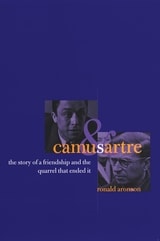
Camus and Sartre
The Story of a Friendship and the Quarrel that Ended ItRonald Aronson
University of Chicago Press, 2003
Albert Camus and Jean-Paul Sartre first met in 1943, during the German occupation of France. The two became fast friends. Intellectual as well as political allies, they grew famous overnight after Paris was liberated. As playwrights, novelists, philosophers, journalists, and editors, the two seemed to be everywhere and in command of every medium in post-war France. East-West tensions would put a strain on their friendship, however, as they evolved in opposing directions and began to disagree over philosophy, the responsibilities of intellectuals, and what sorts of political changes were necessary or possible.
As Camus, then Sartre adopted the mantle of public spokesperson for his side, a historic showdown seemed inevitable. Sartre embraced violence as a path to change and Camus sharply opposed it, leading to a bitter and very public falling out in 1952. They never spoke again, although they continued to disagree, in code, until Camus's death in 1960.
In a remarkably nuanced and balanced account, Aronson chronicles this riveting story while demonstrating how Camus and Sartre developed first in connection with and then against each other, each keeping the other in his sights long after their break. Combining biography and intellectual history, philosophical and political passion, Camus and Sartre will fascinate anyone interested in these great writers or the world-historical issues that tore them apart.
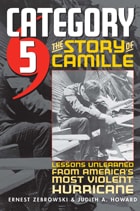
Category 5
The Story of Camille, Lessons Unlearned from America's Most Violent HurricaneErnest Zebrowski and Judith A. Howard
University of Michigan Press, 2005
"This highly readable account aimed at a general audience excels at telling the plight of the victims and how local political authorities reacted. The saddest lesson is how little the public and the government learned from Camille. Highly recommended for all public libraries, especially those on the Gulf and East coasts."
—Library Journal online
As the unsettled social and political weather of summer 1969 played itself out amid the heat of antiwar marches and the battle for civil rights, three regions of the rural South were devastated by the horrifying force of Category 5 Hurricane Camille.
Camille's nearly 200 mile per hour winds and 28-foot storm surge swept away thousands of homes and businesses along the Gulf Coast of Louisiana and Mississippi. Twenty-four oceangoing ships sank or were beached; six offshore drilling platforms collapsed; 198 people drowned. Two days later, Camille dropped 108 billion tons of moisture drawn from the Gulf onto the rural communities of Nelson County, Virginia-nearly three feet of rain in 24 hours. Mountainsides were washed away; quiet brooks became raging torrents; homes and whole communities were simply washed off the face of the earth.
In this gripping account, Ernest Zebrowski and Judith Howard tell the heroic story of America's forgotten rural underclass coping with immense adversity and inconceivable tragedy.
Category 5 shows, through the riveting stories of Camille's victims and survivors, the disproportionate impact of natural disasters on the nation's poorest communities. It is, ultimately, a story of the lessons learned-and, in some cases, tragically unlearned-from that storm: hard lessons that were driven home once again in the awful wake of Hurricane Katrina.
"Emergency responses to Katrina were uncoordinated, slow, and--at least in the early days--woefully inadequate. Politicians argued about whether there had been one disaster or two, as if that mattered. And before the last survivors were even evacuated, a flurry of finger-pointing had begun. The question most neglected was: What is the shelf life of a historical lesson?"
Ernest Zebrowski is founder of the doctoral program in science and math education at Southern University, a historically black university in Baton Rouge, Louisiana, and Professor of Physics at Pennsylvania State University's Pennsylvania College of Technology. His previous books include Perils of a Restless Planet: Scientific Perspectives on Natural Disasters. Judith Howard earned her Ph.D. in clinical social work from UCLA, and writes a regular political column for the Ruston, Louisiana, Morning Paper.
"Category 5 examines with sensitivity the overwhelming challenges presented by the human and physical impacts from a catastrophic disaster and the value of emergency management to sound decisions and sustainability."
--John C. Pine, Chair, Department of Geography & Anthropology and Director of Disaster Science & Management, Louisiana State University
Catherine
A StoryWilliam Makepeace Thackeray
University of Michigan Press, 1999
The Thackeray Edition proudly announces two additions to its collection: Catherine and The Luck of Barry Lyndon. The Thackeray Edition is the first full-scale scholarly edition of William Makepeace Thackeray's works to appear in over seventy years, and the only one ever to be based on an examination of manuscripts and relevant printed texts. It is also a concrete attempt to put into practice a theory of scholarly editing that gives new insight into Thackeray's own compositional process.
Written in 1839-40 for Fraser's Magazine, Catherine was Thackeray's first novel. Although originally intended as a spoof of the 1830s Newgate school of criminal romance, it has intrinsic merit of its own for its cynical narrator and roguish heroine, both of whom harbinger similar creations in Vanity Fair eight years later.
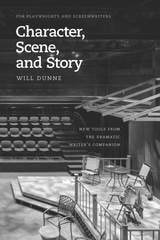
Character, Scene, and Story
New Tools from the Dramatic Writer's CompanionWill Dunne
University of Chicago Press, 2017
Featuring forty-two new workshop-tested exercises, this sequel to The Dramatic Writer’s Companion allows writers to dig deeper into their scripts by fleshing out images, exploring characters from an emotional perspective, tapping the power of color and sense memory to trigger ideas, and trying other visceral techniques. The guide also includes a troubleshooting section to help tackle problem scenes. Writers with scripts already in progress will find they can think deeper about their characters and stories. And those who are just beginning to write will find the guidance they need to discover their best starting point. The guide is filled with hundreds of examples, many of which have been developed as both plays and films.
Character, Scene, and Story is fully aligned with the new edition of The Dramatic Writer’s Companion, with cross-references between related exercises so that writers have the option to explore a given topic in more depth. While both guides can stand alone, together they give writers more than one hundred tools to develop more vivid characters and craft stronger scripts.

Circle of Love Over Death
The Story of the Mothers of the Plaza de MayoMatilde Mellibovsky
Northwestern University Press, 1996
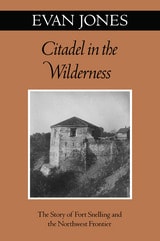
Citadel In The Wilderness
The Story of Fort Snelling and the Northwest FrontierEvan Jones
University of Minnesota Press, 2001
The lively history of this frontier fort.
History/Regional
The lively history of this frontier fort, now back in print!In 1824 Colonel Josiah Snelling erected a stone fortress at the point where the Minnesota and Mississippi rivers merged, on territory secured by Lieutenant Zebulon Pike in a treaty with the Sioux chief Little Crow. Evan Jones describes the intriguing history of Fort Snelling, the Gibraltar of the West, its effect on the Native Americans of the region, and its role in the westward movement.“A story of bitter and complex rivalries. . . . With massive towers and walls capping a limestone cliff, [Fort Snelling] defied attack. But it influenced movements and events hundreds of miles away. The Sioux opposed the Chippewa, the North West Company contended with the Hudson’s Bay outfit, and Astor’s American Fur Company fought them both. . . . This book unfolds a forty-year struggle in the wilderness.” --New York Times Book Review“The author offers here a rollicking tale of high adventure and low shenanigans in and around Fort Snelling. As much the story of the Indians of the region as of the hardy Americans (famous and infamous) who walked inside this fort’s impressive walls, Citadel relays its message of courage and chicanery with a minimum of ‘undying prose’ but a maximum of straightforward and incisive storytelling.” --Library JournalEvan Jones (1915–1996) was born in Le Sueur, Minnesota. A writer of American history and cookbooks, he is the author of The Minnesota (also published in paperback by University of Minnesota Press), Trappers and Mountain Men, Epicurean Delight: The Life and Times of James Beard, and The L. L. Bean Book of New New England Cookery.ISBN 0-8166-3879-9 Paper £10.95 $14.95 256 Pages 23 black-and-white photos 5 3/8 x 8 1/2 MayFesler-Lampert Minnesota Heritage SeriesTranslation Inquiries: Penguin Putnam, Inc.
Cold Anger
A Story of Faith and Power PoliticsMary Beth Rogers
University of North Texas Press, 1990
Crooked Road
The Story of the Alaska HighwayDavid A. Remley
University of Alaska Press, 2008
Crossing Under the Hudson
The Story of the Holland and Lincoln TunnelsGillespie, Angus K
Rutgers University Press, 2011
Crossing Under the Hudson takes a fresh look at the planning and construction of two key links in the transportation infrastructure of New York and New Jersey--the Holland and Lincoln Tunnels. Writing in an accessible style that incorporates historical accounts with a lively and entertaining approach, Angus Kress Gillespie explores these two monumental works of civil engineering and the public who embraced them. He describes and analyzes the building of the tunnels, introduces readers to the people who worked there--then and now--and places the structures into a meaningful cultural context with the music, art, literature, and motion pictures that these tunnels, engineering marvels of their day, have inspired over the years.
Today, when new concerns about global terrorism may trump bouts of simple tunnel tension, Gillespie's Crossing Under the Hudson continues to cast a light at the end of the Holland and Lincoln Tunnels.