54 books match the query 'Tanzania' and 5 start with c

cover of Challenging Nature: Local Knowledge, Agroscience, and Food Security in Tanga Region, Tanzania

Challenging Nature

Local Knowledge, Agroscience, and Food Security in Tanga Region, Tanzania

Philip W. Porter

University of Chicago Press, 2005

Tanga Region, Tanzania, is an area of persistent rural poverty with a long history of drought, floods, food shortages, famine, and social and economic disruption. Though farmers have been cultivating the land there for hundreds of years, they have consistently been unable to supply adequate food for the region's inhabitants. In Challenging Nature, Philip Porter examines eighteen farming communities to understand what the farmers there know about their environment and which historical and economic factors play into the lack of food security. 

Porter first began work on this project in 1972, asking 250 farmers in the region about life history, environmental and agricultural changes, types of crops grown and methods of planting, environmental assessments, agricultural practices, food and water supplies, training and education, and attitudes toward nature. Twenty years later, he returned and reinterviewed as many farmers as could be found from the first survey. The result contextualizes the environmental history of the region while informing current and future agricultural development.

[more]
cover of Cheetahs of the Serengeti Plains: Group Living in an Asocial Species

Cheetahs of the Serengeti Plains

Group Living in an Asocial Species

T. M. Caro

University of Chicago Press, 1994

Cheetahs of the Serengeti Plains is the most comprehensive account of carnivore social behavior to date. Synthesizing more than a decade of research in the wild, this book offers a detailed account of the behavior and ecology of cheetahs. Compared with other large cats, and other mammals, cheetahs have an unusual breeding system; whereas lions live in prides and tigers are solitary, some cheetahs live in groups while others live by themselves. Tim Caro explores group and solitary living among cheetahs and discovers that the causes of social behavior vary dramatically, even within a single species.

Why do cheetah cubs stay with their mother for a full year after weaning? Why do adolescents remain in groups? Why do adult males live in permanent associations with each other? Why do adult females live alone? Through observations on the costs and benefits of group living, Caro offers new insight into the complex behavior of this extraordinary species. For example, contrary to common belief about cooperative hunting in large carnivores, he shows that neither adolescents nor adult males benefit from hunting in groups.

With many surprising findings, and through comparisons with other cat species, Caro enriches our understanding of the evolution of social behavior and offers new perspectives on conservation efforts to save this charismatic and endangered carnivore.
[more]
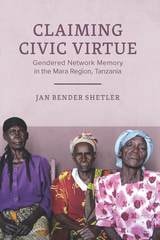
cover of Claiming Civic Virtue: Gendered Network Memory in the Mara Region, Tanzania

Claiming Civic Virtue

Gendered Network Memory in the Mara Region, Tanzania

Jan Bender Shetler

University of Wisconsin Press, 2019

Among communities in the Mara region of Tanzania, it is considered men’s responsibility to maintain “history.” But when Jan Bender Shetler’s questions turned to specific familial connections within the village, she discovered her male informants had to occasionally leave the room—to ask their wives for clarification. The result is an original and wide-ranging investigation of the gendered nature of historical memory and its influence on the development of the region over the past 150 years. Shetler’s exploration of these oral traditions and histories opens exciting new vistas for understanding how women and men in this culture tell their stories and assert their roles as public intellectuals—with important implications for research in African and gender studies, and the history of ethnicity and nationalism.
[more]
cover of Cultured States: Youth, Gender, and Modern Style in 1960s Dar es Salaam

Cultured States

Youth, Gender, and Modern Style in 1960s Dar es Salaam

Andrew Ivaska

Duke University Press, 2011
Cultured States is a vivid account of the intersections of postcolonial state power, the cultural politics of youth and gender, and global visions of modern style in Dar es Salaam, Tanzania, during the 1960s and early 1970s. Andrew Ivaska describes a cosmopolitan East African capital rocked by debates over youth culture, national cultural policy, the rumored sexual escapades of the postcolonial elite, the content of university education, leftist activism, and the reform of colonial-era marriage laws. If young Tanzanians saw themselves as full-fledged participants in modern global culture, their understandings of the modern conflicted with that of a state launching “decency campaigns” banning cultural forms such as soul music, miniskirts, wigs, and bell-bottoms. Promoted by the political elite as a radical break from the colonial order, these campaigns nonetheless contained strong echoes of colonial assumptions about culture, tradition, and African engagements with the modern city. Exploring the ambivalence over the modern at the heart of these contests, Ivaska uses them as lenses through which to analyze struggles around gender relations and sexual politics, youth and masculinity, and the competition for material resources in a Dar es Salaam in rapid flux. Cultured States is a major contribution to understandings of urban cultural politics; national political culture; social struggles around gender, generation, and wealth; and the transnational dimensions of postcolonial histories too often conceived within national frames.
[more]
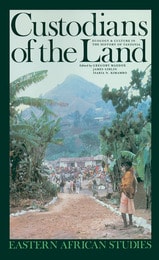
cover of Custodians of the Land: Ecology and Culture in the History of Tanzania

Custodians of the Land

Ecology and Culture in the History of Tanzania

Gregory H. Maddox

Ohio University Press, 1995

Farming and pastoral societies inhabit ever-changing environments. This relationship between environment and rural culture, politics and economy in Tanzania is the subject of this volume which will be valuable in reopening debates on Tanzanian history.

In his conclusion, Isaria N. Kimambo, a founding father of Tanzanian history, reflects on the efforts of successive historians to strike a balance between external causes of change and local initiative in their interpretations of Tanzanian history.

He shows that nationalist and Marxist historians of Tanzanian history, understandably preoccupied through the first quarter-century of the country's post-colonial history with the impact of imperialism and capitalism on East Africa, tended to overlook the initiatives taken by rural societies to transform themselves.

Yet there is good reason for historians to think about the causes of change and innovation in the rural communities of Tanzania, because farming and pastoral people have constantly changed as they adjusted to shifting environmental conditions.

[more]