Results by title
59 books match the query 'Tragedy' and 5 start with c

Celinda, A Tragedy
A Bilingual EditionValeria Miani
Iter Press, 2010
—Virginia Cox
Professor of Italian, New York University
Character and the Individual Personality in English Renaissance Drama
Tragedy, History, TragicomedyJohn E. Curran
University of Delaware Press, 2014
Published by University of Delaware Press. Distributed worldwide by Rutgers University Press.
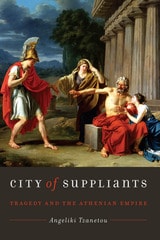
City of Suppliants
Tragedy and the Athenian EmpireBy Angeliki Tzanetou
University of Texas Press, 2012
After fending off Persia in the fifth century BCE, Athens assumed a leadership position in the Aegean world. Initially it led the Delian League, a military alliance against the Persians, but eventually the league evolved into an empire with Athens in control and exacting tribute from its former allies. Athenians justified this subjection of their allies by emphasizing their fairness and benevolence towards them, which gave Athens the moral right to lead. But Athenians also believed that the strong rule over the weak and that dominating others allowed them to maintain their own freedom. These conflicting views about Athens’ imperial rule found expression in the theater, and this book probes how the three major playwrights dramatized Athenian imperial ideology.
Through close readings of Aeschylus’ Eumenides, Euripides’ Children of Heracles, and Sophocles’ Oedipus at Colonus, as well as other suppliant dramas, Angeliki Tzanetou argues that Athenian tragedy performed an important ideological function by representing Athens as a benevolent and moral ruler that treated foreign suppliants compassionately. She shows how memorable and disenfranchised figures of tragedy, such as Orestes and Oedipus, or the homeless and tyrant-pursued children of Heracles were generously incorporated into the public body of Athens, thus reinforcing Athenians’ sense of their civic magnanimity. This fresh reading of the Athenian suppliant plays deepens our understanding of how Athenians understood their political hegemony and reveals how core Athenian values such as justice, freedom, piety, and respect for the laws intersected with imperial ideology.
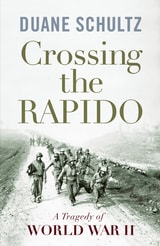
Crossing the Rapido
A Tragedy of World War IIDuane Schultz
Westholme Publishing, 2010
The True Story of an Impossible Mission During the Liberation of Italy
"World War II history writing at its best.” —Dallas Morning News
“Schultz convey stories of individual courage and fear. He presents the Rapido crossing as part of an experience that changed lives utterly.” —Publishers Weekly
“Well written, superbly documented and containing many helpful illustrations and maps, this fine book will appeal to military history enthusiasts of all ages.” —Read@MPL (Milwaukee Public Library)
“Duane Schultz has written another powerful account of the Second World War.” —Daily News, Iron Mountain, Michigan
“A fast-paced, dramatic account of World War II combat.”—Global War StudiesThe Rapido River was the last natural barrier between General Mark W. Clark’s Fifth U.S. Army and Rome. Ignoring intelligence reports that the Germans had significant forces protecting the opposite side of the river, Clark ordered the 36th Division to make a nighttime crossing on January 20, 1944. The division, already coming through some of the heaviest fighting in Italy, knew they could not succeed: they had to cross a fast-flowing river at night in bitter cold and face one of the strongest, most formidable German defensive lines in Europe, full of minefields, veteran troops, and withering artillery and mortar fire. Once in the water, men in full field gear were borne away by the current or vanished in massive explosions. The few who managed to reach the other side found themselves pinned down unable to move. Soldiers died by the hundreds, yet the stunned survivors who fell back to the launch site were ordered to attack again, this time in daylight. Of the 4,000 men who attempted the crossing, more than half did not return. General Clark never accepted blame for ordering the assault despite the numerous warnings he received from both British and American commanders. Although they were decimated, the division went on to lead a key surprise attack that opened Rome to Allied forces, and ultimately fought in France, where they had the distinction of capturing Hermann Goering and Field Marshal Gerd von Rundstedt.
In Crossing the Rapido: A Tragedy of World War II, Duane Schultz follows the action at the ground level using survivors’ interviews and army documents to tell the story of one division’s sacrifice in war. In doing so, he demonstrates that the American soldier will face the greatest odds without protest, but expects those in command to share any failure or success.“Those of us who were present will always remember the men of the 36th, climbing silently in the night behind the enemy, armed with little but their American competence and a personal faith in their quiet, retiring general who had never let them down. If Generals Alexander and Clark received the key to the city of Rome, it was General Walker who turned the key and handed it to them.” —Eric Sevareid, reporting from Italy during World War II
“I have never seen so many dead as on that day.” —John Huston, Academy Award winning director during his wartime filming of The Battle of San Pietro

Crossings
Nietzsche and the Space of TragedyJohn Sallis
University of Chicago Press, 1991
The Birth of Tragedy is a rethinking of art at the
limit of metaphysics. His close reading focuses on the
complexity of the Apollinian/Dionysian dyad and on the
crossing of these basic art impulses in tragedy.
"Sallis effectively calls into question some commonly
accepted and simplistic ideas about Nietzsche's early
thinking and its debt to Schopenhauer, and proposes
alternatives that are worth considering."—Richard
Schacht, Times Literary Supplement