Results by title
63 books match the query 'Turkey & Ottoman Empire' and 5 start with c
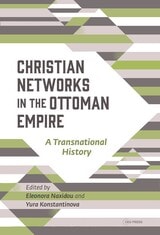
Christian Networks in the Ottoman Empire
A Transnational HistoryYura Konstantinova
Central European University Press, 2024
Observers and historians continue to marvel at the diversity and complexity of the Ottoman Empire. This book explores the significant and multifaceted role that Orthodox Christian networks played in the sultan’s realm from the 17th century until WWI. These multi-ethnic, multi-lingual, and multi-confessional formations contributed fundamentally to the political, economic, social, and cultural development of the Empire as well as to its gradual disintegration.
Bringing together scholars from most Balkan countries, Christian Networks in the Ottoman Empire describes the variety of Orthodox Christian networks under Ottoman rule. The examples examined include commercial relations, intellectual networks, educational systems, religious dynamics, consular activities, and revolutionary movements, and involve Muslims and Christians, Romanians and Serbs, Bulgarians and Greeks, Albanians and Turks. The contributions show that the Christian populations and their elites were an integral part of Ottoman society.
The geographical spread of the formal and informal networks enriches our understanding of the terms ‘center’ and ‘periphery.’ They were either centered within the official Ottoman borders and extended their activities to other states and empires, or vice versa, located elsewhere, but also active in the Ottoman Empire. A common feature of these formations is their constant fluctuation, which enables a dynamic understanding of Ottoman history.
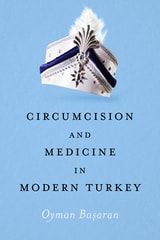
Circumcision and Medicine in Modern Turkey
Oyman Basaran
University of Texas Press, 2023
An investigation of how the expansion of modern medicine in Turkey transformed young boys’ experiences of circumcision.
In Turkey, circumcision is viewed as both a religious obligation and a rite of passage for young boys, as communities celebrate the ritual through gatherings, gifts, and special outfits. Yet the procedure is a potentially painful and traumatic ordeal. With the expansion of modern medicine, the social position of sünnetçi (male circumcisers) became subject to the institutional arrangements of Turkey’s evolving health care and welfare system. In the transition from traditional itinerant circumcisers to low-ranking health officers in the 1960s and hospital doctors in the 1990s, the medicalization of male circumcision has become entangled with state formation, market fetishism, and class inequalities.
Based on Oyman Başaran’s extensive ethnographic and historical research, Circumcision and Medicine in Modern Turkey is a close examination of the socioreligious practice of circumcision in twenty-five cities and their outlying towns and villages in Turkey. By analyzing the changing subjectivity of medical actors who seek to alleviate suffering in male circumcision, Başaran offers a psychoanalytically informed alternate approach to the standard sociological arguments surrounding medicalization and male circumcision.
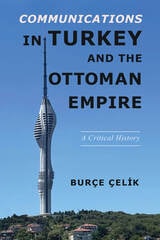
Communications in Turkey and the Ottoman Empire
A Critical HistoryBurçe Çelik
University of Illinois Press, 2023
The history of communications in the Ottoman Empire and Turkey contradicts the widespread belief that communications is a byproduct of modern capitalism and other Western forces. Burçe Çelik uses a decolonial perspective to analyze the historical commodification and militarization of communications and how it affected production and practice for oppressed populations like women, the working class, and ethnic and religious minorities. Moving from the mid-nineteenth century through today, Çelik places networks within the changing geopolitical landscape and the evolution of modern capitalism in relationship to struggles involving a range of social and political actors. Throughout, she challenges Anglo- and Eurocentric assumptions that see the non-West as an ahistorical imitation of, or aberration from, the development of Western communications.
Ambitious and comprehensive, Communications in Turkey and the Ottoman Empire merges political economy with social history to challenge Western-centered assumptions about the origins and development of modern communications.
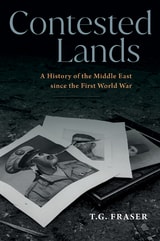
Contested Lands
A History of the Middle East From the First World War to the PresentT. G. Fraser
Haus Publishing, 2024
Until the First World War, the Ottoman Empire had dominated the Middle East for four centuries. Its collapse, coupled with the subsequent clash of European imperial policies, unleashed a surge of political feelings among the people of the Middle East as they vied for national self-determination. Over the century that followed, the region has become almost synonymous with unrest and conflict.
An accessible survey of the last century, Contested Lands tells the story of what happened in the Middle East and what it means today. T. G. Fraser analyzes the fault lines of the tension, including the damage brought by imperialism, the creation of the State of Israel, competition between secular rulers and emerging democratic and theocratic forces, and the rise of Arab Nationalism in the face of fraying regional alliances and the Islamic revival. Fraser offers a close look at how the events of the twenty-first century—the tragedy of 9/11, the Arab Spring, and Syria’s civil war—have combined with complex social and economic changes to transform the region. Untangling the history of the Middle East, this book offers a detailed and insightful picture of the region and why its heritage remains important today.
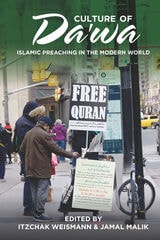
Culture of Da'wa
Preaching in the Modern WorldEdited by Itzchak Weismann and Jamil Malik
University of Utah Press, 2020
This book provides the first in-depth, wide-scope treatment of da’wa. A term difficult to translate, da’wa covers a semantic field ranging from the call or invitation to Islam, to religious preaching and proselytizing, to the mission and message of Islam. Historically da’wa has been directed outward to nonbelievers, but in modern times it has turned increasingly inward to “straying” Muslims. While the media and many scholars have focused on extremism and militant groups that have raised the banner of jihad, this volume argues that da’wa, not jihad, forms the backbone of modern Islamic politics and religiosity, and that the study of da’wa is essential for understanding contemporary Islamic politics as well as jihadist activity. Contributors represent a variety of approaches and come from a range of academic, religious, and national backgrounds. In these essays, they analyze the major discourses of da’wa, their embodiment in the major Islamic movements of the twentieth century, and their transformation into new forms of activism through the media, the state, and jihadi groups—including al-Qaeda and ISIS—in the twenty-first century.