Results by title
62 books match the query 'Twain, Mark' and 5 start with c
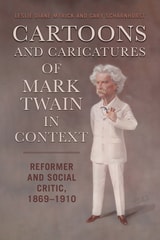
Cartoons and Caricatures of Mark Twain in Context
Reformer and Social Critic, 1869–1910Leslie Diane Myrick and Gary Scharnhorst
University of Alabama Press, 2023
Cartoons and Caricatures of Mark Twain in Context: Reformer and Social Critic, 1869–1910 examines the production, reception, and history of Twain’s reputation as a social and political satirist. Myrick and Scharnhorst trace the evolution of Twain’s depiction throughout his life, career, and even death and across more than seventy illustrations—from portrayals of the famous author as a court jester adorned with cap and bells, to a regally haloed king with a royal train—offering a new perspective on his influence and reputation. Although he was among the most photographed figures of the nineteenth century, Myrick and Scharnhorst focus on a medium that Twain, an expert ofself-promotion and brand management, could not control. As a result, Myrick and Scharnhorst have compiled an innovative and incisive visual reception history.
Cartoons and Caricatures of Mark Twainin Context illustrates the popular and often critical response to many famous and infamous episodes in his career, such as the storm of controversy that surrounded the publication of his anti-imperialist writings at the turn of the twentieth century. Routinely depicted with hair like a fright wig, a beak-like nose, and a cigar in hand, no matter the context or the costume, Twain was instantly recognizable. Yet it was not merely the familiarity of his image that made him a regular feature in visual commentary, but also his willingness to speak out against corruption and to insert himself into controversies of his day.
Centenary Reflections on Mark Twain's No. 44, The Mysterious Stranger
Edited with an introduction by Joseph Csicsila and Chad Rohman
University of Missouri Press, 2009
All of these essays attest to the importance of this late work in Twain’s canon, whether considering how Twain’s efforts at truth-telling are premeditated and shaped by his own experiences, tracing the biblical and religious influences that resonate in No. 44, or exploring the text’s psychological dimensions. Several address its importance as a culminating work in which Twain’s seemingly disjointed story lines coalesce in meaningful, albeit not always satisfactory, ways. An afterword by Alan Gribben traces the critical history of the “Mysterious Stranger” manuscripts and the contributions of previous critics. A wide-ranging critical introduction and a comprehensive bibliography on the last century of scholarship bracket the contributions.
Close inspection of this multidimensional novel shows how Twain evolved as a self-conscious thinker and humorist—and that he was a more conscious artist throughout his career than has been previously thought. Centenary Reflections deepens our understanding of one of Twain’s most misunderstood texts, confirming that the author of No. 44 was a pursuer of an elusive truth that was often as mysterious a stranger as Twain himself.
Confederate Bushwhacker
Mark Twain in the Shadow of the Civil WarJerome Loving
University Press of New England, 2013
Constructing Mark Twain
New Directions in ScholarshipEdited with an introduction by Laura E. Skandera-Trombley and Michael J. Kiskis
University of Missouri Press, 2001
The thirteen essays in this collection combine to offer a complex and deeply nuanced picture of Samuel Clemens. With the purpose of straying from the usual notions of Clemens (most notably the Clemens/Twain split that has ruled Twain scholarship for over thirty years), the editors have assembled contributions from a wide range of Twain scholars. As a whole, the collection argues that it is time we approach Clemens not as a shadow behind the literary persona but as a complex and intricate creator of stories, a creator who is deeply embedded in the political events of his time and who used a mix of literary, social, and personal experience to fuel the movements of his pen.
The essays illuminate Clemens's connections with people and events not usually given the spotlight and introduce us to Clemens as a man deeply embroiled in the process of making literary gold out of everyday experiences. From Clemens's wonderings on race and identity to his looking to family and domesticity as defining experiences, from musings on the language that Clemens used so effectively to consideration of the images and processes of composition, these essays challenge long-held notions of why Clemens was so successful and so influential a writer. While that search itself is not new, the varied approaches within this collection highlight markedly inventive ways of reading the life and work of Samuel Clemens.
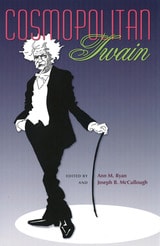
Cosmopolitan Twain
Edited by Ann M. Ryan and Joseph B. McCullough
University of Missouri Press, 2008