Results by title
109 books match the query 'United States. Army' and 7 start with c
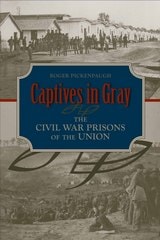
Captives in Gray
The Civil War Prisons of the UnionRoger Pickenpaugh
University of Alabama Press, 2009
“This is a vivid description of conditions and events rarely described: the imprisonment of captured Confederate soldiers during the Civil War. Its many parallels to circumstances in Andersonville are especially intriguing.” —Jimmy Carter, 39th President of the United States
Contains contemporary reports from prisoners and witnesses humanize the grim realities of the POW camps.
Captives in Gray is Civil War prison camp authority Roger Pickenpaugh’s acclaimed and definitive account of the Union’s POW camps. Combining his own extensive research into official records and a rich variety of letters and diaries with the best contemporary scholarship, Pickenpaugh covers every major northern camp.
Because the Union won few victories in 1861 and took few prisoners, the North had time to plan and build prison camps, an opportunity it largely squandered. Pickenpaugh gives illuminating accounts of the role and leadership of thrifty Lieutenant Colonel William Hoffman, the commissary general of prisoners for most of the conflict, and President Abraham Lincoln's secretaries of war, the incompetent Simon Cameron and the malignant Edwin M. Stanton.
Death came in many ways. Soldiers from the Deep South had no experience with extreme cold, and they died by the hundreds each winter. In one memorable freeze, Rock Island, Illinois, saw temperatures between twenty-eight and thirty-one degrees below zero. With insufficient fuel and inadequate shelter, clothing, and blankets, prisoners there and in other camps froze to death. Food rations varied widely. A few Confederates enjoyed better rations than they had in the CSA armies, but the majority supplemented their meager rations by eating rats, dogs, cats, and seagulls.
Poor medical care added to the death toll. Treatment was bad even by the standards of Civil War medicine, often due to Hoffman's reluctance to spend. Prisoners suffered from lice and scurvy, as well as pneumonia, measles, and a variety of fevers. As in both armies, diarrhea and dysentery were chronic. Smallpox epidemics killed many. Poor sanitation and drainage caused 385 deaths at Elmira, New York, in September 1864 alone.
During the war, over 12 percent of rebel prisoners, or 25,976 of the 214,865, died in captivity. Together with his Captives in Blue, Captives in Gray gives the fullest account of the experiences of prisoners of war in the American Civil War.
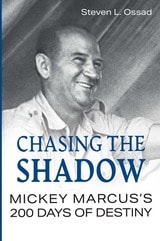
Chasing the Shadow
Mickey Marcus's 200 Days of DestinySteven L. Ossad
University of Missouri Press, 2024
The life of David “Mickey” Marcus has become the stuff of legends and myths (even fantasy), conspiracy, wild exaggeration, and untethered embellishment. The image of Marcus cast by the character portrayed by Kirk Douglas in the film version of his life still dominates most evocations of the man, for good or ill. And these days, reactions to the book or film rest mostly on the current headlines rather than the historical context of the struggle in which Marcus died, or the events that cast him as a real-life player in an event marked by destiny.
Chasing the Shadow: Mickey Marcus’s 200 Days of Destiny is the first comprehensive and balanced biography of David Daniel “Mickey” Marcus, a founder of American Civil Affairs and Military Government doctrine and practice and a seminal figure in early Israeli military history. Far from merely a tribute to Mickey Marcus's legacy, Ossad’s work serves as a critical tool for understanding the realities of mid-20th-century warfare in a Postwar colonial struggle and the dynamics of U.S.-Israeli military and political relations in 1948, the critical year for Israel’s struggle for independence. Indeed, Chasing the Shadow is a valuable read for those interested in Middle East history, Jewish military history, and a fascinating character whose story is told in an engaging, informative, and insightful narrative.

Chemical Heroes
Pharmacological Supersoldiers in the US MilitaryAndrew Bickford
Duke University Press, 2020
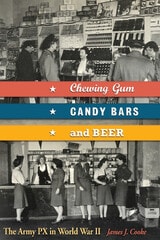
Chewing Gum, Candy Bars, and Beer
The Army PX in World War IIJames J. Cooke
University of Missouri Press, 2009
The AES was dedicated to providing soldiers with some of the comforts they had enjoyed in civilian life—candy, beer, cigarettes, razor blades, soap—whether by operating an exchange close to where they were fighting or by sending goods forward to the lines, free of charge. The beer may have been only “3.2,” but it was cheap and, unlike British beer, was served cold, thanks to PX coolers. And a constant supply of cigarettes and chewing gum gave GIs an advantage when flirting with the local girls.
In chronicling the history of the AES, James J. Cooke harks back to the Civil War, in which sutlers sold basic items to the Yankee troops for exorbitant prices, and to the First World War, when morale-building provisions were brought in by agencies such as the Red Cross. He then traces the evolution of the PX through World War II from the point of view of those who ran the service and that of the soldiers who used it, blending administrative history with colorful anecdotes and interspersing letters from GIs.
Cooke views the PX as a manifestation of American mobility, materialism, and the cultural revolution of mass consumerism that flourished in the 1920s, serving soldiers who were themselves products of this new American way of retail and expected a high level of material support in time of war. He emphasizes the accomplishments of Major General Joseph W. Byron, chief PX officer from 1941 to 1943, and his deputy, Colonel Frank Kerr. He also tells how the PX dealt with the presence of large numbers of women in uniform and the need to meet their demands in exchange offerings.
By 1945, General Byron could boast that the Army Exchange Service operated the world’s largest department store chain, serving the grandest army the United States had ever put in the field, and today the PX is still a central factor of military life. Yet as Cooke shows, the key to the AES’s importance was ultimately the way it bolstered morale—and helped give our fighting men the will to keep fighting.
Claiming Union Widowhood
Race, Respectability, and Poverty in the Post-Emancipation SouthBrandi Clay Brimmer
Duke University Press, 2020
Command Culture
Officer Education in the U.S. Army and the German Armed Forces, 1901-1940, and the Consequences for World War IIJörg Muth
University of North Texas Press, 2011
Conjuring Freedom
Music and Masculinity in the Civil War's “Gospel Army”Johari Jabir
The Ohio State University Press, 2017
Reflecting the structure of the ring shout—the counterclockwise song, dance, drum, and story in African American history and culture—Conjuring Freedom offers three new concepts to cultural studies in order to describe the practices, techniques, and implications of the troop’s performance: (1) Black Communal Conservatories, borrowing from Robert Farris Thompson’s “invisible academies” to describe the structural but spontaneous quality of black music-making, (2) Listening Hermeneutics, which accounts for the generative and material affects of sound on meaning-making, and (3) Sonic Politics, which points to the political implications of music’s use in contemporary representations of race and history.