Results by title
161 books match the query 'Universities and colleges' and 15 start with c
Called to Reckon
Replacing History and Reclaiming Mission at a Midwestern CollegeEdited by Jane E. Simonsen
Southern Illinois University Press, 2025
Campus Life
Undergraduate Cultures from the End of the Eighteenth Century to the PresentHelen Lefkowitz Horowitz
University of Chicago Press, 1988
Campuses of Consent
Sexual and Social Justice in Higher EducationTheresa A. Kulbaga and Leland G. Spencer
University of Massachusetts Press, 2019
Winner of the 2020 OSCLG Outstanding Book Award
This new book for scholars and university administrators offers a provocative critique of sexual justice language and policy in higher education around the concept of consent. Complicating the idea that consent is plain common sense, Campuses of Consent shows how normative and inaccurate concepts about gender, gender identity, and sexuality erase queer or trans students' experiences and perpetuate narrow, regressive gender norms and individualist frameworks for understanding violence.
Theresa A. Kulbaga and Leland G. Spencer prove that consent in higher education cannot be meaningfully separated from larger issues of institutional and structural power and oppression. While sexual assault advocacy campaigns, such as It's On Us, federal legislation from Title IX to the Clery Act, and more recent affirmative-consent measures tend to construct consent in individualist terms, as something “given” or “received” by individuals, the authors imagine consent as something that can be constructed systemically and institutionally: in classrooms, campus communication, and shared campus spaces.
Capital of Mind
The Idea of a Modern American UniversityAdam R. Nelson
University of Chicago Press, 2024
Capital of Mind is the second volume in a breathtakingly ambitious new economic history of American higher education. Picking up from the first volume, Exchange of Ideas, Adam R. Nelson looks at the early decades of the nineteenth century, explaining how the idea of the modern university arose from a set of institutional and ideological reforms designed to foster the mass production and mass consumption of knowledge. This “industrialization of ideas” mirrored the industrialization of the American economy and catered to the demands of a new industrial middle class for practical and professional education. From Harvard in the north to the University of Virginia in the south, new experiments with the idea of a university elicited intense debate about the role of scholarship in national development and international competition, and whether higher education should be supported by public funds, especially in periods of fiscal austerity. The history of capitalism and the history of the university, Nelson reveals, are intimately intertwined—which raises a host of important questions that remain salient today. How do we understand knowledge and education as commercial goods? Should they be public or private? Who should pay for them? And, fundamentally, what is the optimal system of higher education for a capitalist democracy?
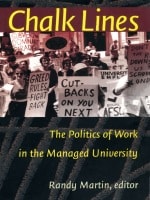
Chalk Lines
The Politics of Work in the Managed UniversityRandy Martin, ed.
Duke University Press, 1999
While tracing the socioeconomic conditions that have led to the present labor situation on campuses, the contributors consider such topics as the political implications of managerialism and the conceptual status of academic labor.
They examine the trend toward restructuring and downsizing, the particular plight of the adjunct professor, the growing emphasis on vocational training in the classroom, and union organizing among university faculty, staff, and graduate students. Placing such issues within the context of the history of labor movements as well as governmental initiatives to train a workforce capable of competing in the global economy, Chalk Lines explores how universities have attempted to remake themselves in the image of the corporate sector. Originally published as an issue of Social Text, this expanded volume, which includes four new essays, offers a broad view of academic labor in the United States.
With its important, timely contribution to debates concerning the future of higher education, Chalk Lines will interest a wide array of academics, administrators, policymakers, and others invested in the state—and fate—of academia.
Contributors. Stanley Aronowitz, Jan Currie, Zelda F. Gamson, Emily Hacker, Stefano Harney, Randy Martin, Bart Meyers, David Montgomery, Frederick Moten, Christopher Newfield, Gary Rhoades, Sheila Slaughter, Jeremy Smith, Vincent Tirelli, William Vaughn, Lesley Vidovich, Ira Yankwitt
City of Broken Dreams
Myth-Making, Nationalism and the University in an African Motor CityLeslie J. Bank
Michigan State University Press, 2019
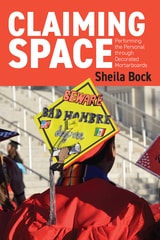
Claiming Space
Performing the Personal through Decorated MortarboardsSheila Bock
Utah State University Press, 2023
Claiming the space of these graduation caps is a popular and widespread way that individuals make their voices heard, or rather seen, in the visual landscape of commencement ceremonies. The forms and meanings of these material displays take shape in relation to broader, ongoing conversations about higher education in the United States, conversations grounded in discourses of belonging, citizenship, and the promises of the American Dream. Integrating observational fieldwork with extensive interviews and surveys, author Sheila Bock highlights the interpretations of individuals participating in this tradition. She also attends to the public framings of this tradition, including how images of mortarboards have grounded online enactments of community through hashtags such as #LatinxGradCaps and #LetTheFeathersFly, as well as what rhetorical framings are employed in news coverage and legal documents in cases where the value of the practice is both called into question and justified.
As university administrators and cultural commentators seek to make sense of the current state of higher education, these forms of material expression offer insight into how students themselves are grappling with higher ed's promises and shortcomings. Claiming Space is a meaningful contribution to folklore, cultural studies, media studies, and education.
Class Warfare
Class, Race, and College Admissions in Top-Tier Secondary SchoolsLois Weis, Kristin Cipollone, and Heather Jenkins
University of Chicago Press, 2014
Drawing on deep and sustained contact with students, parents, teachers, and administrators at three iconic secondary schools in the United States, the authors unveil a formidable process of class positioning at the heart of the college admissions process. They detail the ways students and parents exploit every opportunity and employ every bit of cultural, social, and economic capital they can in order to gain admission into a “Most Competitive” or “Highly Competitive Plus” university. Moreover, they show how admissions into these schools—with their attendant rankings—are used to lock in or improve class standing for the next generation. It’s a story of class warfare within a given class, the substrata of which—whether economically, racially, or socially determined—are fiercely negotiated through the college admissions process.
In a historic moment marked by deep economic uncertainty, anxieties over socioeconomic standing are at their highest. Class, as this book shows, must be won, and the collateral damage of this aggressive pursuit may just be education itself, flattened into a mere victory banner.
Composition, Rhetoric, and Disciplinarity
Rita Malenczyk
Utah State University Press, 2018
Edited by four nationally recognized leaders of composition scholarship, Composition, Rhetoric, and Disciplinarity asks a fundamental question: can Composition and Rhetoric, as a discipline, continue its historical commitment to pedagogy without sacrificing equal attention to other areas, such as research and theory? In response, contributors to the volume address disagreements about what it means to be called a discipline rather than a profession or a field; elucidate tensions over the defined breadth of Composition and Rhetoric; and consider the roles of research and responsibility as Composition and Rhetoric shifts from field to discipline.
Outlining a field with a complex and unusual formation story, Composition, Rhetoric, and Disciplinarity employs several lenses for understanding disciplinarity—theory, history, labor, and pedagogy—and for teasing out the implications of disciplinarity for students, faculty, institutions, and Composition and Rhetoric itself. Collectively, the chapters speak to the intellectual and embodied history leading to this point; to questions about how disciplinarity is, and might be, understood, especially with regard to Composition and Rhetoric; to the curricular, conceptual, labor, and other sites of tension inherent in thinking about Composition and Rhetoric as a discipline; and to the implications of Composition and Rhetoric’s disciplinarity for the future.
Contributors: Linda Adler-Kassner, Elizabeth H. Boquet, Christiane Donahue, Whitney Douglas, Doug Downs, Heidi Estrem, Kristine Hansen, Doug Hesse, Sandra Jamieson, Neal Lerner, Jennifer Helene Maher, Barry Maid, Jaime Armin Mejía, Carolyn R. Miller, Kelly Myers, Gwendolynne Reid, Liane Robertson, Rochelle Rodrigo, Dawn Shepherd, Kara Taczak
Compositional Subjects
Enfiguring Asian/American WomenLaura Hyun Yi Kang
Duke University Press, 2002
The book opens by tracking the jagged emergence of “Asian American women” as a distinct social identity over the past three decades. Kang then directs critical attention to how the attempts to compose them as discrete subjects of consciousness, visibility, and action demonstrate a broader, ongoing tension between socially particularized subjects and disciplinary knowledges. In addition to the shifting meanings and alignments of “Asian,” “American,” and “women,” the book examines the discourses, political and economic conditions, and institutional formations that have produced Asian/American women as generic authors, as visibly desirable and desiring bodies, as excludable aliens and admissible citizens of the United States, and as the proper labor for transnational capitalism. In analyzing how these enfigurations are constructed and apprehended through a range of modes including autobiography, cinematography, historiography, photography, and ethnography, Kang directs comparative attention to the very terms of their emergence as Asian/American women in specific disciplines.
Finally, Kang concludes with a detailed examination of selected literary and visual works by Korean women artists located in the United States and Canada, works that creatively and critically contend with the problematics of identification and representation that are explored throughout the book. By underscoring the forceful and contentious struggles that animate all of these compositional gestures, Kang proffers Asian/American women as a vexing and productive figure for cultural, political and epistemological critique.
Conditionally Accepted
Navigating Higher Education from the MarginsEdited by Eric Joy Denise and Bertin M. Louis, Jr.
University of Texas Press, 2024
A collection of essays that provides advice and strategies for BIPOC scholars on how to survive, thrive, and resist in academic institutions.
Conditionally Accepted builds upon an eponymous blog on InsideHigherEd.com, which is now a decade-old national platform for BIPOC academics in the United States. Bringing together perspectives from academics of color on navigating intersecting forms of injustice in the academy, each chapter offers situated knowledge about experiencing—and resisting—marginalization in academia. Contextualized within existing scholarship, these personal narratives speak to institutional betrayals while highlighting agency and sharing stories of surviving on treacherous terrain. Covering topics from professional development to the emptiness of diversity, equity, and inclusion efforts, and redefining what it means to be an academic in our contemporary moment, this edited collection directly confronts issues of systemic exclusion, discrimination, harassment, microaggressions, tokenism, and surveillance. Letting marginalized scholars know they are not alone, Conditionally Accepted offers concrete wisdom for readers seeking to navigate and transform oppressive academic institutions.
Contingency, Exploitation, and Solidarity
Labor and Action in English CompositionSeth Kahn
University Press of Colorado, 2017
Composition has been a microcosm of the corporatization of higher education for thirty years, with adjuncts often handling the hard work of writing instruction. We've learned enough to know that change is needed. Influenced by the efforts of organizations such as New Faculty Majority, Faculty Forward, PrecariCorps, and national faculty unions, this collection highlights action, describing efforts that have improved adjunct working conditions in English departments. The editors categorize these efforts into five threads: strategies for self-advocacy; organizing within and across ranks; professionalizing in complex contexts; working for local changes to workload, pay, and material conditions; and protecting gains.
Contributors to this collection include contingent and tenure-line faculty from private, public, and community colleges, as well as writing program administrators and writing center faculty. Their voices address contingency, exploitation, and solidarity in activist terms deriving from institutional realities and cases. Collectively, they offer creative and constructive responses that can enact labor justice and champion the disciplinary energies of all members of our collegial community.
Contributors: Janelle Adsit, Jacob Babb, Chris Blankenship, Rebekah Shultz Colby, Richard Colby, Anicca Cox, Sue Doe, Tracy Donhardt, Dawn Fels, Barbara Heifferon, Desirée M. Holter, Justin Jory, Jeffrey Klausman, Michelle LaFrance, Sarah Layden, Carol Lind, Maria Maisto, Amanda Martin, Mark McBeth, Tim McCormack, Joan Mullin, Dani Nier-Weber, Glenn Moomau, Michael Murphy, Anna K. Nardo, Rolf Norgaard, Courtney Adams Wooten, Lacey Wootton, Allison Laubach Wright

Copyright, Fair Use, and the Challenge for Universities
Promoting the Progress of Higher EducationKenneth D. Crews
University of Chicago Press, 1993
In the first large-scale study of its kind, Kenneth D. Crews surveys the copyright policies of ninety-eight American research universities. His analysis reveals a variety of ways in which universities have responded to—and how they could better manage—the conflicting goals of copyright policies: avoiding infringements while promoting lawful uses that serve teaching and research. He explains in detail the background of copyright law and congressional guidelines affecting familiar uses of photocopies, videotapes, software, and reserve rooms. Crews concludes that most universities are overly conservative in their interpretation of copyright and often neglect their own interests, adding unnecessary costs and obstacles to the lawful dissemination of information.
Copyright, Fair Use, and the Challenge for Universities provides administrators, instructors, lawyers, librarians, and educational leaders a much-needed exegesis of copyright and how it can better serve higher education.
Creating Interdisciplinarity
Interdisciplinary Research and Teaching among College and University FacultyLisa R. Lattuca
Vanderbilt University Press, 2001
Whether exploring the connections between apparently related disciplines, such as English and women's studies, or such seemingly disparate fields as economics and theology, Lattuca moves away from previous definitions based on the degrees of integration across disciplines and instead focuses on the nature of the inquiry behind the work. She organizes her findings around the processes through which faculty pursue interdisciplinarity, the contexts (institutional, departmental, and disciplinary) in which faculty are working, and the ways in which those contexts relate to and affect the interdisciplinary work. Her findings result in useful suggestions for individuals concerned with the meaning of faculty work, the role and impact of disciplines in academe today, and the kinds of issues that should guide the evaluation of faculty scholarship.
Crisis Leadership in Higher Education
Theory and PracticeRalph A. Gigliotti
Rutgers University Press, 2020