Results by title
51 books match the query 'Volume' and 5 start with c
Caciques and Their People
A Volume in Honor of Ronald SporesEdited by Joyce Marcus and Judith Francis Zeitlin
University of Michigan Press, 1994
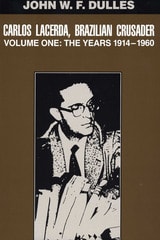
Carlos Lacerda, Brazilian Crusader
Volume I: The Years 1914-1960By John W. F. Dulles
University of Texas Press, 1991
Playwright, journalist, and spectacularly successful governor, Carlos Lacerda was Brazil's foremost orator in the 20th century and its most controversial politician. He might have become president in the 1960s had not the military taken over. In the words of eminent historian José Honório Rodrigues, "No one person influenced the Brazilian historical process as much as Carlos Lacerda from 1945 to 1968."
In this volume, the first of a two-volume biography, Professor Dulles paints a portrait of a rebellious youth, who had the willfulness of his prominent father and who crusaded for Communism before becoming its most outspoken foe. Recalling Lacerda's rallying cry, "Brazil must be shaken up," Dulles traces the career of the journalist whose unsparing attacks on the men in power led authorities to imprison him and employ thugs who pummeled him physically. The story covers events in which Lacerda helped alter Brazil, such as the redemocratization in 1945 and his revelation of scandals in high places in the early 1950s. An unsuccessful attempt by government men to murder him in 1954 led to the suicide of President Getulio Vargas in 1954.
Lacerda's spirited oratory helped him become Brazil's most popular congressman, but it scared the rulers of Brazil and they prohibited the broadcast of his speeches after he returned from exile in 1956. Their effort to deprive him of his mandate stirred the entire nation and culminated in one of the most dramatic sessions ever held in the Chamber of Deputies.
Dulles, who knew Lacerda well and had access to his papers, sheds light on Lacerda the man, ardent in courtship and in all his undertakings, intellectually restless, and scornful of routine and mediocrity. Lacerda had a vitriolic pen that made bitter enemies, but, as disclosed in these pages, his courage and incorruptibility attracted an enthusiastic following, evident in the landslide election victories that brought him seats on Rio de Janeiro's city council and in the federal Congress.
Classics in Translation, Volume I
Greek LiteratureEdited by Paul L. MacKendrick and Herbert M. Howe
University of Wisconsin Press, 1959
Here, translated into modern English, are the works of literature, history, science, oratory, and philosophy that constitute the mainstream of classical Greek thought and continue to influence world civilizations. This volume includes:
· Complete translations of Aeschylus’ Agamemnon, Sophocles’ Antigone, Euripides’ Medea, Aristophanes’ Frogs, and The Constitution of Athens by the “Old Oligarch.”
· Abridged translations of Homer’s Iliad and Odyssey, The Homeric Hymn to Hermes, and Plutarch’s Life of Tiberius Gracchus.
· Selections from Hesiod and Lucian; from twenty-eight lyric poets including Sappho, Pindar, and Meleagar; from the histories of Herodotus and Thucydides; and from eight Attic orators, including Isocrates and Demosthenes.
· Selections from the scientific writings of Hippocrates, Archimedes, and Galen.
· Selections from the pre-Socratic philosophers and from Plato, Aristotle, Epicurus, and Epictetus.

Commentaries on the Psalms, Volume
St. Hilary of Poitiers
Catholic University of America Press, 2027
Constitutional History of the American Revolution, Volume I
The Authority Of RightsJohn Phillip Reid
University of Wisconsin Press, 1987
Constitutional History of the American Revolution
Volume I: The Authority of Rights
Volume II: The Authority to Tax
Volume III: The Authority to Legislate
Volume IV: The Authority of Law
John Phillip Reid addresses the central constitutional issues that divided the American colonists from their English legislators: the authority to tax, the authority to legislate, the security of rights, the nature of law, the foundation of constitutional government in custom and contractarian theory, and the search for a constitutional settlement.