139 books match the query 'World War, 1914-1918' and 13 start with c
cover of Capital, the State, and War: Class Conflict and Geopolitics in the Thirty Years' Crisis, 1914-1945

Capital, the State, and War

Class Conflict and Geopolitics in the Thirty Years' Crisis, 1914-1945

Alexander Anievas

University of Michigan Press, 2014

The history of the modern social sciences can be seen as a series of attempts to confront the challenges of social disorder and revolution wrought by the international expansion of capitalist social relations. Alexander Anievas focuses on one particularly significant aspect of this story: the intersocietal or geosocial origins of the two world wars, and, more broadly, the confluence of factors behind the Thirty Years’ Crisis between 1914 and 1945.

Anievas presents the Thirty Years’ Crisis as a result of the development of global capitalism with all its destabilizing social and geopolitical consequences, particularly the intertwined and co-constitutive nature of imperial rivalries, social revolutions, and anti-colonial struggles. Building on the theory of uneven and combined development, he unites geopolitical and sociological explanations into a single framework, thereby circumventing the analytical stalemate between primacy of domestic politics and primacy of foreign policy approaches.
[more]
cover of Central America and the Treaty of Versailles

Central America and the Treaty of Versailles

Michael Streeter

Haus Publishing, 2010
They were in the United States' backyard, and in some cases under her direct protection. So in many ways it was little surprise when Cuba, Haiti, Nicaragua, Guatemala, Panama and Honduras joined the war on the Allied side in 1917 and 1918. Their involvement in the war was minimal, indeed scarcely noticeable, but it was enough. It earned these small relatively powerless nations—in Haiti's case barely a functioning state—an invitation to sit alongside the Great Powers at the Paris Peace Conference of 1919 and sign the Treaty of Versailles.
[more]
cover of Chicago Transformed: World War I and the Windy City

Chicago Transformed

World War I and the Windy City

Joseph Gustaitis

Southern Illinois University Press, 2016

WINNER, Russell P. Strange Book of the Year Award from the Illinois State Historical Society, 2017!

It’s been called the “war that changed everything,” and it is difficult to think of a historical event that had a greater impact on the world than the First World War. Events during the war profoundly changed our nation, and Chicago, especially, was transformed during this period. Between 1913 and 1919, Chicago transitioned from a nineteenth-century city to the metropolis it is today. Despite the importance of the war years, this period has not been documented adequately in histories of the city. In Chicago in World War I: How the Great War Transformed a Great City, Joseph Gustaitis fills this gap in the historical record, covering the important wartime events, developments, movements, and people that helped shape Chicago.
 
Gustaitis attributes many of Chicago’s changes to the labor shortage caused by the war. African Americans from the South flocked to Chicago during the Great Migration, and Mexican immigration increased as well. This influx of new populations along with a wave of anti-German hysteria—which nearly extinguished German culture in Chicago—changed the city’s ethnic composition. As the ethnic landscape changed, so too did the culture. Jazz and blues accompanied African Americans to the city, and Chicago soon became America’s jazz and blues capital. Gustaitis also demonstrates how the nation’s first sexual revolution occurred not during the 1960s but during the World War I years, when the labor shortage opened up unprecedented employment opportunities for women. These opportunities gave women assertiveness and freedom that endured beyond the war years. In addition, the shortage of workers invigorated organized labor, and determined attempts were made to organize in Chicago’s two leading industrial workplaces—the stockyards and the steel mills—which helped launch the union movement of the twentieth century. Gustaitis explores other topics as well: Prohibition, which practically defined the city in the 1920s; the exploits of Chicago’s soldiers, both white and black; life on the home front; the War Exposition in Grant Park; and some of the city’s contributions to the war effort. The book also contains sketches of the wartime activities of prominent Chicagoans, including Jane Addams, Ernest Hemingway, Clarence Darrow, Rabbi Emil Hirsch, John T. McCutcheon, “Big Bill” Thompson, and Eunice Tietjens.
 
Although its focus is Chicago, this book provides insight into change nationwide, as many of the effects that the First World War had on the city also affected the United States as a whole. Drawing on a variety of sources and written in an accessible style that combines economic, cultural, and political history, Chicago in World War I: How the Great War Transformed a Great City portrays Chicago before the war, traces the changes initiated during the war years, and shows how these changes still endure in the cultural, ethnic, and political landscape of this great city and the nation.
[more]
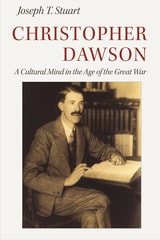
cover of Christopher Dawson: A Cultural Mind in the Age of the Great War

Christopher Dawson

A Cultural Mind in the Age of the Great War

Joseph T. Stuart

Catholic University of America Press, 2022

The English historian Christopher Dawson (1889-1970) was the first Catholic Studies professor at Harvard University and has been described as one of the foremost Catholic thinkers of modern times. His focus on culture prefigured its importance in Catholicism since Vatican Council II and in the rise of mainstream cultural history in the late twentieth century. How did Dawson think about culture and why does it matter? Joseph T. Stuart argues that through Dawson’s study of world cultures, he acquired a “cultural mind” by which he attempted to integrate knowledge according to four implicit rules: intellectual architecture, boundary thinking, intellectual asceticism, and intellectual bridges. Dawson’s multilayered approach to culture, instantiating John Henry Newman’s philosophical habit of mind, is key to his work and its relevance. By it, he responded to the cultural fragmentation he sensed after the Great War (1914-1918). Stuart supports these claims by demonstrating how Dawson formed his cultural mind practicing an interdisciplinary science of culture involving anthropology, sociology, history, and comparative religion. Stuart shows how Dawson applied his cultural thinking to problems in politics and education. This book establishes how Dawson’s simple definition of culture as a “common way of life” reconciles intellectualist and behavioral approaches to culture. In addition, Dawson’s cultural mind provides a synthesis helpful for recognizing the importance of Christian culture in education. It demonstrates principles which construct a more meaningful cultural history. Anyone interested in the idea of culture, the connection of religion to the social sciences, Catholic Studies, or Dawson studies will find this book an engaging and insightful intellectual history.
[more]
cover of Citizen, Invert, Queer: Lesbianism and War in Early Twentieth-Century Britain

Citizen, Invert, Queer

Lesbianism and War in Early Twentieth-Century Britain

Deborah Cohler

University of Minnesota Press, 2010

In late nineteenth-century England, “mannish” women were considered socially deviant but not homosexual. A half-century later, such masculinity equaled lesbianism in the public imagination. How did this shift occur? Citizen, Invert, Queer illustrates that the equation of female masculinity with female homosexuality is a relatively recent phenomenon, a result of changes in national and racial as well as sexual discourses in early twentieth-century public culture.
 
Incorporating cultural histories of prewar women’s suffrage debates, British sexology, women’s work on the home front during World War I, and discussions of interwar literary representations of female homosexuality, Deborah Cohler maps the emergence of lesbian representations in relation to the decline of empire and the rise of eugenics in England. Cohler integrates discussions of the histories of male and female same-sex erotics in her readings of New Woman, representations of male and female suffragists, wartime trials of pacifist novelists and seditious artists, and the interwar infamy of novels such as Radclyffe Hall’s The Well of Loneliness and Virginia Woolf’s Orlando.
 
By examining the shifting intersections of nationalism and sexuality before, during, and after the Great War, this book illuminates profound transformations in our ideas about female homosexuality.
[more]
cover of Civilian Internment in Canada: Histories and Legacies

Civilian Internment in Canada

Histories and Legacies

Rhonda Hinther

University of Manitoba Press, 2020
[more]
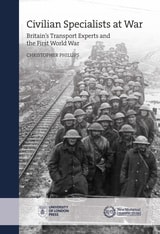
cover of Civilian Specialists at War: Britain's transport experts and the First World War

Civilian Specialists at War

Britain's transport experts and the First World War

Christopher Phillips

University of London Press, 2020

World War I was the first great general conflict to be fought between highly industrial societies able to manufacture and transport immense quantities of goods over land and sea. Yet the armies of the war were too vast in scale, their movements too complex, and the infrastructure upon which they depended too specialized to be operated by professional soldiers alone.

In Civilian Specialists at War, Christopher Phillips examines the relationship between industrial society and industrial warfare through the lens of Britain’s transport experts. Phillips analyzes the multiple connections between the army, the government, and the senior executives of some of prewar Britain’s largest industrial enterprises, revealing that civilian transport experts were a key component of Britain’s strategies in World War I. This book also details the application of recognizably civilian technologies and methods to the prosecution of war, and documents how transport experts were constrained by the political and military requirements of coalition warfare.
[more]
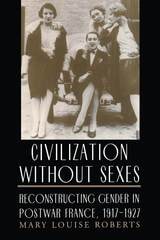
cover of Civilization without Sexes: Reconstructing Gender in Postwar France, 1917-1927

Civilization without Sexes

Reconstructing Gender in Postwar France, 1917-1927

Mary Louise Roberts

University of Chicago Press, 1994

In the raucous decade following World War I, newly blurred boundaries between male and female created fears among the French that theirs was becoming a civilization without sexes. This new gender confusion became a central metaphor for the War's impact on French culture and led to a marked increase in public debate concerning female identity and woman's proper role. Mary Louise Roberts examines how in these debates French society came to grips with the catastrophic horrors of the Great War.

In sources as diverse as parliamentary records, newspaper articles, novels, medical texts, writings on sexology, and vocational literature, Roberts discovers a central question: how to come to terms with rapid economic, social, and cultural change and articulate a new order of social relationships. She examines the role of French trauma concerning the War in legislative efforts to ban propaganda for abortion and contraception, and explains anxieties about the decline of maternity by a crisis in gender relations that linked soldiery, virility, and paternity.

Through these debates, Roberts locates the seeds of actual change. She shows how the willingness to entertain, or simply the need to condemn, nontraditional gender roles created an indecisiveness over female identity that ultimately subverted even the most conservative efforts to return to traditional gender roles and irrevocably altered the social organization of gender in postwar France.
[more]
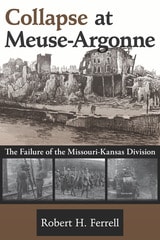
cover of Collapse at Meuse-Argonne: The Failure of the Missouri-Kansas Division

Collapse at Meuse-Argonne

The Failure of the Missouri-Kansas Division

Robert H. Ferrell

University of Missouri Press, 2004
During World War I, the Thirty-fifth Division was made up of National Guard units from Missouri and Kansas. Composed of thousands of men from the two states, the Missouri-Kansas Division entered the great battle of the Meuse-Argonne with no battle experience and only a small amount of training, a few weeks of garrisoning in a quiet sector in Alsace. The division fell apart in five days, and the question Robert Ferrell attempts to answer is why.
The Thirty-fifth Division was based at Camp Doniphan on the Fort Sill reservation in Oklahoma and was trained essentially for stationary, or trench, warfare. In March 1918, the German army launched a series of offensives that nearly turned the tide on the Western Front. The tactics were those of open warfare, quick penetrations by massive forces, backed by heavy artillery and machine guns. The American Expeditionary Forces (AEF) commanded by Gen. John J. Pershing were unprepared for this change in tactics. When the Thirty-fifth Division was placed in the opening attack in the Meuse-Argonne on September 26, 1918, it quickly fell.
In addition to the Thirty-fifth Division’s lack of experience, its problems were compounded by the necessary confusions of turning National Guard units into a modern assemblage of men and machines. Although the U.S. Army utilized observers during the initial years of World War I, their dispatches had piled up in the War College offices in Washington and, unfortunately, were never studied.
The Thirty-fifth Division was also under the command of an incompetent major general and an incompetent artillery brigadier. The result was a debacle in five days, with the division line pushed backward and held only by the 110th Engineer Regiment of twelve hundred men, bolstered by what retreating men could be shoved into the line, some of them at gunpoint.
Although three divisions got into trouble at the outset of the Meuse-Argonne, the Thirty-fifth’s failure was the worst. After the collapse, the Red Cross representative of the division, Henry J. Allen, became governor of Kansas and instigated investigations by both houses of Congress. Secretary of War Newton D. Baker testified in an effort to limit the political damage. But the hullabaloo gradually died down, and the whole sad episode passed into the darker corridors of history.
By focusing on a single event in history, Collapse at Meuse-Argonne offers a unique glimpse into one of the most critical battles of World War I. Historians, as well as the general reader, will find this new perspective on what really happened to the Thirty-fifth Division fascinating.
[more]
cover of Coming Out of War: Poetry, Grieving, and the Culture of the World Wars

Coming Out of War

Poetry, Grieving, and the Culture of the World Wars

Janis P. Stout

University of Alabama Press, 2005

World War I is widely considered “the Great War” and World War II, “the Good War.” Janis Stout thinks of them as two parts of a whole that continues to engage historians and literary scholars searching for an understanding of both the actual war experiences and the modern culture of grief they embody. In Coming Out of War: Poetry, Grieving, and the Culture of the World Wars Stout argues that poetry, of all the arts, most fully captures and conveys those cultural responses.

While probing the work of such well known war poets as Rupert Brooke, Wilfred Owen, and Randall Jarrell, Stout also highlights the impact of the wars on lesser studied, but equally compelling, sources such as the music of Charles Ives and Cole Porter, Aaron Copland and Irving Berlin. She challenges the commonplace belief that war poetry came only from the battlefield and was written only by men by examining the wartime writings of women poets such as Rose Macaulay, Marianne Moore, Elizabeth Bishop, and Gwendolyn Brooks. She also challenges the assumption that World War II did not produce poetry of distinction by studying the work of John Ciardi, Karl Shapiro, Louis Simpson, Robert Frost, and Wallace Stevens. While emphasizing aesthetic continuity between the wars, Stout stresses that the poetry that emerged from each displays a greater variety than is usually recognized.

A final chapter considers Benjamin Britten’s War Requiem as a culmination and embodiment of the anti-war tradition in 20th-century poetry and music, and speculates on the reasons why, despite their abundance and eloquence, these expressions of grief and opposition to war have effected so little change.
[more]
cover of Company K

Company K

William March

University of Alabama Press, 1989

Through fragmented testimonies of Marines, the novel exposes the psychological and moral wreckage left in the wake of modern warfare.

This book was originally published in 1933. It is the first novel by William March, pen name for William Edward Campbell. Stemming directly from the author's experiences with the US Marines in France during World War I, the book consists of 113 sketches, or chapters, tracing the fictional Company K's war exploits and providing an emotional history of the men of the company that extends beyond the boundaries of the war itself.

William Edward Campbell served courageously in France as evidenced by his chestful of medals and certificates, including the Croix de Guerre, the Distinguished Service Cross, and the Navy Cross. However, without the medals and citations we would know of his bravery. For it is clear in the pages of Company K that this book was written by a man who had been to war, who had clearly seen his share of the worst of it, who had somehow survived, and who had committed himself afterward to the new bravery of sense-making embodied in the creation of major literary art. It is of that bravery that we still have the record of magnificent achievement, the brave terrible gift of Company K.
[more]
cover of Consequences of Peace: The Versailles Settlement - Aftermath and Legacy

Consequences of Peace

The Versailles Settlement - Aftermath and Legacy

Alan Sharp

Haus Publishing, 2010

Consequences of Peace: The Versailles Settlement - Aftermath and Legacy. This final volume in the Paris Peace Conference series will evaluate the immediate and later effects of the last great peace gathering which sought to settle the world's affairs at a stroke - something that was not attempted after either the Second World War or the Cold War. The Versailles settlement has not enjoyed a great reputation. It has been blamed for causing a second major conflict within a generation, thus apparently fulfilling Marshal Foch's gloomy prediction that "This is not a peace, it is an armistice for twenty years." More recently commentators have suggested that the post-1989 ethnic disturbances in the Balkans and on the fringes of the former Soviet Union are "the old chickens of Versailles coming home to roost." The contemporary world still struggles to come to terms with the implications of President Woodrow Wilson's troublesome principle of national self-determination, and remains embroiled in the ambiguities and complexities of the Middle East, an area for whose boundaries and problems the Great War and settlement bear significant responsibility. We are also still seeking to realise more effectively some of the nobler ambitions of the peacemakers, expressed in the Covenant of the League of Nations, in their concern for the human rights of minority nationalities left on the wrong side of the new borders that they sanctioned, and in their attempt to extend criminal responsibility for war beyond the operational irregularities of combatants to political and military leaders. Ninety years on, the settlement still casts a long shadow.
[more]
cover of Constructing Disability after the Great War: Blind Veterans in the Progressive Era

Constructing Disability after the Great War

Blind Veterans in the Progressive Era

Evan P. Sullivan

University of Illinois Press, 2024

As Americans--both civilians and veterans--worked to determine the meanings of identity for blind veterans of World War I, they bound cultural constructs of blindness to all the emotions and contingencies of mobilizing and fighting the war, and healing from its traumas. Sighted Americans’ wartime rehabilitation culture centered blind soldiers and veterans in a mix of inspirational stories. Veterans worked to become productive members of society even as ableism confined their unique life experiences to a collection of cultural tropes that suggested they were either downcast wrecks of their former selves or were morally superior and relatively flawless as they overcame their disabilities and triumphantly journeyed toward successful citizenship. Sullivan investigates the rich lives of blind soldiers and veterans and their families to reveal how they confronted barriers, gained an education, earned a living, and managed their self-image while continually exposed to the public’s scrutiny of their success and failures.
[more]