751 books match the query 'International Relations' and 56 start with c
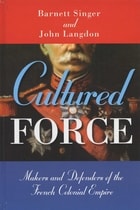
cover of Cultured Force: Makers and Defenders of the French Colonial Empire

Cultured Force

Makers and Defenders of the French Colonial Empire

Barnett Singer and John Langdon

University of Wisconsin Press, 2008
Bridging gaps between intellectual history, biography, and military/colonial history, Barnett Singer and John Langdon provide a challenging, readable interpretation of French imperialism and some of its leading figures from the early modern era through the Fifth Republic.  They ask us to rethink and reevaluate, pulling away from the usual shoal of simplistic condemnation.  In a series of finely-etched biographical studies, and with much detail on both imperial culture and wars (including World War I and II), they offer a balanced, deep, strong portrait of key makers and defenders of the French Empire, one that will surely stimulate much historical work in the field.
[more]
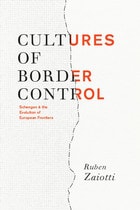
cover of Cultures of Border Control: Schengen and the Evolution of European Frontiers

Cultures of Border Control

Schengen and the Evolution of European Frontiers

Ruben Zaiotti

University of Chicago Press, 2011

In recent years, a number of European countries abolished national border controls in favor of Europe’s external frontiers. In doing so, they challenged long-established conceptions of sovereignty, territoriality, and security in world affairs. 

Setting forth a new analytic framework informed by constructivism and pragmatism, Ruben Zaiotti traces the transformation of underlying assumptions and cultural practices guiding European policymakers and postnational Europe, shedding light on current trends characterizing its politics and relations with others. The book also includes a fascinating comparison to developments in North America, where the United States has pursued more restrictive border control strategies since 9/11. As a broad survey of the origins, evolution, and implications of this remarkable development in European integration, Cultures of Border Control will be of interest to students and scholars of international relations and political geography.
[more]
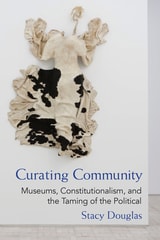
cover of Curating Community: Museums, Constitutionalism, and the Taming of the Political

Curating Community

Museums, Constitutionalism, and the Taming of the Political

Stacy Douglas

University of Michigan Press, 2017

In Curating Community: Museums, Constitutionalism, and the Taming of the Political, Stacy Douglas challenges the centrality of sovereignty in our political and juridical imaginations. Creatively bringing together constitutional, political, and aesthetic theory, Douglas argues that museums and constitutions invite visitors to identify with a prescribed set of political constituencies based on national, ethnic, or anthropocentric premises. In both cases, these stable categories gloss over the radical messiness of the world and ask us to conflate representation with democracy. Yet the museum, when paired with the constitution, can also serve as a resource in the production of alternative imaginations of community. Consequently, Douglas’s key contribution is the articulation of a theory of counter-monumental constitutionalism, using the museum, that seeks to move beyond individual and collective forms of sovereignty that have dominated postcolonial and postapartheid theories of law and commemoration. She insists on the need to reconsider deep questions about how we conceptualize the limits of ourselves, as well as our political communities, in order to attend to everyday questions of justice in the courtroom, the museum, and beyond.
Curating Community is a book for academics, artists, curators, and constitutional designers interested in legacies of violence, transitional justice, and democracy.
 
[more]
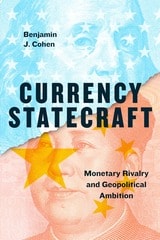
cover of Currency Statecraft: Monetary Rivalry and Geopolitical Ambition

Currency Statecraft

Monetary Rivalry and Geopolitical Ambition

Benjamin J. Cohen

University of Chicago Press, 2018

At any given time, a limited number of national currencies are used as instruments of international commerce, to settle foreign trade transactions or store value for investors and central banks. How countries whose currencies gain international appeal choose to use this status forms their strategy of currency statecraft. In different circumstances, issuing governments may welcome and promote the internationalization of their currency, tolerate it, or actively oppose it. Benjamin J. Cohen offers a provocative explanation of the strategic policy choices at play.
           
In a comprehensive review that ranges from World War II to the present, Cohen convincingly argues that one goal stands out as the primary motivation for currency statecraft: the extent of a country’s geopolitical ambition, or how driven it is to build or sustain a prominent place in the international community. When a currency becomes internationalized, it generally increases the power of the nation that produces it. In the persistent contestation that characterizes global politics, that extra edge can matter greatly, making monetary rivalry an integral component of geopolitics. Today, the major example of monetary rivalry is the emerging confrontation between the US dollar and the Chinese renminbi. Cohen describes how China has vigorously promoted the international standing of its currency in recent years, even at the risk of exacerbating relations with the United States, and explains how the outcome could play a major role in shaping the broader geopolitical engagement between the two superpowers. 
 
[more]
cover of Cyprus: The Post-Imperial Constitution

Cyprus

The Post-Imperial Constitution

Vassilis K. Fouskas and Alex O. Tackie

Pluto Press, 2009
[more]
cover of Czechoslovak Diplomacy and the Gulag: Deportation of Czechoslovak Citizens to the USSR and the Negotiation for their Repatriation, 1945-1953

Czechoslovak Diplomacy and the Gulag

Deportation of Czechoslovak Citizens to the USSR and the Negotiation for their Repatriation, 1945-1953

Milada Polisenská

Central European University Press, 2016

After the entry of the Red Army into Czechoslovak territory in 1945, Red Army authorities began to arrest and deport Czechoslovak citizens to labor camps in the Soviet Union. The regions most affected were Eastern and South Slovakia and Prague. The Czechoslovak authorities repeatedly requested a halt to the deportations and that the deported Czechoslovaks be returned immediately. It took a long time before these protests generated any response. Czechoslovak Diplomacy and the Gulag focuses on the diplomatic and political aspects of the deportations. The author explains the steps taken by the Czechoslovak Government in the repatriation agenda from 1945 to 1953 and reconstructs the negotiations with the Soviets. The research tries to answer the question of why and how the Russians deported the civilian population from Czechoslovakia which was their allied country already during the war. Key words: 1. World War, 1939–1945—Deportations from Czechoslovakia. 2. Forced labor—Soviet Union—History. 3. Labor camps—Soviet Union—History. 4. Czechs—Soviet Union—History. 5. Slovaks—Soviet Union—History. 6. Czechoslovakia—Foreign relations—Soviet Union. 7. Soviet Union—Foreign relations—Czechoslovakia. 8. Czechoslovakia—Foreign relations—1945–1992. 9. Repatriation—Czechoslovakia—History.
[more]