Results by title
941 books match the query 'Military' and 58 start with c
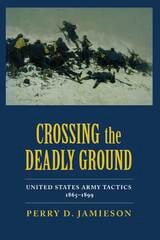
Crossing the Deadly Ground
United States Army Tactics, 1865–1899Perry D. Jamieson
University of Alabama Press, 2004
Attempts to answer difficult questions about battle tactics employed by the United States Army
Weapons improved rapidly after the Civil War, raising difficult questions about the battle tactics employed by the United States Army. The most fundamental problem was the dominance of the tactical defensive, when defenders protected by fieldworks could deliver deadly fire from rifles and artillery against attackers advancing in close-ordered lines. The vulnerability of these offensive forces as they crossed the so-called "deadly ground" in front of defensive positions was even greater with the improvement of armaments after the Civil War.
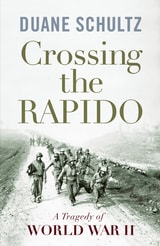
Crossing the Rapido
A Tragedy of World War IIDuane Schultz
Westholme Publishing, 2010
The True Story of an Impossible Mission During the Liberation of Italy
"World War II history writing at its best.” —Dallas Morning News
“Schultz convey stories of individual courage and fear. He presents the Rapido crossing as part of an experience that changed lives utterly.” —Publishers Weekly
“Well written, superbly documented and containing many helpful illustrations and maps, this fine book will appeal to military history enthusiasts of all ages.” —Read@MPL (Milwaukee Public Library)
“Duane Schultz has written another powerful account of the Second World War.” —Daily News, Iron Mountain, Michigan
“A fast-paced, dramatic account of World War II combat.”—Global War StudiesThe Rapido River was the last natural barrier between General Mark W. Clark’s Fifth U.S. Army and Rome. Ignoring intelligence reports that the Germans had significant forces protecting the opposite side of the river, Clark ordered the 36th Division to make a nighttime crossing on January 20, 1944. The division, already coming through some of the heaviest fighting in Italy, knew they could not succeed: they had to cross a fast-flowing river at night in bitter cold and face one of the strongest, most formidable German defensive lines in Europe, full of minefields, veteran troops, and withering artillery and mortar fire. Once in the water, men in full field gear were borne away by the current or vanished in massive explosions. The few who managed to reach the other side found themselves pinned down unable to move. Soldiers died by the hundreds, yet the stunned survivors who fell back to the launch site were ordered to attack again, this time in daylight. Of the 4,000 men who attempted the crossing, more than half did not return. General Clark never accepted blame for ordering the assault despite the numerous warnings he received from both British and American commanders. Although they were decimated, the division went on to lead a key surprise attack that opened Rome to Allied forces, and ultimately fought in France, where they had the distinction of capturing Hermann Goering and Field Marshal Gerd von Rundstedt.
In Crossing the Rapido: A Tragedy of World War II, Duane Schultz follows the action at the ground level using survivors’ interviews and army documents to tell the story of one division’s sacrifice in war. In doing so, he demonstrates that the American soldier will face the greatest odds without protest, but expects those in command to share any failure or success.“Those of us who were present will always remember the men of the 36th, climbing silently in the night behind the enemy, armed with little but their American competence and a personal faith in their quiet, retiring general who had never let them down. If Generals Alexander and Clark received the key to the city of Rome, it was General Walker who turned the key and handed it to them.” —Eric Sevareid, reporting from Italy during World War II
“I have never seen so many dead as on that day.” —John Huston, Academy Award winning director during his wartime filming of The Battle of San Pietro
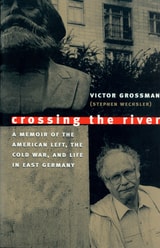
Crossing the River
A Memoir of the American Left, the Cold War, and Life in East GermanyVictor Grossman
University of Massachusetts Press, 2003
What could possibly impel a relatively privileged twenty-four-year-old American-serving in the U.S. Army in Germany in 1952 to swim across the Danube River to what was then referred to as the Soviet Zone? How are we to understand his decision to forsake the land of his birth and build a new life in the still young German Democratic Republic? These are the questions at the core of this memoir by Victor Grossman, who was born Stephen Wechsler but changed his name after defecting to the GDR.
A child of the Depression, Grossman witnessed firsthand the dislocations wrought by the collapse of the U.S. economy during the 1930s. Widespread unemployment and poverty, CIO sit-down strikes, and the fight to save Republican Spain from fascism-all made an indelible impression as he grew up in an environment that nurtured a commitment to left-wing causes. He continued his involvement with communist activities as a student at Harvard in the late 1940s and after graduation, when he took jobs in two factories in Buffalo, New York, and tried to organize their workers.
Fleeing McCarthyite America and potential prosecution, Grossman worked in the GDR with other Western defectors and eventually became, as he notes, the “only person in the world to attend Harvard and Karl Marx universities.” Later, he was able to establish himself as a freelance journalist, lecturer, and author. Traveling throughout East Germany, he evaluated the failures as well as the successes of the GDR's “socialist experiment.” He also recorded his experiences, observations, and judgments of life in East Berlin after reunification, which failed to bring about the post-Communist paradise so many had expected.
Written with humor as well as candor, Crossing the River provides a rare look at the Cold War from the other side of the ideological divide.
Mark Solomon, a distinguished historian of the American left, provides a historical afterword that places Grossman's experiences in a larger Cold War context.
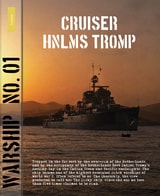
Cruiser HNLMS Tromp
Jantinus Mulder
Amsterdam University Press, 2023
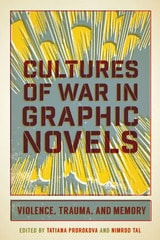
Cultures of War in Graphic Novels
Violence, Trauma, and MemoryProrokova, Tatiana
Rutgers University Press, 2018
Cultures of War in Graphic Novels examines the representation of small-scale and often less acknowledged conflicts from around the world and throughout history. The contributors look at an array of graphic novels about conflicts such as the Boxer Rebellion (1899-1901), the Irish struggle for national independence (1916-1998), the Falkland War (1982), the Bosnian War (1992-1995), the Rwandan genocide (1994), the Israel-Lebanon War (2006), and the War on Terror (2001-). The book explores the multi-layered relation between the graphic novel as a popular medium and war as a pivotal recurring experience in human history. The focus on largely overlooked small-scale conflicts contributes not only to advance our understanding of graphic novels about war and the cultural aspects of war as reflected in graphic novels, but also our sense of the early twenty-first century, in which popular media and limited conflicts have become closely interrelated.
Custer's Last Stand
The Unfinished ManuscriptNorman Maclean
University of Chicago Press, 2008
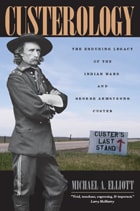
Custerology
The Enduring Legacy of the Indian Wars and George Armstrong CusterMichael A. Elliott
University of Chicago Press, 2007
It’s easy to understand why this tremendous defeat shocked the American public at the time. But with Custerology, Michael A. Elliott tackles the far more complicated question of why the battle still haunts the American imagination today. Weaving vivid historical accounts of Custer at Little Bighorn with contemporary commemorations that range from battle reenactments to the unfinished Crazy Horse memorial, Elliott reveals a Custer and a West whose legacies are still vigorously contested. He takes readers to each of the important places of Custer’s life, from his Civil War home in Michigan to the site of his famous demise, and introduces us to Native American activists, Park Service rangers, and devoted history buffs along the way. Elliott shows how Custer and the Indian Wars continue to be both a powerful symbol of America’s bloody past and a crucial key to understanding the nation’s multicultural present.
“[Elliott] is an approachable guide as he takes readers to battlefields where Custer fought American Indians . . . to the Michigan town of Monroe that Custer called home after he moved there at age 10 . . . to the Black Hills of South Dakota where Custer led an expedition that gave birth to a gold rush."—Steve Weinberg, Atlanta Journal-Constitution
“By ‘Custerology,’ Elliott means the historical interpretation and commemoration of Custer and the Indian Wars in which he fought not only by those who honor Custer but by those who celebrate the Native American resistance that defeated him. The purpose of this book is to show how Custer and the Little Bighorn can be and have been commemorated for such contradictory purposes.”—Library Journal
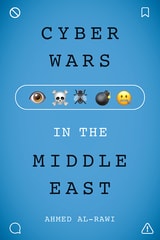
Cyberwars in the Middle East
Ahmed Al-Rawi
Rutgers University Press, 2021
On the one hand, nation-states as well as their affiliated hacking groups like cyber warriors employ hacking as offensive and defensive tools in connection to the cyber activity or inactivity of other nation-states, such as the role of Russian Trolls disseminating disinformation on social media during the US 2016 presidential election. This is regarded as a horizontal flow of political disruption. Sometimes, nation-states, like the UAE, Saudi Arabia, and Bahrain, use hacking and surveillance tactics as a vertical flow (top-bottom) form of online political disruption by targeting their own citizens due to their oppositional or activists’ political views. On the other hand, regular hackers who are often politically independent practice a form of bottom-top political disruption to address issues related to the internal politics of their respective nation-states such as the case of a number of Iraqi, Saudi, and Algerian hackers. In some cases, other hackers target ordinary citizens to express opposition to their political or ideological views which is regarded as a horizontal form of online political disruption. This book is the first of its kind to shine a light on many ways that governments and hackers are perpetrating cyber attacks in the Middle East and beyond, and to show the ripple effect of these attacks.