Results by title
871 books match the query 'Social history' and 53 start with c
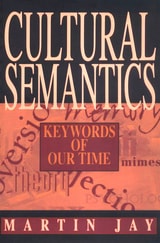
Cultural Semantics
Keywords of Our TimeMartin Jay
University of Massachusetts Press, 1998
A selection of Martin Jay's recent writings on contemporary thought and culture, this is a book about ideas that matter—and about why ideas matter. Borrowing from Flaubert's notion of a dictionary of “received ideas” and Raymond Williams's explorations of the “keywords” of the modern age, Jay investigates some of the central concepts by which we currently organize our thoughts and lives. His topics range from “theory” and “experience” to the meaning of “multiculturalism” and the dynamics of cultural “subversion.” Among the thinkers he engages are Bataille and Foucault, Adorno and Lacoue-Labarthe, Walter Benjamin, Christa Wolf, and Jean-François Lyotard.
By looking closely at what “words do and perform,” Jay makes us aware of the extent to which the language we use mediates and shapes our experience. By helping to distance us from much that we now take for granted, he makes it difficult for us to remain comfortably certain about what we think we know.
Elegantly written and richly insightful, this is a work of cultural criticism and intellectual analysis of the first order.
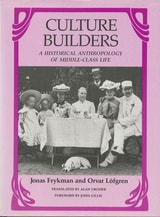
Culture Builders
A Historical Anthropology of Middle Class LifeFrykman, Jonas
Rutgers University Press, 1987
Culture Builders deals primarily with the ways in which ideas about the good and proper life are anchored in the trivialities and routines of everyday life: in the sharing of a meal, in holiday-making, and in the upbringing of children. The authors describe how the attitudes of the bourgeoisie toward. Time and time-keeping set them apart from the peasantry. Uses and perceptions of naturals increasingly divided the classes. For peasants, nature consisted of natural resources to be used. Fr the bourgeoisie, nature had only non-productive connotations. Another change was the growing importance of home over the community. Life became a romantic ideal, not an economic necessity. For the first time, parents became self-conscious about how to raise their children.
Frykman and Lögnen also show how the middle-class developed new perceptions of dirt, pollution, orderliness, health, sexuality, and bodily functions, and how they disdained the filth of peasant households. By stressing refinement, rationality, morality, and discipline, the middle classes were able to differentiate themselves not only from the peasants, but also from the degenerate aristocracy and the disordered and uncontolled emerging working class. The bourgeoisie viewed their own form of culture as the highest on the evolutionary ladder, and turned it into a national culture against which all other groups would be measured.
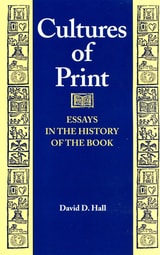
Cultures of Print
Essays in the History of the BookDavid D. Hall
University of Massachusetts Press, 1996
David D. Hall examines the interchange between popular and learned cultures and the practices of reading and writing. His writings deal with change and continuity, exploring the possibility of a reading revolution and arguing for the long duration of a Protestant vernacular tradition. A newly written essay on book culture in the early Chesapeake describes a system of scribal publication. The pieces reflect Hall's belief that the better we understand the production and consumption of books, the closer we come to a social history of culture.