Results by title
1214 books match the query 'Subjects & Themes' and 60 start with c
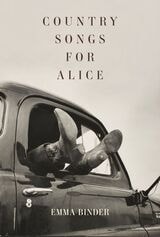
Country Songs for Alice
Emma Binder
Tupelo Press, 2024
In Country Songs for Alice, a nonbinary, queer narrator passes through the crucible of love, romance, and heartbreak against the backdrop of rural America—a landscape which offers luminous belonging, even as the hazards of homophobia, loneliness, and isolation loom large. Part roadtrip, part mixtape, these poems are explorations of love, music, romance, pageantry, loneliness, and belonging in the rural places and small towns that seem to preclude queer culture. Country Songs for Alice not only tells the story of a relationship and its dissolution but reclaims country western imagery and aesthetics for a queer audience, dousing the narrator’s experience in the language of cowboys, horses, rodeos, trucks, and desert skies.

Creative Critical Interventions for Social Justice
Edited by Natasha Tanna, Abeyamí Ortega Domínguez, and Hakan Sandal-Wilson
University College London, 2026
This volume reimagines conventional academic forms to highlight creative-critical approaches grounded in queer, antiracist, transfeminist, and decolonial frameworks.
Creative Critical Interventions for Social Justice is an edited volume grounded in a commitment to politically engaged research. It examines knowledge that is often excluded from conventional academic production and explores the potential for creative critical writing and cultural production to advance social justice-focused research and practice. It highlights creative-critical research by queer and/or racialized scholars, accompanied by reflections on the possibilities and pitfalls of drawing on researcher positionality in knowledge production.
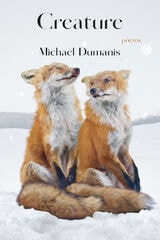
Creature
Michael Dumanis
Four Way Books, 0
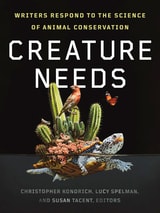
Creature Needs
Writers Respond to the Science of Animal ConservationChristopher Kondrich
University of Minnesota Press, 2024
A kaleidoscopic literary exploration of extinction and conservation, inspired by the latest scientific research
Creature Needs is a polyvocal call to arms about animal extinction and habitat loss that harnesses the power of literature and scientific research to move us, and stir our hearts and minds, toward action and change. A collection of new literary works by prominent writers paired with excerpts from recent scientific articles that inspired and informed them, this innovative anthology engages the collaborative, cross-disciplinary spirit and energy that is necessary to address the impact of humans on all other animals on our planet.
Divided into six sections representing the basic needs for survival—air, food, water, shelter, room to move, and each other—the stories and poems in Creature Needs vividly portray how these essential conditions are under assault through climate change, habitat loss, plastic and industrial pollution, and human intervention in natural landscapes. As the dominant species on Earth, humans not only control access to survival resources but we also overconsume and harm them. Rather than surrender to despair, the writers here believe that we have the power, if we choose, to change course and protect these resources.
A collaboration with the nonprofit organization Creature Conserve, Creature Needs is a path-setting fusion of literary art and scientific research that deepens our understanding of the interdependence between life and habitat, illuminating the stark choices we face to conserve resources and ensure that the basic needs of all species are met.
Contributors: Kazim Ali, Mary-Kim Arnold, Ramona Ausubel, David Baker, Charles Baxter, Aimee Bender, Kimberly Blaeser, Oni Buchanan, Tina Cane, Ching-In Chen, Mónica de la Torre, Tongo Eisen-Martin, Thalia Field, Ben Goldfarb, Annie Hartnett, Sean Hill, Hester Kaplan, Donika Kelly, Robin McLean, Miranda Mellis, Rajiv Mohabir, Kyoko Mori, David Naimon, Craig Santos Perez, Beth Piatote, Rena Priest, Alberto Ríos, Eléna Rivera, Sofia Samatar, Sharma Shields, Eleni Sikelianos, Maggie Smith, Juliana Spahr, Tim Sutton, Jodie Noel Vinson, Asiya Wadud, Claire Wahmanholm, Marco Wilkinson, Jane Wong.
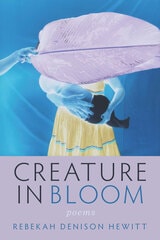
Creature in Bloom
Rebekah Denison Hewitt
University of Wisconsin Press, 2026
It is rare to find a collection so grounded in the manifold meanings of motherhood—in all its anxiety, ambivalence, and joy. From the aches and fears of pregnancy, through the pain and relief of childbirth, to the perplexing questions and worries of parenting, Rebekah Denison Hewitt grapples with what it is to make a human (and to sometimes lose one), “the baby a creature / in bloom / the mother / a lotus eater.”
Closing with the counsel “Do not be afraid. / Rinse your heart out. Proceed,” these poems give readers many reasons to fear—health issues, genetic deformities, postpartum depression, gun violence, and car accidents. Yet always lurking underneath are light, optimism, and a stubborn willingness to soldier on. Exploring the stories, myths, and personal histories that shape the experience of modern motherhood, Creature in Bloom expands the conversation around what it means to be a mother.
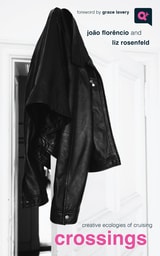
Crossings
Creative Ecologies of CruisingJoão Florêncio
Rutgers University Press, 2025
A creative dialogue between a queer artist and a queer academic reminiscing about and thinking with their cruising experiences, Crossings takes queer sex practices and cultures seriously as ways of knowing and world-making. The result is an erotic hybrid form hovering between scholarship and avant-garde experimentation, between critical manifesto and sex memoir. Here, the voices of each author, merged together in one, invite the reader to inhabit the erotic spacetime between self and other, the familiar and the strange, desire and pleasure, climax and release. That is, the spaces and temporalities of cruising itself.
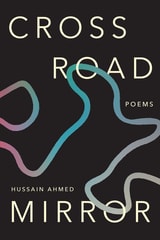
Crossroad Mirror
PoemsHussain Ahmed
Northwestern University Press, 2026
War and its reverberations propel people across the Nigerian landscape in Hussain Ahmed’s third collection
In Crossroad Mirror many poems begin after sundown—in quiet moments when the bounds between the past and the present, the living and the dead, blur. War and its aftershocks often form the backdrop for these scenes, though Ahmed’s verse rarely brings us to the battlefield itself. Instead, we hear the stories of refugees, civilian casualties, and ordinary soldiers trying to make sense of their circumstances. “There’s no vocabulary in the army—for grief, or death,” writes Ahmed. “Each door you exit, leads to another parade ground.” A group of soldiers wait out a rainstorm—and the war—together in a tent. Their families linger by the radio and listen for news. The “missing” loom as large as the dead.
Tracing the threads of migration that war so often catalyzes, Crossroad Mirror takes us from grassland to cornfield to coastline and explores the role storytelling and spirituality play in leaving and grieving.

Cry Sower
Whitney Koo
University of Utah Press, 2027
Cutlish
Rajiv Mohabir
Four Way Books, 2021
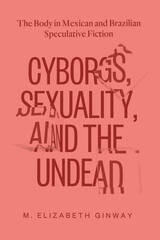
Cyborgs, Sexuality, and the Undead
The Body in Mexican and Brazilian Speculative FictionM. Elizabeth Ginway
Vanderbilt University Press, 2020
In Cyborgs, Sexuality, and the Undead, M. Elizabeth Ginway examines all these issues from a number of theoretical perspectives, most importantly through the lens of Bolívar Echeverría’s “baroque ethos,” which emphasizes the strategies that subaltern populations may adopt in order to survive and prosper in the face of massive historical and structural disadvantages. Foucault’s concept of biopolitics is developed in discussion with Roberto Esposito’s concept of immunity and Giorgio Agamben’s distinction between “political life” and “bare life.”
This book will be of interest to scholars of speculative fiction, as well as Mexicanists and Brazilianists in history, literary studies, and critical theory.