Results by title
17 books match the query 'Traditions'
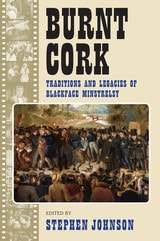
Burnt Cork
Traditions and Legacies of Blackface MinstrelsyStephen Johnson
University of Massachusetts Press, 2012
Beginning in the 1830s and continuing for more than a century, blackface minstrelsy—stage performances that claimed to represent the culture of black Americans—remained arguably the most popular entertainment in North America. A renewed scholarly interest in this contentious form of entertainment has produced studies treating a range of issues: its contradictory depictions of class, race, and gender; its role in the development of racial stereotyping; and its legacy in humor, dance, and music, and in live performance, film, and television. The style and substance of minstrelsy persist in popular music, tap and hip-hop dance, the language of the standup comic, and everyday rituals of contemporary culture. The blackface makeup all but disappeared for a time, though its influence never diminished—and recently, even the makeup has been making a comeback.
This collection of original essays brings together a group of prominent scholars of blackface performance to reflect on this complex and troublesome tradition. Essays consider the early relationship of the blackface performer with American politics and the antislavery movement; the relationship of minstrels to the commonplace compromises of the touring “show” business and to the mechanization of the industrial revolution; the exploration and exploitation of blackface in the mass media, by D. W. Griffith and Spike Lee, in early sound animation, and in reality television; and the recent reappropriation of the form at home and abroad.
In addition to the editor, contributors include Dale Cockrell, Catherine Cole, Louis Chude-Sokei, W. T. Lhamon, Alice Maurice, Nicholas Sammond, and Linda Williams.
Changes in Sacred Texts and Traditions
Methodological Encounters and DebatesMartti Nissinen
SBL Press, 2024
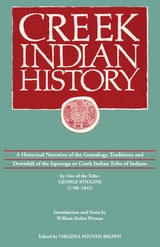
Creek Indian History
A Historical Narrative of the Genealogy, Traditions and Downfall of the Ispocoga or Creek Indian Tribe of Indians by One of the Tribe, George Stiggins (1788-1845)George Stiggins
University of Alabama Press, 2003
An essential narrative preserving the cultural memory, social life, and internal conflicts of the Creek people from an author within the tribe.
George Stiggins, a Creek Indian half blood living in Alabama, wrote this history more than 150 years ago. Raised in the white culture by his father, an English trader, Stiggins nevertheless lived in close contact with the Creeks because his mother was a full blood of the Natchez tribe, part of the Creek Confederacy.
Stiggins writes with firsthand knowledge of the tribes in the central southeast—the Alabamas, Natchez, Abekas, Uchees, and others. He tells of their origins, their towns and chiefs, and their way of life, he traces critical events leading to the Creek War—the battles of Burnt Corn and Fort Mims—and details the roles of the Indian leaders involved. In “Tecumseh and the Age of Prophecy,” he describes how the powerful influence of prophets, such as Josiah Francis and Jim Boy, who incited the Creeks to civil war as the confederacy split into war and peace factions. Stiggin’s account of William Weatherford’s controversial role in the Creek War has special value because Weatherford was Stiggins’s brother-in-law. His descriptions of religious and social aspects of the Creek lifeways make this work prime source material.
William Wyman’s notes and introduction put the Stiggins account into historical perspective and trace its circuitous route to publication. First issued in 1989, Creek Indian History has become an important primary document for the study of Native American history and culture.
Crossing Boundaries
Traditions and Transformations in Law and Society ResearchAustin Sarat
Northwestern University Press, 1998

Fighting Back in Appalachia
Traditions of Resistance and Changeedited by Stephen L. Fisher
Temple University Press, 1993
Contributors: Bill Allen, Mary K. Anglin, Fran Ansley, Alan Banks, Dwight Billings, Mary Beth Bingman, Sherry Cable, Guy and Candie Carawan, Richard A. Couto, Stephen William Foster, John M. Glen, Hal Hamilton, Bennett M. Judkins, Don Manning-Miller, Ellen Ryan, Jim Sessions, Joe Szakos, Karen Tice, Chris Weiss, and the editor.
History, Medicine, and the Traditions of Renaissance Learning
Nancy G. Siraisi
University of Michigan Press, 2007
A path-breaking work at last available in paper, History, Medicine, and the Traditions of Renaissance Learning is Nancy G. Siraisi’s examination of the intersections of medically trained authors and history from 1450 to 1650. Rather than studying medicine and history as separate traditions, Siraisi calls attention to their mutual interaction in the rapidly changing world of Renaissance erudition. With remarkably detailed scholarship, Siraisi investigates doctors’ efforts to explore the legacies handed down to them from ancient medical and anatomical writings.

Rimsky-Korsakov's Harmonic Theory
Practical Manual of Harmony, Its Sources, History, and TraditionsLarisa P. Jackson
University of North Texas Press, 2022
Sámi People
Traditions in TransitionsVeli-Pekka Lehtola
University of Alaska Press, 2005
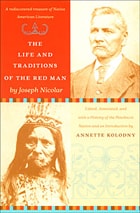
The Life and Traditions of the Red Man
A rediscovered treasure of Native American literatureJoseph Nicolar
Duke University Press, 2007
The Life and Traditions of the Red Man has not been widely available until now, largely because Nicolar passed away just a few months after the printing of the book was completed, and shortly afterwards most of the few hundred copies that had been printed were lost in a fire. This new edition has been prepared with the assistance of Nicolar’s descendants and members of the Penobscot Nation. It includes a summary history of the tribe; an introduction that illuminates the book’s narrative strategies, the aims of its author, and its key themes; and annotations providing historical context and explaining unfamiliar words and phrases. The book also contains a preface by Nicolar’s grandson, Charles Norman Shay, and an afterword by Bonnie D. Newsom, former Director of the Penobscot Nation’s Department of Cultural and Historic Preservation. The Life and Traditions of the Red Man is a remarkable narrative of Native American culture, spirituality, and literary daring.
The New Anthology of American Poetry
Traditions and Revolutions, Beginnings to 1900Edited by Steven Gould Axelrod, Camille Roman, and Thomas Travisano
Rutgers University Press, 2002
Volume I begins with a generous selection of Native American materials, then spans the years from the establishment of the American colonies to about 1900, a world on the brink of World War I and the modern era. Part One focuses on poetry from the very beginnings through the end of the eighteenth century. The expansion and development of a newly forged nation engendered new kinds of poetry. Part Two includes works from the early nineteenth century through the time of the Civil War. The poems in Part Three reflect the many issues affecting a nation undergoing tumultuous change: the Civil War, immigration, urbanization, industrialization, and cultural diversification.
Such well-recognized names as Anne Bradstreet, Edward Taylor, Phillis Wheatley, Edgar Allan Poe, Herman Melville, Walt Whitman, Emily Dickinson, and Stephen Crane appear in this anthology alongside such less frequently anthologized poets as George Horton, Sarah Helen Whitman, Elizabeth Oakes-Smith, Frances Harper, Rose Terry Cooke, Helen Hunt Jackson, Adah Menken, Sarah Piatt, Ina Coolbrith, Emma Lazarus, Albery Whitman, Owl Woman (Juana Manwell) Sadakichi Hartmann, Ernest Fenollosa, James Weldon Johnson, Paul Laurence Dunbar, and—virtually unknown as a poet—Abraham Lincoln. It also includes poems and songs reflecting the experiences of a variety of racial and ethnic groups.
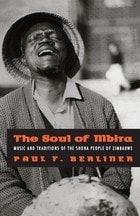
The Soul of Mbira
Music and Traditions of the Shona People of ZimbabwePaul F. Berliner
University of Chicago Press, 1993
"Paul Berliner's The Soul of Mbira is probably the best ethnography ever written about an African musical tradition. It is a complete classic . . . . I know of no other instrument with the range of the mbira, and the book is equal to the instrument."—John Chernoff
"[The Soul of Mbira] illustrates the fact that Shona mbira music in its beauty, subtlety, and virtuosity demands the same kind of respect that we might hold for any other classical music."—David Reck, Parabola
"The book is a model of ethnomusicological thinking and investigation and it suggests a specific way of approaching a complex socio-musical system."—John Baily, Popular Music
"When next someone asks 'What is ethnomusicology?' or 'What do ethnomusicologists do?' I shall suggest this book. . . . This is a landmark in ethnomusicological literature. Berliner succeeds in conveying both the joy that goes with mbira playing and the mystic relationship between the player and his instrument. In short, this is humanized ethnomusicology."—K.A. Gourlay, Ethnomusicology
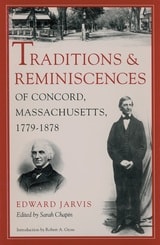
Traditions and Reminiscences of Concord, Massachusetts, 1779-1878
Edward Jarvis
University of Massachusetts Press, 1993
A statistician and pioneer in the treatment of the mentally ill, Edward Jarvis (1803–1884) decided late in life to record his recollections of Concord, Massachusetts, the town in which he was raised. Using Lemuel Shattuck's History of Concord as the springboard for his thoughts, Jarvis produced a remarkable document. Traditions and Reminiscences is encyclopedic in scope but intimate in style; it provides an astonishingly detailed account of life in early nineteenth-century Concord. Jarvis escorts us through the family home, making certain we understand the function and value of each item in the domestic scene. Then he is off to the neighbors' houses, to the schoolhouse, the church, the social clubs, the library, the post office, the town hall, and even the tavern, where he unabashedly counts patrons' drinks. Along the way we learn about neighborly cooperation—quiltings, husking bees, and barn raisings—about social manners and respectability, and about local vices. The result is a vast storehouse of information and a vivid portrait of life in an early nineteenth-century preindustrial community. The memoir also provides a first-hand witness to the crusade for moral reform that transformed mid-nineteenth-century New England.

Traditions in World Cinema
Badley, Linda R
Rutgers University Press, 2006
Traditions in World Cinema brings together a colorful and wide ranging collection of world cinematic traditions—national, regional, and global—all of which are in need of introduction, investigation and, in some cases, critical reassessment. The movements described range from well-known traditions such as German expressionism, Italian neorealism, French, British, and Czech new wave, and new Hollywood cinema to those of emerging significance, such as Danish Dogma, postcommunist cinema, Brazilian post–Cinema Novo, new Argentine cinema, pre-independence African film traditions, Israeli persecution films, new Iranian cinema, Hindi film songs, Chinese wenyi pian melodrama, Japanese horror, and global found-footage cinema.
The essays, all written by recognized experts in the field, are jargon free and accessible to both general readers and students. In addition, each chapter is followed by a list of suggested films and readings, offering readers pathways to further viewing and study.
Bringing fresh insights to those movements that have provided significant and noteworthy alternatives to Hollywood, this book is an essential introduction to the rich diversity of world cinema.
Traditions of Natural Law in Medieval Philosophy
Dominic Farrell
Catholic University of America Press, 2022
These various traditions of medieval reflection on natural law, and their interrelation, merit further study, particularly since they touch upon many current philosophical concerns. They grapple with the problem of ethical and religious pluralism. They consider whether universally valid standards of action and social life are accessible to those who rely on reason rather than divine law. In so doing, they develop sophisticated accounts of many central issues in metaethics, action theory, jurisprudence, and the philosophy of religion. However, do they reach a consensus about natural law, or do they end up defending incommensurable ethical frameworks? Do they confirm the value of arguments based on natural law or do they cast doubt on it?
This collection brings together contributions from various expert scholars to explore these issues and the pluralism that exists within medieval reflection on natural law. It is the first one to study the relation between the natural law theories of these various traditions of medieval philosophy: Jewish, Islamic, Byzantine, and Latin.
Each of the first four essays surveys the ‘natural law theory’ of one of the religious traditions of medieval philosophy—Jewish, Islamic, Byzantine, and Latin—and its relation to the others. The next four essays explore some of the alternative accounts of natural law that arise within the Latin tradition. They range over St. Bonaventure, Peter of Tarentaise, Matthew of Aquasparta, John Duns Scotus, and Marsilius of Padua.
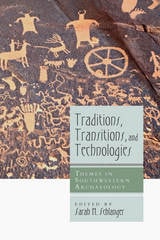
Traditions, Transitions, and Technologies
Themes in Southwestern ArchaeologySarah H. Schlanger
University Press of Colorado, 2016

Travels and Traditions of Waterfowl
H. Albert Hochbaum
University of Minnesota Press, 1967
Travels and Traditions of Waterfowl was first published in 1967. Minnesota Archive Editions uses digital technology to make long-unavailable books once again accessible, and are published unaltered from the original University of Minnesota Press editions.
With the combined talents of naturalist, writer, and artist, H. Albert Hochbaum captures the varying moods of earth and sky and spirit of flight. For many years as director of the Delta Waterfowl Research Station in Manitoba, Canada, he has observed the ways of the waterfowl. In this book he portrays and discusses the flights and habits of the birds he has watched in the vast marsh country—the wild ducks, geese, and swans of North America.
This book is the winner of a publication award of the Wildlife Society. It is recommended by the American Association for the Advancement of Science in its AAAS Science Book List for Young Artists.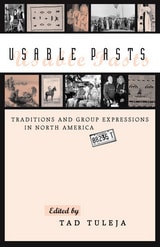
Usable Pasts
Traditions and Group Expressions in North AmericaTad Tuleja
Utah State University Press, 1997