1185 books match the query 'Travel' and 66 start with c
cover of Connecting the West: Historic Railroad Stops and Stage Stations in Elko County, Nevada

Connecting the West

Historic Railroad Stops and Stage Stations in Elko County, Nevada

Shawn Hall

University of Nevada Press, 2002

Shawn Hall's immensely popular guidebooks to Nevada ghost towns have become essential resources for backcountry explorers and scholars alike. Now Hall returns to Elko County to survey the county's railroad and stage stations, as well as other sites not included in his earlier survey of this colorful section of the state. As in his earlier volumes, Hall includes a history of each site he lists, along with period and contemporary photographs, directions for locating the sites, and an assessment of their present condition. His historical accounts, based on a wide range of primary and secondary sources, are both scholarly and engaging, rich in anecdotes and personalities, and in the fascinating minutia of history often ignored by more academic writers. Shawn Hall's dedication to documenting Nevada's thousands of historic sites has enriched our knowledge of the state's relatively brief but very eventful past. Connecting the West is a worthy addition to Hall's remarkable efforts to preserve the state's history.
[more]
cover of Cosmopolitan Twain

Cosmopolitan Twain

Edited by Ann M. Ryan and Joseph B. McCullough

University of Missouri Press, 2008
Cosmopolitan Twain takes seriously Mark Twain’s life as a citizen of urban landscapes: from the streets of New York City to the palaces of Vienna to the suburban utopia of Hartford. Traditional readings of Mark Twain orient his life and work by distinctly rural markers such as the Mississippi River, the Wild West, and small-town America; yet, as this collection shows, Twain’s sensibilities were equally formed in the urban centers of the world. These essays represent Twain both as a product of urban frontiers and as a prophet of American modernity, situating him squarely within the context of an evolving international and cosmopolitan community.
 
As Twain traveled and lived in these locales, he acquired languages, costumes, poses, and politics that made him one of the first truly cosmopolitan world citizens. Beginning with New York City—where Twain spent more of his life than in Hannibal—we learn that his early experiences there fed his fascination with racial identity and economic privilege. While in St. Louis and New Orleans, Twain developed a strategic detachment that became a part of his cosmopolitan persona. His contact with bohemian writers in San Francisco excited his ambitions to become more than a humorist, while sojourns in Buffalo and Hartford marked Twain’s uneasy accommodation to domesticity and cultural prominence. London finally liberated him from his narrowly constructed national identity, while Vienna allowed him to fully achieve his transnational voice. The volume ends by presenting Elmira, New York, as a complement, and something of a counterpart, to Twain’s cosmopolitan life, creating a domestic retreat from the pace and complexity of an increasingly urban, modern America.
 
In response to each of these cities, Twain generated writings that marked America’s movement into the twentieth century and toward the darker realities that made possible this cosmopolitan state. Cosmopolitan Twain presents Twain’s eventual descent into skepticism and despair not as a departure from his early values but rather as a dark awakening into the new terms of American identity, history, and moral authority. This collection reveals a writer who is decidedly less static than the iconic portrait that dominates popular culture. It offers a corrective to the familiar image of Twain as the nostalgic voice of America’s rural past, presenting Twain as a citizen of modernity and a visionary of a global and cosmopolitan future.
[more]
cover of Country Boy: The Roots of Johnny Cash

Country Boy

The Roots of Johnny Cash

Colin Edward Woodward

University of Arkansas Press, 2022

Winner, 2023 J. G. Ragsdale Book Award from the Arkansas Historical Association

Because Johnny Cash cut his classic singles at Sun Records in Memphis and reigned for years as country royalty from his Nashville-area mansion, people tend to associate the Man in Black with Tennessee. But some of Cash’s best songs—including classics like “Pickin’ Time,” “Big River,” and “Five Feet High and Rising”—sprang from his youth in the sweltering cotton fields of northeastern Arkansas.

In Country Boy, Colin Woodward combines biography, history, and music criticism to illustrate how Cash’s experiences in Arkansas shaped his life and work. The grip of the Great Depression on Arkansas’s small farmers, the comforts and tragedies of family, and a bedrock of faith all lent his music the power and authenticity that so appealed to millions. Though Cash left Arkansas as an eighteen-year-old, he often returned to his home state, where he played some of his most memorable and personal concerts. Drawing upon the country legend’s songs and writings, as well as the accounts of family, fellow musicians, and chroniclers, Woodward reveals how the profound sincerity and empathy so central to Cash’s music depended on his maintaining a deep connection to his native Arkansas—a place that never left his soul.
[more]
cover of Creatures of the Air: Music, Atlantic Spirits, Breath, 1817–1913

Creatures of the Air

Music, Atlantic Spirits, Breath, 1817–1913

J. Q. Davies

University of Chicago Press, 2023

An account of nineteenth-century music in Atlantic worlds told through the history of the art’s elemental medium, the air.

Often experienced as universal and incorporeal, music seems an innocent art form. The air, the very medium by which music constitutes itself, shares with music a claim to invisibility. In Creatures of the Air, J. Q. Davies interrogates these claims, tracing the history of music’s elemental media system in nineteenth-century Atlantic worlds. He posits that air is a poetic domain, and music is an art of that domain.

From West Central African ngombi harps to the European J. S. Bach revival, music expressed elemental truths in the nineteenth century. Creatures of the Air tells these truths through stories about suffocation and breathing, architecture and environmental design, climate strife, and racial turmoil. Contributing to elemental media studies, the energy humanities, and colonial histories, Davies shows how music, no longer just an innocent luxury, is implicated in the struggle for control over air as a precious natural resource. What emerges is a complex political ecology of the global nineteenth century and beyond.
[more]
cover of Crossing Jerusalem: Journeys at the Centre of the World’s Trouble

Crossing Jerusalem

Journeys at the Centre of the World’s Trouble

Nicholas Woodsworth

Haus Publishing, 2010

Jerusalem is not an ordinary city and Crossing Jerusalem is not a standard telling of its story. At once a traditional travelogue, a questioning of spiritual values, and an examination of the beliefs that have sustains Jerusalem’s populations through centuries of conflict and division, this book offers an unusual yet penetrating perspective of the city and its inhabitancies.
[more]
cover of Crossing the Blue Willow Bridge: A Journey to My Daughter's Birthplace in China

Crossing the Blue Willow Bridge

A Journey to My Daughter's Birthplace in China

Nancy McCabe

University of Missouri Press, 2011
 
Even before Nancy McCabe and her daughter, Sophie, left for China, it was clear that, as the mother of an adopted child from China, McCabe would be seeing the country as a tourist while her daughter, who was seeing the place for the first time in her memory, was “going home.” Part travelogue, part memoir, Crossing the Blue Willow Bridge immerses readers in an absorbing and intimate exploration of place and its influence on the meaning of family.
A sequel to Meeting Sophie, which tells McCabe’s story of adopting Sophie as a single woman, Crossing the Blue Willow Bridge picks up a decade later with a much different Sophie—a ten-year-old with braces who wears black nail polish, sneaks eyeliner, wears clothing decorated with skulls, and has mixed feelings about being one of the few non-white children in the little Pennsylvania town where they live. Since she was young, Sophie had felt a closeness to the country of her birth and held it in an idealized light. At ten, she began referring to herself as Asian instead of Asian-American. It was McCabe’s hope that visiting China would “help her become comfortable with both sides of the hyphen, figure out how to be both Chinese and American, together.”
As an adoptive parent of a foreign-born child, McCabe knows that homeland visits are an important rite of passage to help children make sense of the multiple strands of their heritage, create their own hybrid traditions, and find their particular place in the world. Yet McCabe, still reeling from her mother’s recent death, wonders how she can give any part of Sophie back to her homeland. She hopes that Sophie will find affirmation and connection in China, even as she sees firsthand some of the realities of China—overpopulation, pollution, and an oppressive government—but also worries about what that will mean for their relationship.
Throughout their journey on a tour for adopted children, mother and daughter experience China very differently. New tensions and challenges emerge, illuminating how closely intertwined place is with sense of self. As the pair learn to understand each other, they lay the groundwork for visiting Sophie’s orphanage and birth village, life-changing experiences for them both.
[more]
cover of Crossing the Driftless: A Canoe Trip through a Midwestern Landscape

Crossing the Driftless

A Canoe Trip through a Midwestern Landscape

Lynne Diebel

University of Wisconsin Press, 2015

The Driftless Area is the land the glaciers missed, an ancient landscape of bluffs, ridgetops, and steep valleys that long ago was a seabed. Covering much of southwestern Wisconsin, its contours were deeply carved from bedrock, not by ice but by many rivers.
            Crossing the Driftless is both a traveler’s tale and an exploration of this dramatic environment, following the streams of geologic and human history. Lynne Diebel and her husband, Bob, crossed the Driftless Area by canoe, journeying 359 river miles (and six Mississippi River locks and five portages) from Faribault, Minnesota, where her family has a summer home on Cedar Lake, to their Wisconsin home in Stoughton, one block from the Yahara River. Traveling by river and portage, they paddled downstream on the Cannon and Mississippi rivers and upstream on the Wisconsin River, in the tradition of voyageurs. Lynne tells the story of their trip, but also the stories of the rivers they canoed and the many tributaries whose confluences they passed.

Finalist, Travel, Foreword Reviews IndieFab Book of the Year Awards

Honorable mention, Nonfiction book, Council for Wisconsin Writers

Winner, Recreation/Sports/Travel, Midwest Book Awards

Best books for public & secondary school libraries from university presses, American Library Association
[more]
cover of Crossing the Street in Hanoi: Teaching and Learning About Vietnam

Crossing the Street in Hanoi

Teaching and Learning About Vietnam

Carol Wilder

Intellect Books, 2013

This is a study of media and cultural artifacts that constitute the remembrance of a tragic war as reflected in the stories of eight people who lived it. Using memoir, history, and criticism, Crossing the Street in Hanoi is based on scholarly research, teaching, and writing as well as extensive personal journals, interviews, and exclusive primary source material. Each chapter uses a human story to frame an exploration in media and cultural criticism. What weaves these different threads into a whole cloth are the stories of the Vietnam War and the long shadow it casts over American and Vietnamese cultures.

[more]
cover of Crossings: A White Man's Journey Into Black America

Crossings

A White Man's Journey Into Black America

Walt Harrington

University of Missouri Press, 1999

One day in the dentist's office journalist Walt Harrington heard a casual racist joke that left him enraged. Married to a black woman, Harrington is the father of two biracial children. His experience in the dentist's office made him realize not only that the joke was about his own children but also that he really knew very little about what it was like to be a black person in America.

After this rude awakening, Harrington set off on a twenty- five-thousand-mile journey through black America, talking with scores of black and white people along the way, including an old sharecropper, a city police chief, a jazz trumpeter, a convicted murderer, a welfare mother, and a corporate mogul. In Crossings, winner of the Gustavus Myers Award for the Study of Human Rights, he relates what he learned as he listened.
[more]
cover of Cruising with Robert Louis Stevenson: Travel, Narrative, and the Colonial Body

Cruising with Robert Louis Stevenson

Travel, Narrative, and the Colonial Body

Oliver S. Buckton

Ohio University Press, 2007
Cruising with Robert Louis Stevenson: Travel, Narrative, and the Colonial Body is the first book-length study about the influence of travel on Robert Louis Stevenson’s writings, both fiction and nonfiction. Within the contexts of late-Victorian imperialism and ethnographic discourse, the book offers original close readings of individual works by Stevenson while bringing new theoretical insights to bear on the relationship between travel, authorship, and gender identity in the Victorian fin de siècle. Oliver S. Buckton develops “cruising” as a critical term, linking Stevenson’s leisurely mode of travel with the striking narrative motifs of disruption and fragmentation that characterize his writings. Buckton traces the development of Stevenson’s career from his early travel books to show how Stevenson’s major works of fiction, such as Treasure Island, Kidnapped, and The Ebb-Tide, draw on innovative techniques and materials Stevenson acquired in the course of his global travels. Exploring Stevenson’s pivotal role in the revival of “romance” in the late nineteenth century, Cruising with Robert Louis Stevenson highlights Stevenson’s treatment of the human body as part of his resistance to realism, arguing that the energies and desires released by travel are often routed through disturbingly resistant or darkly comic corporeal figures. Buckton gives extensive attention to Stevenson’s writing about the South Seas, arguing that his groundbreaking critiques of European colonialism are formed in awareness of the fragility and desirability of Polynesian bodies and island landscapes. Cruising with Robert Louis Stevenson will be indispensable to all admirers of Stevenson as well as of great interest to readers of travel writing, Victorian ethnography, gender studies, and literary criticism.
[more]
cover of Cuba, Hot and Cold

Cuba, Hot and Cold

Tom Miller

University of Arizona Press, 2017

Cuba—mysterious, intoxicating, captivating. Whether you’re planning to go or have just returned, Cuba, Hot and Cold is essential for your bookshelf. With a keen eye and dry wit, author Tom Miller takes readers on an intimate journey from Havana to the places you seldom find in guidebooks.

A brilliant raconteur and expert on Cuba, Miller is full of enthralling behind-the-scenes stories. His subjects include one of the world’s most resourceful master instrument makers, the famous photo of Che Guevara, and the explosion of the USS Maine. A veteran of the underground press of the 1960s, Miller describes the day Cuba’s State Security detained him for distributing copies of the United Nations Human Rights Declaration of 1948 and explains how the dollar has become the currency of necessity. His warm reminiscences explain the complexities of life in Cuba.

Since his first visit to the island thirty years ago, Miller has shown us the real people of Havana and the countryside, the Castros and their government, and the protesters and their rigor. His first book on Cuba, Trading with the Enemy, brought readers into the “Special Period,” Fidel’s name for the country’s period of economic free fall. Cuba, Hot and Cold brings us up to date, providing intimate and authentic glimpses of day-to-day life.
 
[more]
cover of Cuba--Going Back

Cuba--Going Back

By Tony Mendoza

University of Texas Press, 1999

Imagine being unable to return to your homeland for thirty-six years. What would you do if you finally got a chance to go back?

In 1996, after travel restrictions between the United States and Cuba were relaxed, Cuban exile Tony Mendoza answered that question. Taking his cameras, notebooks, and an unquenchable curiosity, he returned for his first visit to Cuba since summer of 1960, when he emigrated with his family at age eighteen. In this book he presents over eighty evocative photographs accompanied by a beautifully written text that mingles the voices of many Cubans with his own to offer a compelling portrait of a resilient people awaiting the inevitable passing of the socialist system that has failed them.

His photographs and interviews bear striking witness to the hardships and inequalities that exist in this workers' "paradise," where the daily struggle to make ends meet on an average income of eight dollars a month has created a longing for change even in formerly ardent revolutionaries. At the same time, Cuba—Going Back is an eloquent record of a personal journey back in time and memory that will resonate with viewers and readers both within and beyond the Cuban American community. It belongs on the shelves of anyone who values excellent photography and well-crafted prose.
[more]
cover of Culture on Tour: Ethnographies of Travel

Culture on Tour

Ethnographies of Travel

Edward M. Bruner

University of Chicago Press, 2004

Recruited to be a lecturer on a group tour of Indonesia, Edward M. Bruner decided to make the tourists aware of tourism itself. He photographed tourists photographing Indonesians, asking the group how they felt having their pictures taken without their permission. After a dance performance, Bruner explained to the group that the exhibition was not traditional, but instead had been set up specifically for tourists. His efforts to induce reflexivity led to conflict with the tour company, which wanted the displays to be viewed as replicas of culture and to remain unexamined. Although Bruner was eventually fired, the experience became part of a sustained exploration of tourist performances, narratives, and practices.

Synthesizing more than twenty years of research in cultural tourism, Culture on Tour analyzes a remarkable variety of tourist productions, ranging from safari excursions in Kenya and dance dramas in Bali to an Abraham Lincoln heritage site in Illinois. Bruner examines each site in all its particularity, taking account of global and local factors, as well as the multiple perspectives of the various actors—the tourists, the producers, the locals, and even the anthropologist himself. The collection will be essential to those in the field as well as to readers interested in globalization and travel.
[more]
cover of Curating the American Past: A Memoir of a Quarter Century at the Smithsonian National Museum of American History

Curating the American Past

A Memoir of a Quarter Century at the Smithsonian National Museum of American History

Pete Daniel

University of Arkansas Press, 2022

“As is well known, Pete is an outstanding storyteller, and this book is no exception."
—Claire Strom, Journal of Southern History


In addition to chronicling significant exhibit work at the Smithsonian National Museum of American History, Curating the American Past, captures the excitement inherent in researching and writing history and Pete Daniel’s efforts to prevent diluted celebratory stories from replacing the red meat of the American past.


In Curating the American Past, Pete Daniel reveals how curators collect objects, plan exhibits, and bring alive the country’s complex and exciting history. In vivid detail, Daniel recounts the exhilaration of innovative research, the joys of collaboration, and the rewards of mentoring new generations of historians. In a career distinguished by prize-winning publications and pathbreaking exhibitions, Daniel also confronted the challenges of serving as a public historian tasked with protecting a definitive American museum from the erosion of scholarly standards. Curating the American Past offers a wealth of museum wisdom, illuminating the crucial role that dedicated historians and curators serve within our most important repositories of cultural memory.
[more]
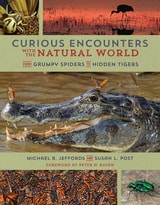
cover of Curious Encounters with the Natural World: From Grumpy Spiders to Hidden Tigers

Curious Encounters with the Natural World

From Grumpy Spiders to Hidden Tigers

Michael Jeffords

University of Illinois Press, 2017
Michael R. Jeffords and Susan L. Post have circled the globe--and explored their neighborhood--collecting images of the natural world. This book opens their personal cabinet of curiosities to tell the stories of the pair's most unusual encounters. From the "necking" battles of mate-hungry giraffes to the breathtaking beauty of millions of monarch butterflies at rest, Jeffords and Post share 200 stunning photographs and their own insightful essays to guide readers on a spectacular journey. Their training as entomologists offers unique perspectives on surprise stag beetle swarms and spider hunting habits. Their photographic eye, honed by decades of observation, finds expression in once-in-a-lifetime images. The result is an eyewitness collection of startling and unusual phenomena that illuminates the diverse life inhabiting our planet.
[more]
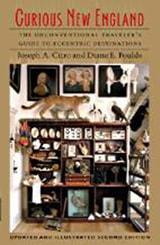
cover of Curious New England: The Unconventional Traveler’s Guide to Eccentric Destinations

Curious New England

The Unconventional Traveler’s Guide to Eccentric Destinations

Joseph E. Citro and Diane E. Foulds

University Press of New England, 2004

New England is truly a Cabinet of Curiosities, and this indispensable guide directs you to its most bizarre, off the wall, and unsettling exhibits. Some evoke hilarity, some horror. Discover singing sand, glowing tombstones, ghostly squirrels, and a musical instrument said to cause madness. Marvel at the most mysterious manuscript in the world. Visit a miniature replica of the Holy Land or climb carved stone steps leading . . . nowhere. Curious New England points the way to all the tantalizing treats and terrifying treasures that remain tucked away in overlooked museums, private collections, and forgotten recesses of this very special region. *A cursed statue in Maine *Ageless American Megaliths *A window embedded in Vermont earth *Titus’s Arch on a New Hampshire hilltop *Artwork made from insect parts With precise directions, hours, and contact information, these fascinating pages reveal each mystery, miracle, and marvel, from world-class weirdness, to minor curiosities, to entertaining distractions. There'll be no more boring Sunday drives when you can visit a spider farm, explore the laboratory of “mad” scientist Wilhelm Reich, view the Hobo Hotel, and observe houses made from paper, wooden crates, mounds of earth—even covered bridges. And New England’s wonders never cease: discover evidence of manned flight a century before the Wright Brothers; visible phantoms manifesting from marble columns; and automobiles emerging from tarmac like dinosaurs from pits of tar. This one-of-a-kind collection spotlights all six New England states, illuminating everything that’s wicked, weird, and wonderful in every hidden corner of a region that rivals Old England in mysteries, miracles, and marvels.
[more]