Results by title
28167 books match the query 'History' and 1913 start with c
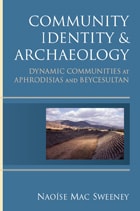
Community Identity and Archaeology
Dynamic Communities at Aphrodisias and BeycesultanNaoíse Mac Sweeney
University of Michigan Press, 2011
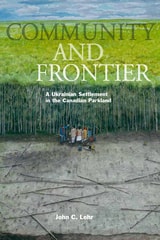
Community and Frontier
A Ukrainian Settlement in the Canadian ParklandJohn C. Lehr
University of Manitoba Press, 2011
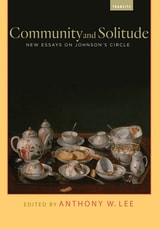
Community and Solitude
New Essays on Johnson’s CircleLee, Anthony W
Bucknell University Press, 2019
Contributors: Christopher Catanese, James Caudle, Marilyn Francus, Christine Jackson-Holzberg, Claudia Thomas Kairoff, Elizabeth Lambert, Anthony W. Lee, James E. May, John Radner, and Lance Wilcox.
Published by Bucknell University Press. Distributed worldwide by Rutgers University Press.
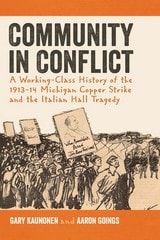
Community in Conflict
A Working-class History of the 1913-14 Michigan Copper Strike and the Italian Hall TragedyGary Kaunonen
Michigan State University Press, 2013
A mirror of great changes that were occurring on the national labor rights scene, the 1913–14 Michigan Copper Strike was a time of unprecedented social upheaval in Michigan’s Upper Peninsula. With organized labor taking an aggressive stance against the excesses of unfettered capitalism, the stage was set for a major struggle between labor and management. The Michigan Copper Strike received national attention and garnered the support of luminaries in organized labor like Mother Jones, John Mitchell, Clarence Darrow, and Charles Moyer. The hope of victory was overshadowed, however, by violent incidents like the shooting of striking workers and their family members, and the bitterness of a community divided. No other event came to symbolize or memorialize the strike more than the Italian Hall tragedy, in which dozens of workers and working-class children died. In Community in Conflict, the efforts of working people to gain a voice on the job and in their community through their unions, and the efforts of employers to crush those unions, take center stage. Previously untapped historical sources such as labor spy reports, union newspapers, coded messages, and artifacts shine new light on this epic, and ultimately tragic, period in American labor history.
Community without Consent
New Perspectives on the Stamp ActEdited by Zachary McLeod Hutchins
Dartmouth College Press, 2016
Compadre Colonialism
Studies in the Philippines under American RuleNorman G. Owen, Editor
University of Michigan Press, 1971
Compagnons de lutte
Avant-garde et critique d’art en Espagne pendant le franquismePaula Barreiro López
Diaphanes, 2023
Company Men
The Invention of Shareholder Value and the Splintering of the American EconomySean Delehanty
University of Chicago Press, 2025
How an esoteric economic theory—and its most devout believers—changed the world forever.
In the modern economy, stock price is king. The value of a corporation is measured in how it enriches its shareholders, even when doing so subtracts from long-term growth or social good. Greed, in the last half-century of corporate practice, has become very good. Company Men is a sweeping intellectual history of how shareholder value rose from the lesser-known edges of academic theory to the vanguard of corporate practice.
Historian Sean Delehanty marshals archival resources to reveal how a group of motivated consultants, activist investors, and academic economists successfully branded shareholder value as the antidote to problems of management and economic stagnation in the 1970s. In their success, they created a class of well-heeled managers who executed shareholder-value theory as an everyday practice—and at the expense of most everything else. Delehanty’s history of the modern American corporation is a sobering account of the business regime that would rule the world and produce no shortage of regrets—even amongst those who championed it. Company Men is intellectual history at its most vital, offering a surprising origin story of our economy’s discontents.
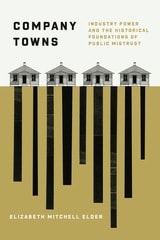
Company Towns
Industry Power and the Historical Foundations of Public MistrustElizabeth Mitchell Elder
University of Chicago Press, 2026
Reveals the deep, historical roots of public distrust in former mining areas in the US, shedding new light on the corrosive feedback loops that persist today.
In Company Towns, Elizabeth Mitchell Elder examines the long-lasting political legacies of mining-company dominance in the Midwest and Appalachia. While the economic consequences of deindustrialization are well-known, Elder shifts the focus to a more insidious problem: the political dysfunction that took root long before the mines shut down.
Drawing on historical and administrative data, Elder shows that the coal industry hindered the growth of local government capacity in the places where it was dominant. Mining companies also engaged in outright corruption to shape local governments, practices which local elites then carried forward. When mining companies withdrew, they left behind not just economic decline, but local governments ill-equipped to govern.
These patterns have had enduring consequences for public life. Elder shows how these historical experiences have fueled a broader cynicism toward government, in which citizens expect little from public institutions and doubt the usefulness of elections. Company Towns underscores the consequences of corporate dominance for state capacity, public opinion, and democratic accountability today.
Comparative Essays on the Poetry and Prose of John Donne and George Herbert
Combined LightsRussell M. Hillier
University of Delaware Press, 2022
Comparative Indigeneities of the Américas
Toward a Hemispheric ApproachEdited by M. Bianet Castellanos, Lourdes Gutiérrez Nájera, and Arturo J. Aldama
University of Arizona Press, 2012
The effects of colonization on the Indigenous peoples of the Américas over the past 500 years have varied greatly. So too have the forms of resistance, resilience, and sovereignty. In the face of these differences, the contributors to this volume contend that understanding the commonalities in these Indigenous experiences will strengthen resistance to colonial forces still at play. This volume marks a critical moment in bringing together transnational and interdisciplinary scholarship to articulate new ways of pursuing critical Indigenous studies.
Comparative Indigeneities of the Américas highlights intersecting themes such as indigenísmo, mestizaje, migration, displacement, autonomy, sovereignty, borders, spirituality, and healing that have historically shaped the experiences of Native peoples across the Américas. In doing so, it promotes a broader understanding of the relationships between Native communities in the United States and Canada and those in Latin America and the Caribbean and invites a hemispheric understanding of the relationships between Native and mestiza/o peoples.
Through path-breaking approaches to transnational, multidisciplinary scholarship and theory, the chapters in this volume advance understandings of indigeneity in the Américas and lay a strong foundation for further research. This book will appeal to scholars and students in the fields of anthropology, literary and cultural studies, history, Native American and Indigenous studies, women and gender studies, Chicana/o studies, and critical ethnic studies.
Ultimately, this deeply informative and empowering book demonstrates the various ways that Indigenous and mestiza/o peoples resist state and imperial attempts to erase, repress, circumscribe, and assimilate them.
Comparative Media Systems
European and Global PerspectivesMiklós Sükösd
Central European University Press, 2010
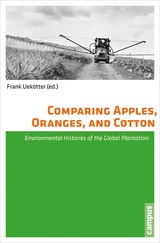
Comparing Apples, Oranges, and Cotton
Environmental Histories of the Global PlantationEdited by Frank Uekötter
Campus Verlag, 2014
Comparing Jewish Societies
Todd M. Endelman, Editor
University of Michigan Press, 1997
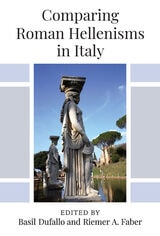
Comparing Roman Hellenisms in Italy
Edited by Basil Dufallo and Riemer A. Faber
University of Michigan Press, 2023
The story of Roman Hellenism—defined as the imitation or adoption of something Greek by those subject to or operating under Roman power—begins not with Roman incursions into the Greek mainland, but in Italy, where our most plentiful and spectacular surviving evidence is concentrated. Think of the architecture of the Roman capital, the Campanian towns of Pompeii and Herculaneum buried by Vesuvius, and the Hellenic culture of the Etruscans. Perhaps “everybody knows” that Rome adapted Greek culture in a steadily more “sophisticated” way as its prosperity and might increased. This volume, however, argues that the assumption of smooth continuity, let alone steady “improvement,” in any aspect of Roman Hellenism can blind us to important aspects of what Roman Hellenism really is and how it functions in a given context.
As the first book to focus on the comparison of Roman Hellenisms per se, Comparing Roman Hellenisms in Italy shows that such comparison is especially valuable in revealing how any singular instance of the phenomenon is situated and specific, and has its own life, trajectory, circumstances, and afterlife. Roman Hellenism is always a work in progress, is often strategic, often falls prey to being forgotten, decontextualized, or reread in later periods, and thus is in important senses contingent. Further, what we may broadly identify as a Roman Hellenism need not imply Rome as the only center of influence. Roman Hellenism is often decentralized, and depends strongly on local agents, aesthetics, and materials. With this in mind, the essays concentrate geographically on Italy to lend both focus and breadth to our topic, as well as to emphasize the complex interrelation of Hellenism at Rome with Rome’s surroundings. Because Hellenism, whether as practiced by Romans or Rome’s subjects, is in fact widely diffused across far-flung geographical regions, the final part of the collection gestures to this broader context.
Compassion and Responsibility
Readings in the History of Social Welfare Policy in the United StatesFrank R. Breul and Steven J. Diner
University of Chicago Press, 1985

Compelled to Act
Histories of Women's Activism in Western CanadaSarah Carter
University of Manitoba Press, 2020
Compelling Visuality
The Work Of Art In And Out Of HistoryClaire Farago
University of Minnesota Press, 2003
Explores what we actually see, touch, and experience when looking at art
Typically, art history is an enterprise of recovery—of searching out the provenance, the original intentions, the physical setting, and historical conditions behind a work of art. The essays in Compelling Visuality address some of the other questions that are less frequently asked—and, in doing so, show how much is to be learned and gained by going beyond the traditional approaches of art history.
In particular, the contributors take up the commonly unexplored question of what is actually present in a work of art—what we see, touch, and experience when confronted with Renaissance or Baroque works that have survived the vicissitudes of time. International and interdisciplinary, this volume conducts readers into an ongoing discussion of the value and significance of personal response to works of art. Contributors: F. R. Ankersmit, U of Groningen; Mieke Bal, U of Amsterdam and Cornell U; Oskar Bätschmann, U of Bern; Georges Didi-Huberman, École des Hautes Études en Sciences Sociales, Paris; Michael Ann Holly, Clark Art Institute; Donald Preziosi, UCLA and Oxford U; Renée van de Vall, U of Maastricht.
Competing Kingdoms
Women, Mission, Nation, and the American Protestant Empire, 1812–1960Barbara Reeves-Ellington, Kathryn Kish Sklar, and Connie A. Shemo, eds.
Duke University Press, 2010
An international and interdisciplinary group of scholars, the contributors bring under-utilized evidence from U.S. and non-U.S. sources to bear on the study of American women missionaries abroad and at home. Focusing on women from several denominations, they build on the insights of postcolonial scholarship to incorporate the agency of the people among whom missionaries lived. They explore how people in China, the Congo Free State, Egypt, India, Japan, Ndebeleland (colonial Rhodesia), Ottoman Bulgaria, and the Philippines perceived, experienced, and negotiated American cultural expansion. They also consider missionary work among people within the United States who were constructed as foreign, including African Americans, Native Americans, and Chinese immigrants. By presenting multiple cultural perspectives, this important collection challenges simplistic notions about missionary cultural imperialism, revealing the complexity of American missionary attitudes toward race and the ways that ideas of domesticity were reworked and appropriated in various settings. It expands the field of U.S. women’s history into the international arena, increases understanding of the global spread of American culture, and offers new concepts for analyzing the history of American empire.
Contributors: Beth Baron, Betty Bergland, Mary Kupiec Cayton, Derek Chang, Sue Gronewold, Jane Hunter, Sylvia Jacobs, Susan Haskell Khan, Rui Kohiyama, Laura Prieto, Barbara Reeves-Ellington, Mary Renda, Connie A. Shemo, Kathryn Kish Sklar, Ian Tyrrell, Wendy Urban-Mead
Competing Memories
The Legacy of Arkansas's Civil WarMark Christ
Butler Center for Arkansas Studies, 2016
Between 2011 and 2015, Arkansas commemorated the 150th anniversary of the American Civil War with re-enactments, lectures, placement of historical markers, and a wide variety of other events that were collectively attended by more than 375,000 people. While the sesquicentennial commemoration highlighted the Civil War events that occurred in the state and honored the people who experienced the war in Arkansas, the question of the war’s significance to modern Arkansas remained.
Competing Memories: The Legacy of Arkansas’s Civil War collects the proceedings of the final seminar sponsored by the Arkansas Civil War Sesquicentennial Commission, which sought to define the lasting impact that the nation’s deadliest conflict had on the state by bringing together some of the state’s leading historians.
In these essays, Thomas A. DeBlack explores the post-war lives of both Union and Confederate soldiers who played prominent roles in Civil War Arkansas. Cherisse Jones-Branch delves into the lives of black Arkansans during the war and Reconstruction. Jeannie Whayne discusses the many ways the Civil War affected the state’s economic development, while Kelly Houston Jones investigates the Civil War’s impact on Arkansas women. Mary Jane Warde examines the devastating effects of the Civil War on Native Americans in Arkansas and the Indian Territory. Elliott West scrutinizes Civil War Arkansas from a continental perspective, and Carl Moneyhon considers the evolution of how we remember the Civil War.
Together, the essays in Competing Memories: The Legacy of Arkansas’s Civil War provide a compelling account of how America’s bloodiest war continues to affect Arkansas and its people today.
Competitive Archaeology in Jordan
Narrating Identity from the Ottomans to the HashemitesBy Elena D. Corbett
University of Texas Press, 2015
An examination of archaeology in Jordan and Palestine, Competitive Archaeology in Jordan explores how antiquities have been used to build narratives and national identities. Tracing Jordanian history, and the importance of Jerusalem within that history, Corbett analyzes how both foreign and indigenous powers have engaged in a competition over ownership of antiquities and the power to craft history and geography based on archaeological artifacts. She begins with the Ottoman and British Empires—under whose rule the institutions and borders of modern Jordan began to take shape—asking how they used antiquities in varying ways to advance their imperial projects. Corbett continues through the Mandate era and the era of independence of an expanded Hashemite Kingdom, examining how the Hashemites and other factions, both within and beyond Jordan, have tried to define national identity by drawing upon antiquities.
Competitive Archaeology in Jordan traces a complex history through the lens of archaeology’s power as a modern science to create and give value to spaces, artifacts, peoples, narratives, and academic disciplines. It thus considers the role of archaeology in realizing Jordan’s modernity—drawing its map; delineating sacred and secular spaces; validating taxonomies of citizens; justifying legal frameworks and institutions of state; determining logos of the nation for display on stamps, currency, and in museums; and writing history. Framing Jordan’s history in this way, Corbett illustrates the manipulation of archaeology by governments, institutions, and individuals to craft narratives, draw borders, and create national identities.
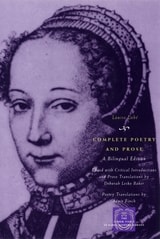
Complete Poetry and Prose
A Bilingual EditionLouise Labé
University of Chicago Press, 2006
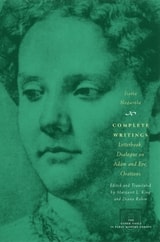
Complete Writings
Letterbook, Dialogue on Adam and Eve, OrationsIsotta Nogarola
University of Chicago Press, 2004
This volume presents English translations of all of Nogarola's extant works and highlights just how daring and original her convictions were. In her letters and orations, Nogarola elegantly synthesized Greco-Roman thought with biblical teachings. And striding across the stage in public, she lectured the Veronese citizenry on everything from history and religion to politics and morality. But the most influential of Nogarola's works was a performance piece, Dialogue on Adam and Eve, in which she discussed the relative sinfulness of Adam and Eve—thereby opening up a centuries-long debate in Europe on gender and the nature of woman and establishing herself as an important figure in Western intellectual history. This book will be a must read for teachers and students of Women's Studies as well as of Renaissance literature and history.
Complete in All Its Parts
Nursing Education at the University of Iowa, 1898-1998Lee Anderson and Kathy Penningroth
University of Michigan Press, 1998
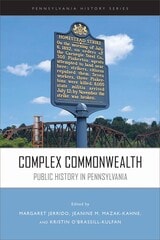
Complex Commonwealth
Public History in PennsylvaniaEdited by Margaret Jerrido, Jeanine M. Mazak-Kahne, and Kristin O'Brassill-Kulfan
Temple University Press, 2027
There are thousands of historic sites across Pennsylvania. The question of whose memories, what histories, and what local heritage deserve preservation has animated historians and communities for centuries. The editors and contributors to Complex Commonwealth provide a collection of accessible essays about public history in Pennsylvania that show how we have commemorated and preserved the state’s material culture, museums, monuments and memorials, parks, archives, libraries, and historic sites over centuries.
Chapters examine the Homestead Steel Strike, the Carlisle Indian School’s Digital Resource Center, and African American cemeteries and burial grounds, among other case studies. The methodologies these public historians use are as diverse as the various histories of labor, gender, religion, and race. It is by shedding light on these underseen histories that Complex Commonwealth affirms the importance of state and regional history to everyday Pennsylvanians.
Complex Commonwealth emphasizes the importance of place and space in shaping how we know what we know about the past and how that collectively shapes our future.
Contributors: Barbara Barksdale, Zachary L. Brodt, Steven Burg, Mary Catherine Foltz, Kelly C. George, James Gerencser, Alexandra Acri Godfrey, Kris Lowrey, Devin C. Manzullo-Thomas, Carol W. Smith, Frank Vitale IV, and the editors
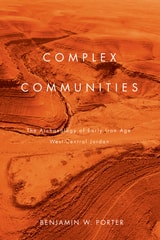
Complex Communities
The Archaeology of Early Iron Age West-Central JordanBenjamin W. Porter
University of Arizona Press, 2013
These settlements emerged during a period of recovery following the political and economic collapse of Bronze Age Mediterranean societies. Scholars have characterized west-central Jordan’s political organization during this time as an incipient Moabite state. Complex Communities argues instead that the settlements were a collection of independent, self-organizing entities. Each community constructed substantial villages with fortifications, practiced both agriculture and pastoralism, and built and stocked storage facilities. From these efforts to produce and store resources, especially food, wealth was generated and wealthier households gained power over their neighbors. However, power was limited by the fact that residents could—and did—leave communities and establish new ones.
Complex Communities reveals that these settlements moved through adaptive cycles as they adjusted to a changing socionatural system. These sustainability-seeking communities have lessons to offer not only the archaeologists studying similar struggles in other locales, but also to contemporary communities facing negative climate change. Readers interested in resilience studies, Near Eastern archaeology, historical ecology, and the archaeology of communities will welcome this volume.
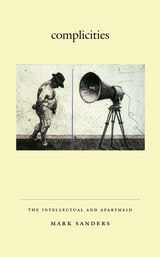
Complicities
The Intellectual and ApartheidMark Sanders
Duke University Press, 2002
Sanders gives detailed analyses of widely divergent thinkers: Afrikaner nationalist poet N. P. van Wyk Louw, Drum writer Bloke Modisane, Xhosa novelist A. C. Jordan, Afrikaner dissident Breyten Breytenbach, and Black Consciousness leader Steve Biko. Drawing on theorists including Derrida, Sartre, and Fanon, and paying particular attention to the linguistic intricacy of the literary and political texts considered, Sanders shows how complicity emerges as a predicament for intellectuals across the ideological and social spectrum. Through discussions of the colonial intellectuals Olive Schreiner and Sol T. Plaatje and of post-apartheid feminist critiques of the Truth and Reconciliation Commission, Complicities reveals how sexual difference joins with race to further complicate issues of collusion.
Complicities sheds new light on the history and literature of twentieth-century South Africa as it weighs into debates about the role of the intellectual in public life.
Composing Japanese Musical Modernity
Bonnie C. Wade
University of Chicago Press, 2013
Wade examines the short history of the composer in Japanese society, looking at the creative and economic opportunities that have sprung up around them—or that they forged—during Japan’s astonishingly fast modernization. She shows that modernist Japanese composers have not bought into the high modernist concept of the autonomous artist, instead remaining connected to the people. Articulating Japanese modernism in this way, Wade tells a larger story of international musical life, of the spaces in which tradition and modernity are able to meet and, ultimately, where modernity itself has been made.
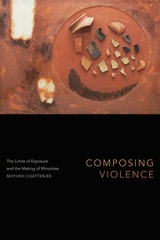
Composing Violence
The Limits of Exposure and the Making of MinoritiesMoyukh Chatterjee
Duke University Press, 2023
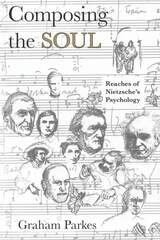
Composing the Soul
Reaches of Nietzsche's PsychologyGraham Parkes
University of Chicago Press, 1994
Composing the Soul is the first study to pay sustained attention to this pronouncement and to examine the contours of Nietzsche's psychology in the context of his life and psychological makeup. Beginning with essays from Nietzsche's youth, Graham Parkes shows the influence of such figures as Goethe, Byron, and Emerson on Nietzsche's formidable and multiple talents. Parkes goes on to chart the development of Nietzsche's psychological ideas in terms of the imagery, drawn from the dialogues of Plato as well as from Nietzsche's own quasi-mystical experiences of nature, in which he spoke of the soul. Finally, Parkes analyzes Nietzsche's most revolutionary idea—that the soul is composed of multiple "drives," or "persons," within the psyche. The task for Nietzsche's psychology, then, was to identify and order these multiple persons within the individual—to compose the soul.
Featuring all new translations of quotations from Nietzsche's writings, Composing the Soul reveals the profundity of Nietzsche's lifelong personal and intellectual struggles to come to grips with the soul. Extremely well-written, this landmark work makes Nietzsche's life and ideas accessible to any reader interested in this much misunderstood thinker.
Composition Commons
Writing a New Idea of the UniversityJessica Yood
Utah State University Press, 2024
Jessica Yood traces the century-long origins of a writing-centered idea of the American university and tracks the resurgence of this idea today. Drawing on archival and classroom evidence from public colleges and universities and written in a lively autoethnographic voice, Yood names “genres of the commons”: intimate, informal writing activities that create peer-to-peer knowledge networks. She shows how these unique genres create collectivity—an academic commons—and calls on scholars to invest in composition as a course cultivating reflective, emergent, shared knowledge. Yood departs from movements that divest from the first-year composition classroom and details how an increasingly diverse student population composes complex, evolving cultural literacies that forge social bonds and forward innovation and intellectual and civic engagement.
The Composition Commons reclaims the commons as critical idea and writing classroom activities as essential practices for remaking higher education in the United States.
Compound Dilemmas
Democracy, Collective Action, and Superpower RivalryMichael Dean McGinnis and John T. Williams
University of Michigan Press, 2001

Computer Game Worlds
Claus Pias
Diaphanes, 2017
With Computer Game Worlds, Claus Pias sets out to answer these questions. Tracing computer games from their earliest forms to the unstoppable commercial and cultural phenomena they have become today, Pias then provides a careful epistemological reconstruction of the process of playing games, both at computers and by computers themselves. The book makes a valuable theoretical contribution to the ongoing discussion about computer games.
Computers in Education
A Half-Century of InnovationRobert Smith
CSLI, 2015
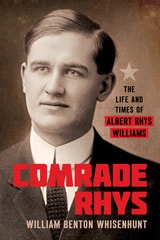
Comrade Rhys
The Life and Times of Albert Rhys WilliamsWilliam Benton Whisenhunt
University of Illinois Press, 2026
William Benton Whisenhunt draws on the largely untapped archive of Williams’s papers to provide a first-ever biography of the dedicated radical writer. Williams spent nearly ten years living and traveling in the USSR, where he observed the Soviet system and reported on it with unusual nuance in numerous books, articles, and speeches. Whisenhunt follows Williams from his early life as a lumberyard worker and preacher through his participation in the Revolution and his long career as a radical writer. Able to see socialism as flawed, Williams’s nonetheless defended it as an alternative to capitalism with such vigor that correspondents often addressed him as Comrade Rhys.
Astute and richly detailed, Comrade Rhys reveals the life and work of an overlooked radical thinker.

Comrade or Brother?
A History of the British Labour MovementMary Davis
Pluto Press, 2009
Critical and iconoclastic, Comrade or Brother? traces the history of the British Labour Movement from its beginnings at the onset of industrialisation through its development within a capitalist society, up to the end of the twentieth-century. Written by a leading activist in the labour movement, the book redresses the balance in much labour history writing. It examines the place of women and the influence of racism and sexism as well as providing a critical analysis of the rival ideologies which played a role in the uneven development of the labour movement.
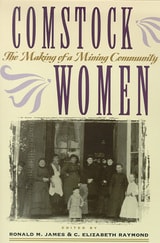
Comstock Women
The Making Of A Mining CommunityRonald M. James
University of Nevada Press, 1997
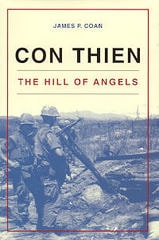
Con Thien
The Hill of AngelsJames P. Coan
University of Alabama Press, 2007
Holding the Hill of Angels: A Marine’s Fight for Survival at the DMZ.
Throughout much of 1967, a remote United States Marine firebase only two miles from the demilitarized zone (DMZ) captured the attention of the world’s media. That artillery-scarred outpost was the linchpin of the so-called McNamara Line intended to deter incursions into South Vietnam by the North Vietnamese Army. As such, the fighting along this territory was particularly intense and bloody, and the body count rose daily.
Con Thien combines James P. Coan’s personal experiences with information taken from archives, interviews with battle participants, and official documents to construct a powerful story of the daily life and combat on the red clay bulls-eye known as "The Hill of Angels." As a tank platoon leader in Alpha Company, 3d Tank Battalion, 3d Marine Division, Coan was stationed at Con Thien for eight months during his 1967-68 service in Vietnam and witnessed much of the carnage.
Con Thien was heavily bombarded by enemy artillery with impunity because it was located in politically sensitive territory and the U.S. government would not permit direct armed response from Marine tanks. Coan, like many other soldiers, began to feel as though the government was as much the enemy as the NVA, yet he continued to fight for his country with all that he had. In his riveting memoir, Coan depicts the hardships of life in the DMZ and the ineffectiveness of much of the U.S. military effort in Vietnam.

ConFiguring America
Iconic Figures, Visuality, and the American IdentityEdited by Klaus Rieser, Michael Fuchs, and Michael Phillips
Intellect Books, 2013
Conceding Composition
A Crooked History of Composition's Institutional FortunesRyan Skinnell
Utah State University Press, 2016
Based on extensive archival research conducted at six American universities and using the specific cases of institutional mission, regional accreditation, and federal funding, this study demonstrates that administrators and faculty have introduced, reformed, maintained, threatened, or eliminated composition as part of negotiations related to nondisciplinary institutional exigencies. Viewing composition from this perspective, author Ryan Skinnell raises new questions about why composition exists in the university, how it exists, and how teachers and scholars might productively reconceive first-year composition in light of its institutional functions.
The book considers the rhetorical, political, organizational, institutional, and promotional options conceding composition opened up for institutions of higher education and considers what the first-year course and the discipline might look like with composition’s transience reimagined not as a barrier but as a consummate institutional value.
Conceived in Doubt
Religion and Politics in the New American NationAmanda Porterfield
University of Chicago Press, 2012
Americans have long acknowledged a deep connection between evangelical religion and democracy in the early days of the republic. This is a widely accepted narrative that is maintained as a matter of fact and tradition—and in spite of evangelicalism’s more authoritarian and reactionary aspects.
In Conceived in Doubt, Amanda Porterfield challenges this standard interpretation of evangelicalism’s relation to democracy and describes the intertwined relationship between religion and partisan politics that emerged in the formative era of the early republic. In the 1790s, religious doubt became common in the young republic as the culture shifted from mere skepticism toward darker expressions of suspicion and fear. But by the end of that decade, Porterfield shows, economic instability, disruption of traditional forms of community, rampant ambition, and greed for land worked to undermine heady optimism about American political and religious independence. Evangelicals managed and manipulated doubt, reaching out to disenfranchised citizens as well as to those seeking political influence, blaming religious skeptics for immorality and social distress, and demanding affirmation of biblical authority as the foundation of the new American national identity.
As the fledgling nation took shape, evangelicals organized aggressively, exploiting the fissures of partisan politics by offering a coherent hierarchy in which God was king and governance righteous. By laying out this narrative, Porterfield demolishes the idea that evangelical growth in the early republic was the cheerful product of enthusiasm for democracy, and she creates for us a very different narrative of influence and ideals in the young republic.

Concentration Camps on the Home Front
Japanese Americans in the House of Jim CrowJohn Howard
University of Chicago Press, 2008
While the basic facts of Japanese-American incarceration are well known, John Howard’s extensive research gives voice to those whose stories have been forgotten or ignored. He highlights the roles of women, first-generation immigrants, and those who forcefully resisted their incarceration by speaking out against dangerous working conditions and white racism. In addition to this overlooked history of dissent, Howard also exposes the government’s aggressive campaign to Americanize the inmates and even convert them to Christianity. After the war ended, this movement culminated in the dispersal of the prisoners across the nation in a calculated effort to break up ethnic enclaves.
Howard’s re-creation of life in the camps is powerful, provocative, and disturbing. Concentration Camps on the Home Front rewrites a notorious chapter in American history—a shameful story that nonetheless speaks to the strength of human resilience in the face of even the most grievous injustices.
Concepts and the Social Order
Robert K. Merton and the Future of SociologyAndras Szigeti
Central European University Press, 2011
Conceptual Harmonies
The Origins and Relevance of Hegel’s LogicPaul Redding
University of Chicago Press, 2023
Conceptual Harmonies develops an original account of G. W. F. Hegel’s perplexing Science of Logic from a simple insight: philosophical and mathematical thought have shaped each other since classical times. Situating Science of Logic within the rise of modern mathematics, Redding stresses Hegel’s attention to Pythagorean ratios, Platonic reason, and Aristotle’s geometrically inspired logic. He then explores how later traditions shaped Hegel’s world, through both Leibniz and new forms of algebraic geometry. This enlightening reading recovers an overlooked stream in Hegel’s philosophy that remains, Redding argues, important for contemporary conceptions of logic.
Concerning Consequences
Studies in Art, Destruction, and TraumaKristine Stiles
University of Chicago Press, 2016
The essays in this book focus primarily on performance art and photography. From war and environmental pollution to racism and sexual assault, Stiles analyzes the consequences of trauma as seen in the works of artists like Marina Abramovic, Pope.L, and Chris Burden. Assembling rich intellectual explorations on everything from Paleolithic paintings to the Bible’s patriarchal legacies to documentary images of nuclear explosions, Concerning Consequences explores how art can provide a distinctive means of understanding trauma and promote individual and collective healing.
Concordance
Black Lawmaking in the U.S. Congress from Carter to ObamaKatherine Tate
University of Michigan Press, 2014
During the height of the civil rights movement, Blacks were among the most liberal Americans. Since the 1970s, however, increasing representation in national, state, and local government has brought about a more centrist outlook among Black political leaders.
Focusing on the Congressional Black Caucus (CBC), Katherine Tate studies the ways in which the nation’s most prominent group of Black legislators has developed politically. Organized in 1971, the CBC set out to increase the influence of Black legislators. Indeed, over the past four decades, they have made progress toward the goal of becoming recognized players within Congress. And yet, Tate argues, their incorporation is transforming their policy preferences. Since the Clinton Administration, CBC members—the majority of whom are Democrats—have been less willing to oppose openly congressional party leaders and both Republican and Democratic presidents. Tate documents this transformation with a statistical analysis of Black roll-call votes, using the important Poole-Rosenthal scores from 1977 to 2010. While growing partisanship has affected Congress as a whole, not just minority caucuses, Tate warns that incorporation may mute the independent voice of Black political leaders.
Concordance
Black Lawmaking in the U.S. Congress from Carter to ObamaKatherine Tate
University of Michigan Press, 2020
Focusing on the Congressional Black Caucus (CBC), Katherine Tate studies the ways in which the nation’s most prominent group of Black legislators has developed politically. Organized in 1971, the CBC set out to increase the influence of Black legislators. Indeed, over the past four decades, they have made progress toward the goal of becoming recognized players within Congress. And yet, Tate argues, their incorporation is transforming their policy preferences. Since the Clinton Administration, CBC members—the majority of whom are Democrats—have been less willing to oppose openly congressional party leaders and both Republican and Democratic presidents. Tate documents this transformation with a statistical analysis of Black roll-call votes, using the important Poole-Rosenthal scores from 1977 to 2010. While growing partisanship has affected Congress as a whole, not just minority caucuses, Tate warns that incorporation may mute the independent voice of Black political leaders.
Concrete Century
Julius Kahn and the Construction RevolutionMichael G. Smith
University of Michigan Press, 2024
Drawing upon Kahn’s personal correspondence, architectural drawings, company records, and contemporary news and journal articles, Michael G. Smith reveals how this man—whose family had immigrated to the US to escape antisemitism in Germany—played an important role in the rise of concrete. Concrete not only turned the tide against widespread destruction of buildings by fire, it also paved the way for our modern economy. Concrete Century will delight readers intrigued by architecture and construction technology alike with the true origin story of modern concrete buildings.
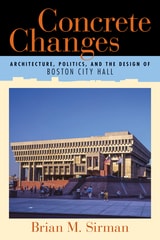
Concrete Changes
Architecture, Politics, and the Design of Boston City HallBrian M. Sirman
University of Massachusetts Press, 2018
And yet Boston City Hall frequently ranks among the country's ugliest buildings. Concrete Changes seeks to answer a common question for contemporary viewers: How did this happen? In a lively narrative filled with big personalities and newspaper accounts, Brian M. Sirman argues that this structure is more than a symbol of Boston's modernization; it acted as a catalyst for political, social, and economic change.
Concrete Colonialism
Architecture, Urbanism, and the US Imperial Project in the PhilippinesDiana Jean S. Martinez
Duke University Press, 2025