4531 books match the query 'Cultural & Ethnic Studies' and 342 start with c
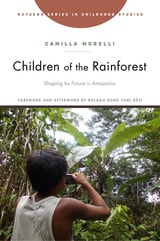
cover of Children of the Rainforest: Shaping the Future in Amazonia

Children of the Rainforest

Shaping the Future in Amazonia

Camilla Morelli

Rutgers University Press, 2023
Children of the Rainforest explores the lives of children growing up in a time of radical change in Amazonia. The book draws on ethnographic fieldwork conducted with the Matses, a group of hunter-gatherer forest dwellers who have lived in voluntary isolation until fairly recently. Having worked with them for over a decade, returning every year to their villages in the rainforest, Camilla Morelli follows closely the life-trajectories of Matses children, watching them shift away from the forest-based lifestyles of their elders and move towards new horizons crisscrossed by concrete paving, lit by the glow of electric lights and television screens, and centered around urban practices and people. The book uses drawings and photographs taken by the children themselves to trace the children’s journeys—lived and imagined—from their own perspectives, proposing an ethnographic analysis that recognizes children’s imaginations, play, and shifting desires as powerful catalysts of social change.
[more]
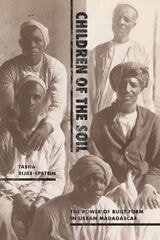
cover of Children of the Soil: The Power of Built Form in Urban Madagascar

Children of the Soil

The Power of Built Form in Urban Madagascar

Tasha Rijke-Epstein

Duke University Press, 2023
In Children of the Soil, Tasha Rijke-Epstein offers an urban history of the port city of Mahajanga, Madagascar, before, during, and after colonization. Drawing on archival and ethnographic evidence, she weaves together the lives and afterlives of built spaces to show how city residents negotiated imperial encroachment, colonial rule, and global racial capitalism over two centuries. From Mahajanga’s hilltop palace to the alluvial depths of its cesspools, the city’s spaces were domains for ideological debates between rulers and subjects, French colonizers and indigenous Malagasy peoples, and Comorian migrants and Indian traders. In these spaces, Mahajanga’s residents expressed competing moral theories about power over people and the land. The built world was also where varying populations reckoned with human, ancestral, and ecological pasts and laid present and future claims to urban belonging. Migrants from nearby Comoros harnessed built forms as anticipatory devices through which they sought to build their presence into the landscape and transform themselves from outsiders into "children of the soil" (zanatany). In tracing the centrality of Mahajanga’s architecture to everyday life, Rijke-Epstein offers new ways to understand the relationships between the material world, the more-than-human realm, and the making of urban life.
[more]
cover of China Pop!: Pop Culture, Propaganda, Pacific Pop-Ups

China Pop!

Pop Culture, Propaganda, Pacific Pop-Ups

Sheng-mei Ma

The Ohio State University Press, 2024

In China Pop! Sheng-mei Ma analyzes the propaganda-laced millennial Chinese pop culture—particularly TV dramas, films, and web novels—that streams online for over one billion Sinophone consumers in China and in diaspora. In part 1, Ma lays bare the “seductive art of propaganda” by reviewing TV series aired during the Chinese Communist Party Centennial in 2021 and the ways pop culture and propaganda are spliced. In part 2, he zeroes in on how the shared traumatic shock of the Cultural Revolution continues to echo. Parts 3 and 4 cross the Pacific to incorporate analysis of media originating outside of China, such as white depictions of revolutionary zeal and Asian American portrayals of immigrant characters that fetishize Asianness and reanimate stereotypes.

With methodological daring, Ma challenges existing scholarship by blending the professional and the personal through a lively and accessible autotheoretical approach. China Pop! walks the East-West cultural tightrope to critique a wide range of pop culture from both sides of the Pacific and sheds new light on the workings of propaganda on its intended audiences and its wider, more subtle reaches in both political and cultural spheres.
[more]
cover of China's Economic Development: The Interplay of Scarcity and Ideology

China's Economic Development

The Interplay of Scarcity and Ideology

Alexander Eckstein

University of Michigan Press, 1975

China's Economic Development: The Interplay of Scarcity and Ideology by Alexander Eckstein provides a comprehensive analysis of China's economic growth and transformation from a socialist economy. Eckstein examines the unique challenges China faced in addressing its economic backwardness, such as scarcity of resources and ideological constraints, and compares its industrialization to other countries. The book explores how Maoist ideology and policy initiatives impacted the country's economic strategies, leading to a fluctuating development pattern characterized by rapid expansion in the 1950s and stagnation in the 1960s. Key themes include the dichotomy between scarcity and ideology, the influence of historical factors on economic structures, and the adaptation to Soviet models. Eckstein sheds light on how China navigated its unique size, population pressures, and low per capita income, arguing that understanding these dynamics is crucial for both development theory and policy design. This volume, part of the Michigan Studies on China series, compiles essays and research that contribute to a nuanced understanding of China's economic systems, with particular focus on the tensions between ideological aspirations and economic realities.
[more]
cover of China's Environment and China's Environment Journalists: A Study

China's Environment and China's Environment Journalists

A Study

Hugo de Burgh and Zeng Rong

Intellect Books, 2012
Environmental issues are of growing concern in China, with numerous initiatives aimed at encouraging dialogue and increasing awareness. And key to these initiatives is the environmental journalist. The first English-language study of this burgeoning field, this book investigates Chinese environmental journalists—their methodologies, their attitudes toward the environment, and their views on the significance of their work—and concludes that most respond enthusiastically to government promptings to report on the environment and climate change. Additional chapters demonstrate journalists’ impact in helping to shape governmental decision making.
[more]
cover of China's Left-Behind Children: Caretaking, Parenting, and Struggles

China's Left-Behind Children

Caretaking, Parenting, and Struggles

Xiaojin Chen

Rutgers University Press, 2024
One unintended consequence of the unprecedented rural-to-urban migration in China over the past three decades is the exponentially increased number of "left-behind" children—children whose parents migrated to more developed areas and who live with one parent or other extended family members. The daily lives of these children, including their caretaking arrangements, parent-child bonding and communication, and schooling, are fraught with distractions and uncertainties. Paying special attention to this marginalized group, this book investigates the role of parental migration and the left-behind status in shaping Chinese family dynamics and children’s general wellbeing, including their school performance, delinquency, resilience, feelings of ambiguous loss, and other psychological problems. Blending theory, empirical research, and real-world interviews with left-behind children, China's Left-Behind Children provides a uniquely close look at these children's lives while also providing the larger national context that defines and shapes their everyday lives.    
 
[more]
cover of China's Participation in the IMF, the World Bank, and GATT: Toward a Global Economic Order

China's Participation in the IMF, the World Bank, and GATT

Toward a Global Economic Order

Harold K. Jacobson and Michel Oksenberg

University of Michigan Press, 1990
Harold K. Jacobson and Michel Oksenberg bring their considerable knowledge of, respectively, international agencies and China to this study of the evolving relationship between the People’s Republic of China and the keystone international economic organizations (KIEQs): the International Monetary Fund, the World Bank and its affiliated agencies, and the General Agreement on Tariffs and Trade (GATT).Until the early 1970s China was hostile toward the KIEOs, seeing them as instruments of capitalist exploitation. The change in that position, and the ensuing rapprochement between the two sides culminating in the negotiations and Chinese membership in the KEIOs, is an important subject. It is made immeasurably more significant by the extraordinary potential of China in the world economy. The different perspectives of the two authors permits this process to be analyzed from the point of view of both sides and to be informed by discussions and interviews with senior officers of the KIEOs and high Chinese officials.Among the questions addressed are: How and why did such a sharp change in the relationship between China and the KIEOs occur? What accounts for the Chinese decision to seek inclusion in the KIEOs? How did the KIEOs, and their most important members, the Western states, come to welcome China’s inclusion? What have the consequences of China’s involvement in the IMF and World Bank been for the two institutions and for China? What are the issues involved in China’s request for entrance in the KIEOs and full participation in the GATT? How will China’s involvement in the KIEOs affect the USSR’s involvement?Although the book deals with issues and events that predate the June, 1989, events in Tiananmen Square, the authors completed their manuscript after those events. They endeavor to interpret their observations in the light of the changed situation in China and the clear evidence that China has not yet settled into easy international participation with the Western states.
[more]
cover of China's Transition to Industrialism: Producer Goods and Economic Development in the Twentieth Century

China's Transition to Industrialism

Producer Goods and Economic Development in the Twentieth Century

Thomas G. Rawski

University of Michigan Press, 1980
China's Transition to Industrialism studies the history and development of a group of industries which have played key roles in China's recent economic gains. Drawing on a wide range of materials, the author focuses on engineering, chemicals, and allied producer industries, showing how the growth of these sectors sparked a dynamic process of development which has spread to encompass the entire Chinese economy. Rawski traces this industrialization process to three distinct sources: vigorous prewar development in the private sector, which created a nucleus of experienced producers in Shanghai and other urban centers; the resource mobilization efforts of the post-1949 Communist government; and a series of economic reforms which relaxed the performance constraints found in other socialist economies and stimulated a burst of innovative activity which has propelled China's economy from the depression of the early 1960s to a record of economic achievement unmatched among the large nations of the developing world.
[more]
cover of China's Trial by Fire: The Shanghai War of 1932

China's Trial by Fire

The Shanghai War of 1932

Donald A. Jordan

University of Michigan Press, 2001

China's Trial by Firepresents the balanced history of how, ten years before Pearl Harbor, Japan tested modern China in a thirty-three-day war, now known as the Shanghai War of1932. Often obscured by the larger World War II, this history details how the Chinese fought from trenches against Japan's modern bombers and navy, and formed a defense that brought the country together for the first time.
Unlike other histories' brief generalizations of the incident, this study traces the war from the initial January 28th Japanese marine raid on Chinese Shanghai. It also studies the roles played by the prevailing Japanese leaders, including the last prewar civilian Prime Minister, Emperor Hirohito, and Admiral Nomura, who was later assigned to pre-Pearl Harbor negotiations.
Not least, the work bridges scholarly boundaries by highlighting the economics of China's leading trade metropolis, Shanghai; the desperate attempts of Chinese politicians and press to manipulate anti-imperialist and anti-Japanese propaganda; and the ways in which the failure of positional trench warfare against Japanese mechanized mobility provided lessons to German observers and the Communists.
Donald Jordan has drawn from as complete a range of primary sources as are available. Both the Nanking and Taipei archives, as well as resources from Tokyo, Settlement Shanghai's police records, Washington, the League of Nations, and London were researched.
Knowing how greatly the Nationalist defense in 1932 influenced the Chinese Communists expands the relevance for scholars of this illustrated study. Others, especially those curious about the U. S. entanglement leading to Pearl Harbor, will find much more than the story of a regional skirmish.
Donald Jordan is Professor of East Asian History, Ohio University.
[more]
cover of China: Adapting the Past, Confronting the Future

China

Adapting the Past, Confronting the Future

Thomas Buoye, Kirk Denton, Bruce Dickson, Barry Naughton, and Martin K. Whyte, Editors

University of Michigan Press, 2002
Completely updated, China: Adapting the Past, Confronting the Future is the latest in a series of classroom units on China from the Center of Chinese Studies at The University of Michigan. It is not only ideal for courses on contemporary China but also an excellent supplement for courses in area studies, international affairs and economics, and women's studies.
Each section, in addition to essay and excerpts, also includes a bibliography of additional topical works as well as suggestions for complementary video and internet teaching resources.
Geography and History: Presents a broad sketch of Chinese history from earliest times and a detailed discussion of the forces that have shaped modern Chinese history. Geography sharpens the focus to China’s rich ecological and ethnic diversity.
Politics: Addresses political issues in post-Tiananmen China, including corruption, human rights, US-China relations, democratic reform, and religious and political dissidents.
Society: Examines contemporary social problems that have emerged in the post-Mao era, including divorce, migrant labor, family planning, problems facing Chinese women, and the proliferation of Chinese and Western religions.
Economy: Assesses the post-Mao economy after twenty years of experimentation and reform, including development of private enterprises, income disparities, case studies in rural and urban economic development, and the prospects for future growth.
Culture: Reviews 20th century Chinese literature, the intersection between politics and the arts, the explosion of popular culture, and changing visual culture in modern China.
Future Trends: Explores the prospects for democratization, generational change in leadership, the direction of modernization, and China’s prospects for political liberalization.
[more]
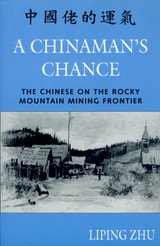
cover of Chinaman's Chance: The Chinese on the Rocky Mountain Mining Frontier

Chinaman's Chance

The Chinese on the Rocky Mountain Mining Frontier

Liping Zhu

University Press of Colorado, 2000

Writers and historians have traditionally portrayed Chinese immigrants in the nineteenth-century American West as victims. By investigating the early history of Idaho's Boise Basin, Liping Zhu challenges this image and offers an alternative discourse to the study of this ethnic minority.Between 1863 and 1910, a large number of Chinese immigrants resided in the Boise Basin to search for gold. As in many Rocky Mountain mining camps, they comprised a majority of the population. Unlike settlers in many other boom-and-bust western mining towns, the Chinese in the Boise Basin managed to stay there for more than half a century.

Thus, the Chinese portrayed all the stereotypical frontier roles-victors, victims, and villains. Their basic material needs were guaranteed, and many individuals were able to climb up the economic ladder. Frontier justice was used to settle disputes; Chinese-Americans frequently challenged white opponents in the various courts as well as in gun battles.

Interesting and provocative, A Chinaman's Chance not only offers general readers a narrative account of the Rocky Mountain mining frontier, but also introduces a fresh interpretation of the Chinese experience in nineteenth-century America to scholars interested in Asian American studies, immigration history, and ethnicity in the American West.
[more]
cover of Chinatown Family

Chinatown Family

Yutang, Lin

Rutgers University Press, 2006

Lin Yutang (1895–1976), author of more than thirty-five books, was arguably the most distinguished Chinese American writer of the twentieth century. In Chinatown Family, he brings humor and wisdom to issues of culture, race, and religion as he tells the engrossing and heart-warming story of an immigrant, working-class Chinese American family that settled in New York City during the 1930s and 1940s. Tracing their sometimes troubled and sometimes rewarding journey, Lin paints a vivid portrait of the wonder and the woe of settling into a new land. In an era when interracial marriages were frowned upon and it was forbidden for working-class Chinese men to bring their families to America, this story shows how one family struggled to become new Americans by applying their Taoist philosophy to resist peacefully the discriminatory laws and racism they encountered.

Beyond the quest for acceptance and economic success, Chinatown Family also probes deep into the heart of the immigration experience by presenting the perils of assimilation. The burgeoning tensionbetween the desire for material wealth and the traditional Chinese belief in the primary importance of family poses the question: Is it possible to attain the American dream without damaging these primary ties? For each family member, the answer to this question turns out to be different. Through the varied paths that each character takes, the novel dramatizes the ways that Chinese immigrants have negotiated between the competing interests of economic opportunity and traditional values.
[more]
cover of Chinatown Film Culture: The Appearance of Cinema in San Francisco’s Chinese Neighborhood

Chinatown Film Culture

The Appearance of Cinema in San Francisco’s Chinese Neighborhood

Kim K. Fahlstedt

Rutgers University Press, 2020
Chinatown Film Culture provides the first comprehensive account of the emergence of film and moviegoing in the transpacific hub of San Francisco in the early twentieth century. Working with materials previously left in the margins of grand narratives of history, Kim K. Fahlstedt uncovers the complexity of a local entertainment culture that offered spaces where marginalized Chinese Americans experienced and participated in local iterations of modernity. At the same time, this space also fostered a powerful Orientalist aesthetic that would eventually be exported to Hollywood by San Francisco showmen such as Sid Grauman. Instead of primarily focusing on the screen-spectator relationship, Fahlstedt suggests that immigrant audiences' role in the proliferation of cinema as public entertainment in the United States saturated the whole moviegoing experience, from outside on the street to inside the movie theater. By highlighting San Francisco and Chinatown as featured participants rather than bit players, Chinatown Film Culture provides an historical account from the margins, alternative to the more dominant narratives of U.S. film history.
[more]
cover of Chinatown Opera Theater in North America

Chinatown Opera Theater in North America

Nancy Yunhwa Rao

University of Illinois Press, 2017

Awards: 
Irving Lowens Award, Society for American Music (SAM), 2019
Music in American Culture Award, American Musicological Society (AMS), 2018
Certificate of Merit for Best Historical Research in Recorded Country, Folk, Roots, or World Music, Association for Recorded Sound Collections (ARSC), 2018
Outstanding Achievement in Humanities and Cultural Studies: Media, Visual, and Performance Studies, Association for Asian American Studies (AAAS), 2019

The Chinatown opera house provided Chinese immigrants with an essential source of entertainment during the pre–World War II era. But its stories of loyalty, obligation, passion, and duty also attracted diverse patrons into Chinese American communities

Drawing on a wealth of new Chinese- and English-language research, Nancy Yunhwa Rao tells the story of iconic theater companies and the networks and migrations that made Chinese opera a part of North American cultures. Rao unmasks a backstage world of performers, performance, and repertoire and sets readers in the spellbound audiences beyond the footlights. But she also braids a captivating and complex history from elements outside the opera house walls: the impact of government immigration policy; how a theater influenced a Chinatown's sense of cultural self; the dissemination of Chinese opera music via recording and print materials; and the role of Chinese American business in sustaining theatrical institutions. The result is a work that strips the veneer of exoticism from Chinese opera, placing it firmly within the bounds of American music and a profoundly American experience.
[more]
cover of Chinatown: The Socioeconomic Potential of an Urban Enclave

Chinatown

The Socioeconomic Potential of an Urban Enclave

Min Zhou, foreword by Alejandro Portes

Temple University Press, 1995

Min Zhou examines how an ethnic enclave works to direct its members into American society, while at the same time shielding them from it. Focusing specifically on New York's Chinatown, a community established more than a century ago, Zhou offers a thorough and modern treatment of the enclave as a socioeconomic system, distinct form, but intrinsically linked with, the larger society.

Zhou's central theme is that Chinatown does not keep immigrant Chinese from assimilating into mainstream society, but instead provides an alternative means of incorporation into society that does not conflict with cultural distinctiveness. Concentrating on the past two decades, Zhou maintains that community networks and social capital are important resources for reaching socioeconomic goals and social positions in the United States; in Chinatown, ethnic employers use family ties and ethnic resources to advance socially. Relying on her family's networks in New York's Chinatown and her fluency in both Cantonese and Mandarin, the author, who was born in the People's Republic of China, makes extensive use of personal interviews to present a rich picture of the daily work life in the community. She demonstrates that for many immigrants, low-paid menial jobs provide by the enclave are expected as a part of the time-honored path to upward social mobility of the family.


In the series Conflicts in Urban and Regional Development, edited by John R. Logan and Todd Swanstrom.
[more]
cover of China’s Allocation of Fixed Capital Investment, 1952–1957

China’s Allocation of Fixed Capital Investment, 1952–1957

Cheng Chu-yuan

University of Michigan Press, 1974
China’s efforts to stimulate industrial development and economic growth through the allocation of investments are analyzed. Cheng concludes with an overall assessment of the distinctive features of the allocation pattern. Includes 41 statistical tables.
[more]
cover of China’s Revolutions and Intergenerational Relations

China’s Revolutions and Intergenerational Relations

Martin K. Whyte, Editor

University of Michigan Press, 2003
China’s Revolutions and Intergenerational Relations counters the widely accepted notion that traditional family patterns are weakened by forces such as economic development and social revolutions. China has experienced wrenching changes on both the economic and the political fronts, yet from the evidence presented here the tradition of filial respect and support for aging parents remains alive and well.
Using collaborative surveys carried out in 1994 in the middle-sized industrial city of Baoding and comparative data from urban Taiwan, the authors examine issues shaping the relationships between adult Chinese children and their elderly parents. The continued vitality of intergenerational support and filial obligations in these samples is not simply an instance of strong Confucian tradition trumping powerful forces of change. Instead, and somewhat paradoxically, the continued strength of filial obligations can be attributed largely to the institutions of Chinese socialism forged in the era of Mao Zedong. With socialist institutions now under assault in the People’s Republic of China, the future of intergenerational relations in the twenty-first century is once again uncertain.
[more]
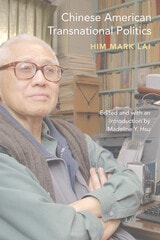
cover of Chinese American Transnational Politics

Chinese American Transnational Politics

Him Mark Lai, Edited and with an Introduction by Madeline Y. Hsu

University of Illinois Press, 2010

Born and raised in San Francisco, Lai was trained as an engineer but blazed a trail in the field of Asian American studies. Long before the field had any academic standing, he amassed an unparalleled body of source material on Chinese America and drew on his own transnational heritage and Chinese patriotism to explore the global Chinese experience.

In Chinese American Transnational Politics, Lai traces the shadowy history of Chinese leftism and the role of the Kuomintang of China in influencing affairs in America. With precision and insight, Lai penetrates the overly politicized portrayals of a history shaped by global alliances and enmities and the hard intolerance of the Cold War era. The result is a nuanced and singular account of how Chinese politics, migration to the United States, and Sino-U.S. relations were shaped by Chinese and Chinese American groups and organizations.

Lai revised and expanded his writings over more than thirty years as changing political climates allowed for greater acceptance of leftist activities and access to previously confidential documents. Drawing on Chinese- and English-language sources and echoing the strong loyalties and mobility of the activists and idealists he depicts, Lai delivers the most comprehensive treatment of Chinese transnational politics to date.
[more]
cover of Chinese American Transnationalism: The Flow of People, Resources

Chinese American Transnationalism

The Flow of People, Resources

Sucheng Chan

Temple University Press, 2005
Chinese American Transnationalism considers the many ways in which Chinese living in the United States during the exclusion era maintained ties with China through a constant interchange of people and economic resources, as well as political and cultural ideas. This book continues the exploration of the exclusion era begun in two previous volumes: Entry Denied, which examines the strategies that Chinese Americans used to protest, undermine, and circumvent the exclusion laws; and Claiming America, which traces the development of Chinese American ethnic identities. Taken together, the three volumes underscore the complexities of the Chinese immigrant experience and the ways in which its contexts changed over the sixty-one year period.
[more]
cover of Chinese Americans and the Politics of Race and Culture

Chinese Americans and the Politics of Race and Culture

Sucheng Chan

Temple University Press, 2008

Sucheng Chan introduces this valuable new anthology with a commanding discussion of the field of Chinese American studies, in which she examines its history and points the way ahead. Here she and Madeline Y. Hsu have brought together leading-edge scholarship from a new generation of thinkers, as useful for scholars as it is for undergraduate readers.

The contributors address a broad range of issues, from the activism of left-wing and Communist Chinese immigrants to the U.S. in the 1920s and early 1930s and humanitarian relief during the Sino-Japanese War to the construction of new Chinese regional identities in New York.
[more]
cover of Chinese Americans in the Heartland: Migration, Work, and Community

Chinese Americans in the Heartland

Migration, Work, and Community

Huping Ling

Rutgers University Press, 2022
The term “Heartland” in American cultural context conventionally tends to provoke imageries of corn-fields, flat landscape, hog farms, and rural communities, along with ideas of conservatism, homogeneity, and isolation. But as the Midwestern and Southern states experienced more rapid population growth than that in California, Hawaii, and New York in the recent decades, the Heartland region has emerged as a growing interest of Asian American studies. Focused on the Heartland cities of Chicago, Illinois and St. Louis, Missouri, this book draws rich evidences from various government records, personal stories and interviews, and media reports, and sheds light on the commonalities and uniqueness of the region, as compared to the Asian American communities on the East and West Coast and Hawaii. Some of the poignant stories such as “the Three Moy Brothers,” “Alla Lee,” and “Save Sam Wah Laundry” told in the book are powerful reflections of Asian American history.
 
[more]
cover of Chinese Boycotts versus Japanese Bombs: The Failure of China's "Revolutionary Diplomacy," 1931-32

Chinese Boycotts versus Japanese Bombs

The Failure of China's "Revolutionary Diplomacy," 1931-32

Donald A. Jordan

University of Michigan Press, 1991
Chinese Boycotts versus Japanese Bombs highlights economic competition as a key to understanding how China and Japan, leading trade partners, slipped toward war in the early 1930s. It describes and evaluates the Nationalist Chinese government's “Revolutionary Diplomacy” — its own brand of foreign policy toward Japan in 1931-32. This approach, which utilized popular boycotts, strikes, and demonstrations, was both innovative and a reflection of Chinas profound anger toward Japan, brought about by the desperation of Chinese industrialists in the face of the efficiency of Japanese producers. Although the anti-Japanese acts failed to break Japanese economic dominion and halt Japanese aggression in Manchuria, the sanctions enticed the United States and England to enter the Chinese market and led them into the role of codefenders against Japan. Battered by the Chinese boycott, Japanese businesses demanded military intervention. In addition, internal domestic strife in China tempted the Japanese military into seizing Manchuria and making an attack on Shanghai in 1932, thus dashing any hope for a peaceable relationship between Japan and China. These events set the stage for what was to become the Asian arena of World War Il.
[more]
cover of Chinese Communist Materials at the Bureau of Investigation Archives, Taiwan

Chinese Communist Materials at the Bureau of Investigation Archives, Taiwan

Peter Donovan, Carl E. Dorris, and Lawrence R. Sullivan

University of Michigan Press, 1976
During the long years of civil strife in China the Nationalist authorities amassed extensive materials on their Communist adversaries. Now stored in government institutions on Taiwan, these materials are an excellent source for the study of the Chinese Communist movement. Among them is the Bureau of Investigation Collection (BIC), which holds over 300,000 volumes of primary documents on the Chinese Communist movement.
The purpose of Chinese Communist Materials is, without any attempt at comprehensive listing of the Bureau’s holdings, to give scholars a representative description of the collection, to point out its implications for research, and suggest new areas for research at the Bureau in the fields of political science and history [1, 4].
[more]
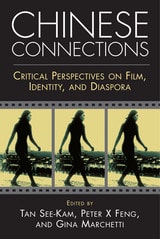
cover of Chinese Connections: Critical Perspectives on Film, Identity, and Diaspora

Chinese Connections

Critical Perspectives on Film, Identity, and Diaspora

Gina Marchetti

Temple University Press, 2009

Chinese Connections is a valuable new anthology that provides a prismatic look at the cross-fertilization between Chinese film and global popular culture. Leading film scholars consider the influence of world cinema on China-related and Chinese-related cinema over the last five decades. Highlighting the neglected connections between Chinese films and American and European cinema, the editors and contributors examine popular works such as Ang Lee’s The Hulk and Olivier Assayas’ Irma Vep to show the nexus of international film production and how national, political, social and sexual identities are represented in the Chinese diaspora.

With talent flowing back and forth between East and West, Chinese Connections explores how issues of immigration, class, race and economic displacement are viewed on a global level, ultimately providing a greater understanding of the impact of Chinese filmmaking at home and abroad.

Contributors include: Grace An, Aaron Anderson, Chris Berry, Evans Chan, Li-Mei Chang, Frances Gateward, Andrew Grossman, Peter Hitchcock, Chuck Kleinhans, Jenny Kwok Wah Lau, Helen Leung, Aaron Magnan-Park, Gayle Wald, Esther C.M. Yau, Emilie Yueh-yu Yeh, Xuelin Zhou and the editors.
[more]
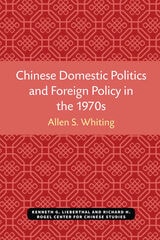
cover of Chinese Domestic Politics and Foreign Policy in the 1970s

Chinese Domestic Politics and Foreign Policy in the 1970s

Allen S. Whiting

University of Michigan Press, 1979
Chinese Domestic Politics and Foreign Policy in the 1970s undertakes a systematic examination of selected aspects of Peking’s foreign policy, using content analysis, both quantitative and qualitative, of the media. The first study treats media images of the United States and Taiwan in 1976–77; the second analyzes domestic politics and foreign trade, 1971–1976. [1, 2]
[more]
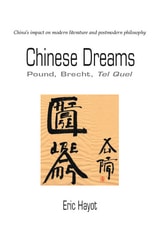
cover of Chinese Dreams: Pound, Brecht, Tel Quel

Chinese Dreams

Pound, Brecht, Tel Quel

Eric Hayot

University of Michigan Press, 2011

China’s profound influence on the avant-garde in the 20th century was nowhere more apparent than in the work of Ezra Pound, Bertolt Brecht, and the writers associated with the Parisian literary journal Tel quel. Chinese Dreams explores the complex, intricate relationship between various “Chinas”—as texts—and the nation/culture known simply as “China”—their context—within the work of these writers. Eric Hayot calls into question the very means of representing otherness in the history of the West and ultimately asks if it might be possible to attend to the political meaning of imagining the other, while still enjoying the pleasures and possibilities of such dreaming. The latest edition of this critically acclaimed book includes a new preface by the author.

“Lucid and accessible . . . an important contribution to the field of East-West comparative studies, Asian studies, and modernism.”
—Comparative Literature Studies

“Instead of trying to decipher the indecipherable ‘China’ in Western literary texts and critical discourses, Hayot chose to show us why and how ‘China’ has remained, and will probably always be, an enchanting, ever-elusive dream. His approach is nuanced and refreshing, his analysis rigorous and illuminating.”
—Michelle Yeh, University of California, Davis
[more]
[more]
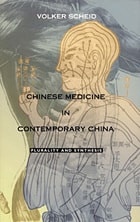
cover of Chinese Medicine in Contemporary China: Plurality and Synthesis

Chinese Medicine in Contemporary China

Plurality and Synthesis

Volker Scheid

Duke University Press, 2002

As a traditional healing art that has established a contemporary global presence, Chinese medicine defies categories and raises many interesting questions. If Chinese medicine is "traditional," why has it not disappeared with the rest of traditional Chinese society? If, as some claim, it is a science, what does that imply about what we call science? What is the secret of Chinese medicine's remarkable adaptability that has allowed it to prosper for more than 2,000 years? In Chinese Medicine in Contemporary China Volker Scheid presents an ethnography of Chinese medicine that seeks to answer these questions, but his ethnography is informed by some atypical approaches.

Scheid, a medical anthropologist and practitioner of Chinese medicine in practice since 1983, has produced an ethnography that accepts plurality as an intrinsic and nonreducible aspect of medical practice. It has been widely noted that a patient visiting ten different practitioners of Chinese medicine may receive ten different prescriptions for the same complaint, yet many of these various treatments may be effective. In attempting to illuminate the plurality in Chinese medical practice, Scheid redefines-and in some cases abandons-traditional anthropological concepts such as tradition, culture, and practice in favor of approaches from disciplines such as science and technology studies, social psychology, and Chinese philosophy. As a result, his book sheds light not only on Chinese medicine but also on the Western academic traditions used to examine it and presents us with new perspectives from which to deliberate the future of Chinese medicine in a global context.
Chinese Medicine in Contemporary China is the product of two decades of research including numerous interviews and case studies. It will appeal to a western academic audience as well as practitioners of Chinese medicine and other interested medical professionals, including those from western biomedicine.
[more]
cover of Chinese Paintings in Chinese Publications, 1956–1968: An Annotated Bibliography and Index to the Paintings

Chinese Paintings in Chinese Publications, 1956–1968

An Annotated Bibliography and Index to the Paintings

Ellen Johnston Laing

University of Michigan Press, 1969
This bibliography includes publications issued between 1956 and August 1968 that reproduce Chinese paintings now in Chinese public or private collections. The great majority of these publications were produced in Mainland China, Taiwan, Hong Kong, or Japan. Each publication included in the bibliography has been provided with a detailed physical description of the publication itself: the amounts of text , the number of plates in color and in monochrome, and a general evaluation of the quality of the reproductions. The title by which each work is referred to in the index is included at the end of each entry.
[more]
cover of Chinese Reportage: The Aesthetics of Historical Experience

Chinese Reportage

The Aesthetics of Historical Experience

Charles A. Laughlin

Duke University Press, 2002

Chinese Reportage details for the first time in English the creation and evolution of a distinctive literary genre in twentieth-century China. Reportage literature, while sharing traditional journalism’s commitment to the accurate, nonfictional portrayal of experience, was largely produced by authors outside the official news media. In identifying the literary merit of this genre and establishing its significance in China’s leftist cultural legacy, Charles A. Laughlin reveals important biases that impede Western understanding of China and, at the same time, supplies an essential chapter in Chinese cultural history.

Laughlin traces the roots of reportage (or baogao wenxue) to the travel literature of the Qing Dynasty but shows that its flourishing was part of the growth of Chinese communism in the twentieth century. In a modern Asian context critical of capitalism and imperialism, reportage offered the promise of radicalizing writers through a new method of literary practice and the hope that this kind of writing could in turn contribute to social revolution and China’s national self-realization. Chinese Reportage explores the wide range of social engagement depicted in this literature: witnessing historic events unfolding on city streets; experiencing brutal working conditions in 1930s Shanghai factories; struggling in the battlefields and trenches of the war of resistance against Japan, the civil war, and the Korean war; and participating in revolutionary rural, social, and economic transformation. Laughlin’s close readings emphasize the literary construction of social space over that of character and narrative structure, a method that brings out the critique of individualism and humanism underlying the genre’s aesthetics.

Chinese Reportage recaptures a critical aspect of leftist culture in China with far-reaching implications for historians and sociologists as well as literary scholars.
[more]
cover of Chinese St Louis: From Enclave To Cultural Community

Chinese St Louis

From Enclave To Cultural Community

Huping Ling

Temple University Press, 2004
Chinese St. Louis offers the first empirical study of a Midwestern Chinese American community from its nineteenth-century origins to the present. As in many cities, Chinese newcomers were soon segregated in an enclave; in St. Louis the enclave was called "Hop Alley." Huping Ling shows how, over time, the community grew and dispersed until it was no longer marked by physical boundaries. She argues that the St. Louis experience departs from the standard models of Chinese settlement in urban areas, which are based on studies of coastal cities. Developing the concept of a cultural community, Ling shows how Chinese Americans in St. Louis have formed and maintained cultural institutions and organizations for social and political purposes throughout the city, which serve as the community's infrastructure. Thus the history of Chinese Americans in St. Louis more closely parallels that of other urban ethnic groups and offers new insight into the range of adaptation and assimilation experience in the United States.
[more]
cover of Chinese Theories of Literary Creation: A Historical and Critical Introduction

Chinese Theories of Literary Creation

A Historical and Critical Introduction

Zong-qi Cai, issue editor

Duke University Press, 2024
This supplement to volume 20 of Prism is the first installment of a four-part project, with roughly concurrent publication in Chinese and English. The works in this project, which include Chinese monographs by Prism’s editor Zong-qi Cai, cover Chinese theories of literature, literary creation, interpretation, and aesthetic judgment. This supplement, specifically, covers topics that include the inadequate presence of China’s literary theory and literary creation in English-language scholarship; an analytical and analytical-reconstructive approach to Six Dynasties comprehensive theories that pieces together isolated comments made by multiple authors over different times into a “theoretic collage” the philosophical foundations laid by pre-Qin and Han-Wei thinkers for the subsequent rise of literary creation the burgeoning impact of Buddhist thought on the theory of artistic creation; and a reflection on and comparison of the distinctive features of major Chinese theories of literary creation to their Western counterparts.
[more]
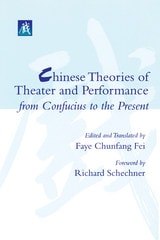
cover of Chinese Theories of Theater and Performance from Confucius to the Present

Chinese Theories of Theater and Performance from Confucius to the Present

Edited and Translated by Faye Chunfang Fei

University of Michigan Press, 2002

Through the writings of noted Chinese philosophers, scholars, artists, and critics from the time of Confucius to the present, this rich compendium provides a fascinating guided tour of China's evolving conceptions of theater and performance. The book's more than sixty selections are arranged chronologically to provide a historical overview of four major periods: antiquity to the Song dynasty (fourth century B.C.E.-1279 C.E.); the Yuan dynasty (1271-1368) and Ming dynasty (1368-1644); the Qing dynasty (1644-1911); and the rest of the twentieth century.
The writings collected here treat the origins, aesthetic principles, and functions of theater. Some are virtual manuals on playwriting and performance techniques; some describe the practices, conditions, and government policies concerning theatrical performance. Many of the selections forcefully dispute the myth that Chinese theater is valuable in performance but lacking in literature--the fact is that there is an equal, if not more prominent, emphasis on theme and content. What emerges from the writings in Chinese Theories of Theater and Performance from Confucius to the Present is a highly evolved and sophisticated aesthetic.
The texts are enhanced by Faye C. Fei's extensive introductions and annotative notes that provide essential background and contextual information. She has provided accurate and engagingly written translations of the texts, making the majority of them available in English for the first time. The anthology will appeal to teachers and students of theater and performance, artists interested in Chinese theater and arts, and scholars and historians of Asia. Literary critics, aestheticians, philosophers, and social scientists will also find the volume of interest, since Chinese conceptions of the theater and performance are closely connected to China's general outlook on the humanities.
Faye C. Fei is Assistant Professor of Dramatic Arts, Macalester College.
[more]
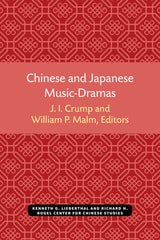
cover of Chinese and Japanese Music-Dramas

Chinese and Japanese Music-Dramas

J. I. Crump and William P. Malm, Editors

University of Michigan Press, 1975
Chinese and Japanese Music-Dramas is the result of a conference on the relations between Chinese and Japanese music-drama held at the University of Michigan, Ann Arbor, on October 1–4, 1971. In addition to the Association for Asian Studies, four U-M departments participated in the conference: the Center for Japanese Studies, the Center for Chinese Studies, the School of Music, and the Speech Department. One important inspiration for the creation of such an interdisciplinary conference was the fact that each participant had found, after years of individual research on music-drama in East Asia, consistent frustration caused by attempts to deal on their own with multiple cultural and technical problems. Another motivating force was an awareness among many members of the four disciplines involved that the topic is in fact one of the largest untouched fields of scholarly endeavor in both Asian and theatrical studies.
The collection opens with J. I. Crump’s exploration of the Ming commentators who began to subject Yüan musical drama to the same critiques as other literature from the past. In the second chapter, Rulan Chao Pian looks to the structure of arias in Peking Opera for clues about what distinguishes this art form. William P. Malm turns to three key sources for the performance conventions of Japanese Noh drama to glean any Sino-Japanese music relationships that exist in technical terms and practices. In the fourth essay, Carl Sesar analyzes a Noh play that stages the tension between Chinese influence and Japanese originality. Roy E Teele concludes the volume with a formal study of Noh play structure to assess lineages of influence from Chinese dramatic forms. After each contribution, the editors print a transcript of the conference participants’ discussion of that paper, providing the reader with a detailed and nuanced view of how the contributors understood and responded to each other’s work.
[more]
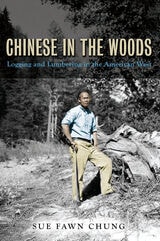
cover of Chinese in the Woods: Logging and Lumbering in the American West

Chinese in the Woods

Logging and Lumbering in the American West

Sue Fawn Chung

University of Illinois Press, 2015
Though recognized for their work in the mining and railroad industries, the Chinese also played a critical role in the nineteenth-century lumber trade. Sue Fawn Chung continues her acclaimed examination of the impact of Chinese immigrants on the American West by bringing to life the tensions, towns, and lumber camps of the Sierra Nevada during a boom period of economic expansion. Chinese workers labored as woodcutters and flume-herders, lumberjacks and loggers. Exploding the myth of the Chinese as a docile and cheap labor army, Chung shows Chinese laborers earned wages similar to those of non-Asians. Men working as camp cooks, among other jobs, could make even more. At the same time, she draws on archives and archaeology to reconstruct everyday existence, offering evocative portraits of camp living, small town life, personal and work relationships, and the production and technical aspects of a dangerous trade. Chung also explores how Chinese used the legal system to win property and wage rights and how economic and technological change ultimately diminished Chinese participation in the lumber industry. Eye-opening and meticulous, Chinese in the Woods rewrites an important chapter in the history of labor and the American West.
[more]
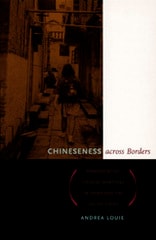
cover of Chineseness across Borders: Renegotiating Chinese Identities in China and the United States

Chineseness across Borders

Renegotiating Chinese Identities in China and the United States

Andrea Louie

Duke University Press, 2004

What happens when Chinese American youths travel to mainland China in search of their ancestral roots, only to realize that in many ways they still feel out of place, or when mainland Chinese realize that the lives of the Chinese abroad may not be as good as they had imagined? By considering programs designed to facilitate interactions between overseas Chinese and their ancestral homelands, Andrea Louie highlights how these programs not only create opportunities for new connections but also reveal the disjunctures that now separate Chinese Americans from China and mainland Chinese from the Chinese abroad.

Louie focuses on “In Search of Roots,” a program that takes young Chinese American adults of Cantonese descent to visit their ancestral villages in China’s Guangdong province. Through ethnographic interviews and observation, Louie examines the experiences of Chinese Americans both during village visits in China and following their participation in the program, which she herself took part in as an intern and researcher. She presents a vivid portrait of two populations who, though connected through family ties generations back, are meeting for the first time in the context of a rapidly changing contemporary China. Louie situates the participants’ and hosts’ shifting understandings of China and Chineseness within the context of transnational flows of people, media, goods, and money; China’s political and economic policies; and the racial and cultural politics of the United States.
[more]
cover of Chocolate and Corn Flour: History, Race, and Place in the Making of "Black" Mexico

Chocolate and Corn Flour

History, Race, and Place in the Making of "Black" Mexico

Laura A. Lewis

Duke University Press, 2012

Located on Mexico's Pacific coast in a historically black part of the Costa Chica region, the town of San Nicolás has been identified as a center of Afromexican culture by Mexican cultural authorities, journalists, activists, and foreign anthropologists. The majority of the town's residents, however, call themselves morenos (black Indians). In Chocolate and Corn Flour, Laura A. Lewis explores the history and contemporary culture of San Nicolás, focusing on the ways that local inhabitants experience and understand race, blackness, and indigeneity, as well as on the cultural values that outsiders place on the community and its residents.

Drawing on more than a decade of fieldwork, Lewis offers a richly detailed and subtle ethnography of the lives and stories of the people of San Nicolás, including community residents who have migrated to the United States. San Nicoladenses, she finds, have complex attitudes toward blackness—as a way of identifying themselves and as a racial and cultural category. They neither consider themselves part of an African diaspora nor deny their heritage. Rather, they acknowledge their hybridity and choose to identify most deeply with their community.
[more]
cover of Choosing Ethnicity, Negotiating Race: Korean Adoptees in America

Choosing Ethnicity, Negotiating Race

Korean Adoptees in America

Mia Tuan

Russell Sage Foundation, 2011

Transnational adoption was once a rarity in the United States, but Americans have been choosing to adopt children from abroad with increasing frequency since the mid-twentieth century. Korean adoptees make up the largest share of international adoptions—25 percent of all children adopted from outside the United States—but they remain understudied among Asian American groups. What kind of identities do adoptees develop as members of American families and in a cultural climate that often views them as foreigners? Choosing Ethnicity, Negotiating Race is the only study of this unique population to collect in-depth interviews with a multigenerational, random sample of adult Korean adoptees. The book examines how Korean adoptees form their social identities and compares them to native-born Asian Americans who are not adopted. How do American stereotypes influence the ways Korean adoptees identify themselves? Does the need to explore a Korean cultural identity—or the absence of this need—shift according to life stage or circumstance? In Choosing Ethnicity, Negotiating Race, sixty-one adult Korean adoptees—representing different genders, social classes, and communities—reflect on early childhood, young adulthood, their current lives, and how they experience others' perceptions of them. The authors find that most adoptees do not identify themselves strongly in ethnic terms, although they will at times identify as Korean or Asian American in order to deflect questions from outsiders about their cultural backgrounds. Indeed, Korean adoptees are far less likely than their non-adopted Asian American peers to explore their ethnic backgrounds by joining ethnic organizations or social networks. Adoptees who do not explore their ethnic identity early in life are less likely ever to do so—citing such causes as general aversion, lack of opportunity, or the personal insignificance of race, ethnicity, and adoption in their lives. Nonetheless, the choice of many adoptees not to identify as Korean or Asian American does not diminish the salience of racial stereotypes in their lives. Korean adoptees must continually navigate society's assumptions about Asian Americans regardless of whether they chose to identify ethnically. Choosing Ethnicity, Negotiating Race is a crucial examination of this little-studied American population and will make informative reading for adoptive families, adoption agencies, and policymakers. The authors demonstrate that while race is a social construct, its influence on daily life is real. This book provides an insightful analysis of how potent this influence can be—for transnational adoptees and all Americans.
[more]
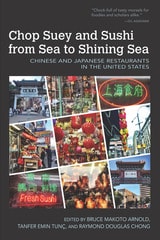
cover of Chop Suey and Sushi from Sea to Shining Sea: Chinese and Japanese Restaurants in the United States

Chop Suey and Sushi from Sea to Shining Sea

Chinese and Japanese Restaurants in the United States

Bruce Makoto Arnold

University of Arkansas Press, 2018

The essays in Chop Suey and Sushi from Sea to Shining Sea fill gaps in the existing food studies by revealing and contextualizing the hidden, local histories of Chinese and Japanese restaurants in the United States.

The writer of these essays show how the taste and presentation of Chinese and Japanese dishes have evolved in sweat and hardship over generations of immigrants who became restaurant owners, chefs, and laborers in the small towns and large cities of America. These vivid, detailed, and sometimes emotional portrayals reveal the survival strategies deployed in Asian restaurant kitchens over the past 150 years and the impact these restaurants have had on the culture, politics, and foodways of the United States.

Some of these authors are family members of restaurant owners or chefs, writing with a passion and richness that can only come from personal investment, while others are academic writers who have painstakingly mined decades of archival data to reconstruct the past. Still others offer a fresh look at the amazing continuity and domination of the “evil Chinaman” stereotype in the “foreign” world of American Chinatown restaurants. The essays include insights from a variety of disciplines, including history, sociology, anthropology, ethnography, economics, phenomenology, journalism, food studies, and film and literary criticism.

Chop Suey and Sushi from Sea to Shining Sea not only complements the existing scholarship and exposes the work that still needs to be done in this field, but also underscores the unique and innovative approaches that can be taken in the field of American food studies.
[more]
cover of Choreographing the Folk: The Dance Stagings of Zora Neale Hurston

Choreographing the Folk

The Dance Stagings of Zora Neale Hurston

Anthea Kraut

University of Minnesota Press, 2008

Recovers an important dimension of the work of the renowned African American artist

While Zora Neale Hurston and her 1937 novel Their Eyes Were Watching God have become widely celebrated, she was also a prolific stage director and choreographer. In the 1930s Hurston produced theatrical concerts that depicted a day in the life of a railroad work camp in Florida and featured a rousing Bahamian Fire Dance as the dramatic finale. In Choreographing the Folk, Anthea Kraut traces the significance and influence of Hurston’s little-known choreographic work.

Hurston’s concerts were concrete illustrations of the “real Negro art theatre” she was eager to establish, and they compellingly demonstrate how she used the arena of performance to advance a nuanced understanding of the black diaspora. Her version of the Fire Dance was staged in a variety of venues during the 1930s. In its multiple representations, Kraut asserts, the dance raised critical issues about ownership, artistry, and authenticity. Choreographing the Folk argues for the significance of Hurston’s choreography, and with perceptiveness, sensitivity, and originality, Kraut illuminates the important and often-contested place of black folk dance in American culture.
[more]
cover of Chorizos in an Iron Skillet: Memories and Recipes from an American Basque Daughter

Chorizos in an Iron Skillet

Memories and Recipes from an American Basque Daughter

Mary Ancho Davis

University of Nevada Press, 2001
Mary Ancho Davis invites everyone to join her at her mother’s table as she recalls her family’s traditions and history and shares special memories from her mother Dominga’s kitchen. From huge cream puffs filled with heavy cream skimmed from the top of raw milk, to recollections of ringing the large iron triangle hanging from a tree branch outside the kitchen door, in Chorizos in an Iron Skillet,Ancho Davis offers wonderful details about life and meals on her family’s Basque ranch.
In this charming cookbook, Mary Ancho Davis traces a path from Old Country traditional dishes to their modern versions as she shares her family’s recipes and details the evolution of Basque cooking in America. A personal cookbook from one Basque family, Chorizos in an Iron Skillet is also an engaging cultural study of culinary traditions that spans several generations of Basque immigration to the American West. With recipes for everything from Chicken with Chocolate and Dominga’s Basque Chorizos to Dried Apricot Pie, these Basque ranch dishes offer a multitude of delicious ideas for down-home cooking.
Illustrated with photographs from the Ancho family, plus helpful advice on ingredients and cooking techniques, Chorizos in an Iron Skillet is the perfect kitchen companion for filling your home with the flavors and aromas of Basque cooking.
[more]
cover of Chosen Women and Inka Statecraft: Bioarchaeology, Gender, and Foodways at Saqsaywaman

Chosen Women and Inka Statecraft

Bioarchaeology, Gender, and Foodways at Saqsaywaman

Bethany L. Turner

University of Alabama Press, 2026

A bioarchaeological study of chosen women’s labor, identity, and health in the Inka ceremonial center of Saqsaywaman

Chosen Women and Inka Statecraft illuminates the intersections between foodways, diet, gender, and power in the expansive Inka ceremonial complex of Saqsaywaman, Peru. Bioarchaeologist Bethany L. Turner weaves together geochemical and osteological research techniques to create osteobiographies for people who were likely special servants to the Inka royalty in the heart of the vast empire. These skeletal individuals, interred in a special cemetery atop Saqsaywaman, date to the fifteenth and sixteenth centuries and were previously excavated by Peruvian archaeologists.

By weaving her own data together with existing archaeological, osteological, and ethnohistoric studies of Saqsaywaman, Turner opens a rare window into everyday life among the aqllakuna, “chosen women” who grew, prepared, and served food and drink to the Inka elite. She argues that the embodied experiences of these individuals underscore the ways in which they were “made performative artifacts of Inka statecraft.” This statecraft was based on reciprocity, “to feed and be fed,” and the lived experiences of the people who lived under it left telltale signs in their bones and teeth. An important finding is that the aqllakuna, who prepared lavish feasts and heroic quantities of the finest maize beer, chicha, were likely not consuming it. However, they showed poor dental health as a result of chewing the maize to process it during brewing. This significant oral decay likely made them susceptible to chronic diseases and may have shortened their lives. Turner also asserts that the aqllakuna at Saqsaywaman included individuals whose skeletons were estimated to have been male but who likely performed feminine roles, reflecting the fluidity of gendered duality in indigenous Andean cosmology. In Chosen Women and Inka Statecraft, archaeologists, anthropologists, Andeanists, and food scholars will find new ways to consider life in the Inka past.
[more]
cover of Christianity and Race in the American South: A History

Christianity and Race in the American South

A History

Paul Harvey

University of Chicago Press, 2016

The history of race and religion in the American South is infused with tragedy, survival, and water—from St. Augustine on the shores of Florida’s Atlantic Coast to the swampy mire of Jamestown to the floodwaters that nearly destroyed New Orleans. Determination, resistance, survival, even transcendence, shape the story of race and southern Christianities. In Christianity and Race in the American South, Paul Harvey gives us a narrative history of the South as it integrates into the story of religious history, fundamentally transforming our understanding of the importance of American Christianity and religious identity.

Harvey chronicles the diversity and complexity in the intertwined histories of race and religion in the South, dating back to the first days of European settlement. He presents a history rife with strange alliances, unlikely parallels, and far too many tragedies, along the way illustrating that ideas about the role of churches in the South were critically shaped by conflicts over slavery and race that defined southern life more broadly. Race, violence, religion, and southern identity remain a volatile brew, and this book is the persuasive historical examination that is essential to making sense of it.
[more]
cover of Christianity, Social Change, and Globalization in the Americas

Christianity, Social Change, and Globalization in the Americas

Peterson, Anna L

Rutgers University Press, 2001

This volume resulted from a collaborative research project into responses of Protestant and Catholic religious communities in the Americas to the challenges of globalization. Contributors from the fields of religion, anthropology, political science, and sociology draw on fieldwork in Peru, El Salvador, and the United States to show the interplay of economic globalization, migration, and growing religious pluralism in Latin America.

Organized around three central themes-family, youth, and community; democratization, citizenship, and political participation; and immigration and transnationalism-the book argues that, at the local level, religion helps people, especially women and youths, solidify their identities and confront the challenges of the modern world. Religious communities are seen as both peaceful venues for people to articulate their needs, and forums for building participatory democracies in the Americas. Finally, the contributors examine how religion enfranchises poor women, youths, and people displaced by war or economic change and, at the same time, drives social movements that seek to strengthen family and community bonds disrupted by migration and political violence.
[more]
cover of Chronicles of a Two-Front War: Civil Rights and Vietnam in the African American Press

Chronicles of a Two-Front War

Civil Rights and Vietnam in the African American Press

Lawrence Allen Eldridge

University of Missouri Press, 2011

During the Vietnam War, young African Americans fought to protect the freedoms of Southeast Asians and died in disproportionate numbers compared to their white counterparts. Despite their sacrifices, black Americans were unable to secure equal rights at home, and because the importance of the war overshadowed the civil rights movement in the minds of politicians and the public, it seemed that further progress might never come.  For many African Americans, the bloodshed, loss, and disappointment of war became just another chapter in the history of the civil rights movement.  Lawrence Allen Eldridge explores this two-front war, showing how the African American press grappled with the Vietnam War and its impact on the struggle for civil rights.
Written in a clear narrative style, Chronicles of a Two-Front War is the first book to examine coverage of the Vietnam War by black news publications, from the Gulf of Tonkin incident in August 1964 to the final withdrawal of American ground forces in the spring of 1973 and the fall of Saigon in the spring of 1975.

Eldridge reveals how the black press not only reported the war but also weighed its significance in the context of the civil rights movement.
The author researched seventeen African American newspapers, including the Chicago Defender, the Baltimore Afro-American, and the New Courier, and two magazines, Jet and Ebony.  He augmented the study with a rich array of primary sources—including interviews with black journalists and editors, oral history collections, the personal papers of key figures in the black press, and government documents, including those from the presidential libraries of Lyndon Johnson, Richard Nixon, and Gerald Ford—to trace the ups and downs of U.S. domestic and wartime policy especially as it related to the impact of the war on civil rights.

Eldridge examines not only the role of reporters during the war, but also those of editors, commentators, and cartoonists. Especially enlightening is the research drawn from extensive oral histories by prominent journalist Ethel Payne, the first African American woman to receive the title of war correspondent. She described a widespread practice in black papers of reworking material from major white papers without providing proper credit, as the demand for news swamped the small budgets and limited staffs of African American papers.  The author analyzes both the strengths of the black print media and the weaknesses in their coverage.

The black press ultimately viewed the Vietnam War through the lens of African American experience, blaming the war for crippling LBJ’s Great Society and the War on Poverty.  Despite its waning hopes for an improved life, the black press soldiered on.
[more]
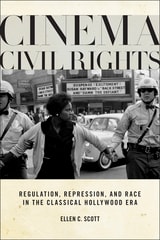
cover of Cinema Civil Rights: Regulation, Repression, and Race in the Classical Hollywood Era

Cinema Civil Rights

Regulation, Repression, and Race in the Classical Hollywood Era

Scott, Ellen C

Rutgers University Press, 2015

From Al Jolson in blackface to Song of the South, there is a long history of racism in Hollywood film. Yet as early as the 1930s, movie studios carefully vetted their releases, removing racially offensive language like the “N-word.” This censorship did not stem from purely humanitarian concerns, but rather from worries about boycotts from civil rights groups and loss of revenue from African American filmgoers.

Cinema Civil Rights presents the untold history of how Black audiences, activists, and lobbyists influenced the representation of race in Hollywood in the decades before the 1960s civil rights era. Employing a nuanced analysis of power, Ellen C. Scott reveals how these representations were shaped by a complex set of negotiations between various individuals and organizations. Rather than simply recounting the perspective of film studios, she calls our attention to a variety of other influential institutions, from protest groups to state censorship boards.

Scott demonstrates not only how civil rights debates helped shaped the movies, but also how the movies themselves provided a vital public forum for addressing taboo subjects like interracial sexuality, segregation, and lynching. Emotionally gripping, theoretically sophisticated, and meticulously researched, Cinema Civil Rights presents us with an in-depth look at the film industry’s role in both articulating and censoring the national conversation on race.
[more]
cover of Cinema and the Cosmopolitan City: Colonial Encounters in Shanghai, 1900–1930

Cinema and the Cosmopolitan City

Colonial Encounters in Shanghai, 1900–1930

Qiliang He

University of Michigan Press, 2027

In early twentieth-century Shanghai, cinema was more than entertainment—it reshaped the city itself. As movie theaters appealed to city dwellers of all backgrounds, colonial authorities struggled to manage this new public space and introduced new safety rules, censorship, and anti-crime measures. Movie theaters unintentionally brought the unofficial way of racial segregation to an end. Moreover, imported films, though emblematic of Western modernity, paradoxically eroded the myth of Western civilizational superiority. These films revealed social ills in Euro-American societies, exposed Hollywood’s racist depictions of Chinese people, and galvanized anti-imperialist and nationalist sentiments among local audiences.

Cinema and the Cosmopolitan City adopts a “cinema off-screen” approach—stitching together urban history and film studies and foregrounding circulation, consumption, and spatial practice. Qiliang He draws on municipal archives, police records, censorship reports, trade journals, film reviews, and news stories to reconstruct the regulatory regimes imposed by the Shanghai Municipal Council and Shanghai Municipal Police, which was targeting both Bolshevism and “immoral” content. This book reveals how cinema didn’t just reflect modern life—it actively changed urban governance, fueled anticolonial feelings, and linked cosmopolitan culture with rising nationalism in China.
[more]
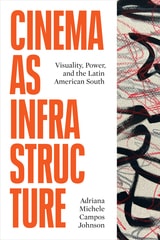
cover of Cinema as Infrastructure: Visuality, Power, and the Latin American South

Cinema as Infrastructure

Visuality, Power, and the Latin American South

Adriana Michele Campos Johnson

University of Texas Press, 2027

Examining the interplay of visuality and infrastructure in Latin American films.

Images do far more than we realize. They do not simply represent or depict; they run our world. Surveillance cameras and drones, medical imaging, social media platforms, market-data visualization––these and other technologies make the image an infrastructure of power, a tool for organizing and governing, impressing labor and extracting value.

Adriana Johnson draws on the medium of film to sensitize us to the logics of visuality as a technology of power. In particular, Latin American cinema presents a key site for both crystallizing and retreating from these logics. Through close readings of Argentine, Paraguayan, and Brazilian movies—including the documentary Bus 174, the dystopian sci-fi The Aerial,and the farcical The Gold Bug—Johnson shows how filmmakers can amplify or attenuate the infrastructural reach of visuality. They also reveal visuality’s otherwise-submerged power, and even engage in something like piracy: hacking into, rerouting, and deconstituting the workings of visual infrastructures. A deeply insightful and theoretically rich account, Cinema as Infrastructure reframes the political stakes of filmmaking in an era when visual forms have become means of production and order.
[more]
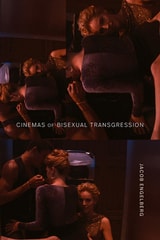
cover of Cinemas of Bisexual Transgression

Cinemas of Bisexual Transgression

Jacob Engelberg

Duke University Press, 2026
In Cinemas of Bisexual Transgression, Jacob Engelberg makes the case for radically recalibrating queer film studies, taking as a starting point those cinematic figures who resist categorization within the gay-straight binary. Engelberg’s engagement with bisexual transgression on film illuminates the mutability and instability of sexuality, and of sociocultural structures more broadly by resisting the censure of images as politically harmful as well as the celebration of transgression as inherently subversive. Instead, Engelberg understands bisexual transgression as a process whereby sociocultural rules are made knowable by being contested. From 1970s vampire films to 1990s erotic thrillers, from lesbian imaginings of female bisexuality to European art cinema’s reckonings with HIV/AIDS, bisexual figures on film embody anxieties around the precarity of binary sexuality while revealing the contingencies of sexuality’s cinematic signification. Revivifying the underexploited contributions of bisexual theory, Cinemas of Bisexual Transgression proposes a new mode of film theorization and analysis that examines the rich space between and beyond dominant categories of sexual organization, where sexual unpredictability, the allure of the forbidden, and the precarity of sexual signification are illuminated.
[more]
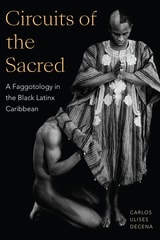
cover of Circuits of the Sacred: A Faggotology in the Black Latinx Caribbean

Circuits of the Sacred

A Faggotology in the Black Latinx Caribbean

Carlos Ulises Decena

Duke University Press, 2023

In Circuits of the Sacred Carlos Ulises Decena examines transnational black Latinx Caribbean immigrant queer life and spirit. Decena models what he calls a faggotology—the erotic in the divine as found in the disreputable and the excessive—as foundational to queer black critical and expressive praxis of the future. Drawing on theoretical analysis, memoir, creative writing, and ethnography of Santería/Lucumí in Santo Domingo, Havana, and New Jersey, Decena moves between languages, locations, pronouns, and genres to map the itineraries of blackness as a “circuit,” a multipronged and multisensorial field. A feminist pilgrimage and extended conversation with the dead, Decena’s study is a provocative work that transforms the academic monograph into a gathering of stories, theoretical innovation, and expressive praxis to channel voices, ancestors, deities, theorists, artists, and spirits from the vantage point of radical feminism and queer-of-color thinking.
[more]