Results by title
2728 books match the query 'Education' and 242 start with c

College Knowledge
101 TipsDavid Schoem
University of Michigan Press, 2005
What educators and students have to say about David Schoem's College Knowledge:
"David Schoem is a devoted teacher. He recognizes the challenges of preparing to be a responsible, compassionate, successful adult in the twenty-first century. He has written a book that can make a meaningful difference in the lives of its readers."
---Jeffrey Lehman, President, Cornell University
"College Knowledge is full of wise, straight-to-the-point guidance for success both in and out of the classroom. Every first-year student should read-a--nd heed---David Schoem's advice. Though written for students, parents of first-year students can learn from it, too!"
---Beverly Daniel Tatum, President, Spelman College
"College Knowledge is a deceptively straightforward guide appropriate for any student entering higher education. As both a parent and an educator, I highly recommend this sage, yet easy-to-digest guide as a must for the college-bound young adult."
---Pamela Horne, Director of Admissions, Michigan State University
"Professor Schoem's insights and encouragement helped me to create many of my most satisfying and lasting experiences during college. This book captures his infectious enthusiasm and will inspire readers to take risks in exploring all that college has to offer."
---Miriam Vogel, former Schoem student
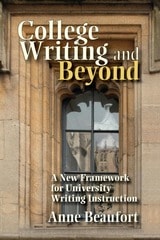
College Writing and Beyond
A New Framework for University Writing InstructionAnne Beaufort
Utah State University Press, 2007
Composition research consistently demonstrates that the social context of writing determines the majority of conventions any writer must observe. Still, most universities organize the required first-year composition course as if there were an intuitive set of general writing "skills" usable across academic and work-world settings.
In College Writing and Beyond: A New Framework for University Writing Instruction, Anne Beaufort reports on a longitudinal study comparing one student’s experience in FYC, in history, in engineering, and in his post-college writing. Her data illuminate the struggle of college students to transfer what they learn about "general writing" from one context to another. Her findings suggest ultimately not that we must abolish FYC, but that we must go beyond even genre theory in reconceiving it.
Accordingly, Beaufort would argue that the FYC course should abandon its hope to teach a sort of general academic discourse, and instead should systematically teach strategies of responding to contextual elements that impinge on the writing situation. Her data urge attention to issues of learning transfer, and to developmentally sound linkages in writing instruction within and across disciplines. Beaufort advocates special attention to discourse community theory, for its power to help students perceive and understand the context of writing.
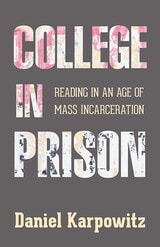
College in Prison
Reading in an Age of Mass IncarcerationKarpowitz, Daniel
Rutgers University Press, 2017
College in Prison chronicles how, since 2001, Bard College has provided hundreds of incarcerated men and women across the country access to a high-quality liberal arts education. Earning degrees in subjects ranging from Mandarin to advanced mathematics, graduates have, upon release, gone on to rewarding careers and elite graduate and professional programs. Yet this is more than just a story of exceptional individuals triumphing against the odds. It is a study in how the liberal arts can alter the landscape of some of our most important public institutions giving people from all walks of life a chance to enrich their minds and expand their opportunities.
Drawing on fifteen years of experience as a director of and teacher within the Bard Prison Initiative, Daniel Karpowitz tells the story of BPI’s development from a small pilot project to a nationwide network. At the same time, he recounts dramatic scenes from in and around college-in-prison classrooms pinpointing the contested meanings that emerge in moments of highly-charged reading, writing, and public speaking. Through examining the transformative encounter between two characteristically American institutions—the undergraduate college and the modern penitentiary—College in Prison makes a powerful case for why liberal arts education is still vital to the future of democracy in the United States.

Colorado
A History of the Centennial State, Fifth EditionCarl Abbott
University Press of Colorado, 2013
The fifth edition tells of conflicts, shifting alliances, and changing ways of life as Hispanic, European, and African American settlers flooded into a region that was already home to Native Americans. Providing a balanced treatment of the entire state’s history—from Grand Junction to Lamar and from Trinidad to Craig—the authors also reveal how Denver and its surrounding communities developed and gained influence.
While continuing to elucidate the significant impact of mining, agriculture, manufacturing, and tourism on Colorado, this edition broadens and focuses its coverage by consolidating material on Native Americans into one chapter and adding a new chapter on sports history. The authors also expand their discussion of the twentieth century with updated sections on the environment, economy, politics, and recent cultural conflicts. New illustrations, updated statistics, and an extensive bibliography including Internet resources enhance this edition.
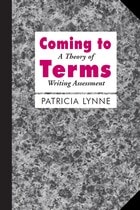
Coming To Terms
A Theory of Writing AssessmentPatricia Lynne
Utah State University Press, 2004
In a provocative book-length essay, Patricia Lynne argues that most programmatic assessment of student writing in U.S. public and higher education is conceived in the terms of mid-20th century positivism. Since composition as a field had found its most compatible home in constructivism, she asks, why do compositionists import a conceptual frame for assessment that is incompatible with composition theory?
By casting this as a clash of paradigms, Lynne is able to highlight the ways in which each theory can and cannot influence the shape of assessment within composition. She laments, as do many in composition, that the objectively oriented paradigm of educational assessment theory subjugates and discounts the very social constructionist principles that empower composition pedagogy. Further, Lynne criticizes recent practice for accommodating the big business of educational testing—especially for capitulating to the discourse of positivism embedded in terms like "validity" and "reliability." These terms and concepts, she argues, have little theoretical significance within composition studies, and their technical and philosophical import are downplayed by composition assessment scholars.
There is a need, Lynne says, for terms of assessment that are native to composition. To open this needed discussion within the field, she analyzes cutting-edge assessment efforts, including the work of Broad and Haswell, and she advances a set of alternate terms for evaluating assessment practices, a set of terms grounded in constructivism and composition.
Coming to Terms is ambitious and principled, and it takes a controversial stand on important issues. This strong new volume in assessment theory will be of serious interest to assessment specialists and their students, to composition theorists, and to those now mounting assessments in their own programs.
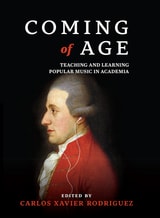
Coming of Age
Teaching and Learning Popular Music in AcademiaEdited by Carlos Rodriguez
Michigan Publishing Services, 2017
This book is a collection of essays originally presented at Ann Arbor Symposium IV, Teaching and Learning Popular Music, at the University of Michigan. Organized into four sections of similar-themed writings, the essays trace numerous discourses, principles, methods, and prospects for popular music education in academia. Additionally, the book contains several features that are useful for modern-day scholars and their institutions. First, it acknowledges the gradual liquidation of traditional disciplinary boundaries, signaling the likely future dominance of interdisciplinary research and collaborations. Second, it values international perspectives of music teaching and learning. Third, the selected topics, methodologies, and predictions provide a working agenda for the future development and success of popular music teaching and learning.
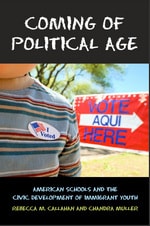
Coming of Political Age
American Schools and the Civic Development of Immigrant YouthRebecca M. Callahan
Russell Sage Foundation, 2013
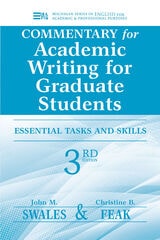
Commentary for Academic Writing for Graduate Students, 3rd Ed.
Essential Tasks and SkillsJohn M. Swales & Christine B. Feak
University of Michigan Press, 2012
The Commentary for the third edition of this successful guide to writing has been revised and expanded in many ways to provide more support for instructors; this includes additional tasks for Units Two and Four to supplement the main text. However, the collegial tone established in previous Commentaries between Swales & Feak and instructors has been retained.
This volume contains commentaries on each of the eight units plus the two appendixes. The format for each unit includes
- a summary of the main points of the unit along with a list of topics covered.
- a synopsis of activities, divided into Language Focus sections and description of tasks.
- some general notes designed to capture the character of the unit, to indicate alternative activities, or to anticipate problems that may arise.
- detailed commentary and discussion of individual tasks, including model or sample answers where possible.
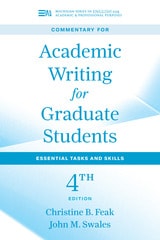
Commentary for Academic Writing for Graduate Students
Essential Tasks and SkillsChristine B. Feak and John M. Swales
University of Michigan Press, 2027
Now in its 4th edition, the Commentary for Academic Writing for Graduate Students remains an important companion text. Useful for instructors as well as students and scholars using Academic Writing for Graduate Students for self-study, the Commentary includes a synopsis of what each unit attempts to achieve, further discussion of certain points, and sample responses to the more controlled tasks. Many of the responses or model texts come directly from class discussion or from submitted homework, which students generously offered for inclusion. In response to numerous requests, the authors have expanded the number of teaching suggestions included at the end of each unit for this edition.
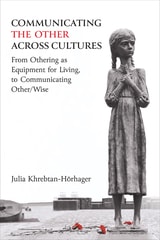
Communicating the Other across Cultures
From Othering as Equipment for Living, to Communicating Other/WiseDr. Julia Khrebtan-Hörhager
University of Michigan Press, 2023
Communicating the Other across Cultures uses examples from the United States, Western Europe, and Russia to demonstrate historical patterns of Othering people, as well as how marginalized people fight back against dominant powers that seek to silence or erase them. Deeply ingrained in our society, cultural Othering affects information in history books, children’s education, and the values upheld in our society. By taking a closer look at historical and modern instances of Othering, Julia Khrebtan-Hörhager shows examples of how different societies created ideas of social and cultural superiority or inferiority, and how deeply they are ingrained in our current society. In everyday life—the cash in your pocket, the movies shown at your local theater, museum exhibits, or politician's speeches—certain cultural ideologies are consistently upheld, while others are silenced. By exposing the communicative patterns of those in power, Khrebtan-Hörhager then suggests alternative ways of thinking, communicating, and eventually being, that offer transformative solutions for global problems.
Communication Incompetencies
A Theory of Training Oral Performance BehaviorGerald M. Phillips
Southern Illinois University Press, 1991
Gerald M. Phillips draws on his twenty-five-year, five-thousand-client experience with the Pennsylvania State University Reticence Program to present a new theory of modification of “inept” communication behavior.
That experience has convinced Phillips that communication is arbitrary and rulebound rather than a process of inspiration. He demonstrates that communication problems can be described as errors that can be detected and classified in order to fit a remediation pattern. Regardless of the source of error, the remedy is to train the individual to avoid or eliminate errors—thus, orderly procedure will result in competent performance.
Inept communicators must be made aware of the obligations and constraints imposed by deep structures that require us to achieve a degree of formal order in our language, without which our discourse becomes incomprehensible.
Communication, Pedagogy, and the Gospel of Mark
Elizabeth E. Shively
SBL Press, 2016
Using Mark as a test case, scholars address questions like: How should my research and my approach to the text play out in the classroom? What differences should my academic context and my students' expectations make? How should new approaches and innovations inform interpretation and teaching? This resource enables biblical studies instructors to explore various interpretative approaches and to begin to engage pedagogical issues in our changing world.
Features:
- Ideas that may be adapted for teaching any biblical text
- Diverse perspectives from nine experts in their fields
- Essays include tips, ideas, and lesson plans for the classroom
Communities of Practice
An Alaskan Native Model for Language Teaching and LearningEdited by Patrick E. Marlow and Sabine Siekmann
University of Arizona Press, 2013
In Alaska, the Second Language Acquisition Teacher Education (SLATE) project was designed to enable Indigenous communities and schools to improve the quality of native-language and English-language instruction and assessment by focusing on the elimination of barriers that have historically hindered degree completion for Indigenous and rural teachers. The Guided Research Collaborative (GRC) model, was employed to support the development of communities of practice through near-peer mentoring and mutual scaffolding. Through this important new model, teachers of both the heritage language, in this case Central Yup’ik, and English were able to situate their professional development into a larger global context based on current notions of multilingualism.
In Communities of Practice contributors show how the SLATE program was developed and implemented, providing an important model for improving second-language instruction and assessment. Through an in-depth analysis of the program, contributors show how this project can be successfully adapted in other communities via its commitment to local control in language programming and a model based on community-driven research.
Communities of Practice demonstrates how an initial cohort of Yup’ik- and English-language teachers collaborated to negotiate and ultimately completed the SLATE program. In so doing, these educators enhanced the program and their own effectiveness as teachers through a greater understanding of language learning. It is these understandings that will ultimately allow heritage- and English-language teachers to work together to foster their students’ success in any language.
Community Engagement Abroad
Perspectives and Practices on Service, Engagement, and Learning OverseasPat Crawford
Michigan State University Press, 2020
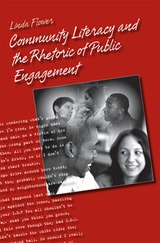
Community Literacy and the Rhetoric of Public Engagement
Linda Flower
Southern Illinois University Press, 2008
Community Literacy and the Rhetoric of Public Engagement explores the critical practice of intercultural inquiry and rhetorical problem-solving that encourages urban writers and college mentors alike to take literate action. Author Linda Flower documents an innovative experiment in community literacy, the Community Literacy Center in Pittsburgh, and posits a powerful and distinctively rhetorical model of community engagement and pedagogy for both marginalized and privileged writers and speakers. In addition, she articulates a theory of local publics and explores the transformative potential of alternative discourses and counter-public performances.
In presenting a comprehensive pedagogy for literate action, the volume offers strategies for talking and collaborating across difference, forconducting an intercultural inquiry that draws out situated knowledge and rival interpretations of shared problems, and for writing and speaking to advocate for personal and public transformation. Flower describes the competing scripts for social engagement, empowerment, public deliberation, and agency that characterize the interdisciplinary debate over models of social engagement.
Extending the Community Literacy Center’s initial vision of community literacy first published a decade ago, Community Literacy and the Rhetoric of Public Engagement makes an important contribution to theoretical conversations about the nature of the public sphere while providing practical instruction in how all people can speak publicly for values and visions of change.
Winner, 2009 Rhetoric Society of America Book Award
Community Service and Social Responsibility in Youth
James Youniss and Miranda Yates
University of Chicago Press, 1997
Using a case study from a predominantly Black, urban high school in Washington, D.C., Youniss and Yates build on the insights of Erik Erikson on the social and historical nature of identity development. They show that service at a soup kitchen as part of a course on social justice gives youth the opportunity to reflect on their status in society, on how society is organized, on how government should use its power, and on moral principles related to homelessness and poverty. Developing a sense of social responsibility and a civic commitment, youth come to see themselves as active agents in society.
The most authoritative work to date on the subject, this book challenges negative stereotypes of contemporary adolescents and illustrates how youth, when given the opportunity, can use their talents for social good. It will interest readers concerned with the development of today's youth and tomorrow's society.
Comparative Education Review, volume 65 number 4 (November 2021)
The University of Chicago Press
University of Chicago Press Journals, 2021
Comparative Education Review, volume 66 number 1 (February 2022)
The University of Chicago Press
University of Chicago Press Journals, 2022
Comparative Education Review, volume 66 number 2 (May 2022)
The University of Chicago Press
University of Chicago Press Journals, 2022
Comparative Education Review, volume 66 number 3 (August 2022)
The University of Chicago Press
University of Chicago Press Journals, 2022
Comparative Education Review, volume 66 number 4 (November 2022)
The University of Chicago Press
University of Chicago Press Journals, 2022
Comparative Education Review, volume 67 number 1 (February 2023)
The University of Chicago Press
University of Chicago Press Journals, 2023
Comparative Education Review, volume 67 number 2 (May 2023)
The University of Chicago Press
University of Chicago Press Journals, 2023
Comparative Education Review, volume 67 number 3 (August 2023)
The University of Chicago Press
University of Chicago Press Journals, 2023
Comparative Education Review, volume 67 number 4 (November 2023)
The University of Chicago Press
University of Chicago Press Journals, 2023
Comparative Education Review, volume 67 number S1 (February 2023)
The University of Chicago Press
University of Chicago Press Journals, 2023
Comparative Education Review, volume 68 number 1 (February 2024)
The University of Chicago Press
University of Chicago Press Journals, 2024
Comparative Education Review, volume 68 number 2 (May 2024)
The University of Chicago Press
University of Chicago Press Journals, 2024
Comparative Education Review, volume 68 number 3 (August 2024)
The University of Chicago Press
University of Chicago Press Journals, 2024
Comparative Education Review, volume 68 number 4 (November 2024)
The University of Chicago Press
University of Chicago Press Journals, 2024
Comparative Education Review, volume 69 number 1 (February 2025)
The University of Chicago Press
University of Chicago Press Journals, 2025
Comparative Education Review, volume 69 number 2 (May 2025)
The University of Chicago Press
University of Chicago Press Journals, 2025
Comparative Education Review, volume 69 number 3 (August 2025)
The University of Chicago Press
University of Chicago Press Journals, 2025
Comparative Education Review, volume 69 number 4 (November 2025)
The University of Chicago Press
University of Chicago Press Journals, 2025
Comparative Education Review, volume 70 number 1 (February 2026)
The University of Chicago Press
University of Chicago Press Journals, 2026
Comparative Education Review, volume 70 number 2 (May 2026)
The University of Chicago Press
University of Chicago Press Journals, 2026
Comparative Education Review, volume 70 number 3 (August 2026)
The University of Chicago Press
University of Chicago Press Journals, 2026
Comparative Studies in Special Education
Kaz Mazurek
Gallaudet University Press, 1994
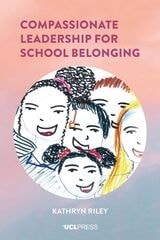
Compassionate Leadership for School Belonging
Kathryn Riley
University College London, 2022
Compassionate Leadership for School Belonging draws on forty years of international research and professional practice to show how schools can be places of safety and fulfillment, even in the most difficult of circumstances. When belonging is a school’s guiding principle, more young people experience a sense of connectedness and friendship, perform better academically, and come to believe in themselves; their teachers feel more professionally fulfilled, their families more accepted. The originality of this highly readable book lies in its scope. It offers international analysis from the OECD alongside insights from the author’s extensive research in schools, powerfully supported by observational vignettes and drawings from the children, young people, and teachers who have been her co-researchers. The book reveals patterns of dislocation, disaffection, and exclusion, and highlights the points of intervention in policy and practice needed across school systems to create the conditions for school belonging. The methodologies, concepts, and research tools offered can be used by practitioners and researchers in their own contexts and to guide school leaders towards creating their own places of belonging.
Compelling Belief
The Culture of American SchoolingStephen Arons
University of Massachusetts Press, 1986
Complacency
Classics and Its Displacement in Higher EducationJohn T. Hamilton
University of Chicago Press, 2022
In response to philosopher Simon Blackburn’s portrayal of complacency as a vice that impairs university study at its core, John T. Hamilton examines the history of complacency in classics and its implications for our contemporary moment.
The subjects, philosophies, and literatures of ancient Greece and Rome were once treated as the foundation of learning, with everything else devolving from them. Hamilton investigates what this model of superiority, derived from the golden age of the classical tradition, shares with the current hegemony of mathematics and the natural sciences. He considers how the qualitative methods of classics relate to the quantitative positivism of big data, statistical reasoning, and presumably neutral abstraction, which often dismiss humanist subjectivity, legitimize self-sufficiency, and promote a fresh brand of academic complacency. In acknowledging the reduced status of classics in higher education today, he questions how scholarly striation and stagnation continue to bolster personal, ethical, and political complacency in our present era.

Complaint!
Sara Ahmed
Duke University Press, 2021
Complete in All Its Parts
Nursing Education at the University of Iowa, 1898-1998Lee Anderson and Kathy Penningroth
University of Michigan Press, 1998
Completing College
Rethinking Institutional ActionVincent Tinto
University of Chicago Press, 2012
Even as the number of students attending college has more than doubled in the past forty years, it is still the case that nearly half of all college students in the United States will not complete their degree within six years. It is clear that much remains to be done toward improving student success. For more than twenty years, Vincent Tinto’s pathbreaking book Leaving College has been recognized as the definitive resource on student retention in higher education. Now, with Completing College, Tinto offers administrators a coherent framework with which to develop and implement programs to promote completion.
Deftly distilling an enormous amount of research, Tinto identifies the essential conditions enabling students to succeed and continue on within institutions. Especially during the early years, he shows that students thrive in settings that pair high expectations for success with structured academic, social, and financial support, provide frequent feedback and assessments of their performance, and promote their active involvement with other students and faculty. And while these conditions may be worked on and met at different institutional levels, Tinto points to the classroom as the center of student education and life, and therefore the primary target for institutional action.
Improving retention rates continues to be among the most widely studied fields in higher education, and Completing College carefully synthesizes the latest research and, most importantly, translates it into practical steps that administrators can take to enhance student success.
Composing Feminist Interventions
Activism, Engagement, PraxisKristine L. Blair
University Press of Colorado, 2018
Composing Media Composing Embodiment
Kristin L. Arola and Anne Frances Wysocki
Utah State University Press, 2012
“What any body is—and is able to do—cannot be disentangled from the media we use to consume and produce texts.” ---from the Introduction.
Kristin Arola and Anne Wysocki argue that composing in new media is composing the body—is embodiment. In Composing (Media) = Composing (Embodiment), they havebrought together a powerful set of essays that agree on the need for compositionists—and their students—to engage with a wide range of new media texts. These chapters explore how texts of all varieties mediate and thereby contribute to the human experiences of communication, of self, the body, and composing. Sample assignments and activities exemplify how this exploration might proceed in the writing classroom.
Contributors here articulate ways to understand how writing enables the experience of our bodies as selves, and at the same time to see the work of (our) writing in mediating selves to make them accessible to institutional perceptions and constraints. These writers argue that what a body does, and can do, cannot be disentangled from the media we use, nor from the times and cultures and technologies with which we engage.
To the discipline of composition, this is an important discussion because it clarifies the impact/s of literacy on citizens, freedoms, and societies. To the classroom, it is important because it helps compositionists to support their students as they enact, learn, and reflect upon their own embodied and embodying writing.
Composing Research
A Contextualist Paradigm for Rhetoric and CompositionCindy Johanek
Utah State University Press, 2000
Cindy Johanek offers a new perspective on the ideological conflict between qualitative and quantitative research approaches, and the theories of knowledge that inform them. With a paradigm that is sensitive to the context of one's research questions, she argues, scholars can develop less dichotomous forms that invoke the strengths of both research traditions. Context-oriented approaches can lift the narrative from beneath the numbers in an experimental study, for example, or bring the useful clarity of numbers to an ethnographic study.
A pragmatic scholar, Johanek moves easily across the boundaries that divide the field, and argues for contextualist theory as a lens through which to view composition research. This approach brings with it a new focus, she writes. "This new focus will call us to attend to the contexts in which rhetorical issues and research issues converge, producing varied forms, many voices, and new knowledge, indeed reconstructing a discipline that will be simultaneously focused on its tasks, its knowledge-makers, and its students."
Composing Research is a work full of personal voice and professional commitment and will be a welcome addition to the research methods classroom and to the composition researcher's own bookshelf.
2000 Outstanding Scholarship Award from the International Writing Centers Association.
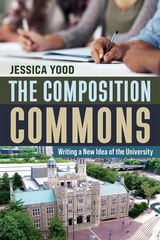
Composition Commons
Writing a New Idea of the UniversityJessica Yood
Utah State University Press, 2024
Jessica Yood traces the century-long origins of a writing-centered idea of the American university and tracks the resurgence of this idea today. Drawing on archival and classroom evidence from public colleges and universities and written in a lively autoethnographic voice, Yood names “genres of the commons”: intimate, informal writing activities that create peer-to-peer knowledge networks. She shows how these unique genres create collectivity—an academic commons—and calls on scholars to invest in composition as a course cultivating reflective, emergent, shared knowledge. Yood departs from movements that divest from the first-year composition classroom and details how an increasingly diverse student population composes complex, evolving cultural literacies that forge social bonds and forward innovation and intellectual and civic engagement.
The Composition Commons reclaims the commons as critical idea and writing classroom activities as essential practices for remaking higher education in the United States.
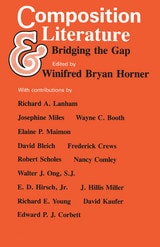
Composition and Literature
Bridging the GapEdited by Winifred Bryan Horner
University of Chicago Press, 1983
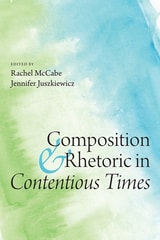
Composition and Rhetoric in Contentious Times
Rachel McCabe
Utah State University Press, 2023
Editors Rachel McCabe and Jennifer Juszkiewicz consider how educators can respond to multiple current crises relating to composition and rhetoric with generosity and cautious optimism; in the process, they address the current concerns about the longevity of the humanities. By engaging with social constructivist, critical race, socioeconomic, and activist pedagogies, each chapter provides an answer to the question, How can our courses help students become stronger writers while contending with current social, environmental, and ethical questions posed by the world around them? The contributors consider this question from numerous perspectives, recognizing the important ways that power and privilege affect our varying means of addressing this question.
Relying on both theory and practice, Composition and Rhetoric in Contentious Times engages the future of composition and rhetoric as a discipline shaped by recent and current global events. This text appeals to early-career writing program administrators, writing center directors, and professional specialists, as well as Advanced Placement high school instructors, graduate students, and faculty teaching graduate-level pedagogy courses.