Results by title
5448 books match the query 'History and criticism' and 372 start with c
Classics from Papyrus to the Internet
An Introduction to Transmission and ReceptionBy Jeffrey M. Hunt, R. Alden Smith, and Fabio Stok
University of Texas Press, 2017
Winner, PROSE Award, Classics, Association of American Publishers (AAP), 2018
Writing down the epic tales of the Trojan War and the wanderings of Odysseus in texts that became the Iliad and the Odyssey was a defining moment in the intellectual history of the West, a moment from which many current conventions and attitudes toward books can be traced. But how did texts originally written on papyrus in perhaps the eighth century BC survive across nearly three millennia, so that today people can read them electronically on a smartphone?
Classics from Papyrus to the Internet provides a fresh, authoritative overview of the transmission and reception of classical texts from antiquity to the present. The authors begin with a discussion of ancient literacy, book production, papyrology, epigraphy, and scholarship, and then examine how classical texts were transmitted from the medieval period through the Renaissance and the Enlightenment to the modern era. They also address the question of reception, looking at how succeeding generations responded to classical texts, preserving some but not others. This sheds light on the origins of numerous scholarly disciplines that continue to shape our understanding of the past, as well as the determined effort required to keep the literary tradition alive. As a resource for students and scholars in fields such as classics, medieval studies, comparative literature, paleography, papyrology, and Egyptology, Classics from Papyrus to the Internet presents and discusses the major reference works and online professional tools for studying literary transmission.

Classics in Film and Fiction
Edited by Deborah Cartmell, Heidi Kaye, I. Q. Hunter, and Imelda Whelehan
Pluto Press, 2000
Classics in Film and Fiction looks at a wide range of texts and their adaptations. Authors discussed are Shakespeare, Charlotte Bronte, Henry James, Franz Kafka, Thomas Mann, Virginia Woolf, Nathaniel Hawthorne, Arthur Miller, Truman Capote and Lewis Carroll. Book to film adaptations analysed include Jane Eyre, The Crucible, The Tempest and Alice in Wonderland. The collection also evaluates the term 'classic' in a wider context, including a comparison of Joyce's Ulysses with Hitchcock's Rear Window. Throughout, the contributors challenge the dichotomy between high culture and pop culture.
Classroom Commentaries
Teaching the Poetria nova across Medieval and Renaissance EuropeMarjorie Curry Woods
The Ohio State University Press, 2009
Clear Word and Third Sight
Folk Groundings and Diasporic Consciousness in African Caribbean WritingCatherine A. John
Duke University Press, 2003
Contesting popular discourses about what constitutes culture and maintaining that neglected strains in negritude discourse provide a crucial philosophical perspective on the connections between folk practices, cultural memory, and collective consciousness, John examines the diasporic principles in the work of the negritude writers Léon Damas, Aimé Césaire, and Léopold Senghor. She traces the manifestations and reworkings of their ideas in Afro-Caribbean writing from the eastern and French Caribbean, as well as the Caribbean diaspora in the United States. The authors she discusses include Jamaica Kincaid, Earl Lovelace, Simone Schwarz-Bart, Audre Lorde, Paule Marshall, and Edouard Glissant, among others. John argues that by incorporating what she calls folk groundings—such as poems, folktales, proverbs, and songs—into their work, Afro-Caribbean writers invoke a psychospiritual consciousness which combines old and new strategies for addressing the ongoing postcolonial struggle.
Clear-Cutting Eden
Ecology and the Pastoral in Southern LiteratureChristopher Rieger
University of Alabama Press, 2009
Examines how Southern literary depictions of the natural world were influenced by the historical, social, and ecological changes of the 1930s and 1940s
Rieger studies the ways that nature is conceived of and portrayed by four prominent Southern writers of the era: Erskine Caldwell, Marjorie Kinnan Rawlings, Zora Neale Hurston, and William Faulkner. Specifically, he argues that these writers created new versions of an old literary mode—the pastoral—in response to the destabilizing effects of the Great Depression, the rise of Southern modernism, and the mechanization of agricultural jobs.
Mass deforestation, soil erosion, urban development, and depleted soil fertility are issues that come to the fore in the works of these writers. In response, each author depicts a network model of nature, where humans are part of the natural world, rather than separate, over, or above it, as in the garden pastorals of the Old South, thus significantly revising the pastoral mode proffered by antebellum and Reconstruction-era writers.
Each writer, Rieger finds, infuses the pastoral mode with continuing relevance, creating new versions that fit his or her ideological positions on issues of race, class, and gender. Despite the ways these authors represent nature and humankind’s place in it, they all illustrate the idea that the natural environment is more than just a passive background against which the substance of life, or fiction, is played out.
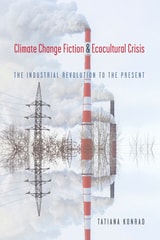
Climate Change Fiction and Ecocultural Crisis
The Industrial Revolution to the PresentTatiana Konrad
University of Nevada Press, 2024
Focusing on a diverse range of issues, including fossil fuels, cheap energy, the intricacies of human–more-than-human relationships, and postcolonial geographies, Konrad illustrates how cli-fi transcends mere storytelling. The genre ultimately emerges as an important means to forecast, imagine, and contemplate climatic events.
The book invites a broadening of the environmental humanities discourse, asking readers not only to deepen their understanding of the current climate crisis, but also to consider how cli-fi culture can be viewed as an effective method to address climate change.
Climate Lyricism
Min Hyoung Song
Duke University Press, 2022
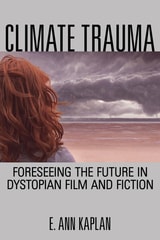
Climate Trauma
Foreseeing the Future in Dystopian Film and FictionKaplan, E. Ann
Rutgers University Press, 2015
Drawing from recent scholarship that analyzes climate change as a form of “slow violence” that humans are inflicting on the environment, Climate Trauma theorizes that such violence is accompanied by its own psychological condition, what its author terms “Pretraumatic Stress Disorder.” Examining a variety of films that imagine a dystopian future, renowned media scholar E. Ann Kaplan considers how the increasing ubiquity of these works has exacerbated our sense of impending dread. But she also explores ways these films might help us productively engage with our anxieties, giving us a seemingly prophetic glimpse of the terrifying future selves we might still work to avoid becoming.
Examining dystopian classics like Soylent Green alongside more recent examples like The Book of Eli, Climate Trauma also stretches the limits of the genre to include features such as Blindness, The Happening, Take Shelter, and a number of documentaries on climate change. These eclectic texts allow Kaplan to outline the typical blind-spots of the genre, which rarely depicts climate catastrophe from the vantage point of women or minorities. Lucidly synthesizing cutting-edge research in media studies, psychoanalytic theory, and environmental science, Climate Trauma provides us with the tools we need to extract something useful from our nightmares of a catastrophic future.
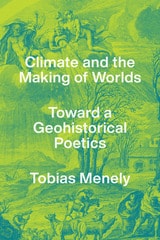
Climate and the Making of Worlds
Toward a Geohistorical PoeticsTobias Menely
University of Chicago Press, 2021
In this book, Tobias Menely develops a materialist ecocriticism, tracking the imprint of the planetary across a long literary history of poetic rewritings and critical readings which continually engage with the climate as a condition of human world making. Menely’s central archive is English poetry written between John Milton’s Paradise Lost (1667) and Charlotte Smith’s “Beachy Head” (1807)—a momentous century and a half during which Britain, emerging from a crisis intensified by the Little Ice Age, established the largest empire in world history and instigated the Industrial Revolution. Incorporating new sciences into ancient literary genres, these ambitious poems aspired to encompass what the eighteenth-century author James Thomson called the “system . . . entire.” Thus they offer a unique record of geohistory, Britain’s epochal transition from an agrarian society, buffeted by climate shocks, to a modern coal-powered nation. Climate and the Making of Worlds is a bracing and sophisticated contribution to ecocriticism, the energy humanities, and the prehistory of the Anthropocene.
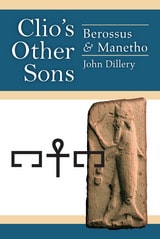
Clio's Other Sons
Berossus and ManethoJohn Dillery
University of Michigan Press, 2015
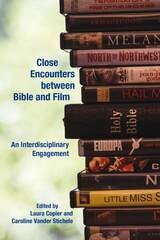
Close Encounters between Bible and Film
An Interdisciplinary EngagementLaura Copier
SBL Press, 2016
Explore new routes into the burgeoning field of biblical literature and film theory
The present collection of essays is a sequel to the groundbreaking Semeia 74 issue, published in 1996, entitled Biblical Glamour and Hollywood Glitz. These new essays showcase the divergent approaches from film studies and cultural studies that can be used in the visual analysis of biblical and religious themes, narratives, and characters in cinema. It is the first volume that specifically addresses issues of methodology, theory, and analysis in the study between bible and film. As such, this collection is of interest to scholars in film studies and theology/religion/biblical studies, who are invested in doing interdisciplinary research in the expanding field of religion and film.
Features
- Specific focus on methods of film analysis, rather than the more common focus on thematic analysis in the study of religion, Bible, and film.
- Visual analysis in the encounter between Bible and film
- Fourteen essays and an introduction by top scholars in the field

Close Encounters
Film, Feminism, and Science FicitonConstance Penley, Elisabeth Lyon, Lynn Spigel, and Janet Bergstrom, Editors
University of Minnesota Press, 1991
Close Encounters was first published in 1991. Minnesota Archive Editions uses digital technology to make long-unavailable books once again accessible, and are published unaltered from the original University of Minnesota Press editions.
Offers new critical approaches to science fiction as represented in film, television, fan culture, and other non-literary media. Addresses the way conventional notions of sexual difference are reworked by science fiction film. Includes the complete script of Peter Wollen's 1987 film Friendship's Death.
Contributors: Raymond Bellour, Janet Bergstrom, Roger Dadoun, Harvey R. Greenberg, M.D., Henry Jenkins III, Enno Patalas, Constance Penley, Vivian Sobchak, Lynn Spigel, and Peter Wollen.
Close Reading
The ReaderFrank Lentricchia and Andrew DuBois, eds.
Duke University Press, 2003
From a 1938 essay by John Crowe Ransom through the work of contemporary scholars, Close Reading highlights the interplay between critics—the ways they respond to and are influenced by others’ works. To facilitate comparisons of methodology, the collection includes discussions of the same primary texts by scholars using different critical approaches. The essays focus on Hamlet, “Lycidas,” “The Rape of the Lock,” Ulysses, Invisible Man, Beloved, Jane Austen, John Keats, and Wallace Stevens and reveal not only what the contributors are reading, but also how they are reading.
Frank Lentricchia and Andrew DuBois’s collection is an essential tool for teaching the history and practice of close reading.
Contributors. Houston A. Baker Jr., Roland Barthes, Homi Bhabha, R. P. Blackmur, Cleanth Brooks, Kenneth Burke, Paul de Man, Andrew DuBois, Stanley Fish, Catherine Gallagher, Sandra Gilbert, Stephen Greenblatt, Susan Gubar, Fredric Jameson, Murray Krieger, Frank Lentricchia, Franco Moretti, John Crowe Ransom, Eve Kosofsky Sedgwick, Helen Vendler
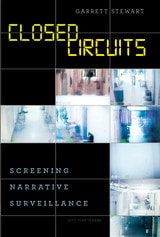
Closed Circuits
Screening Narrative SurveillanceGarrett Stewart
University of Chicago Press, 2015
In Closed Circuits, Garrett Stewart analyzes a broad spectrum of films, from M and Rear Window through The Conversation to Déjà Vu, Source Code, and The Bourne Legacy, in which cinema has articulated—and performed—the drama of inspection’s unreturned look. While mainstays of the thriller, both the act and the technology of surveillance, Stewart argues, speak to something more foundational in the very work of cinema. The shared axis of montage and espionage—with editing designed to draw us in and make us forget the omnipresence of the narrative camera—extends to larger questions about the politics of an oversight regime that is increasingly remote and robotic. To such a global technopticon, one telltale response is a proliferating mode of digitally enhanced “surveillancinema.”
Closely and Consciously
Reading and the US Women's Liberation MovementYung-Hsing Wu
University of Massachusetts Press, 2024
The significant archive of writing that came out of the women’s liberation movement in the United States, from 1965 to 1980, speaks to the value activists placed on reading as an act that is at once personal and yet also about the collective good. Yung-Hsing Wu examines the importance of reading—personal, professional, vocational, aesthetic, and always political—and how the act itself brought a host of women, each with their own history with the movement, into relation, and into a belief in that relation. The value given to reading can be seen in the ways feminists pursued media representation; in consciousness-raising (CR) groups including shared reading in their meetings; in women opening bookstores, developing newsletters, establishing journals, and starting presses; and in corporate publishers pursuing feminist fiction.
Closely and Consciously crisscrosses distinct print spheres, including newsletters and periodicals produced by feminist cells and consciousness-raising groups, feminist presses seeking to articulate their visions for women’s writing, the emergence of feminist literary criticism in first-time monographs and newly established journals, personal and editorial correspondence, press records, and the publishing histories of bestsellers that testified to the increasingly broad popularity of women’s writing. Uniting all these disparate activists and media outlets, and providing crucial relationality, was reading. With a mix of close readings and archival research, Wu unpacks and interprets this central act of reading and why it matters during a crucial moment of feminist history.
Closet Devotions
Richard Rambuss
Duke University Press, 1998
Through startling rereadings of works ranging from the devotional verse of the metaphysical poets (Donne, Herbert, Crashaw, and Traherne) to photographer Andres Serrano’s controversial “Piss Christ,” from Renaissance religious iconography to contemporary gay porn, Rambuss uncovers the highly charged erotic imagery that suffuses religious devotional art and literature. And he explores one of Christian culture’s most guarded (and literal) closets—the prayer closet itself, a privileged space where the vectors of same-sex desire can travel privately between the worshiper and his or her God.
Elegantly written and theoretically astute, Closet Devotions illuminates the ways in which sacred Christian devotion is homoeroticized, a phenomenon that until now has gone unexplored in current scholarship on religion, the body, and its passions. This book will attract readers across a wide array of disciplines, including gay and lesbian studies, literary theory and criticism, Renaissance studies, and religion.

Closet Writing/Gay Reading
The Case of Melville's PierreJames Creech
University of Chicago Press, 1994
In Closet Writing/Gay Reading, Creech shows how a literary critic can be receptive to implicit and closeted sexual content. Forcefully advocating a tactic of identification and projection in literary analysis, he lends renewed currency to the kind of "sentimental" response to literature that continental theory—particularly deconstruction—has sought to discredit.
In the second half of his book, Creech sets out to analyze what he considers the exemplary novel of the nineteenth-century closet, Melville's Pierre, or: The Ambiguities. By approaching Pierre as the gay man Melville longed to have as its reader, Creech is able to decipher the novel's "encrypted erotics" and to reveal that Melville's apparent tale of incest is actually a homosexual novel in disguise. The closeted "address" to queer-sensitive readers that Pierre disseminates finally receives a critical reading that strives to be explicit, shareable, and public.
Closures
Heterosexuality and the American SitcomGrace Lavery
Duke University Press, 2024
Clothed Villainy
Acting White in Early Modern DramaJamie Paris
University of Alabama Press, 2026
Examines how centuries-old stagecraft shaped modern racial politics—and why the performance of whiteness still commands the spotlight.
From Shakespearean blackface to the alt-right’s khaki-clad protests, Clothed Villainy: Acting White in in Early Modern Drama by Jamie Paris confronts the uncomfortable truths of racial performance across centuries. Paris argues that whiteness is not a fixed identity but a precarious and performative construct—shaped and sustained through actions, appearances, and cultural scripts.
Drawing on critical race theory, performance studies, and Indigenous scholarship, Clothed Villainy traces how racial scripts—whether “playing Black,” “playing Indian,” or especially “playing white”—have been used to uphold white supremacy and erase marginalized identities. By examining the costuming and characterization of white actors portraying Black villains on the early modern stage, Paris reveals how these theatrical traditions continue to echo in contemporary racial politics.
Written with bold clarity and personal insight, this book opens space for reimagining race, history, and identity through a more critical and inclusive lens. Clothed Villainy is essential reading for scholars, students, and anyone seeking to understand the deep-rooted performance of race in society and how we might reimagine it for a more equitable future.
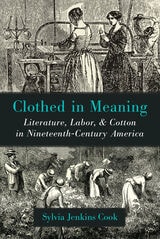
Clothed in Meaning
Literature, Labor, and Cotton in Nineteenth-Century AmericaSylvia Jenkins Cook
University of Michigan Press, 2020
Cloth and clothing provide potent tropes not only for physical but also for intellectual forms of self-expression. Drawing on sources ranging from fugitive slave narratives, newspapers, manifestos, and mill workers’ magazines to fiction, poetry, and autobiographies, Clothed in Meaning examines the significant part played by mill workers and formerly enslaved people, many of whom still worked picking cotton, in this revolution of literary self-expression. They created a new literature from their palpable daily intimacy with cotton, cloth, and clothing, as well as from their encounters with grimly innovative modes of work. In the materials of their labor they discovered vivid tropes for formulating their ideas and an exotic and expert language for articulating them. The harsh conditions of their work helped foster in their writing a trenchant irony toward the demeaning reduction of human beings to “hands” whose minds were unworthy of interest. Ultimately, Clothed in Meaning provides an essential examination of the intimate connections between oppression and luxury as recorded in the many different voices of nineteenth-century labor.
Clowns in the Burying Ground
The Grateful Dead, Literature, and the Limits of PhilosophyChristopher K. Coffman
Duke University Press, 2026

Coded Encounters
Writing, Gender, and Ethnicity in Colonial Latin AmericaFrancisco Javier Cevallos
University of Massachusetts Press, 1994
Codes of Conduct
Race, Ethics, and the Color of Our CharacterHolloway, Karla F. C.
Rutgers University Press, 1995
In Codes of Conduct, Karla Holloway meditates on the dynamics of race and ethnicity as they are negotiated in the realms of power. Her uniquely insightful and intelligent analysis guides us in a fresh way through Anita Hill’s interrogation, the assault on Tawana Brawley, the mass murders of Atlanta’s children, the schisms between the personal and public domains of her life as a black professor, and––in a moving epilogue––the story of her son’s difficulties growing up as a young black male in contemporary society. Its three main sections: “The Body Politic,” “Language, Thought, and Culture,” and “The Moral Lives of Children,” relate these issues to the visual power of the black and female body, the aesthetic resonance and racialized drama of language, and our children’s precarious habits of surviving. Throughout, Holloway questions the consequences in African-American community life of citizenship that is meted out sparingly when one’s ethnicity is colored.
This is a book of a culture’s stories––from literature, public life, contemporary and historical events, aesthetic expression, and popular culture––all located within the common ground of African-American ethnicity. Holloway writes with a passion, urgency, and wit that carry the reader swiftly through each chapter. The book should take its place among those other important contemporary works that speak to the future relationships between whites and blacks in this country.
Cognitive Fictions
Joseph Tabbi
University of Minnesota Press, 2002
The first comprehensive look at the effect of new technologies on contemporary American fiction
Bringing together cognitive science and literary analysis to map a new "media ecology," Cognitive Fictions limns an evolutionary process in which literature must find its place in an artificial environment partly produced and thoroughly mediated by technological means. Joseph Tabbi provides a penetrating account of a developing consciousness emerging from the struggle between print and electronic systems of communication.
Central to Tabbi’s work is the relation between the arrangement of communicating "modules" that cognitive science uses to describe the human mind and the arrangement of visual, verbal, and aural media in our technological culture. He looks at particular literary works by Thomas Pynchon, Richard Powers, David Markson, Lynne Tillman, Paul Auster, and others as both inscriptions of thought consistent with distributed cognitive models, and as self-creations out of the media environment. The first close reading of contemporary American writing in the light of systems theory and cognitive science, Cognitive Fictions makes needed sense of how the moment-by-moment operations of human thought find narrative form in a world increasingly defined by competing and often incompatible representations.
Cognitive Literary Studies
Current Themes and New DirectionsEdited by Isabel Jaén and Julien Jacques Simon
University of Texas Press, 2012
In the first decade of the twenty-first century, our understanding of the cognition of literature was transformed by scientific discoveries, such as the mirror neuron system and its role in empathy. Addressing questions such as why we care so deeply about fictional characters, what brain activities are sparked when we read literature, and how literary works and scholarship can inform the cognitive sciences, this book surveys the exciting recent developments in the field of cognitive literary studies and includes contributions from leading scholars in both the humanities and the sciences.
Beginning with an overview of the evolution of literary studies, the editors trace the recent shift from poststructuralism and its relativism to a growing interdisciplinary interest in the empirical realm of neuroscience. In illuminating essays that examine the cognitive processes at work when we experience fictional worlds, with findings on the brain’s creativity sites, this collection also explores the impact of literature on self and society, ending with a discussion on the present and future of the psychology of fiction. Contributors include Literature and the Brain author Norman N. Holland, on the neuroscience of metafiction reflected in Don Quixote; clinical psychologist Aaron Mishara on the neurology of self in the hypnagogic (between waking and sleeping) state and its manifestations in Kafka’s stories; and literary scholar Brad Sullivan’s exploration of Romantic poetry as a didactic tool, applying David Hartley’s eighteenth-century theories of sensory experience.
Cold Warriors
Manliness on Trial in the Rhetoric of the WestSuzanne Clark
Southern Illinois University Press, 2000
Cold Warriors: Manliness on Trial in the Rhetoric of the West returns to familiar cultural forces—the West, anticommunism, and manliness—to show how they combined to suppress dissent and dominate the unruliness of literature in the name of a national identity after World War II. Few realize how much the domination of a “white male” American literary canon was a product not of long history, but of the Cold War. Suzanne Clark describes here how the Cold War excluded women writers on several levels, together with others—African American, Native American, poor, men as well as women—who were ignored in the struggle over white male identity.
Clark first shows how defining national/individual/American identity in the Cold War involved a brand new configuration of cultural history. At the same time, it called upon the nostalgia for the old discourses of the West (the national manliness asserted by Theodore Roosevelt) to claim that there was and always had been only one real American identity.
By subverting the claims of a national identity, Clark finds, many male writers risked falling outside the boundaries not only of public rhetoric but also of the literary world: men as different from one another as the determinedly masculine Ernest Hemingway and the antiheroic storyteller of the everyday, Bernard Malamud. Equally vocal and contentious, Cold War women writers were unwilling to be silenced, as Clark demonstrates in her discussion of the work of Mari Sandoz and Ursula Le Guin.
The book concludes with a discussion of how the silencing of gender, race, and class in Cold War writing maintained its discipline until the eruptions of the sixties. By questioning the identity politics of manliness in the Cold War context of persecution and trial, Clark finds that the involvement of men in identity politics set the stage for our subsequent cultural history.
Collaborative Dickens
Authorship and Victorian Christmas PeriodicalsMelisa Klimaszewski
Ohio University Press, 2019
From 1850 to 1867, Charles Dickens produced special issues (called “numbers”) of his journals Household Words and All the Year Round, which were released shortly before Christmas each year. In Collaborative Dickens, Melisa Klimaszewski undertakes the first comprehensive study of these Christmas numbers. She argues for a revised understanding of Dickens as an editor who, rather than ceaselessly bullying his contributors, sometimes accommodated contrary views and depended upon multivocal narratives for his own success.
Klimaszewski uncovers connections among and between the stories in each Christmas collection. She thus reveals ongoing conversations between the works of Dickens and his collaborators on topics important to the Victorians, including race, empire, supernatural hauntings, marriage, disability, and criminality. Stories from Wilkie Collins, Elizabeth Gaskell, and understudied women writers such as Amelia B. Edwards and Adelaide Anne Procter interact provocatively with Dickens’s writing. By restoring links between stories from as many as nine different writers in a given year, Klimaszewski demonstrates that a respect for the Christmas numbers’ plural authorship and intertextuality results in a new view of the complexities of collaboration in the Victorian periodical press and a new appreciation for some of the most popular texts Dickens published.
Collecting Music in the Aran Islands
A Century of History and PracticeDeirdre Ní Chonghaile
University of Wisconsin Press, 2022
For more than 150 years, individuals have traveled the countryside with pen, paper, tape recorders, and even video cameras to document versions of songs, music, and stories shared by communities. As technologies and methodologies have advanced, the task of gathering music has been taken up by a much broader group than scholars. The resulting collections created by these various people can be impacted by the individual collectors’ political and social concerns, cultural inclinations, and even simple happenstance, demonstrating a crucial yet underexplored relationship between the music and those preserving it.
Collecting Music in the Aran Islands, a critical historiographical study of the practice of documenting traditional music, is the first to focus on the archipelago off the west coast of Ireland. Deirdre Ní Chonghaile argues for a culturally equitable framework that considers negotiation, collaboration, canonization, and marginalization to fully understand the immensely important process of musical curation. In presenting four substantial, historically valuable collections from the nineteenth and twentieth centuries, she illustrates how understanding the motivations and training (or lack thereof) of individual music collectors significantly informs how we should approach their work and contextualize their place in the folk music canon.
Collecting Visible Evidence
Jane Gaines
University of Minnesota Press, 1999
A redefinition of the nature of documentary film.
In documentary studies, the old distinctions between fiction and nonfiction no longer apply, as contemporary film and video artists produce works that defy classification. Coming together to make sense of these developments, the contributors to this book effectively redefine documentary studies. They trace the documentary impulse in the early detective camera, in the reenactment of battle scenes from World War I, and in the telecast of the Nevada A-bomb test in 1952. Other topics include experiments in virtual reality; the crisis of representation in anthropology; and video art and documentary work that challenge the asymmetry of the postcolonial us/them divide.
Contributors: Jenny Cool; Elizabeth Cowie, U of Kent; Faye Ginsburg, New York U; Tom Gunning, U of Chicago; Eithne Johnson; Alexandra Juhasz, Pitzer College; Neil Lerner, Davidson College; Akira Mizuta Lippit, San Francisco State U; Nancy Lutkehaus, USC; James M. Moran; Vivian Sobchack, UCLA; Linda Williams, U of California, Berkeley; Mark Williams, Dartmouth College; Mark J. P. Wolf, Concordia U, Wisconsin.
Collections in Context
The Organization of Knowledge and Community in EuropeEdited by Karen Fresco and Anne D. Hedeman
The Ohio State University Press, 2011
The fourteen essays that comprise Collections in Context: The Organization of Knowledge and Community in Europe interrogate questions posed by French, Flemish, English, and Italian collections of all sorts—libraries as a whole, anthologies and miscellanies assembled within a single manuscript or printed book, and even illustrated ivory boxes.
With essays by a wide array of international scholars, Collections in Context demonstrates that the very act of collecting inevitably imposes some kind of relationship among what might otherwise be naively thought of as disparate elements and simultaneously exposes something about the community that created and used the collection. Thus, Collections in Context offers unusual insights into how collecting both produced knowledge and built community in early modern Europe.

College Girls
A Century in FictionShirley Marchalonis
Rutgers University Press, 1995
Since the opening of Vassar College in 1865, objections to higher education for women have ranged from charges that females were mentally and physically incapable of learning to the belief that educating women would destroy society. Underlying all arguments was the folk wisdom which declared that women could not live and work together. To counteract such beliefs, women’s colleges tried to create a special kind of space and new role models that would allow women to exist for a short time in idyllic (or, at least, idealized) conditions. The debate over women’s education, for the good or ill of society, generated a great deal of "print," including short stories and novels. Shirley Marchalonis guides us through the history of this fiction, its depiction of the complexities of the college experience, and the conflicting attitudes that teetered between fascination and fear, celebration and regret.
Using novels, short stories, and some juvenile fiction from 1865 to 1940--all of it specifically about college “girls”--she examines these ideas, the way they developed over time, and their significance in understanding women’s education and women’s history. The debate over separate colleges for women continues to this day and can be better understood in the context of this informative and entertaining look at the past.
Collisions With History
Latin American Fiction and Social Science from “El Boom” to the New World OrderFrederick M. Nunn
Ohio University Press, 2001
Latin American intellectuals have traditionally debated their region’s history, never with so much agreement as in the fiction, commentary, and scholarship of the late twentieth century. Collisions with History shows how “fictional histories” of discovery and conquest, independence and early nationhood, and the recent authoritarian past were purposeful revisionist collisions with received national versions. These collisions occurred only because of El Boom, thus making Latin America’s greatest literary movement a historical phenomenon as well. Frederick M. Nunn discusses the cataclysmic view of history conveyed in Boom novels and examines the thought and self-perception of selected authors whose political activism enhanced the appeal of their works—historical and otherwise: Alejo Carpentier, Carlos Fuentes, Gabriel García Márquez, and Augusto Roa Bastos; Julio Cortázar, Isabel Allende, Mario Vargas Llosa, and Darcy Ribeiro.
Collisions with History demonstrates how their commentary on history, literature, politics, and international affairs reveals a conscious sense of purpose. From between the lines of their nonfiction emerges a consensus that outside forces have defined as well as controlled Latin America’s history.
Professor Nunn also suggests that, with novelists now no longer very interested in colliding with history, it may fall to social scientists to speak for what remains of the region’s past in the New World Order.
Colonial Angels
Narratives of Gender and Spirituality in Mexico, 1580-1750By Elisa Sampson Vera Tudela
University of Texas Press, 2000
Spain's attempt to establish a "New Spain" in Mexico never fully succeeded, for Spanish institutions and cultural practices inevitably mutated as they came in contact with indigenous American outlooks and ways of life. This original, interdisciplinary book explores how writing by and about colonial religious women participated in this transformation, as it illuminates the role that gender played in imposing the Spanish empire in Mexico.
The author argues that the New World context necessitated the creation of a new kind of writing. Drawing on previously unpublished writings by and about nuns in the convents of Mexico City, she investigates such topics as the relationship between hagiography and travel narratives, male visions of the feminine that emerge from the reworking of a nun's letters to her confessor into a hagiography, the discourse surrounding a convent's trial for heresy by the Inquisition, and the reports of Spanish priests who ministered to noble Indian women. This research rounds out colonial Mexican history by revealing how tensions between Spain and its colonies played out in the local, daily lives of women.
Colonial Fantasies
Conquest, Family, and Nation in Precolonial Germany, 1770-1870Susanne Zantop
Duke University Press, 1997
From as early as the sixteenth century, Germans preoccupied themselves with an imaginary drive for colonial conquest and possession that eventually grew into a collective obsession. Zantop illustrates the gendered character of Germany’s colonial imagination through critical readings of popular novels, plays, and travel literature that imagine sexual conquest and surrender in colonial territory—or love and blissful domestic relations between colonizer and colonized. She looks at scientific articles, philosophical essays, and political pamphlets that helped create a racist colonial discourse and demonstrates that from its earliest manifestations, the German colonial imagination contained ideas about a specifically German national identity, different from, if not superior to, most others.
Colonial Itineraries of Contemporary Mexico
Literary and Cultural InquiriesEdited by Oswaldo Estrada and Anna M. Nogar
University of Arizona Press, 2014
Through a transformative interdisciplinary lens, this book studies the ultra-contemporary chronicles of Carlos Monsiváis, the poetry of Carmen Boullosa and Luis Felipe Fabre, and the novels of Enrique Serna, Héctor de Mauleón, Mónica Lavín, and Pablo Soler Frost, among others. The book also pays close attention to a good sample of recent children’s literature that revisit Mexico’s colonia. It includes the transatlantic perspective of Spanish novelist Inma Chacón, and a detailed analysis of the strategies employed by Laura Esquivel in the creation of a best seller. Other chapters are devoted to the study of transnational film productions, a play by Flavio González Mello, and a set of novels set in the nineteenth-century colonia that problematize static notions of both personal and national identity within specific cultural palimpsests. Taken together, these incisive readings open broader conversations about Mexican coloniality as it continues well into the twenty-first century.
Colonial Legacies in Chicana/o Literature and Culture
Looking Through the KaleidoscopeVanessa Fonseca-Chávez
University of Arizona Press, 2020
Vanessa Fonseca-Chávez traces how Spanish colonial texts reflect the motivation for colonial domination. She argues that layers of U.S. colonialism complicate how Chicana/o literary scholars think about Chicana/o literary and cultural production. She brings into view the experiences of Chicana/o communities that have long-standing ties to the U.S. Southwest but whose cultural heritage is tied through colonialism to multiple nations, including Spain, Mexico, and the United States.
While the legacies of Chicana/o literature simultaneously uphold and challenge colonial constructs, the metaphor of the kaleidoscope makes visible the rupturing of these colonial fragments via political and social urgencies. This book challenges readers to consider the possibilities of shifting our perspectives to reflect on stories told and untold and to advocate for the inclusion of fragmented and peripheral pieces within the kaleidoscope for more complex understandings of individual and collective subjectivities.
This book is intended for readers interested in how colonial legacies are performed in the U.S. Southwest, particularly in the context of New Mexico, Texas, and Arizona. Readers will relate to the book’s personal narrative thread that provides a path to understanding fragmented identities.
Colonial Power, Colonial Texts
India in the Modern British NovelM. Keith Booker
University of Michigan Press, 1997
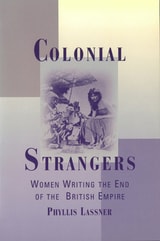
Colonial Strangers
Women Writing the End of the British EmpireLassner, Phyllis
Rutgers University Press, 2004
Drawing on memoirs, fiction, reportage, and film adaptations, Colonial Strangers explores the critical perspectives of writers who correct prevailing stereotypes of British women as agents of imperialism. They also question their own participation in British claims of moral righteousness and British politics of cultural exploitation. These authors take center stage in debates about connections between the racist ideologies of the Third Reich and the British Empire.
Colonial Strangers reveals how the literary responses of key artists represent not only compelling reading, but also a necessary intervention in colonial and postcolonial debates and the canons of modern British fiction.
Colonialism and Race in Luso-Hispanic Literature
Jerome C. Branche
University of Missouri Press, 2006
Colonization, Violence, and Narration in White South African Writing
André Brink, Breyten Breytenbach, and J. M. CoetzeeRosemary Jane Jolly
Ohio University Press, 1995
The representation of pain and suffering in narrative form is an ongoing ethical issue in contemporary South African literature. Can violence be represented without sensationalistic effects, or, alternatively, without effects that tend to be conservative because they place the reader in a position of superiority over the victim or the perpetrator?
Jolly looks at three primary South African authors—André Brink, Breyten Breytenbach, and J. M. Coetzee—to consider violence in the context of apartheid and colonialism and their inherent patriarchies.
Jolly also discusses the violence attendant upon the act of narration in the broader context of critiques of Kafka, Freud, Hegel, the postcolonial critics Jan Mohamed and Bhabha, and feminists such as Susan Suleiman.
Columbo
Make Me a Perfect MurderAmelie Hastie
Duke University Press, 2024
Come Buy, Come Buy
Shopping and the Culture of Consumption in Victorian Women’s WritingKrista Lysack
Ohio University Press, 2008
From the 1860s through the early twentieth century, Great Britain saw the rise of the department store and the institutionalization of a gendered sphere of consumption. Come Buy, Come Buy considers representations of the female shopper in British women’s writing and demonstrates how women’s shopping practices are materialized as forms of narrative, poetic, and cultural inscription, showing how women writers emphasize consumerism as productive of pleasure rather than the condition of seduction or loss. Krista Lysack examines works by Christina Rossetti, Mary Elizabeth Braddon, George Eliot, and Michael Field, as well as the suffragette newspaper Votes for Women, in order to challenge the dominant construction of Victorian femininity as characterized by self-renunciation and the regulation of appetite.
Come Buy, Come Buy considers not only literary works, but also a variety of archival sources (shopping guides, women’s fashion magazines, household management guides, newspapers, and advertisements) and cultural practices (department store shopping, shoplifting and kleptomania, domestic economy, and suffragette shopkeeping). With this wealth of sources, Lysack traces a genealogy of the woman shopper from dissident domestic spender to aesthetic connoisseur, from curious shop-gazer to political radical.
Come In and Hear the Truth
Jazz and Race on 52nd StreetPatrick Burke
University of Chicago Press, 2008
Come In and Hear the Truth uses a range of materials, from classic photographs to original interviews with musicians, to bring the street’s vibrant history to life and to shed new light on the interracial contacts and collaborations it generated.
Comedy Is A Man In Trouble
Slapstick In American MoviesAlan Dale
University of Minnesota Press, 2002
An enthusiast’s look at the art of physical comedy—now in paperback!
Legendary screen comedian Jerry Lewis once said, "The premise of all comedy is a man in trouble." The films that endeared Lewis and others to us hinged on the physical assault of their hero, the pie in the face or slip on the banana peel that reduced the movie star to the level of the audience. Alan Dale presents a lively and accessible look at slapstick, a form of comedy with roots in the circus and vaudeville that has been refashioned by actors ranging from Buster Keaton to the Marx Brothers, from Katharine Hepburn to Jim Carrey.
Winner of the Theater Library Association’s Special Jury Prize for Distinguished Achievement
Comic Book Film Style
Cinema at 24 Panels per SecondBy Dru Jeffries
University of Texas Press, 2017
Superhero films and comic book adaptations dominate contemporary Hollywood filmmaking, and it is not just the storylines of these blockbuster spectacles that have been influenced by comics. The comic book medium itself has profoundly influenced how movies look and sound today, as well as how viewers approach them as texts. Comic Book Film Style explores how the unique conventions and formal structure of comic books have had a profound impact on film aesthetics, so that the different representational abilities of comics and film are put on simultaneous display in a cinematic work.
With close readings of films including Batman: The Movie, American Splendor, Superman, Hulk, Spider-Man 2, V for Vendetta, 300, Scott Pilgrim vs. the World, Watchmen, The Losers, and Creepshow, Dru Jeffries offers a new and more cogent definition of the comic book film as a stylistic approach rather than a genre, repositioning the study of comic book films from adaptation and genre studies to formal/stylistic analysis. He discusses how comic book films appropriate comics’ drawn imagery, vandalize the fourth wall with the use of graphic text, dissect the film frame into discrete panels, and treat time as a flexible construct rather than a fixed flow, among other things. This cinematic remediation of comic books’ formal structure and unique visual conventions, Jeffries asserts, fundamentally challenges the classical continuity paradigm and its contemporary variants, placing the comic book film at the forefront of stylistic experimentation in post-classical Hollywood.
Comic Book Movies
Davis, Blair
Rutgers University Press, 2018
Film scholar Blair Davis also considers how the genre’s visual style is equally important as its weighty themes, and he details how advances in digital effects have allowed filmmakers to incorporate elements of comic book art in innovative ways. As he reveals, comic book movies have inspired just as many innovations to Hollywood’s business model, with film franchises and transmedia storytelling helping to ensure that the genre will continue its reign over popular culture for years to come.
Comic Faith
The Great Tradition from Austen to JoyceRobert M. Polhemus
University of Chicago Press, 1980
Comics Studies
A GuidebookCharles Hatfield
Rutgers University Press, 2020
In the twenty-first century, the field of comics studies has exploded. Scholarship on graphic novels, comic books, comic strips, webcomics, manga, and all forms of comic art has grown at a dizzying pace, with new publications, institutions, and courses springing up everywhere. The field crosses disciplinary and cultural borders and brings together myriad traditions. Comics Studies: A Guidebook offers a rich but concise introduction to this multifaceted field, authored by leading experts in multiple disciplines. It opens diverse entryways to comics studies, including history, form, audiences, genre, and cultural, industrial, and economic contexts. An invaluable one-stop resource for veteran and new comics scholars alike, this guidebook represents the state of the art in contemporary comics scholarship.
Comics and Nation
Power, Pop Culture, and Political Transformation in PolandEwa Stanczyk
The Ohio State University Press, 2022
Winner, BASEES George Blazyca Award in East European Studies
Comics and Nation offers a fresh perspective on the role of popular culture in the one-hundred-year history of the Polish state, from its foundation in 1918 to the present. Drawing on dozens of press articles, interviews, and readers’ letters, Ewa Stanczyk discusses how journalists, artists, and audiences used comics to probe the boundaries of national culture and scrutinize the established notions of Polishness. Critical moments of Poland’s political transformation ––the establishment of the interwar Polish Republic, the Cold War, the liberalization of the 1970s, the 1989 democratic transition, the turn to memory politics in the 2000s––have all been reflected in the history of Polish comics. Stanczyk offers new insights into how the production of homegrown comics and the influx of foreign works enabled commentators to express their fears, hopes, and disillusionment with political, economic, and cultural changes in Poland and beyond. At its core, Comics and Nation rethinks the impact of popular culture and transnational exchange on Polish nation building, citizenship formation, and the legitimation of power.
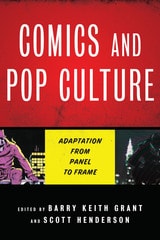
Comics and Pop Culture
Adaptation from Panel to FrameBy Barry Keith Grant and Scott Henderson
University of Texas Press, 2019
It is hard to discuss the current film industry without acknowledging the impact of comic book adaptations, especially considering the blockbuster success of recent superhero movies. Yet transmedial adaptations are part of an evolution that can be traced to the turn of the last century, when comic strips such as “Little Nemo in Slumberland” and “Felix the Cat” were animated for the silver screen. Representing diverse academic fields, including technoculture, film studies, theater, feminist studies, popular culture, and queer studies, Comics and Pop Culture presents more than a dozen perspectives on this rich history and the effects of such adaptations.
Examining current debates and the questions raised by comics adaptations, including those around authorship, style, and textual fidelity, the contributors consider the topic from an array of approaches that take into account representations of sexuality, gender, and race as well as concepts of world-building and cultural appropriation in comics from Modesty Blaise to Black Panther. The result is a fascinating re-imagination of the texts that continue to push the boundaries of panel, frame, and popular culture.