Results by title
4743 books match the query 'Religion' and 302 start with c
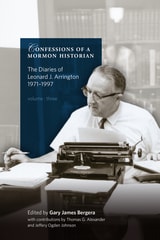
Confessions of a Mormon Historian
The Diaries of Leonard J. Arrington, 1971-1997: Volume 3, Exile, 1980-97Gary James Bergera
Signature Books, 2018
Leonard Arrington (1917–99) was born an Idaho chicken rancher whose early interests seemed not to extend much beyond the American west. Throughout his life, he tended to project a folksy persona, although nothing was farther from the truth.
He was, in fact, an intellectually oriented, academically driven young man, determined to explore the historical, economic, cultural, and religious issues of his time. After distinguishing himself at the University of North Carolina (Chapel Hill) and serving in the army during World War II in North Africa and Italy, Arrington accepted a professorship at Utah State University. In 1972 he was called as the LDS Church Historian—an office he held for ten years until, following a stormy tenure full of controversy over whether the “New Mormon History” he championed was appropriate for the church, he was quietly released and transferred, along with the entire Church History Division, to Brigham Young University. It was hoped that this would remove the impression in people’s minds that his writings were church-approved.
His personal diaries reveal a man who was firmly committed to his church, as well as to rigorous historical scholarship. His eye for detail made him an important observer of “church headquarters culture.”
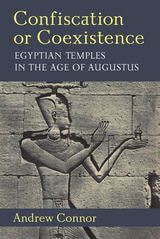
Confiscation or Coexistence
Egyptian Temples in the Age of AugustusAndrew Connor
University of Michigan Press, 2022
The interpretative consensus developed after the publication of a handful of key documents—P.Tebt. 2.302 especially, alongside BGU 4.1198 and 1200, and P.Berl.Leihg. 1.5. Connor offers a fundamentally revised interpretation of these texts, building from a fresh examination of the papyri themselves. The book frames the interpretation in a wider discussion of Roman interactions with Egyptian religion, including material from inside and outside Egypt, and locates the development of an interpretative consensus in early 20th-century scholarship within the wider context of empire and colonization at the time. In doing so, Connor explores these papyri through their historical, intellectual, and linguistic contexts, alongside a number of other important texts bearing on the relationship between the temples and the Roman state.
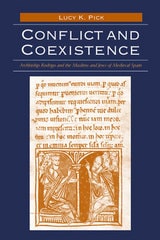
Conflict and Coexistence
Archbishop Rodrigo and the Muslims and Jews of Medieval SpainLucy K. Pick
University of Michigan Press, 2004
---J. N. Hillgarth, Professor Emeritus, University of Toronto
"By focusing on the diversified activities of the talented mid-thirteenth-century archbishop of Toledo, Lucy Pick brilliantly illuminates the complex relations between the Christian conquerors of Spain and the conquered Muslim and Jewish populations. Students of medieval Spain, of the medieval Roman Catholic Church, of medieval Muslims and Islam, and of medieval Jews and Judaism will benefit from this excellent study."
---Robert Chazan, New York University.
In Conflict and Coexistence, Lucy Pick sets out to explain how Christians, Muslims, and Jews lived alongside one another in medieval Spain. By examining the life and works of Rodrigo Jiménez de Rada, the Archbishop of Toledo (1209-47), Pick explains that the perceived threat of the non-Christian presence was managed through the subordination of Muslims and Jews.
Rodrigo stood at the center of a transformative period of history in the Iberian peninsula. During his long and varied career as archbishop, he acted as scholar, warrior, builder, and political leader. The wave of victories he helped initiate were instrumental in turning back the tide of Muslim attacks on Christian Spain and restarting the process of Christian territorial conquest. However, Toledo was still a multiethnic city in which Christians lived side by side with Jews and Muslims. As archbishop, he was faced with the considerable challenge of maintaining peace and prosperity in a city where religious passions and intolerance were a constant threat to stability.
This work seeks to examine Rodrigo's relations with the Muslims and Jews of his community both as he idealized them on paper and as he worked through them in real life. Though Rodrigo wrote an anti-Jewish polemic, and set out to conquer Muslim-held lands, he also used scholarly patronage and literary creation to combat internal and external, Christian and non-Christian threats alike. His intended and actual consequences of these varied techniques were to allow Christians, Muslims, and Jews to live together under Christian authority. Rodrigo was bound by practical necessity to find a means of accommodating these groups that was both effective and theologically satisfactory. Throughout this influential work, Pick examines the various aspects of Rodrigo's life and career that led to his policies and the consequences that his work and beliefs brought about in medieval Spain.
This book will be of interest to anyone who studies the history, religion, and literature of medieval Spain, to those interested in the transmission of learning from the Muslim to the Christian world, and to those who study intellectual life and development in medieval Europe.
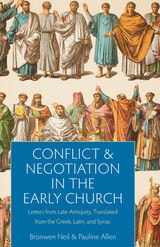
Conflict and Negotiation in the Early Church
Letters from Late Antiquity, Translated from the Greek, Latin, and SyriacBronwen Neil
Catholic University of America Press, 2020
Conflict and Negotiation in the Early Church focuses on the period 500 to 700 CE, one of the least documented periods in the history of the church, but also one of the most formative, whose conflicts resonate still in contemporary Christian communities, especially in the Middle East.
To uncover the hidden history of this period and its theological controversies, Neil and Allen have tapped a little known written source, the letters that were exchanged by bishops, emperors and other civic leaders of the sixth and seventh centuries. This was an era of crisis for the Byzantine empire, at war first with Persia, and then with the Arab forces united under the new faith of Islam. Official letters were used by the churches of Rome and Constantinople to pursue and defend their claims to universal and local authority, a constant source of conflict. As well as the east-west struggle, Christological disagreements with the Syrian church demanded increasing attention from the episcopal and imperial rulers in Constantinople, even as Rome set itself adrift and looked to the West for new allies.
From this troubled period, 1500 letters survive in Greek, Latin, and Syriac. With translations of a number of these, many rendered into English for the first time, Conflict and Negotiation in the Early Church examines the ways in which diplomatic relations between churches were developed, and in some cases hindered or even permanently ruptured, through letter-exchange at the end of Late Antiquity.
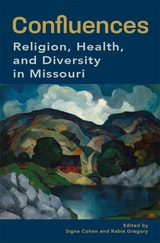
Confluences
Religion, Health, and Diversity in MissouriSigne Cohen
University of Missouri Press, 2025
The contributors to this volume explore connections between religious affiliation, race, gender, ethnicity, epidemiology, and attitudes towards health and medicine in Missouri from the nineteenth century to the present day. They ask what role religious belief systems play in healthcare outcomes and offer important arguments for building a dialogue between faith communities and medical caregivers. Centering on Missouri as a site for religious transformation and diversity, this volume documents how religious perspectives shape contemporary America.
Initial chapters outline the religious history of Missouri, relaying the history of medicine in the region before and after Missouri statehood. Subsequent essays document Missouri’s religious diversity by contemplating Native American, Asian American, and African American religious experiences in Missouri, intentionally recovering and respectfully contextualizing understudied events and forgotten individuals. The volume’s remaining essays consider religious responses to the Cholera, Influenza, and Covid-19 epidemics and show how Native American, Euro-American, and African American Missourians have transformed U.S. history and healthcare. Collectively, the essays in this book demonstrate that religious freedom, medical knowledge, and transnational encounters are woven into the historical fabric of the region.
Featuring essays by experts in Religious Studies and Health Sciences, this volume will be of interest to scholars of religion, sociology, public health, and medicine, as well as readers more generally interested in the history and culture of Missouri.
Confronting Vulnerability
The Body and the Divine in Rabbinic EthicsJonathan Wyn Schofer
University of Chicago Press, 2010
While imparting their ethical lessons, rabbinic texts often employ vivid images of death, aging, hunger, defecation, persecution, and drought. In Confronting Vulnerability, Jonathan Wyn Schofer carefully examines these texts to find out why their creators thought that human vulnerability was such a crucial tool for instructing students in the development of exemplary behavior.
These rabbinic texts uphold virtues such as wisdom and compassion, propound ideal ways of responding to others in need, and describe the details of etiquette. Schofer demonstrates that these pedagogical goals were achieved through reminders that one’s time on earth is limited and that God is the ultimate master of the world. Consciousness of death and of divine accounting guide students to live better lives in the present. Schofer’s analysis teaches us much about rabbinic pedagogy in late antiquity and also provides inspiration for students of contemporary ethics. Despite their cultural distance, these rabbinic texts challenge us to develop theories and practices that properly address our frailties rather than denying them.
Congregation and Community
Ammerman, Nancy
Rutgers University Press, 1996
Change--in population, economy, and culture--is sweeping through American communities. Corner groceries are stocking new foods. New roads are being built and Main Streets abandoned. Schools have come and gone, and old friends move away as strangers arrive. But in every community, no matter how volatile, religious institutions provide for their members places of moral guidance and spiritual nurture, civic participation, and identity.
How do congregations react to significant community change? Why do some religious institutions decline in the face of racial integration while others adapt and grow? How do congregations make sense of economic distress? Do they provide havens from community upheaval or vehicles for change? Congregation and Community is the most comprehensive study to date of congregations in the face of community transformation. Nancy Ammerman and her colleagues include stories of over twenty congregations in nine communities from across the nation, communities with new immigrant populations, growing groups of gays and lesbians, rapid suburbanization, and economic dislocations.
With almost half of the nation's population attending religious services each week, it is impossible to understand change in American society without a close look at congregations. Congregation and Community will exist as a standard resource for years to come, and clergy, academics, and general readers alike will benefit from its insights.
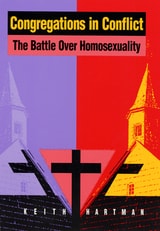
Congregations in Conflict
The Battle over HomosexualityHartman, Keith
Rutgers University Press, 1996
A Methodist church puts its minister on trial after he marches in a gay rights parade. A Quaker meeting struggles to decide whether to marry a lesbian couple. An entire congregation is thrown out of the Southern Baptist Convention for deciding that a gay divinity student had a sincere calling to the ministry, and an order of celibate monks comes out of the closet. An Episcopal priest blesses two same-sex relationships--then a closeted gay lawyer leads the charge to have him fired.
Homosexuality is the most divisive issue facing churches today. Like the issue of slavery 150 years ago, it is a matter that ignites passionate convictions on both sides, a matter that threatens to turn members of the same faith against each other, to divide congregations, and possibly even to fragment several denominations. Like slavery, it is an issue that calls up basic questions about what it means to be a Christian. How does one know right from wrong? Is the Bible fallible? Do good Christians always follow their church's teachings, or are they allowed to think for themselves on moral issues? And to what source does one finally look to determine what God really wants?
While many books have been written analyzing the scriptural and theological dimensions of the conflict, none has yet shown how it is being played out in the pews. Congregations in Conflict examines nine churches that were split by disagreements over gay and lesbian issues, and how the congregations resolved them.
Hartman explores in very readable prose how different denominations have handled their conflicts and what it says about the nature of their faith. He shows some churches coming through their struggles stronger and more unified, while others irrevocably split. Most importantly, he illuminates how people with a passionate clash of beliefs can still function together as a community of faith.
Connexions
Histories of Race and Sex in North AmericaEdited by Jennifer Brier, Jim Downs, and Jennifer L. Morgan
University of Illinois Press, 2016
Conquered Conquerors
Love and War in the Song of SongsDanilo Verde
SBL Press, 2020
The first comprehensive study of the Song of Songs' use of military metaphors
Although love transcends historical and cultural boundaries, its conceptualizations, linguistic expressions, and literary representations vary from culture to culture. In this study, Danilo Verde examines love through the military imagery found throughout the Song’s eight chapters. Verde approaches the military metaphors, similes, and scenes of the Song using cognitive metaphor theory to explore the overlooked representation of love as war. Additionally, this book investigates how the Song conceptualizes both the male and the female characters, showing that the concepts of masculinity and femininity are tightly interconnected in the poem. Conquered Conquerors provides fresh insights into the Song's figurative language and the conceptualization of gender in biblical literature.
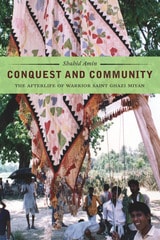
Conquest and Community
The Afterlife of Warrior Saint Ghazi MiyanShahid Amin
University of Chicago Press, 2016
Conquest and Community is Shahid Amin's answer. Covering more than eight hundred years of history, the book centers on the enduringly popular saint Ghazi Miyan, a youthful soldier of Islam whose shrines are found all over India. Amin details the warrior saint’s legendary exploits, then tracks the many ways he has been commemorated in the centuries since. The intriguing stories, ballads, and proverbs that grew up around Ghazi Miyan were, Amin shows, a way of domesticating the conquest—recognizing past conflicts and differences but nevertheless bringing diverse groups together into a community of devotees. What seems at first glance to be the story of one mythical figure becomes an allegory for the history of Hindu-Muslim relations over an astonishingly long period of time, and a timely contribution to current political and historical debates.
Consensual Incapacity to Marry
Catherine Godfrey-Howell
St. Augustine's Press, 2019
The anthropology that supports marriage perceives justice to be a particular reality, and for this reason marriage will always be a subject of law and of great interest to jurists and sociologists alike. With respect to the realization of justice in marriage, understood as the moment the bond is created, Catholic ecclesiology and canon law articulate an original legal category––namely, the consensual incapacity to marry. In the last fifty years, however, and despite the juridical innovations provided by the current Code of Canon Law promulgated in 1983, American canonical practice in the sphere of marriage law has lost its foundation. The consequences of this include mechanisms of judgment that are rendered incoherent although not inactive, particularly in local tribunals reviewing claims of marriage nullity. In other words, the application of law in the Catholic Church moves forward without a clear indication of its anthropological basis. Canon law, then, on the issue of marriage is perceived to be purposefully oppressive or absolutely meaningless.
Jurists, scholars, and members of the Roman Curia acknowledge that, more than a general response to this crisis of law and marriage, what might be needed most is greater scrutiny of the canon in which the formula for consensual incapacity appears. It is furthermore acknowledged that American canonical practice is perhaps the most influential in the world, and is responsible for shaping and sustaining the global attention given to this issue. To fully grasp the crisis and the best way forward, a profile of this canon in American jurisprudence is fundamental and demanded presently. The new course charted by canonical studies and formation of jurists, as well as the new developments in ecclesiastical legislation, will find guidance in this study provided by Catherine Godfrey-Howell, and further insight in the foreword given by the American Cardinal prelate and former Prefect of the Apostolic Signatura, Raymond Leo Cardinal Burke.
Consolation to Stagirius
Robert G.T. St. John Chrysostom
Catholic University of America Press, 2025

Conspicuous Bodies
Provincial Belief and the Making of Joyce and RushdieJean Kane
The Ohio State University Press, 2014
Conspicuous Bodies presents Joyce as a founder and Rushdie as an inheritor of a distinctive discourse of belief about the importance of physical bodies and knowledge in religious practice. In doing so, it moves the reception of Joyce and Rushdie away from what previous critics have emphasized—away from questions of aesthetics and from a narrow understanding of belief—and instead questions the assumption that belief should be segregated from matters of physicality and knowledge. Kane reintroduces the concept of spiritual embodiment in order to expand our understanding of what counts as spiritual agency in non-western and minority literatures.
Constructing Antichrist
Paul, Biblical Commentary, and the Development of Doctrine in the Early Middle AgesKevin L. Hughes
Catholic University of America Press, 2005
Constructing Nineteenth-Century Religion
Literary, Historical, and Religious Studies in DialogueEdited by Joshua King and Winter Jade Werner
The Ohio State University Press, 2019
The participle in its title—Constructing—acknowledges that any articulation of nineteenth-century religion is never just a work of the past: scholars also actively construct religion as their disciplinary assumptions (and indeed personal and lived investments) shape their research and findings. Constructing NineteenthCentury Religion newly analyzes the diverse ways in which religion was debated and deployed in a wide range of nineteenthcentury texts and contexts. While focusing primarily on nineteenthcentury Britain, the collection also contributes to the increasingly transnational and transcultural outlook of postsecular studies, drawing connections between Britain and the United States, continental Europe, and colonial India.
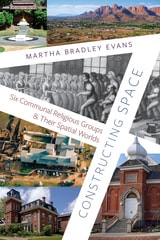
Constructing Space
Six Communal Religious Groups and Their Spatial WorldsMartha Bradley Evans
University of Utah Press, 2025
Religion transforms and inspires specific ways of living in the world. Through architecture and the built environment, members of religious communities communicate intangible beliefs about God, gender and family, the sacred and profane, and more. This captivating volume explores the spatial worlds of six different religious communities— the Latter-day Saints, the Oneida Colony, the Shakers, the Branch Davidians, the FLDS, and Adidam—through the architecture and cultural landscapes they built.
What does the strict order and regularity of a Shaker village tell us about the community’s hierarchies and relationships? How might a temple building site affect an LDS Church member’s daily life? Constructing Space reveals the hidden language of meaning, association, and identity that religious persons speak as they mold their faith into concrete forms, and how they interpret the meanings of those spaces within their practices.
Constructing and Deconstructing Power in Psalms 107-150
W. Dennis Tucker Jr.
SBL Press, 2014
Essential research on the relationship between the Persian empire and the the formation of the book of Psalms
In this latest entry in the Ancient Israel and Its Literature series, W. Dennis Tucker, Jr. examines the role of Persian imperial ideology in the creation of psalms in Book 5 of the Psalter and in the shaping of the book of Psalms as a whole. Although much research has been conducted on the relationship between the Persian empire and the creation of biblical texts, the book of Psalms has been largely absent from this discussion. Tucker seeks to rectify this omission by illustrating that Book 5 constructed a subtle anti-imperial ideology in response to the threats imposed from all empires both past and present.
Features:
- Close study of the psalms portrayal of human power to that of Yahweh
- Comparison of Achaemenid propaganda to the ideology found in the psalms
- Evidence drawn from Persian iconography and inscriptions

Constructs of Prophecy in the Former and Latter Prophets and Other Texts
Lester L. Grabbe
SBL Press, 2011
Explore the ancient context of prophecy and prophetic figures
This collection of essays examines the construction of prophecy in the Former and Latter Prophets, Chronicles, Daniel, and even in the Quran. This unique anthology recognizes that these texts do not simply describe the prophetic phenomena but rather depict prophets according to various conventional categories or their own individual points of view. Each essay analyzes how these writings portray prophecy or prophets to better understand how the respective authors structured their writings.
Features
- Introduction and twelve essays cover prophecy in the Hebrew Bible and the Quran
- Essays examine the relationship between the prophets and the cult, oral pronouncements and written collections, and divination, prophecy, and apocalypticism
- Additional essays raise questions about the prophetic persona and examine the prophets in hermeneutical perspective
Consuming Religion
Kathryn Lofton
University of Chicago Press, 2017
What are you drawn to like, to watch, or even to binge? What are you free to consume, and what do you become through consumption? These questions of desire and value, Kathryn Lofton argues, are questions for the study of religion. In eleven essays exploring soap and office cubicles, Britney Spears and the Kardashians, corporate culture and Goldman Sachs, Lofton shows the conceptual levers of religion in thinking about social modes of encounter, use, and longing. Wherever we see people articulate their dreams of and for the world, wherever we see those dreams organized into protocols, images, manuals, and contracts, we glimpse what the word “religion” allows us to describe and understand.
With great style and analytical acumen, Lofton offers the ultimate guide to religion and consumption in our capitalizing times.
Consuming Religion
Kathryn Lofton
University of Chicago Press, 2017
What are you drawn to like, to watch, or even to binge? What are you free to consume, and what do you become through consumption? These questions of desire and value, Kathryn Lofton argues, are questions for the study of religion. In eleven essays exploring soap and office cubicles, Britney Spears and the Kardashians, corporate culture and Goldman Sachs, Lofton shows the conceptual levers of religion in thinking about social modes of encounter, use, and longing. Wherever we see people articulate their dreams of and for the world, wherever we see those dreams organized into protocols, images, manuals, and contracts, we glimpse what the word “religion” allows us to describe and understand.
With great style and analytical acumen, Lofton offers the ultimate guide to religion and consumption in our capitalizing times.
Contemplation and Kingdom
Kevin Hart
St. Augustine's Press, 2020
This book is vintage Hart, erudite, well written, a treat for a wide readership. It is an example of how theology ought to be done, with a clarity and depth unsurpassed in today’s scholarly world. Its blend of anglo-saxon elegance and continental insights will be praised in the Academy and outside. – Jean-Yves Lacoste, Clare Hall, Cambridge
In the light of great contemporary interest in contemplation, this brilliant and erudite work is a stunning example. The focus on Richard of St. Victor and Thomas Aquinas is especially appropriate. Theologians and philosophers will be especially thankful for Kevin Hart’s work on the actuality of contemplation. – David Tracy, University of Chicago
Kevin Hart holds the Edwin B. Kyle Chair of Christian Theology at the University of Virginia where he is also Courtesy Professor of English and Courtesy Professor of French. In 2020 he was awarded the Aquinas Medal by the Department of Philosophy at the University of Dallas. His 2020 Étienne Gilson Lectures, given at L'Institut Catholique de Paris, offer a fresh approach to the theology of the imago dei in Augustine. His 2020 Gifford Lectures, given at Glasgow University, examine various questions to do with the theology of contemplation and propose a new "hermeneutics of contemplation." His most recent scholarly publications include Kingdoms of God and Poetry and Revelation, and his most recent collections of poetry are Wild Track: New and Selected Poems and Barefoot.
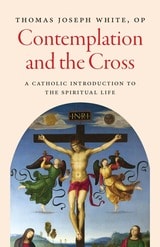
Contemplation and the Cross
A Catholic Introduction to the Spiritual LifeThomas Joseph White, OP
Catholic University of America Press, 2025
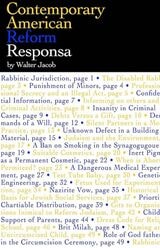
Contemporary American Reform Responsa - PDF Electronic Version
Rabbi Walter Jacob
Central Conference of American Rabbis, 1987
When is abortion permitted? Should smoking be banned in synagogue buildings? Do we recite Kaddish for a convicted criminal? May human blood be sold for medical purposes? What is the Reform position on the use of mikvah? These questions and more are the topic of this volume, edited by Rabbi Walter Jacob and originally published in 1987. The questions included in this volume reflect the concerns of Reform Jews at the time the book was published, and much of it is still relevant today.
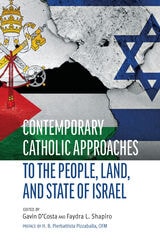
Contemporary Catholic Approaches to the People, State, and Land of Israel
Gavin D'Costa
Catholic University of America Press, 2021
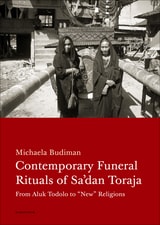
Contemporary Funeral Rituals of Sa'dan Toraja
From Aluk Todolo to "New" ReligionsMichaela Budiman
Karolinum Press, 2013
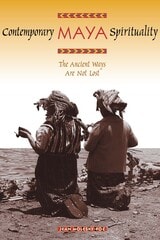
Contemporary Maya Spirituality
The Ancient Ways Are Not LostBy Jean Molesky-Poz
University of Texas Press, 2006
Since the mid-1980s, when Guatemala returned to civilian rule and achieved relative peace and stability, the Maya have begun openly expressing their spiritual beliefs and practices. Jean Molesky-Poz draws on in-depth dialogues with Maya Ajq'ijab' (keepers of the ritual calendar), her own participant observation, and inter-disciplinary resources to offer a comprehensive, innovative, and well-grounded understanding of contemporary Maya spirituality and its theological underpinnings. She reveals significant continuities between contemporary and ancient Maya worldviews and spiritual practices.
Molesky-Poz opens with a discussion of how the public emergence of Maya spirituality is situated within the religious political history of the Guatemalan highlands, particularly the recent pan-Maya movement. She investigates Maya cosmovision and its foundational principles, as expressed by Ajq'ijab'. At the heart of this work, Ajq'ijab' interpret their obligation, lives, and spiritual work. In subsequent chapters, Molesky-Poz explores aspects of Maya spirituality—sacred geography (the reciprocal relationship between the earth and humans, sacred places, and the significance of the cross or quatrefoil map), sacred time (how the 260-day sacred calendar is "the heart of the wisdom of the Maya," the matrix of Maya culture), and ritual practice (the distinct way and method of ancestral study, with special attention to fire ceremonialism). She confirms contemporary Maya spirituality as a faith tradition with elaborate historical roots that has significance for individual, collective, and historical lives, reaffirming its own public space and legal right to be practiced.
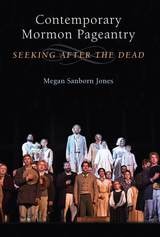
Contemporary Mormon Pageantry
Seeking After the DeadMegan Sanborn Jones
University of Michigan Press, 2018
Contemporary Mormonism
SOCIAL SCIENCE PERSPECTIVESEdited by Marie Cornwall, Tim B. Heaton, and Lawrence A. Young
University of Illinois Press, 1994
Contemporary Reform Responsa - PDF Electronic Version
Rabbi Solomon B. Freehof
Central Conference of American Rabbis, 1974
Can a synagogue share a building with a Unitarian Church? Can a religious marriage be performed without a civil marriage? Is it allowed to photocopy from books? Must a convert be buried in a Jewish cemetery?
These questions and more are the topic of this volume, edited by Dr. Solomon Freehof and originally published in 1974. The questions included in this volume reflect the concerns of Reform Jews at the time the book was published, much of which is still relevant today.
Contested Boundaries
Itinerancy and the Reshaping of the Colonial American Religious WorldTimothy D. Hall
Duke University Press, 1994
This book expands our understanding of evangelical itinerancy in the 1740s by viewing it within the context of Britain’s expanding commercial empire. As pro- and anti-revivalists tried to shape a burgeoning transatlantic consumer society, the itinerancy of the Great Awakening appears here as a forceful challenge to contemporary assumptions about the place of individuals within their social world and the role of educated leaders as regulators of communication, order, and change. The most celebrated of these itinerants was George Whitefield, an English minister who made unprecedented tours through the colonies. According to Hall, the activities of the itinerants, including Whitefield, encouraged in the colonists an openness beyond local boundaries to an expanding array of choices for belief and behavior in an increasingly mobile and pluralistic society. In the process, it forged a new model of the church and its social world.
As a response to and a source of dynamic social change, itinerancy in Hall’s powerful account provides a prism for viewing anew the worldly and otherworldly transformations of colonial society. Contested Boundaries will be of interest to students and scholars of colonial American history, religious studies, and cultural and social anthropology.
Contested Canonizations
The Last Medieval Saints, 1482-1523Ronald C. Finucane
Catholic University of America Press, 2011
Contested Reproduction
Genetic Technologies, Religion, and Public DebateJohn H. Evans
University of Chicago Press, 2010
Scientific breakthroughs have led us to a point where soon we will be able to make specific choices about the genetic makeup of our offspring. In fact, this reality has arrived—and it is only a matter of time before the technology becomes widespread.
Much like past arguments about stem-cell research, the coming debate over these reproductive genetic technologies (RGTs) will be both political and, for many people, religious. In order to understand how the debate will play out in the United States, John H. Evans conducted the first in-depth study of the claims made about RGTs by religious people from across the political spectrum, and Contested Reproduction is the stimulating result.
Some of the opinions Evans documents are familiar, but others—such as the idea that certain genetic conditions produce a “meaningful suffering” that is, ultimately, desirable—provide a fascinating glimpse of religious reactions to cutting-edge science. Not surprisingly, Evans discovers that for many people opinion on the issue closely relates to their feelings about abortion, but he also finds a shared moral language that offers a way around the unproductive polarization of the abortion debate and other culture-war concerns. Admirably evenhanded, Contested Reproduction is a prescient, profound look into the future of a hot-button issue.
Contesting Sacrifice
Religion, Nationalism, and Social Thought in FranceIvan Strenski
University of Chicago Press, 2002
Strenski suggests that the annihilating spirituality rooted in the Catholic model of Eucharistic sacrifice persuaded the judges in the Dreyfus Case to overlook or play down his possible innocence because a scapegoat was needed to expiate the sins of France and save its army from disgrace. Strenski also suggests that the French army's strategy in World War I, French fascism, and debates over public education and civic morals during the Third Republic all owe much to Catholic theology of sacrifice and Protestant reinterpretations of it. Pointing out that every major theorist of sacrifice is French, including Bataille, Durkheim, Girard, Hubert, and Mauss, Strenski argues that we cannot fully understand their work without first taking into account the deep roots of sacrificial thought in French history.
Contextualizing Israel's Sacred Writings
Ancient Literacy, Orality, and Literary ProductionBrian B. Schmidt
SBL Press, 2015
An essential resource exploring orality and literacy in the pre-Hellenistic southern Levant and the Hebrew Bible
Situated historically between the invention of the alphabet, on the one hand, and the creation of ancient Israel's sacred writings, on the other, is the emergence of literary production in the ancient Levant. In this timely collection of essays by an international cadre of scholars, the dialectic between the oral and the written, the intersection of orality with literacy, and the advent of literary composition are each explored as a prelude to the emergence of biblical writing in ancient Israel. Contributors also examine a range of relevant topics including scripturalization, the compositional dimensions of orality and textuality as they engage biblical poetry, prophecy, and narrative along with their antecedents, and the ultimate autonomy of the written in early Israel. The contributors are James M. Bos, David M. Carr, André Lemaire, Robert D. Miller II, Nadav Na'aman, Raymond F. Person Jr., Frank H. Polak, Christopher A. Rollston, Seth L. Sanders, Joachim Schaper, Brian B. Schmidt, William M. Schniedewind, Elsie Stern, and Jessica Whisenant.
Features
- Addresses questions of literacy and scribal activity in the Levant and Negev
- Articles examine memory, oral tradition, and text criticism
- Discussion of the processes of scripturalization
Continuing Revelation
Essays on DoctrineBryan Buchanan
Signature Books, 2021
Determining what is and what is not Mormon doctrine is a difficult endeavor. The Church of Jesus Christ of Latter-day Saints embraces four books of scripture as its canon, but also believes the church is led by a living prophet. Additions to the canon have been rare since the death of church founder Joseph Smith. Joseph Fielding Smith, tenth church president, said that if the prophet ever contradicts canon, canon prevails. On the other hand, Ezra Taft Benson, the church’s thirteenth president, said that the living prophet’s words are more important than cannon. Such messages create no shortage of confusion among church members.
The question “What is doctrine?” opens the door for theologians and historians to wrestle over the answer, and to do so thoughtfully and insightfully. In Continuing Revelation, editor Bryan Buchanan has compiled essays that seek greater understanding about what doctrine is and why it matters.
The Challenge of Defining LDS Doctrine, by Loyd Isao Ericson • LDS Theology and the Omnis: The Dangers of Theological Speculation, by David H. Bailey • Crawling out of the Primordial Soup: A Step toward the Emergence of an LDS Theology Compatible with Organic Evolution, by Steven L. Peck • “To Destroy the Agency of Man”: The War in Heaven in LDS Thought, by Boyd Petersen • Three Sub-Degrees in the Celestial Kingdom?, by Shannon P. Flynn • Heavenly Mother: The Mother of All Women, by Blaire Ostler • Mormonism and the Problem of Heterodoxy, by Kelli D. Potter • Women at the Gates of Mortality: Relief Society Birth and Death Rituals, by Susanna Morrill • “Shake Off the Dust of Thy Feet”: The Rise and Fall of Mormon Ritual Cursing, by Samuel R. Weber • “Satan Mourns Naked Upon the Earth: Locating Mormon Possession and Exorcism Rituals in the American Religious Landscape, 1830–1977, by Stephen C. Taysom
Continuing the Quest for Morality Truly Christian, Truly African
The Achievement of Paulinus Odozor, C,S,Sp.Maurice Ashley Agbaw-Ebai
St. Augustine's Press, 2025
Paulinus Ikechukwu Odozor is among the preeminent moral theologians of our time. He has reached the pinnacle of his profession after serving more than two decades as a professor of theology at the University of Notre Dame. Among African theologians, he stands at the forefront of the generation that came of age in the early postconciliar period. Fr. Odozor’s work in Morality Truly Christian, Truly African: Foundational, Methodological, and Theological Considerations (2014) has become a classic in the field of Catholic moral theology. His contribution to reuniting moral theology to dogmatics is a key element to processing the contention in theological scholarship in the wake of Vatican II and the shifting of the socio-economic global landscape. Understanding the influence of theologians such as Richard McCormick, Charles Curran, and Edward Schillebeeckx, Fr. Odozor, he is unable to ignore the work of John Paul II, Joseph Ratzinger, Joseph Boyle, and John Cavadini as essential to the age of renewal in the field of moral theology.
The essays in this volume highlight the fruits of Fr. Odozor's ability to move between the spheres of moral and dogmatic theology, and his particular treatment of the nature of God, ecclesiology, and interreligious dialogue. He is a theologian who is rightly positioned within a postconciliar moral theological context, and his thought is critical as we enter a new era in the Church that no longer takes Vatican II as its reference point––that is, the Church is reorienting toward the future, in continuity but seeking to discern what lies ahead. Claiming postconciliar theologians shared basic agreement regarding the mission of the Church, within the foggy contention among pre- and postconciliar moral theologians Odozor sees a legitimate albeit complex connection. Fr. Odozor's appreciation for Humanae Vitae and Veritatis Splendor is clear, and his fidelity to seeing issues like contraception as a "God question" and representing the concerns and voices of Africa make him an indispensable leader of the Church in this field of study. His mission to "bring Africa to the University of Notre Dame, and Notre Dame to Africa," has been more successful than former dean John Cavadini expected: African theology is no longer separated from the wider world thanks to this partnership and Fr. Odozor's acumen to establish moral theology's stature in the wider field.
Contributions include: Maurice Agbaw-Ebai, "Ratzinger's Theological Anthropology in Conversation with Aspects of Paulinus Odozor's Understanding of the Human Person in Christ"; Raymond Olusesan Aina, MSP, "Paulinus Ikechukwu Odozor’s Unfinished Quest for a Truly African and Christian Moral Theology of Marriage"; Anthony Akinwale, OP, "Politics, the Common Good and Holiness"; Melanie Susan Barrett, "Aquinas, Balthasar, and African Tradition: Christian Conversion of Individuals and Cultures"; Jana M. Bennett, "The Importance of Anamnesis for Moral Life"; John Berkman, "Abominations and Absolute Prohibitions: Killing the Innocent According to Anscombe and Odozor"; John C. Cavadini, "African Theology and a Classical Theory of Inculturation"; David A. Clairmont, "Catholic Comparative Theological Ethics: Elements of an Approach to Tradition, Ethics, and Dialogue (with Odozor and Clooney, in the Church)"; David Elliot, "The Legacy of the African Church Fathers to St. Thomas Aquinas’ Account of Virtue Growth and Spiritual Practice"; Dennis Kasule, "Facing Up to the Challenge of Moral Formation in African Catechumenates Today: Drawing on African Catechumenates of the Past and Paulinus Odozor’s Seven Guidelines for Inculteration"; Matthew Levering, "Natural Law in Bénézet Bujo, Paulinus Odozor, and Stephen L. Brock"; Tegha Afuhwi Nji, "Paulinus Odozor and Joseph Ratzinger on the Question of Moral Objectivity: A Morality Truly African and Truly Christian?"; Emmanuel Ojeifo, "African and Christian: Black Sanctity and the Future of African Catholicism"; Bede Ukwuije, C.S.Sp., "Trinitarian Conception of God as Basis for an African Christian Ethics"; Paulinus Odozor, C.S.Sp., "Continuing the Quest for a Morality Truly Christian and African."
Continuing the Reformation
Essays on Modern Religious ThoughtB. A. Gerrish
University of Chicago Press, 1993
Gerrish devotes three essays to each of four topics: Martin Luther and the Reformation; religious belief and the Age of Reason; Friedrich Schleiermacher and the renewal of Protestant theology; and Schleiermacher's disciple Ernst Troeltsch, for whom the theological task was to give a rigorous account of the faith prevailing in a particular religious community at a particular time. Gerrish shows how faith itself has become a primary object of inquiry, not only in the newly emerging philosophy of religion but also in a new style of church theology which no longer assumes that faith rests on immutable dogmas. For Gerrish, the new theology of Protestant liberalism takes for its primary object of inquiry the changing forms of the religious life. This important book will interest scholars of systematic Christian theology, modern intellectual and cultural history, and the history and philosophy of religion.
Contraception and Persecution
Charles E. Rice
St. Augustine's Press, 2014
Contradiction and Conflict
The Popular Church in NicaraguaDebra Sabia
University of Alabama Press, 2013
Debra Sabia describes and analyzes the rise, growth, and fragmentation of the popular church and assesses the effect of the Christian base communities on religion, politics, and the nation's social revolutionary experiment.
Controlling Corporeality
The Body and the Household in Ancient IsraelBerquist, Jon L.
Rutgers University Press, 2002
Human bodily existence is at the core of the Torah and the rest of the Hebrew Scriptures—from birth to death. From God’s creation of Adam out of clay, to the narratives of priests and kings whose regulations governed bodily practices, the Hebrew Bible focuses on the human body. Moreover, ancient Israel’s understanding of the human body has greatly influenced both Judaism and Christianity. Despite this pervasive influence, ancient Israel’s view of the human body has rarely been studied and, until now, has been poorly understood.
In this beautifully written book, Jon L. Berquist guides the reader through the Hebrew Bible, examining ancient Israel’s ideas of the body, the unstable roles of gender, the deployment of sexuality, and the cultural practices of the time. Conducting his analysis with reference to contemporary theories of the body, power, and social control, Berquist offers not only a description and clarification of ancient Israelite views of the body, but also an analysis of how these views belong to the complex logic of ancient social meanings. When this logic is understood, the familiar Bible becomes strange and opens itself to a wide range of new interpretations.
Controversial Concordats
The Vatican's Relations with Napoleon, Mussolini, and HitlerFrank J. Coppa
Catholic University of America Press, 1999
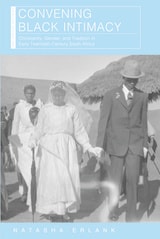
Convening Black Intimacy
Christianity, Gender, and Tradition in Early Twentieth-Century South AfricaNatasha Erlank
Ohio University Press, 2022
An unprecedented study of how Christianity reshaped Black South Africans’ ideas about gender, sexuality, marriage, and family during the first half of the twentieth century.
This book demonstrates that the primary affective force in the construction of modern Black intimate life in early twentieth-century South Africa was not the commonly cited influx of migrant workers but rather the spread of Christianity. During the late nineteenth and early twentieth centuries, African converts developed a new conception of intimate life, one that shaped ideas about sexuality, gender roles, and morality.
Although the reshaping of Black intimacy occurred first among educated Africans who aspired to middle-class status, by the 1950s it included all Black Christians—60 percent of the Black South African population. In turn, certain Black traditions and customs were central to the acceptance of sexual modernity, which gained traction because it included practices such as lobola, in which a bridegroom demonstrates his gratitude by transferring property to his bride’s family. While the ways of understanding intimacy that Christianity informed enjoyed broad appeal because they partially aligned with traditional ways, other individuals were drawn to how the new ideas broke with tradition. In either case, Natasha Erlank argues that what Black South Africans regard today as tradition has been unequivocally altered by Christianity.
In asserting the paramount influence of Christianity on unfolding ideas about family, gender, and marriage in Black South Africa, Erlank challenges social historians who have attributed the key factor to be the migrant labor system. Erlank draws from a wide range of sources, including popular Black literature and the Black press, African church and mission archives, and records of the South African law courts, which she argues have been underutilized in histories of South Africa. The book is sure to attract historians and other scholars interested in the history of African Christianity, African families, sexuality, and the social history of law, especially colonial law.
Convent Paradise
Arcangela Tarabotti
Iter Press, 2020
The Other Voice in Early Modern Europe - The Toronto Series volume 73
Conversion
Miriam Bodian
Rutgers University Press, 2026
Conversion of a Continent
Contemporary Religious Change in Latin AmericaSteigenga, Timothy
Rutgers University Press, 2007
Conversion of a Continent brings together twelve original essays that document and explore competing explanations for how and why conversion has occurred. Contributors draw on various insights from social movement theory to religious studies to help outline its impact on national attitudes and activities, gender relations, identity politics, and reverse waves of missions from Latin America aimed at the American immigrant community.
Unlike other studies on religious conversion, this volume pays close attention to who converts, under what circumstances, the meaning of conversion to the individual, and how the change affects converts’ beliefs and actions. The thematic focus makes this volume important to students and scholars in both religious studies and Latin American studies.
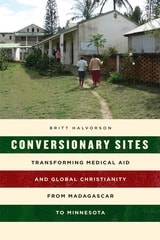
Conversionary Sites
Transforming Medical Aid and Global Christianity from Madagascar to MinnesotaBritt Halvorson
University of Chicago Press, 2018
A nuanced critique of the ambivalent relationships among religion, capitalism, and humanitarian aid, Conversionary Sites draws important connections between religion and science, capitalism and charity, and the US and the Global South.
Coptic Manuscripts in the Freer Collection
Part I. The Coptic Psalter in the Freer CollectionEdited by William H. Worrell
University of Michigan Press, 1916
Cormac McCarthy
An American ApocalypseMarkus Wierschem
Michigan State University Press, 2024
Correspondence on Christology and Grace
Rob Roy McGregor
Catholic University of America Press, 2013