Results by title
297 books match the query 'Alabama' and 13 start with d

Darkroom
A Memoir in Black and WhiteLila Quintero Weaver
University of Alabama Press, 2012
A Latina girl’s journey through the shadows of the civil rights era.
Darkroom is a deeply moving graphic memoir that chronicles Lila Quintero Weaver’s experience growing up as an Argentine immigrant in 1960s Alabama during the height of the civil rights movement. Through striking black-and-white illustrations and heartfelt narrative, Weaver explores the complexities of race, identity, and belonging in a society divided by segregation. Neither Black nor White, her family occupies a unique position that offers a powerful lens on the struggles for justice and equality. This coming-of-age story blends personal history with pivotal social change, inviting readers to reflect on themes of immigration, cultural assimilation, and moral courage. Darkroom is both an intimate portrait and a universal tale of resilience, making it an essential read for those interested in civil rights, memoirs, and graphic storytelling.
Dead Towns of Alabama
W. Stuart Harris
University of Alabama Press, 2001
Rediscover Alabama's long-vanished towns, forts, settlements, and former state capitals that time left behind.
Dead Towns of Alabama is not merely a series of obituaries for dead towns. Instead, it brings back to life 83 Indian towns, 77 fort sites, and 112 colonial, territorial, and state towns. W. Stuart Harris conjures up a wealth of fascinating images from Alabama's rich and colorful past--images of life as the Indians lived it, of colonial life in the wilderness, of Spanish explorers and French exiles, of danger and romance, of riverboats and railroads, of plantations and gold mines, of stagecoaches and ferries. Overall, it presents a thoroughly absorbing panorama of Alabama's early history.
Here we learn about two former capitals--St. Stephens and Cahaba--that have deteriorated to mouldering ruins now. We learn about once thriving communities--county seats, river landings and crossings, trading posts, junctions, and other settlements--that time has forgotten. Absent from most maps, these sites come alive again in Harris's fascinating account, filled anew with the bustling activity of their former inhabitants.
First published in 1977, Dead Towns of Alabama is a unique guidebook to every region of the state. It is an invaluable resource for historians, students, tourists, and anyone interested in exploring Alabama's interesting historical and cultural past.

Dear Denise
Letters to the Sister I Never KnewLisa McNair
University of Alabama Press, 2022
Poignant, honest, and heartfelt letters to a sister who perished in the 16th Street Baptist Church bombing.
Lisa McNair was born in 1964, one year after her older sister, Denise, was murdered in the bombing of the 16th Street Baptist Church in Birmingham, Alabama. Dear Denise is a collection of forty letters from Lisa addressed to the sister she never knew, but in whose shadow of sacrifice and lost youth she was raised. These letters offer an intimate look into the life of a family touched by one of the most heinous tragedies of the Civil Rights Movement.
Written in a genuine, accessible, familiar, and easy-to-read voice, Lisa’s letters apprise her late sister of all that has come to pass in the years since her death. Lisa considers her own challenges and accomplishments as a student in remarkably different—and very racially complex—schools; the birth of their baby sister, Kim; their father’s election to the Alabama legislature; her evolving sense of faith and place, and sometimes lack thereof, within the Black church; her college experiences; and her own sense of self as she’s matured into adulthood. She reveals some of the family’s difficulties and health challenges, and shares some of their joys and celebrations.
The letters are accompanied by 29 black-and-white photographs, most of them from the McNair family collection, many of them taken by her father, a professional photographer who documented the Civil Rights Movement in Alabama both before and after Denise’s murder. An unswervingly candid, gentle, and nuanced book, Dear Denise is a testament to one singular life lived bravely and truthfully (if sometimes confusedly or awkwardly), during decades of bewildering social change and in the shadow of one life never fully lived.
Death at Cross Plains
An Alabama Reconstruction TragedyGene L. Howard with a foreword by Gary B. Mills
University of Alabama Press, 1984
Reconstruction in the South is a much studied and yet little understood period in the region’s history. In many areas it was marked by such violence as to have been guerrilla warfare in all but name. Death at Cross Plains is the gripping story of one local incident that illuminates the aftermath of the Civil War throughout the region.
Deep South Dynasty
The Bankheads of AlabamaKari Frederickson
University of Alabama Press, 2022
WINNER OF THE GULF SOUTH HISTORICAL ASSOCIATION'S MICHAEL V. R. THOMASON BOOK AWARD
Family, influence, and the making of Southern power.
From Reconstruction through the end of World War II, the Bankheads served as the principal architects of the political, economic, and cultural framework of Alabama and the greater South. As a family, they were instrumental in fashioning the New South and the twentieth century American political economy, but now the Bankhead name is largely associated only with place names.
Deep South Dynasty: The Bankheads of Alabama is a deeply researched epic family biography that reflects the complicated and evolving world inhabited by three generations of the extremely accomplished—if problematic—Bankhead family of northwest Alabama. Kari Frederickson’s expertly crafted account traces the careers of five members of the family—John Hollis Bankhead; his sons, John Hollis Bankhead Jr. and William Brockman Bankhead; his daughter, Marie Bankhead Owen; and his granddaughter, Tallulah Brockman Bankhead.
A Confederate veteran and son of a slaveholder, John Hollis Bankhead held political office almost continuously from 1865 until his death in 1920, first in state-level positions and ultimately in Congress–in the House then in the Senate–for thirty-three years. Two of his three sons, John Jr. and William, followed in their father’s political footsteps. John Jr., a successful corporate attorney, was elected to the state legislature and then to the US Senate in 1930; William was elected to the House of Representatives in 1916 and chosen Speaker of the House in 1936. Together, father and sons played key roles in crafting and maintaining a conservative political culture, legal code, and economic system that facilitated economic opportunities for cotton farmers, coal barons, and emerging industries in Alabama and across the South while perpetuating White supremacy.
Daughter Marie Bankhead Owen extended the family’s cultural power during her thirty-five-year tenure as director of the Alabama Department of Archives and History. From this position and through her work with groups like the United Daughters of the Confederacy, she embraced and disseminated a historical narrative steeped in Lost Cause mythology that validated the power and privilege of White elites and naturalized the second-class status of African Americans. William’s daughter, actress Tallulah Bankhead, benefited from her family’s rich political bloodlines and in turn lent them a touch of glamour and made the Bankheads modern. Frederickson’s meticulously researched examination of this once-powerful but now largely forgotten southern family is a sweeping and complex story of the region and its relationship with the wider world over the course of eight decades, from the wreckage of the Civil War to the dawn of the nuclear age.
Diamonds in the Rough
A History of Alabama's Cahaba Coal FieldJames Sanders Day
University of Alabama Press, 2013
Winner of the 2014 Clinton Jackson Coley Award for Best Work on Alabama Local History from the Alabama Historical Association
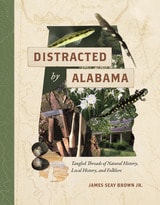
Distracted by Alabama
Tangled Threads of Natural History, Local History, and FolkloreJames Seay Brown Jr.
University of Alabama Press, 2022
Where rivers, railroads, and redhorse fish tell the story of Alabama’s soul.
A gateway to Alabama for the omnivorous mind, Distracted by Alabama is a collection of twelve captivating essays about Alabama and the South by Samford University writer and scholar Jim Brown, a former president of the Alabama Folklife Association.
During his decades living and teaching in Alabama, Brown followed his curiosity down myriad pathways about Alabama and the region, including the state’s majestic landscape, plants and animals found nowhere else, history, and rich folkways. In the tapestry of Alabama culture, Brown traces the threads of Native American, African slave, and European settler influences, woven over the centuries into novel patterns that surprise and fascinate.
Writing in the voice of a learned companion, Brown reveals insights and stories about unforgettable facets of Alabama culture, such as Sacred Harp singers and African American railroad callers, the use of handmade snares and stationary fishtraps to catch river redhorse and freshwater drum, white oak basketmaking and herbal medicine traditions, the evolution of the single-pen log cabin into the impressive two-story I-house, and a wealth of other engrossing stories.
An instant classic, Distracted by Alabama is a keepsake that readers who love, visit, or are curious about Alabama and Southern culture will return to again and again.
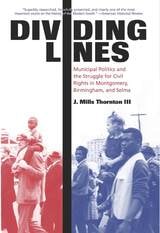
Dividing Lines
Municipal Politics and the Struggle for Civil Rights in Montgomery, Birmingham, and SelmaJ. Mills Thornton, III
University of Alabama Press, 2006
Presents the story of the civil rights movement from the perspective of community-municipal history at the grassroots level
Thornton demonstrates that the movement had powerful local sources in its three birth cities—Montgomery, Birmingham, and Selma. There, the arcane mechanisms of state and city governance and the missteps of municipal politicians and civic leaders—independent of emerging national trends in racial mores—led to the great swell of energy for change that became the civil rights movement.

Dixie Heretic
The Civil Rights Odyssey of Renwick C. KennedyTennant McWilliams
University of Alabama Press, 2023
A life-and-times biography of the minister and social reformer Renwick C. Kennedy
Drawn from some 5,000 letters, six decades of daily-diary writings, and extensive interviews, Dixie Heretic: The Civil Rights Odyssey of Renwick C. Kennedy offers a life-and-times biography of the Alabama Black Belt minister, Renwick C. Kennedy (1900–1985). Here, Tennant McWilliams gives an unvarnished account of Kennedy’s tortuous efforts to make his congregants and other southern whites “better Christians.”
Kennedy came from “upcountry” South Carolina, a place rife with Scotch-Irish Associate Reformed Presbyterians—people of biblical infallibility and individual piety and salvation. In 1927, after a life-changing theology education at Princeton, he moved to Camden, Alabama, county seat of Wilcox County. There, he came to believe that God had a mandate for him: to change the “Half Christian” conservative, and the often violent, racial behaviors around him. As a neo-orthodox Protestant, Kennedy never rejected literal approaches to the Bible. Still, out of the “Full Christian” Social Gospel, he urged changed racial behavior. Ultimately this led him to publish confrontational short stories and essays in Christian Century and New Republic—most set in fictitious “Yaupon County.”
In World War II, Kennedy served as a chaplain with the famed 102nd Evacuation Hospital. He came home hoping the Allied victory would spur Americans to fight racial segregation just as they had fought racial fascism in Europe. The 1948 Dixiecrat movement dashed these hopes, turning much of his neo-orthodox optimism to cynicism. His hope found fleeting resurgence in the civil rights movement, and saw Kennedy quietly leading desegregation of Troy University, where he was an administrator. But the era’s assassinations, combined with George Wallace and the rise of southern white Republicans, regularly returned him to the frustrated hopes of 1948 and fostered a pessimism about truly changed hearts that he took to his grave in 1985.

Doc
The Story of a Birmingham Jazz ManFrank "Doc" Adams and Burgin Mathews
University of Alabama Press, 2012
Autobiography of jazz elder statesman Frank “Doc” Adams, highlighting his role in Birmingham, Alabama’s, historic jazz scene and tracing his personal adventure that parallels, in many ways, the story and spirit of jazz itself.
Doc tells the story of an accomplished jazz master, from his musical apprenticeship under John T. “Fess” Whatley and his time touring with Sun Ra and Duke Ellington to his own inspiring work as an educator and bandleader.
Central to this narrative is the often-overlooked story of Birmingham’s unique jazz tradition and community. From the very beginnings of jazz, Birmingham was home to an active network of jazz practitioners and a remarkable system of jazz apprenticeship rooted in the city’s segregated schools. Birmingham musicians spread across the country to populate the sidelines of the nation’s bestknown bands. Local musicians, like Erskine Hawkins and members of his celebrated orchestra, returned home heroes. Frank “Doc” Adams explores, through first-hand experience, the history of this community, introducing readers to a large and colorful cast of characters—including “Fess” Whatley, the legendary “maker of musicians” who trained legions of Birmingham players and made a significant mark on the larger history of jazz. Adams’s interactions with the young Sun Ra, meanwhile, reveal life-changing lessons from one of American music’s most innovative personalities.
Along the way, Adams reflects on his notable family, including his father, Oscar, editor of the Birmingham Reporter and an outspoken civic leader in the African American community, and Adams’s brother, Oscar Jr., who would become Alabama’s first black supreme court justice. Adams’s story offers a valuable window into the world of Birmingham’s black middle class in the days before the civil rights movement and integration. Throughout, Adams demonstrates the ways in which jazz professionalism became a source of pride within this community, and he offers his thoughts on the continued relevance of jazz education in the twenty-first century.

Down the River
or Practical Lessons Under The Code DuelloGeorge W Hooper
University of Alabama Press, 2007
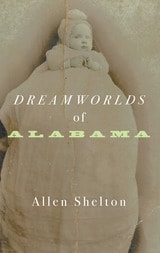
Dreamworlds of Alabama
Allen Shelton
University of Minnesota Press, 2007
“I speak in what others often hear as a strange accent. My past can’t be located. I live in Buffalo, New York, an exile from the South. But these aren’t Yankee dreams, even though my past seems like a fabrication, a dreamworld in which I’m a paper character and not a historical participant, with scars from barbed wire ripping under the pressure and flying through the air like a swarm of bees, or a horse rearing up and banging its head into mine from within, exploding my forehead.” —from the Preface
Wisteria draped on a soldier’s coffin, sent home to Alabama from a Virginia battlefield. The oldest standing house in the county, painted gray and flanked by a pecan orchard. A black steel fence tool, now perched atop a pile of books like a prehistoric bird of prey. In Dreamworlds of Alabama, Allen Shelton explores physical, historical, and social landscapes of northeastern Alabama. His homeplace near the Appalachian foothills provides the setting for a rich examination of cultural practices, a place where the language of place and things resonates with as much vitality and emotional urgency as the language of humans.
Throughout the book, Shelton demonstrates how deeply culture is inscribed in the land and in the most intimate spaces of the person—places of belonging and loss, insight and memory.
Born and raised in Jacksonville, Alabama, Allen Shelton is associate professor of sociology at Buffalo State College.

Dying Inside
The HIV/AIDS Ward at Limestone PrisonBenjamin Fleury-Steiner
University of Michigan Press, 2008
"The HIV+ men incarcerated in Limestone Prison's Dorm 16 were put there to be forgotten. Not only do Benjamin Fleury-Steiner and Carla Crowder bring these men to life, Fleury-Steiner and Crowder also insist on placing these men in the middle of critical conversations about health policy, mass incarceration, and race. Dense with firsthand accounts, Dying Inside is a nimble, far-ranging and unblinking look at the cruelty inherent in our current penal policies."
---Lisa Kung, Director, Southern Center for Human Rights
"The looming prison health crisis, documented here at its extreme, is a shocking stain on American values and a clear opportunity to rethink our carceral approach to security."
---Jonathan Simon, University of California, Berkeley
"Dying Inside is a riveting account of a health crisis in a hidden prison facility."
---Michael Musheno, San Francisco State University, and coauthor of Deployed
"This fresh and original study should prick all of our consciences about the horrific consequences of the massive carceral state the United States has built over the last three decades."
---Marie Gottschalk, University of Pennsylvania, and author of The Prison and the Gallows
"An important, bold, and humanitarian book."
---Alison Liebling, University of Cambridge
"Fleury-Steiner makes a compelling case that inmate health care in America's prisons and jails has reached the point of catastrophe."
---Sharon Dolovich, University of California, Los Angeles
"Fleury-Steiner's persuasive argument not only exposes the sins of commission and omission on prison cellblocks, but also does an excellent job of showing how these problems are the natural result of our nation's shortsighted and punitive criminal justice policy."
---Allen Hornblum, Temple University, and author of Sentenced to Science
Dying Inside brings the reader face-to-face with the nightmarish conditions inside Limestone Prison's Dorm 16---the segregated HIV ward. Here, patients chained to beds share their space with insects and vermin in the filthy, drafty rooms, and contagious diseases spread like wildfire through a population with untreated---or poorly managed at best---HIV.
While Dorm 16 is a particularly horrific human rights tragedy, it is also a symptom of a disease afflicting the entire U.S. prison system. In recent decades, prison populations have exploded as Americans made mass incarceration the solution to crime, drugs, and other social problems even as privatization of prison services, especially health care, resulted in an overcrowded, underfunded system in which the most marginalized members of our society slowly wither from what the author calls "lethal abandonment."
This eye-opening account of one prison's failed health-care standards is a wake-up call, asking us to examine how we treat our forgotten citizens and compelling us to rethink the American prison system in this increasingly punitive age.