Results by title
399 books match the query 'American fiction' and 17 start with d

Darkly Perfect World
Colonial Adventure, Postmodernism, and American NoirStanley Orr
The Ohio State University Press, 2010
Daughters, Fathers, and the Novel
The Sentimental Romance of HeterosexualityLynda Zwinger
University of Wisconsin Press, 1991
Daughters, Fathers, and the Novel is a provocative study of the father-daughter story—a neglected dimension of the family romance. It has important implications for the history of the novel, for our understanding of key texts in that history, and for theories concerning the representation of gender, family relations, and heterosexuality in Western culture.
In the English and American novel, argues Lynda Zwinger, “the good woman” . . . is a father’s daughter, . . . constructed to the very particular specifications of an omnipresent and unvoiced paternal desire.” Zwinger supports her case with an analysis of both “high-brow” and “low-brow” novels and with ingenious textual analyses of five novels: Clarissa Harlowe, Dombey and Son, Little Women, The Golden Bowl, and The Story of O.
In the dominant discourse of Anglo-American culture, the father’s daughter provides the cornerstone for the patriarchal edifice of domesticity and the alibi for patriarchal desire. Zwinger’s analysis of the sexual politics embodied in the figure of this sentimental daughter raises compelling critical and cultural issues. Zwinger shows how different readings of Clarissa’s story form a sentimental composite that makes her available in perpetuity to heterosexual desire. Dombey and Son illuminates the erotic dimension of the sentimental, the titillation always inherent in the spectacle of virtue in distress. Zwinger’s analysis of Little Women in the context of Louisa May Alcott’s own life-text focuses upon the problems of a daughter trying to write the filial romance. The Golden Bowl deploys the daughter of sentiment as a “cover story” for a feminine version of the Oedipal story, founded on the daughter who can’t say yes, but doesn’t say no. The Story of O reveals the pornographic dimension in romantic and sentimental love.
In her conclusion, Zwinger offers an overview of the nineteenth-century novel, asking what difference it makes when the writer is a daughter. She shows how the daughter’s family romance pictures the father as inadequate, ironically requiring the sentimental daughter as a patriarchal prop. She develops a useful concept of hysteria and argues that generic “disorder” and hysterical “intrusions” mark the family romance novels of Jane Austen, Emily and Charlotte Brontë, and George Eliot. And finally, she makes the case that the daughter’s choice to stay home is not necessarily an act of simple complicity, for by staying home she comes as close as she can to disrupting the father-daughter romance.
Dead Balls and Double Curves
An Anthology of Early Baseball FictionEdited and with an Introduction by Trey Strecker. Foreword by Arnold Hano
Southern Illinois University Press, 2004
Dead Balls and Double Curves: An Anthology of Early Baseball Fiction collects twenty-two classic stories from baseball’s youth, presented in chronological order to capture the development of this most American of sports. Many of these tales have never before been reprinted, adding historical value to the rich literary merits of this anthology.
Editor Trey Strecker’s collection begins with an informal village match in an excerpt from James Fenimore Cooper’s Home as Found (1838), published the year prior to Abner Doubleday’s alleged invention of the game outside Cooperstown, New York, and concludes with the arrival of the superstar slugger that signaled the end of the dead-ball era in Heywood Broun’s The Sun Field (1923). The sampling of fiction from the eighty-five-year interim loads the bases with the humor, realism, and athletic gallantry of the sport’s earliest years. Not all grandstanding and heroism, these stories also explore cultural and class conflicts, racial strife, town rivalries, labor disputes, gambling scandals, and the striking personalities that decorated a simple game’s evolution into a national pastime.
Dead Balls and Double Curves presents a lineup of first-division writers, including Mark Twain, Frank Norris, Christy Mathewson, Edna Ferber, and the game’s poet laureate, Ring Lardner, plus legendary characters such as Baseball Joe, South-Paw Skaggs, Tin Can Tommy, and the sole artiste of the mythic double curve, Frank Merriwell. Throughout the volume, each author’s abiding affection for the game and its characters shines through with diamond-like focus.

Design and Debris
A Chaotics of Postmodern American FictionJoseph Conte
University of Alabama Press, 2002
Reading eight major contemporary authors through the lens of chaos theory, Conte offers new and original interpretations of works that have been the subject of much critical debate
Design and Debris discusses the relationship between order and disorder in the works of John Hawkes, Harry Mathews, John Barth, Gilbert Sorrentino, Robert Coover, Thomas Pynchon, Kathy Acker, and Don DeLillo. In analyzing their work, Joseph Conte brings to bear a unique approach adapted from scientific thought: chaos theory. His chief concern is illuminating those works whose narrative structures locate order hidden in disorder (whose authors Conte terms “proceduralists”), and those whose structures reflect the opposite, disorder emerging from states of order (whose authors Conte calls “disruptors”).Documenting the paradigm shift from modernism, in which artists attempted to impose order on a disordered world, to postmodernism, in which the artist portrays the process of “orderly disorder,” Conte shows how the shift has led to postmodern artists' embrace of science in their treatment of complex ideas. Detailing how chaos theory interpenetrates disciplines as varied as economics, politics, biology, and cognitive science, he suggests a second paradigm shift: from modernist specialization to postmodern pluralism. In such a pluralistic world, the novel is freed from the purely literary and engages in a greater degree of interactivity-between literature and science, and between author and reader. Thus, Conte concludes, contemporary literature is a literature of flux and flexibility.
Dialogues/Dialogi
Literary and Cultural Exchanges Between (Ex)Soviet and American WomenSusan Hardy Aiken, Adele Barker, Maya Koreneva, and Ekaterina Stetsenko
Duke University Press, 1993
Dialogues/Dialogi pairs stories by Tillie Olsen, Toni Cade Bambara, Jayne Anne Phillips, and Leslie Marmon Silko (reprinted here in full) with Russian stories by I. Grekova, Liudmila Petrushevskaya, Elena Makarova, and Anna Nerkagi, many of them appearing here for the first time in English. Exquisite in their stylistic and thematic variety, suggestive of the range of women's experience and fiction in both countries, each story is the subject of paired interpretive essays by an American and an (ex)Soviet critic from among the book's authors.
A colloquy of diverse voices speaking together in multiple, mutually illuminating exchanges, Dialogues/Dialogi testifies to the possibility of evolving relationships among women across borders once considered impassable.

Dime Novel Roundup
Annotated Index, 1931–1981Michael L. Cook
University of Wisconsin Press, 1983
This book includes a chronological listing of issues of the Dime Novel Roundup, which was published for over fifty years. It also features an index to the contents of the Dime Novel Roundup.
Dinarzad's Children
An Anthology of Contemporary Arab American FictionPauline Kaldas
University of Arkansas Press, 2009
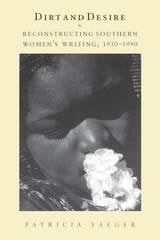
Dirt and Desire
Reconstructing Southern Women's Writing, 1930-1990Patricia Yaeger
University of Chicago Press, 2000
For Yaeger, works by black and white southern women writers reveal a shared obsession with monstrosity and the grotesque and with the strange zones of contact between black and white, such as the daily trauma of underpaid labor and the workings of racial and gender politics in the unnoticed yet all too familiar everyday. Yaeger also excavates a southern fascination with dirt—who owns it, who cleans it, and whose bodies are buried in it.
Yaeger's brilliant, theoretically informed readings of Zora Neale Hurston, Harper Lee, Carson McCullers, Toni Morrison, Flannery O'Connor, Alice Walker, and Eudora Welty (among many others) explode the mystifications of southern literary tradition and forge a new path for southern studies.
The book won the Barbara Perkins and George Perkins Award given by the Society for the Study of Narrative Literature.
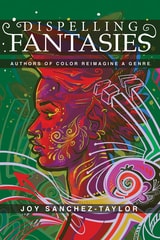
Dispelling Fantasies
Authors of Color Reimagine a GenreJoy Sanchez-Taylor
The Ohio State University Press, 2025
In Dispelling Fantasies, Joy Sanchez-Taylor examines how authors of color, such as R. F. Kuang, N. K. Jemisin, Nnedi Okorafor, Tomi Adeyemi, Tasha Suri, Aiden Thomas, Nghi Vo, and Marlon James, among others, offer critical counterpoints to the history of white-dominated, Eurocentric fantasy. The traditional fantasy that these authors are writing against reinforces Christian virtues and colonial, white supremacist structures; Sanchez-Taylor argues that its racial tropes are tied to a history of colonization and Christian missionary practices, with popular fantasy narratives often depicting Indigenous groups as primitive, deviant peoples in need of salvation. Such representations are based on a Western binary of rational versus magical and are influenced by tenets of Christianity, ultimately contributing to depictions of “the dark fantastic” or fantasy worlds where dark and othered characters are implicitly portrayed as evil and irredeemable. Organized around four Christian ideals that appear frequently in Western fantasy texts—virtue, envy, patriarchy, and salvation—Dispelling Fantasies demonstrates how non-Eurocentric fantasy worlds offer alternative versions of morality, race, gender, and sexuality and make space for authors to move away from hierarchical, binary systems of good and evil.
Disturbing Indians
The Archaeology of Southern FictionAnnette Trefzer
University of Alabama Press, 2007
How Faulkner, Welty, Lytle, and Gordon reimagined and reconstructed the Native American past in their work.
In this book, Annette Trefzer argues that not only have Native Americans played an active role in the construction of the South’s cultural landscape—despite a history of colonization, dispossession, and removal aimed at rendering them invisible—but that their under-examined presence in southern literature also provides a crucial avenue for a post-regional understanding of the American South. William Faulkner, Eudora Welty, Andrew Lytle, and Caroline Gordon created works about the Spanish conquest of the New World, the Cherokee frontier during the Revolution, the expansion into the Mississippi Territory, and the slaveholding societies of the American southeast. They wrote 100 years after the forceful removal of Native Americans from the southeast but consistently returned to the idea of an "Indian frontier," each articulating a different vision and discourse about Native Americans—wholesome and pure in the vision of some, symptomatic of hybridity and universality for others.
Trefzer contends that these writers engage in a double discourse about the region and nation: fabricating regional identity by invoking the South’s "native" heritage and pointing to issues of national guilt, colonization, westward expansion, and imperialism in a period that saw the US sphere of influence widen dramatically. In both cases, the "Indian" signifies regional and national self-definitions and contributes to the shaping of cultural, racial, and national "others." Trefzer employs the idea of archeology in two senses: quite literally the excavation of artifacts in the South during the New Deal administration of the 1930s (a surfacing of material culture to which each writer responded) and archeology as a method for exploring texts she addresses (literary digs into the textual strata of America’s literature and its cultural history).
Divergent Trajectories
Interviews with Innovative Fiction WritersFlore Chevaillier
The Ohio State University Press, 2017
Including interviews with R. M. Berry, Debra Di Blasi, Percival Everett, Thalia Field, Renee Gladman, Bhanu Kapil, Lance Olsen, Michael Martone, Carole Maso, Joseph McElroy, Christina Milletti, Alan Singer, and Steve Tomasula, Divergent Trajectories provides a framework that allows innovative authors to discuss in some depth their works, backgrounds, formal research, thematic preferences, genre treatment, aesthetic philosophies, dominant linguistic expressions, cultural trends, and the literary canon. Through an examination of these concepts, writers ask what “traditional” and “innovative” writing is, and most of all, what fiction is today.
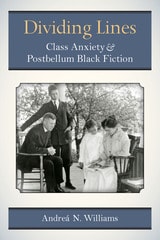
Dividing Lines
Class Anxiety and Postbellum Black FictionAndreá N. Williams
University of Michigan Press, 2013

Documents of American Realism and Naturalism
Donald Pizer
Southern Illinois University Press, 1998
Donald Pizer presents the major critical discussions of American realism and naturalism from the beginnings of the movement in the 1870s to the present. He includes the most often cited discussions ranging from William Dean Howells, Henry James, and Frank Norris in the late nineteenth century to those by V. L. Parrington, Malcolm Cowley, and Lionel Trilling in the early twentieth century. To provide the full context for the effort to interpret the nature and significance of realism and naturalism during the periods when the movements were live issues on the critical scene, however, he also includes many uncollected essays. His selections since World War II reflect the major recent tendencies in academic criticism of the movements.
Through introductions to each of the three sections, Pizer provides background, delineating the underlying issues motivating attempts to attack, defend, or describe American realism and naturalism. In particular, Pizer attempts to reveal the close ties between criticism of the two movements and significant cultural concerns of the period in which the criticism appeared. Before each selection, Pizer provides a brief biographical note and establishes the cultural milieu in which the essay was originally published. He closes his anthology with a bibliography of twentieth-century academic criticism of American realism and naturalism.
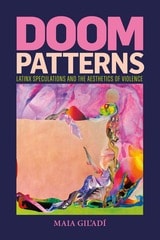
Doom Patterns
Latinx Speculations and the Aesthetics of ViolenceMaia Gil'Adí
Duke University Press, 2025
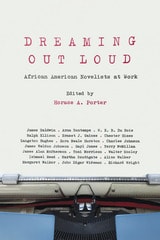
Dreaming Out Loud
African American Novelists at WorkHorace Porter
University of Iowa Press, 2015
Some essays explore the challenges of being an African American writer in the United States, broadly addressing aesthetic and racial prejudice in American publishing and literature and its changing face over the decades. Others are more specific and personal, recounting how the authors came to be a reader and writer in a culture that did not always encourage them to do so. Some are more general and focus on practice and craft, while still other essays offer detailed behind-the-scenes accounts of how famous novels, such as Native Son, Invisible Man, The Autobiography of Miss Jane Pittman, and The Color Purple, came to life. Ranging from the Harlem Renaissance, through the Civil Rights movement, and into the twenty-first century, this anthology explores what it has meant to be an African American novelist over the past hundred years.
Found within are essays by twenty-one African American novelists, including Nobel Prize-winner Toni Morrison, National Book Award-winners Ralph Ellison and Charles Johnson, Pulitzer Prize-winners Alice Walker and James Alan McPherson, and well-known canonical writers such as W. E. B. Du Bois, James Weldon Johnson, Langston Hughes, Richard Wright, Zora Neale Hurston, and Margaret Walker. Dreaming Out Loud seeks to inspire writers and readers alike, while offering a fascinating and important portrait of novelists at work in their own words.
CONTRIBUTORS
James Baldwin, Arna Bontemps, W. E. B. Du Bois, Ralph Ellison, Ernest Gaines, Chester Himes, Langston Hughes, Zora Neale Hurston, Charles Johnson, James Weldon Johnson, Gayl Jones, Terry McMillan, James Alan McPherson, Toni Morrison, Walter Mosley, Ishmael Reed, Martha Southgate, Alice Walker, Margaret Walker, John Edgar Wideman, Richard Wright

Dreaming Revolution
Transgression in the Development of American RomanceScott Bradfield
University of Iowa Press, 1993
Dreaming Revolution usefully employs current critical theory to address how the European novel of class revolt was transformed into the American novel of imperial expansion. Bradfield shows that early American romantic fiction—including works by William Godwin, Charles Brockden Brown, James Fenimore Cooper, and Edgar Allan Poe—can and should be considered as part of a genre too often limited to the nineteenth-century European novel. In a spirited discussion of the works from these four authors, Bradfield argues that Americans take the class dynamics of the European psychological novel and apply them to the American landscape, reimagining psychological spaces as geographical ones.
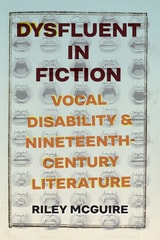
Dysfluent in Fiction
Vocal Disability and Nineteenth-Century LiteratureRiley McGuire
The Ohio State University Press, 2025
Honorable Mention, 2025 Victorian Popular Fiction Association First Book Prize
In Dysfluent in Fiction, Riley McGuire unspools a literary history of vocal disability in the nineteenth century, arguing that this underexamined literary trope helps us to understand vocal hierarchies that still structure our present. Adopting the term “dysfluency” to show departure from normative expectations of pace, pitch, and fluency, McGuire reveals how dysfluent speech populates an enormous number of nineteenth-century texts and played a formative role in the lives of some of the period’s most influential writers.
Dysfluent in Fiction examines anglophone literature during the long nineteenth century in both England and America by authors such as William Makepeace Thackeray, Charlotte Brontë, Lewis Carroll, Mary Elizabeth Braddon, and Frederick Douglass. Examples of dysfluencies across genres include lisping lovers, a baby-talking fairy, a mute detective, various disabilities in narratives of enslavement, and more. These representations show how disabled speech was both stigmatized and celebrated in ways that clarify our contemporary response to the spectrum of human articulation and that are a vocal corollary to current notions of neurodiversity. Dysfluency’s power, McGuire contends, lies in its denial that a single mode of articulation is possible, let alone desirable.