384 books match the query 'Black Studies (Global)' and 9 start with d

cover of Dance Cadaverous: Antiblackness of the Social World and Social Theory

Dance Cadaverous

Antiblackness of the Social World and Social Theory

Moon-Kie Jung and João H. Costa Vargas

Duke University Press, 2027

In Dance Cadaverous, Moon-Kie Jung and João H. Costa Vargas argue that the modern social world and modern social theory are foundationally antiblack. Antiblackness, the ontological exclusion inaugurated by racial slavery, persists while social theorists reproduce the exclusion, missing and misrecognizing this profoundly antisocial predicament at the heart of modernity. Across three historical moments—antebellum, Jim Crow, and contemporary—Jung and Vargas offer fundamental critiques of antiblackness, putting under scrutiny humanist and posthumanist social theories, science and technology studies, agency, genocide, racism, people-of-color intersectionality, and environmental justice. Drawing on radical Black study, freedom struggles, and jazz improvisation, they propose antisociology and abolitionist antipolitics as paths forward to provincialize and leave behind the modern social world.
[more]
cover of Dead Weight: A Memoir in Essays

Dead Weight

A Memoir in Essays

Randall Horton

Northwestern University Press, 2022

Dead Weight chronicles the improbable turnaround of a drug smuggler who, after being sentenced to eight years in state prison, returned to society to earn a PhD in creative writing and become the only tenured professor in the United States with seven felony convictions. Horton’s visceral essays highlight the difficulties of trying to change one’s life for the better, how the weight of felony convictions never dissipates.
 
The memoir begins with a conversation between Horton and Ralph Ellison’s Invisible Man statue in New York City. Their imagined dialogue examines the psychological impact of racism on Black men and boys, including Horton’s separation from his mother, immediately after his birth, in a segregated Alabama hospital. From his current life as a professor and prison reformer, Horton looks back on his experiences as a drug smuggler and trafficker during the 1980s–1990s as well as the many obstacles he faced after his release. He also examines the lasting impact of his drug activity on those around him, reflecting on the allure of economic freedom and the mental escapism that cocaine provided, an allure so strong that both sellers and users were willing to risk prison. Horton shares historical context and vivid details about people caught in the war on drugs who became unsuspecting protagonists in somebody else’s melodrama.
 
Lyrical and gripping, Dead Weight reveals the lifelong effects of one man’s incarceration on his psyche, his memories, and his daily experience of American society.

 
[more]
cover of Dear Science and Other Stories

Dear Science and Other Stories

Katherine McKittrick

Duke University Press, 2021
In Dear Science and Other Stories Katherine McKittrick presents a creative and rigorous study of black and anticolonial methodologies. Drawing on black studies, studies of race, cultural geography, and black feminism as well as a mix of methods, citational practices, and theoretical frameworks, she positions black storytelling and stories as strategies of invention and collaboration. She analyzes a number of texts from intellectuals and artists ranging from Sylvia Wynter to the electronica band Drexciya to explore how narratives of imprecision and relationality interrupt knowledge systems that seek to observe, index, know, and discipline blackness. Throughout, McKittrick offers curiosity, wonder, citations, numbers, playlists, friendship, poetry, inquiry, song, grooves, and anticolonial chronologies as interdisciplinary codes that entwine with the academic form. Suggesting that black life and black livingness are, in themselves, rebellious methodologies, McKittrick imagines without totally disclosing the ways in which black intellectuals invent ways of living outside prevailing knowledge systems.
[more]
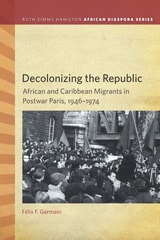
cover of Decolonizing the Republic: African and Caribbean Migrants in Postwar Paris, 1946–1974

Decolonizing the Republic

African and Caribbean Migrants in Postwar Paris, 1946–1974

Félix F. Germain

Michigan State University Press, 2016

Decolonizing the Republic is a conscientious discussion of the African diaspora in Paris in the post–World War II period. This book is the first to examine the intersection of black activism and the migration of Caribbeans and Africans to Paris during this era and, as Patrick Manning notes in the foreword, successfully shows how “black Parisians—in their daily labors, weekend celebrations, and periodic protests—opened the way to ‘decolonizing the Republic,’ advancing the respect for their rights as citizens.” Contrasted to earlier works focusing on the black intellectual elite, Decolonizing the Republic maps the formation of a working-class black France. Readers will better comprehend how those peoples of African descent who settled in France and fought to improve their socioeconomic conditions changed the French perception of Caribbean and African identity, laying the foundation for contemporary black activists to deploy a new politics of social inclusion across the demographics of race, class, gender, and nationality. This book complicates conventional understandings of decolonization, and in doing so opens a new and much-needed chapter in the history of the black Atlantic.
 
[more]
cover of Diaspora Without Displacement: The Coloniality and Promise of Capoeira in Senegal

Diaspora Without Displacement

The Coloniality and Promise of Capoeira in Senegal

Celina de Sá

Duke University Press, 2025

Capoeira—a game of combat primarily developed by enslaved West Central Africans—has become an icon of both Brazilian national culture and pride in the country’s diasporic African heritage. Yet the sport remains less accessible in Africa itself, overshadowed in large part by participants in the Global North. In Diaspora Without Displacement, Celina de Sá tells the story of capoeira as it "returns" to the African continent through the creative initiatives of young urban professionals in Senegal. De Sá demonstrates how a new generation of African capoeiristas are taking up their own Afro-diasporic performance tradition, effectively reframing notions of diaspora and race through their social practice. Though capoeira has largely Angolan roots and the agents of return are typically white Brazilians and Europeans, the West African practitioners de Sá documents nonetheless form an exceptional relationship to capoeira that, in turn, becomes a mode of political and social consciousness. Analyzing a capoeira network across West Africa, de Sá shows how urban West Africans use capoeira to explore the relationship between Blackness, diaspora, and African heritage.
[more]
cover of Diverse Pathways: Race and the Incorporation of Black, White, and Arab-Origin Africans in the United States

Diverse Pathways

Race and the Incorporation of Black, White, and Arab-Origin Africans in the United States

Kevin J. A. Thomas

Michigan State University Press, 2014

Africans are among the fastest-growing immigrant groups in the United States. Although they are racially and ethnically diverse, few studies have examined how these differences affect their patterns of incorporation into society. This book is the first to highlight the role of race and ethnicity, Arab ethnicity in particular, in shaping the experiences of African immigrants. It demonstrates that American conceptions of race result in significant inequalities in the ways in which African immigrants are socially integrated. Thomas argues that suggestions that Black Africans are model-minorities who have overcome the barriers of race are misleading, showing that Black and Arab-ethnicity Africans systematically experience less favorable socioeconomic outcomes than their White African counterparts. Overall, the book makes three critical arguments. First, historical and contemporary constructions of race have important implications for understanding the dynamics of African immigration and settlement in the United States. Second, there are significant racial inequalities in the social and economic incorporation of contemporary African immigrants. Finally, Arab ethnicity has additional implications for understanding intra-racial disparities in incorporation among contemporary African immigrants. In general, these arguments are foundational for understanding the diversity of African immigrant experiences.
[more]
cover of Doc: The Story of a Birmingham Jazz Man

Doc

The Story of a Birmingham Jazz Man

Frank "Doc" Adams and Burgin Mathews

University of Alabama Press, 2012

Autobiography of jazz elder statesman Frank “Doc” Adams, highlighting his role in Birmingham, Alabama’s, historic jazz scene and tracing his personal adventure that parallels, in many ways, the story and spirit of jazz itself.

Doc tells the story of an accomplished jazz master, from his musical apprenticeship under John T. “Fess” Whatley and his time touring with Sun Ra and Duke Ellington to his own inspiring work as an educator and bandleader.

Central to this narrative is the often-overlooked story of Birmingham’s unique jazz tradition and community. From the very beginnings of jazz, Birmingham was home to an active network of jazz practitioners and a remarkable system of jazz apprenticeship rooted in the city’s segregated schools. Birmingham musicians spread across the country to populate the sidelines of the nation’s bestknown bands. Local musicians, like Erskine Hawkins and members of his celebrated orchestra, returned home heroes. Frank “Doc” Adams explores, through first-hand experience, the history of this community, introducing readers to a large and colorful cast of characters—including “Fess” Whatley, the legendary “maker of musicians” who trained legions of Birmingham players and made a significant mark on the larger history of jazz. Adams’s interactions with the young Sun Ra, meanwhile, reveal life-changing lessons from one of American music’s most innovative personalities.

Along the way, Adams reflects on his notable family, including his father, Oscar, editor of the Birmingham Reporter and an outspoken civic leader in the African American community, and Adams’s brother, Oscar Jr., who would become Alabama’s first black supreme court justice. Adams’s story offers a valuable window into the world of Birmingham’s black middle class in the days before the civil rights movement and integration. Throughout, Adams demonstrates the ways in which jazz professionalism became a source of pride within this community, and he offers his thoughts on the continued relevance of jazz education in the twenty-first century.
[more]
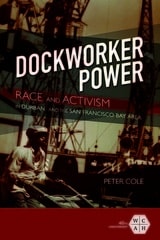
cover of Dockworker Power: Race and Activism in Durban and the San Francisco Bay Area

Dockworker Power

Race and Activism in Durban and the San Francisco Bay Area

Peter Cole

University of Illinois Press, 2018

Philip Taft Labor History Book Award, Labor and Working-Class History Association (LAWCHA) and the Cornell ILR School, 2019
A Black Perspectives Best Black History Book of 2018

Dockworkers have power. Often missed in commentary on today's globalizing economy, workers in the world's ports can harness their role, at a strategic choke point, to promote their labor rights and social justice causes. Peter Cole brings such overlooked experiences to light in an eye-opening comparative study of Durban, South Africa, and the San Francisco Bay Area, California. Path-breaking research reveals how unions effected lasting change in some of the most far-reaching struggles of modern times. First, dockworkers in each city drew on longstanding radical traditions to promote racial equality. Second, they persevered when a new technology--container ships--sent a shockwave of layoffs through the industry. Finally, their commitment to black internationalism and leftist politics sparked transnational work stoppages to protest apartheid and authoritarianism. Dockworker Power not only brings to light surprising parallels in the experiences of dockers half a world away from each other. It also offers a new perspective on how workers can change their conditions and world.

 

[more]
cover of Dub: Finding Ceremony

Dub

Finding Ceremony

Alexis Pauline Gumbs

Duke University Press, 2019

The concluding volume in a poetic trilogy, Alexis Pauline Gumbs's Dub: Finding Ceremony takes inspiration from theorist Sylvia Wynter, dub poetry, and ocean life to offer a catalog of possible methods for remembering, healing, listening, and living otherwise. In these prose poems, Gumbs channels the voices of her ancestors, including whales, coral, and oceanic bacteria, to tell stories of diaspora, indigeneity, migration, blackness, genius, mothering, grief, and harm. Tracing the origins of colonialism, genocide, and slavery as they converge in Black feminist practice, Gumbs explores the potential for the poetic and narrative undoing of the knowledge that underpins the concept of Western humanity. Throughout, she reminds us that dominant modes of being human and the oppression those modes create can be challenged, and that it is possible to make ourselves and our planet anew.
[more]