Results by title
211 books match the query 'Blacks' and 3 start with d
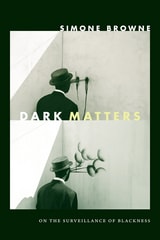
Dark Matters
On the Surveillance of BlacknessSimone Browne
Duke University Press, 2015
In Dark Matters Simone Browne locates the conditions of blackness as a key site through which surveillance is practiced, narrated, and resisted. She shows how contemporary surveillance technologies and practices are informed by the long history of racial formation and by the methods of policing black life under slavery, such as branding, runaway slave notices, and lantern laws. Placing surveillance studies into conversation with the archive of transatlantic slavery and its afterlife, Browne draws from black feminist theory, sociology, and cultural studies to analyze texts as diverse as the methods of surveilling blackness she discusses: from the design of the eighteenth-century slave ship Brooks, Jeremy Bentham's Panopticon, and The Book of Negroes, to contemporary art, literature, biometrics, and post-9/11 airport security practices. Surveillance, Browne asserts, is both a discursive and material practice that reifies boundaries, borders, and bodies around racial lines, so much so that the surveillance of blackness has long been, and continues to be, a social and political norm.
[more]
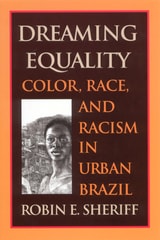
Dreaming Equality
Color, Race, and Racism in Urban BrazilSheriff, Robin E.
Rutgers University Press, 2001
In the 1933 publication The Masters and the Slaves, Brazilian scholar and novelist Gilberto Freyre challenged the racist ideas of his day by defending the “African contribution” to Brazil’s culture. In so doing, he proposed that Brazil was relatively free of most forms of racial prejudice and could best be understood as a “racial democracy.” Over time this view has grown into the popular myth that racism in Brazil is very mild or nonexistent.
This myth contrasts starkly with the realities of a pernicious racial inequality that permeates every aspect of Brazilian life. To study the grip of this myth on African Brazilians’ views of themselves and their nation, Robin E. Sheriff spent twenty months in a primarily black shantytown in Rio de Janeiro, studying the inhabitants’s views of race and racism. How, she asks, do poor African Brazilians experience and interpret racism in a country where its very existence tends to be publicly denied? How is racism talked about privately in the family and publicly in the community—or is it talked about at all?
Sheriff’s analysis is particularly important because most Brazilians live in urban settings, and her examination of their views of race and racism sheds light on common but underarticulated racial attitudes. This book is the first to demonstrate that urban African Brazilians do not subscribe to the racial democracy myth and recognize racism as a central factor shaping their lives.
[more]
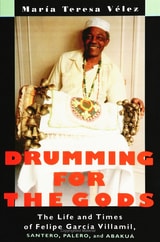
Drumming For The Gods
Maria Velez
Temple University Press, 2000
"I am Felipe Garcia Villamil" begins Drumming for the Gods, the life history of the Afro-Cuban artist whose music has survived both political and personal upheaval. "Balogun for thirty years. Oluana, of Matanzas, Cuba, for about forty years. Omoana for almost forty-five years. OluIyesa [he knows the secrets of the Iyesa drums]." A practitioner of sacred drumming for almost his entire life, Felipe practiced his trade in Cuba both before and after the Revolution and brought it with him to New York, where he continues to play for the gods.
This book focuses on three periods of Felipe's life, each marked by changes in his personal life and by important historical events. The first period covers his formative years during which he received his initial training. Through Felipe's story, we explore the legacy of slavery in Cuba, the nature of Afro-Cuban religions and their musical traditions, and the history of bata drums. The second period covers the critical years of the Cuban Revolution. Here we see the effect of social turmoil both n music and religious practice (santero, palero, and abakua). The third period covers Felipe's life in New York as a refugee/immigrant, and the role of music in rebuilding his identity. Felipe's story illuminates his cultural practices and beliefs as well as the ways in which an individual musician selects and modifies the elements of his cultural heritage to create a voice that is personal and unique. Felipe not only lives through history but also makes history, shaping an identity that cannot be described as "Cuban immigrant," "Afro-Cuban," "religious drummer," or "santeria initiate," but is composed of all of them.
Through Felipe's experiences, Maria Teresa Velez reveals the interaction between social, political, economic, and cultural forces and an individual's own actions. The professionalization of musicians in Cuba following the Revolution and the plight of Afro-Cuban immigrants in New York are seen as large historical and social problems to which Felipe must personally respond. A noted ethnomusicologist, Velez provides the most insightful and comprehensive English-language study of an individual Cuban religious drummer available.
Drumming for the Gods is a must-read for those interested in ethnomusicology, Caribbean studies, and Afro-Cuban religions and culture.
[more]