Results by title
86 books match the query 'Chile' and 5 start with d
Defusing Democracy
Central Bank Autonomy and the Transition from Authoritarian RuleDelia M. Boylan
University of Michigan Press, 2001
Many of today's new democracies are constrained by institutional forms designed by previous authoritarian rulers. In this timely and provocative study, Delia M. Boylan traces the emergence of these vestigial governance structures to strategic behavior by outgoing elites seeking to protect their interests from the vicissitudes of democratic rule.
One important outgrowth of this political insulation strategy--and the empirical centerpiece of Boylan's analysis--is the existence of new, highly independent central banks in countries throughout the developing world. This represents a striking transformation, for not only does central bank autonomy remove a key aspect of economic decision making from democratic control; in practice it has also kept many of the would-be expansionist governments that hold power today from overturning the neoliberal policies favored by authoritarian predecessors.
To illustrate these points, Defusing Democracy takes a fresh look at two transitional polities in Latin America--Chile and Mexico--where variation in the proximity of the democratic "threat" correspondingly yielded different levels of central bank autonomy.
Boylan concludes by extending her analysis to institutional contexts beyond Latin America and to insulation strategies other than central bank autonomy. Defusing Democracy will be of interest to anyone--political scientists, economists, and policymakers alike--concerned about the genesis and consolidation of democracy around the globe.
Delia M. Boylan is Assistant Professor, Harris Graduate School of Public Policy Studies, University of Chicago.
[more]

Democracy After Pinochet
Politics, Parties, and Elections in ChileAlan Angell
University of London Press, 2007
This book explores how democracy has developed in Chile since the end of the military dictatorship in 1990. It brings together an examination of international influences on the country's political development with empirically based analyses of Chilean political institutions and change. Chapters one and two examine international aspects of the 1973 coup and how these influenced the development of politics inside Chile. Chapters three, four, and five provide empirical analyses of the 1989, 1993, and 1999/2000 presidential elections, respectively. Chapter six investigates how the Pinochet factor influenced developments after 1990 and the Chilean reaction to Pinochet's arrest in London in 1998. Chapter seven assesses changes in the Chilean party system and links these to similar processes elsewhere. The final chapter examines the paradox that despite economic and social advances, opinion polls report a low level of attachment to democracy and very low levels of confidence in political institutions.
[more]
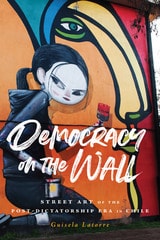
Democracy on the Wall
Street Art of the Post-Dictatorship Era in ChileGuisela Latorre
The Ohio State University Press, 2019
Guisela Latorre’s Democracy on the Wall: Street Art of the Post-Dictatorship Era in Chile documents and critically deconstructs the explosion of street art that emerged in Chile after the dictatorship of Augusto Pinochet, providing the first broad analysis of the visual vocabulary of Chile’s murals and graffiti while addressing the historical, social, and political context for this public art in Chile post-1990.
Exploring the resurgence and impact of the muralist brigades, women graffiti artists, the phenomenon of “open-sky museums,” and the transnational impact on the development of Chilean street art, Latorre argues that mural and graffiti artists are enacting a “visual democracy,” a form of artistic praxis that seeks to create alternative images to those produced by institutions of power. Keenly aware of Latin America’s colonial legacy and deeply flawed democratic processes, and distrustful of hegemonic discourses promoted by government and corporate media, the artists in Democracy on the Wall utilize graffiti and muralism as an alternative means of public communication, one that does not serve capitalist or nationalist interests. Latorre posits that through these urban interventions that combine creativity with social action, Chilean street artists formulate visions of what a true democracy looks like.
Exploring the resurgence and impact of the muralist brigades, women graffiti artists, the phenomenon of “open-sky museums,” and the transnational impact on the development of Chilean street art, Latorre argues that mural and graffiti artists are enacting a “visual democracy,” a form of artistic praxis that seeks to create alternative images to those produced by institutions of power. Keenly aware of Latin America’s colonial legacy and deeply flawed democratic processes, and distrustful of hegemonic discourses promoted by government and corporate media, the artists in Democracy on the Wall utilize graffiti and muralism as an alternative means of public communication, one that does not serve capitalist or nationalist interests. Latorre posits that through these urban interventions that combine creativity with social action, Chilean street artists formulate visions of what a true democracy looks like.
[more]
Desired States
Sex, Gender, and Political Culture in ChileLessie Jo Frazier
Rutgers University Press, 2020
Desired States challenges the notion that in some cultures, sex and sexuality have become privatized and located in individual subjectivity rather than in public political practices and institutions. Instead, the book contends that desire is a central aspect of political culture. Based on fieldwork and archival research, Frazier explores the gendered and sexualized dynamics of political culture in Chile, an imperialist context, asking how people connect with and become mobilized in political projects in some cases or, in others, become disaffected or are excluded to varying degrees. The book situates the state in a rich and changing context of transnational and localized movements, imperialist interests, geo-political conflicts, and market forces to explore the broader struggles of desiring subjects, especially in those dimensions of life that are explicitly sexual and amorous: free love movements, marriage, the sixties’ sexual revolution in Cold War contexts, prostitution policies, ideas about men’s gratification, the charisma of leaders, and sexual/domestic violence against women.
[more]
Dismantling the Nation
Contemporary Art in ChileEdited by Florencia San Martín, Carla Macchiavello Cornejo, and Paula Solimano
Amherst College Press, 2023
The first volume to theorize and historicize contemporary artistic practices from Chile in the English language, Dismantling the Nation begins from a position of radical criticism against the nation-state of Chile and its capitalist, heteronormative, and extractivist rule. At a truly pivotal moment in the country’s history, when it is redefining what it wants to be, the works here propose a way of forging a feminist and decolonial future for Chile. The authors attend to practices from distinct locations in Chile, reconceptualizing geographical borders from a transnational and transdisciplinary perspective while engaging with ecocriticism and Indigenous epistemologies. This is an essential volume for anyone looking to understand the current social, political, and artistic movements in Chile.
[more]