Results by title
134 books match the query 'Chinese' and 7 start with d
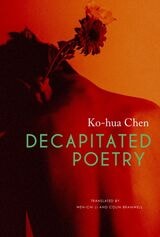
Decapitated Poetry
Ko-Hua Chen
Seagull Books, 2023
Poems from a boisterously out and open queer voice from Taiwan.
Ko-hua Chen’s Decapitated Poetry was the first explicitly queer book of poems published in Taiwan and remains a foundational work in Taiwanese poetry. Decades after it first appeared in 1995, this collection retains the capacity to shock, appall, and jolt readers into recognizing homosexuality as its own specific category of being. Behind Chen’s depictions of the disjunctive realities of queer erotic life, a formidable and uncompromising poetic intelligence can be seen at play. Alongside the erotic, satirical offerings from Decapitated Poetry, this volume includes selections from Chen’s remarkable sci-fi sequences that offer further transcorporeal meditations on forbidden queer love. Excoriating, heretical, tender, and always alive to the transgressive potential of language, this exhilarating volume from Seagull’s Pride List is the perfect introduction to one of Taiwanese poetry’s most daring voices.
Ko-hua Chen’s Decapitated Poetry was the first explicitly queer book of poems published in Taiwan and remains a foundational work in Taiwanese poetry. Decades after it first appeared in 1995, this collection retains the capacity to shock, appall, and jolt readers into recognizing homosexuality as its own specific category of being. Behind Chen’s depictions of the disjunctive realities of queer erotic life, a formidable and uncompromising poetic intelligence can be seen at play. Alongside the erotic, satirical offerings from Decapitated Poetry, this volume includes selections from Chen’s remarkable sci-fi sequences that offer further transcorporeal meditations on forbidden queer love. Excoriating, heretical, tender, and always alive to the transgressive potential of language, this exhilarating volume from Seagull’s Pride List is the perfect introduction to one of Taiwanese poetry’s most daring voices.
[more]
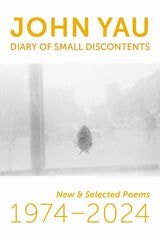
Diary of Small Discontents
New & Selected Poems 1974–2024John Yau
Omnidawn, 2025
A collection of poetry showcasing the diversity of subjects and forms in Yau’s writing.
This collection brings together work from half a century of writing by John Yau. Preoccupied with forms and musical structures, Yau’s work includes sestinas, sonnets, pantoums, and lists, as well as invented forms. Employing both strict and open-ended frameworks, Yau creates multi-faceted poems that can shift abruptly from humor to outrage and consider topics including Chinese American identity, school shootings, invented countries, and haunted memories. Some poems are grounded in an autobiographical voice, while others take on the voices of other characters, including contemporary artists and a fictional Chinese private eye.
Spanning the vast diversity of Yau’s forms and subjects, the poems in Diary of Small Discontents add up to an unapologetically original collection.
[more]
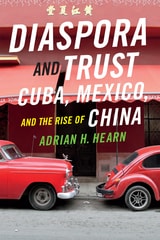
Diaspora and Trust
Cuba, Mexico, and the Rise of ChinaAdrian H. Hearn
Duke University Press, 2016
In Diaspora and Trust Adrian H. Hearn proposes that a new paradigm of socio-economic development is gaining importance for Cuba and Mexico. Despite their contrasting political ideologies, both countries must build new forms of trust among the state, society, and resident Chinese diaspora communities if they are to harness the potentials of China’s rise. Combining political and economic analysis with ethnographic fieldwork, Hearn analyzes Cuba's and Mexico's historical relations with China, and highlights how Chinese diaspora communities are now deepening these ties. Theorizing trust as an alternative to existing models of exchange—which are failing to navigate the world's shifting economic currents—Hearn shows how Cuba and Mexico can reformulate the balance of power between state, market, and society. A new paradigm of domestic development and foreign engagement based on trust is becoming critical for Cuba, Mexico, and other countries seeking to benefit from China’s growing economic power and social influence.
[more]

Digital Methods and Traditional Chinese Literary Studies
Thomas Mazanec, Jeffrey Tharsen, and Jing Chen, special issue editors
Duke University Press, 0
This special issue of the Journal of Chinese Literature and Culture offers groundbreaking research taking place at the intersection of digital humanities and classical Chinese literary studies. Contributors put forth bold conclusions about the history of traditional Chinese literary culture, showing how the digital humanities can extend philology’s and literary studies’ traditional concerns to reexamine classic literary texts within the contexts of their production, reception, and circulation. Contributors use the tools and metrics of social-network analysis to study literary culture, map the geography of poetry production, and use sophisticated programs to trace patterns of rhetoric and allusion. Rather than purely focusing on theory or methodology, the contributors provide concrete case studies that offer new insights driven by digital tools and databases. The issue envisions a future in which computational technologies are an essential component of any humanistic study.
Contributors. Jing Chen, Timothy Clifford, Yi-long Huang, Chao-lin Liu, Thomas Mazanec, Evan Nicoll-Johnson, Qiao Junjun, Donald Sturgeon, Jeffrey Tharsen, Wang Zhaopeng, Bingyu Zheng, Mariana Zorkina
Contributors. Jing Chen, Timothy Clifford, Yi-long Huang, Chao-lin Liu, Thomas Mazanec, Evan Nicoll-Johnson, Qiao Junjun, Donald Sturgeon, Jeffrey Tharsen, Wang Zhaopeng, Bingyu Zheng, Mariana Zorkina
[more]
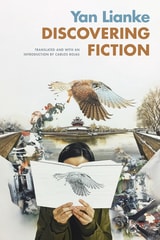
Discovering Fiction
Yan Lianke
Duke University Press, 2022
Over the past twenty years, Chinese novelist Yan Lianke has emerged as one of the most important writers in the world. In Discovering Fiction, Yan offers insights into his views on literature and realism, the major works that inspired him, and his theories of writing. He juxtaposes discussions of the high realism of Leo Tolstoy and Lu Xun against Franz Kafka’s modernism and Gabriel García Márquez’s magical realism, charting the relationship between causality, truth, and modes of realism. He also discusses his approach to realism, which he terms “mythorealism”—a way of capturing the world’s underlying truth by relying on the allegories, myths, legends, and dreamscapes that emerge from daily life. Revealing and instructive, Discovering Fiction gives readers an unprecedented look into the mind and art of a literary giant.
[more]
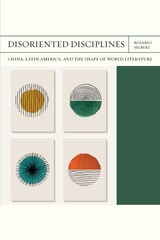
Disoriented Disciplines
China, Latin America, and the Shape of World LiteratureRosario Hubert
Northwestern University Press, 2024
An urgent call to think on the edges, surfaces, and turns of the literary artifact when it crosses cultural boundaries
In the absence of specialized programs of study, abstract discussions of China in Latin America took shape in contingent critical infrastructures built at the crossroads of the literary market, cultural diplomacy, and commerce. As Rosario Hubert reveals, modernism flourishes comparatively, in contexts where cultural criticism is a creative and cosmopolitan practice.
Disoriented Disciplines: China, Latin America, and the Shape of World Literature understands translation as a material act of transfer, decentering the authority of the text and connecting seemingly untranslatable cultural traditions. In this book, chinoiserie, “coolie” testimonies, Maoist prints, visual poetry, and Cold War memoirs compose a massive archive of primary sources that cannot be read or deciphered with the conventional tools of literary criticism. As Hubert demonstrates, even canonical Latin American authors, including Jorge Luis Borges, Octavio Paz, and Haroldo de Campos, write about China from the edges of philology, mediating the concrete as well as the sensorial.
Advocating for indiscipline as a core method of comparative literary studies, Disoriented Disciplines challenges us to interrogate the traditional contours of the archives and approaches that define the geopolitics of knowledge.
[more]
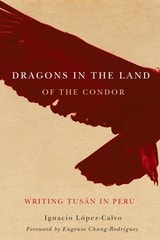
Dragons in the Land of the Condor
Writing Tusán in PeruIgnacio López-Calvo, Foreword by Eugenio Chang-Rodríguez
University of Arizona Press, 2014
Building on his 2013 study on Nikkei cultural production in Peru, in Dragons in the Land of the Condor Ignacio López-Calvo studies the influence of a Chinese ethnic background in the writing of several twentieth- and twenty-first-century Sino-Peruvian authors.
While authors like Siu Kam Wen and Julia Wong often rely on their Chinese cultural heritage for inspiration, many others, like Pedro Zulen, Mario Wong, and Julio Villanueva Chang, choose other sources of inspiration and identification. López-Calvo studies the different strategies used by these writers to claim either their belonging in the Peruvian national project or their difference as a minority ethnic group within Peru. Whether defending the rights of indigenous Peruvians, revealing the intricacies of a life of self-exploitation among Chinese shopkeepers, exploring their identitarian dilemmas, or re-creating—beyond racial memory—life under the political violence in Lima of the 1980s, these authors provide their community with a voice and a collective agency, while concomitantly repositioning contemporary Peruvian culture as transnational.
López-Calvo bridges from his earlier study of Peruvian Nikkei’s testimonials and literature and raises this question: why are Chinese Peruvian authors seemingly more disconnected from their Asian heritage than Japanese Peruvian authors from theirs? The author argues that the Chinese arrival in Peru half a century earlier influenced a stronger identification with the criollo world. Yet he argues that this situation may soon be changing as the new geopolitical and economic influence of the People’s Republic of China in the world, particularly in Latin America and the Caribbean, affects the way Chinese and Sino–Latin American communities and their cultures are produced and perceived.
[more]