496 books match the query 'Christian Theology' and 12 start with d
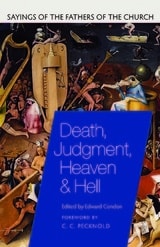
cover of Death, Judgement, Heaven, and Hell

Death, Judgement, Heaven, and Hell

Edward Condon

Catholic University of America Press, 2019
In this volume, canon lawyer and writer Edward Condon compiles a book full of wisdom and compelling insights. More than anything, the Fathers warn us that our life is short, and the reckoning for how we have lived it eternal. The urgency of the Church’s message, brought to life in the sayings of the Fathers, comes to remind us of our true calling and inheritance in baptism, and of the richness of the heavenly reward, which is not so much the fruit of our efforts on Earth but the fulfillment of God’s promise of love to us. The terror of hell is not the threat of the dictator, but a dire warning of the true scope of our freedom as children of God.
[more]
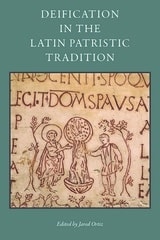
cover of Deification in the Latin Patristic Tradition

Deification in the Latin Patristic Tradition

Jared Ortiz

Catholic University of America Press, 2019
It has become a commonplace to say that the Latin Fathers did not really hold a doctrine of deification. Indeed, it is often asserted that Western theologians have neglected this teaching, that their occasional references to it are borrowed from the Greeks, and that the Latins have generally reduced the rich biblical and Greek Patristic understanding of salvation to a narrow view of redemption. The essays in this volume challenge this common interpretation by exploring, often for the first time, the role this doctrine plays in a range of Latin Patristic authors.
[more]
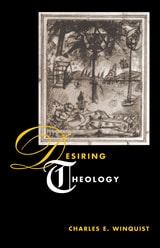
cover of Desiring Theology

Desiring Theology

Charles E. Winquist

University of Chicago Press, 1994

One of the foremost scholars exploring the intersection of theology and continental philosophy, Charles E. Winquist argues for the possibility of theological thinking in a postmodern secular milieu. Moving beyond the now familiar reiteration of postmodernity's losses—the death of God, the displacement of the self, the end of history, the closure of the Book—Winquist equates a desire to think theologically with a desire, amidst postmodernity's disappointments, for a thinking that does not disappoint. To desire theology in this sense is to desire to know an "other" in and of language that can be valued in the forming of personal and communal identity. In this book, "desiring theology" carries another sense as well, for Winquist argues that, in the wake of psychoanalysis, theology must elaborate the meaning and importance of desire in its own discourse.

Winquist's work is tactical as well as theoretical, showing what kind of work theology can do in a postmodern age. He suggests that theology is closely akin to what Gilles Deleuze and Felix Guattari refer to as a minor intensive use of a major language. The minor intensive theological use of language, Winquist argues, pressures the ordinary weave of discourse and opens it to desire. Thus theology becomes a work against "the disappointment of thinking." Deeply engaged with the work of Nietzsche, Derrida, Tillich, Robert P. Scharlemann, and Mark C. Taylor, among others, this book is a significant addition to contemporary theology.
[more]
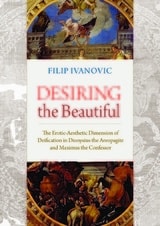
cover of Desiring the Beautiful

Desiring the Beautiful

Filip Ivanovic

Catholic University of America Press, 2019
Desiring the Beautiful studies the concept of deification, theosis, in two of the most influential early Christian philosopher-theologians, who might be considered as theoretical consolidators of the idea of theosis, and argues that the proper understanding of their central soteriological concept must take into account its dimension of love and beauty.
[more]
cover of Dialogues

Dialogues

Saint Gregory the Great

Catholic University of America Press, 1959
No description available
[more]
cover of Disciplinary, Moral, and Ascetical Works

Disciplinary, Moral, and Ascetical Works

Catholic University of America Press, 1959
No description available
[more]
cover of Discourse on the State and Grandeurs of Jesus: The Ineffable Union of the Diety with Humanity

Discourse on the State and Grandeurs of Jesus

The Ineffable Union of the Diety with Humanity

Pierre de Bérulle

Catholic University of America Press, 2023
Pierre de Bérulle (1575–1629) is one of the foremost personalities of early modern Catholicism. As the founder of the “French school” of spirituality, he has exercised a profound influence on the Church from the seventeenth century to the present day. Until now, however, very little of Bérulle’s writings have been available in English. This volume provides the first complete English translation of his best-known work, first printed in Paris in 1623 and titled Discourses on the State and Grandeurs of Jesus, by the Ineffable Union of the Deity with Humanity, and the Submission and Servitude that Is Due Him and His Most Holy Mother in Response to This Wondrous State. Composed in his maturity, this work expresses Bérulle’s theology of the Man-God, whose self-emptying has enabled us to become “capable” of God. In contrast to other spiritual writers who taught that mystical union with God follows the extinction of all sensory and conceptual awareness and all activity of willing, Bérulle’s focus is on the faithful soul’s participation in what he calls Jesus’ “states,” or inner dispositions. The state that Bérulle describes and honors supremely in this text is Jesus’ state of self-emptying in the mystery of the Incarnation. In the hypostatic union, our humanity in Christ is lifted up to heaven, and Christ is the first fruit of humanity-made-divine, the “firstborn among many brothers.” Through him we become children of God by adoption, participants in God’s divine being. This is an outstanding translation, conveying not only the meaning but also the beauty and rhetorical features of the original. The Discourses will repay reading as a poignant source of personal devotion, a primary text of the Catholic Reformation, and a classic of spiritual theology.
[more]
cover of Discourses against Judaizing Christians

Discourses against Judaizing Christians

Saint John Chrysostom

Catholic University of America Press, 1979
No description available
[more]
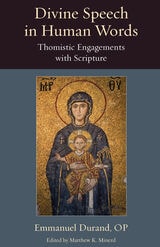
cover of Divine Speech in Human Words: Thomistic Engagements with Scripture

Divine Speech in Human Words

Thomistic Engagements with Scripture

Emmanuel Durand, OP

Catholic University of America Press, 2022
Is the portrait of God revealed in Scripture fundamentally intelligible? The biblical accounts of God reveal seemingly contradictory themes: God’s holiness and narratives telling of his anger; the Divine Omnipotence faced with the Impossible; the suffering Christ upon the Cross and the transcendent Trinity of Persons in God; the unique Savior and the universality of God’s salvific will; and so forth. How are we to hold together all of this data without denying any aspect of the mystery of God? Must we give into our ambient culture’s sense that the biblical God cannot be taken seriously by truly discerning and rational minds when they try to understand “the Divine”? Or, in the midst of this apparent contradiction, can we find the lines of harmony in the revealed mysteries? In Divine Speech in Human Words, Fr. Emmanuel Durand unties some of the knots that face us when we reflect on the God of biblical Revelation. In each of the essays gathered here, Fr. Durand sympathetically articulates the tensions and apparent contradictions experienced by contemporary minds as they strive to understand the revealed truth of God. A whole host of topics are covered in this volume: the Cross and the revelation of the Trinity; God’s holiness and transcendence; divine immutability and the sorrow of a loving God; Divine Providence and human prayer; the fatherhood of God and eschatology; Christ’s way of life; and many others. Drawing philosophical insights from the Thomistic tradition as his intellectual tools, Fr. Durand nonetheless emphasizes the importance of a properly theological mode of reflection, allowing these issues to be illuminated by the revealed truth of Sacred Scripture. Thus, for each of these difficult topics, he shows that a vital theological response must not limit itself to mere logical rigor but, rather, requires metaphysical insight and, above all, sapiential appreciation of God’s revealed word. With such instruments in hand, each essay approaches the tensions of biblical revelation with an eager readiness to show how a thoughtful Thomistic practice of biblical theology can guide faith as it seeks an understanding of both contemporary and perennial theological problems.
[more]
cover of Documents from the Luciferians: In Defense of the Nicene Creed

Documents from the Luciferians

In Defense of the Nicene Creed

Colin M. Whiting

SBL Press, 2019

Six important documents for scholars of early church history

This volume includes English translations of several documents concerning the Luciferians, a group of fourth-century Christians whose name derives from the bishop Lucifer of Cagliari. Documents include a confession of faith written for Emperor Theodosius I and a theological treatise written for his wife by Luciferian clergyman Faustinus, the first English translation of a Luciferian petition to Theodosius that focuses on the persecution the community has suffered, Theodosius’s imperial law in response to the Luciferians, two letters composed by Luciferians that purport to represent correspondence from the bishop Athanasius of Alexandria to Lucifer, and the priest Jerome’s Dialogus adversus Luciferianos. These texts highlight connections between developments in Christian theology and local Christian communities in the course of the fourth century.

Features:

  • The first English translation of Faustinus’s Libellus precum
  • An overview of the development of late antique theology and Christianity
  • An introduction to Luciferian beliefs and the translated texts
[more]
cover of Dogmatic and Polemical Works

Dogmatic and Polemical Works

Saint Jerome

Catholic University of America Press, 1965
St. Jerome's reputation rests primarily on his achievements as a translator and as a scriptural exegete. The important service that he rendered to the Church in his doctrinal works is often overlooked or minimized by those who look for originality and independence of thought
[more]
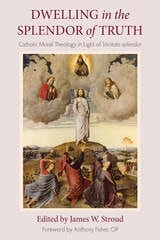
cover of Dwelling in the Splendor of Truth: Catholic Moral Theology in Light of <i>Veritatis splendor</i>

Dwelling in the Splendor of Truth

Catholic Moral Theology in Light of <i>Veritatis splendor</i>

James W. Stroud

Catholic University of America Press, 2026

On August 6, 1993, Pope John Paul II promulgated the long-awaited encyclical on moral theology entitled Veritatis splendor. In this landmark encyclical, directed principally toward bishops, Pope John Paul II sought a reset of the discipline of Catholic moral theology after the Second Vatican Council in response to the theological dissent that had called into question the foundations of Catholic morality. More than thirty years after the promulgation of Veritatis splendor, the essays in this edited volume consider the major themes and topics of this encyclical as it seeks to contribute to the revitalization of moral theology today. These themes and topics include: the rich young man and the renewal of moral theology, freedom, nature, and law, conscience, intrinsically evil acts, the state of revisionism, the moral object, martyrdom and morality, evangelization, the role of the moral theologian, and the role of scripture in moral theology. Contributors include: William C. Mattison, III, Irene Alexander, Matthew Levering, Matthew Dugandzic, James W. Stroud, Stephen L. Brock, Patrick Clark, Timothy P. O’Malley, Jana Marguerite Bennet, John Grabowski, with a foreword by Archbishop of Sydney Anthony Fisher, OP.
[more]