Results by title
231 books match the query 'Colonies' and 11 start with d
DETECTING THE NATION
FICTIONS OF DETECTION AND THE IMPERIAL VENTURECaroline Reitz
The Ohio State University Press, 2004
Dark Side of the Light
Slavery and the French EnlightenmentLouis Sala-Molins
University of Minnesota Press, 2006
Translated into English for the first time, Dark Side of the Light scrutinizes Condorcet’s Reflections on NegroSlavery and the works of Montesquieu, Rousseau, and Diderot side by side with the Code Noir (the royal document that codified the rules of French Caribbean slavery) in order to uncover attempts to uphold the humanist project of the Enlightenment while simultaneously justifying slavery. Wielding the pen of both the ironist and the moralist, Sala-Molins demonstrates the flawed nature of these attempts and the reasons given for this denial of rights, from the imperatives of public order to the incomplete humanity of the slave (and thus the need for his progressive humanization through slavery), to the economic prosperity that depended on his labor. At the same time, Sala-Molins uses the techniques of literature to give equal weight to the perspective of the “barefooted, the starving, and the slaves” through expository prose and scenes between slave and philosopher, giving moral agency and flesh-and-blood dimensions to issues most often treated as abstractions.
Both an urgent critique and a measured analysis, Dark Side of the Light reveals the moral paradoxes of Enlightenment philosophies and their world-changing consequences.
Louis Sala-Molins is a moral and political philosopher and emeritus professor at the University of Toulouse. He is the author of many books, including Le Code Noir, ou Le calvaire de Canaan and L’Afrique aux Amériques.
John Conteh-Morgan is associate professor of French and Francophone, African-American, and African studies at Ohio State University. He is the author of Theatre and Drama in Francophone Africa: A Critical Introduction.

Death and Dying in Colonial Spanish America
Edited by Martina Will de Chaparro and Miruna Achim
University of Arizona Press, 2011
The variety of sources uncovered in the authors’ original archival research suggests the wide diversity of topics and approaches they employ: Nahua annals, Spanish chronicles, Inquisition case records, documents on land disputes, sermons, images, and death registers. Geographically, the range of research focuses on the viceroyalties of New Spain, Peru, and New Granada.
The resulting records—both documentary and archaeological—offer us a variety of vantage points from which to view each of these cultural groups as they came into contact with others. Much less tied to modern national boundaries or old imperial ones, the many facets of the new historical research exploring the topic of death demonstrate that no attitudes or practices can be considered either “Western” or universal.
Decolonizing the Sodomite
Queer Tropes of Sexuality in Colonial Andean CultureBy Michael J. Horswell
University of Texas Press, 2006
Early Andean historiography reveals a subaltern history of indigenous gender and sexuality that saw masculinity and femininity not as essential absolutes. Third-gender ritualists, Ipas, mediated between the masculine and feminine spheres of culture in important ceremonies and were recorded in fragments of myths and transcribed oral accounts. Ritual performance by cross-dressed men symbolically created a third space of mediation that invoked the mythic androgyne of the pre-Hispanic Andes. The missionaries and civil authorities colonizing the Andes deemed these performances transgressive and sodomitical.
In this book, Michael J. Horswell examines alternative gender and sexuality in the colonial Andean world, and uses the concept of the third gender to reconsider some fundamental paradigms of Andean culture. By deconstructing what literary tropes of sexuality reveal about Andean pre-Hispanic and colonial indigenous culture, he provides an alternative history and interpretation of the much-maligned aboriginal subjects the Spanish often referred to as "sodomites." Horswell traces the origin of the dominant tropes of masculinist sexuality from canonical medieval texts to early modern Spanish secular and moralist literature produced in the context of material persecution of effeminates and sodomites in Spain. These values traveled to the Andes and were used as powerful rhetorical weapons in the struggle to justify the conquest of the Incas.
Discipline and the Other Body
Correction, Corporeality, ColonialismSteven Pierce and Anupama Rao, eds.
Duke University Press, 2006
The contributors, who include both historians and anthropologists, address instances of colonial violence from the early modern period to the twentieth century and from Asia to Africa to North America. They consider diverse topics, from the interactions of race, law, and violence in colonial Louisiana to British attempts to regulate sex and marriage in the Indian army in the early nineteenth century. They examine the political dilemmas raised by the extensive use of torture in colonial India and the ways that British colonizers flogged Nigerians based on beliefs that different ethnic and religious affiliations corresponded to different degrees of social evolution and levels of susceptibility to physical pain. An essay on how contemporary Sufi healers deploy bodily violence to maintain sexual and religious hierarchies in postcolonial northern Nigeria makes it clear that the state is not the only enforcer of disciplinary regimes based on ideas of difference.
Contributors. Laura Bear, Yvette Christiansë, Shannon Lee Dawdy, Dorothy Ko, Isaac Land, Susan O’Brien, Douglas M. Peers, Steven Pierce, Anupama Rao, Kerry Ward
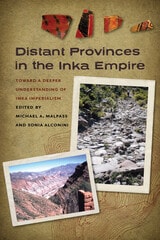
Distant Provinces in the Inka Empire
Toward a Deeper Understanding of Inka ImperialismMichael A. Malpass
University of Iowa Press, 2010
Who was in charge of the widespread provinces of the great Inka Empire of the fifteenth and sixteenth centuries: Inka from the imperial heartland or local leaders who took on the trappings of their conquerors, either by coercion or acceptance? By focusing on provinces far from the capital of Cuzco, the essays in this multidisciplinary volume provide up-to-date information on the strategies of domination asserted by the Inka across the provinces far from their capital and the equally broad range of responses adopted by their conquered peoples.
Contributors to this cutting-edge volume incorporate the interaction of archaeological and ethnohistorical research with archaeobotany, biometrics, architecture, and mining engineering, among other fields. The geographical scope of the chapters—which cover the Inka provinces in Bolivia, in southeast Argentina, in southern Chile, along the central and north coast of Peru, and in Ecuador—build upon the many different ways in which conqueror and conquered interacted. Competing factors such as the kinds of resources available in the provinces, the degree of cooperation or resistance manifested by local leaders, the existing levels of political organization convenient to the imperial administration, and how recently a region had been conquered provide a wealth of information on regions previously understudied. Using detailed contextual analyses of Inka and elite residences and settlements in the distant provinces, the essayists evaluate the impact of the empire on the leadership strategies of conquered populations, whether they were Inka by privilege, local leaders acculturated to Inka norms, or foreign mid-level administrators from trusted ethnicities.
By exploring the critical interface between local elites and their Inka overlords, Distant Provinces in the Inka Empire builds upon Malpass’s 1993 Provincial Inca: Archaeological and Ethnohistorical Assessment of the Impact of the Inca State to support the conclusions that Inka strategies of control were tailored to the particular situations faced in different regions. By contributing to our understanding of what it means to be marginal in the Inka Empire, this book details how the Inka attended to their political and economic goals in their interactions with their conquered peoples and how their subjects responded, producing a richly textured view of the reality that was the Inka Empire.

Dockside Reading
Hydrocolonialism and the Custom HouseIsabel Hofmeyr
Duke University Press, 2022
Domestic Violence and the Law in Colonial and Postcolonial Africa
Emily S. Burrill
Ohio University Press, 2010
Domestic Violence and the Law in Colonial and Postcolonial Africa reveals the ways in which domestic space and domestic relationships take on different meanings in African contexts that extend the boundaries of family obligation, kinship, and dependency. The term domestic violence encompasses kin-based violence, marriage-based violence, gender-based violence, as well as violence between patrons and clients who shared the same domestic space. As a lived experience and as a social and historical unit of analysis, domestic violence in colonial and postcolonial Africa is complex.
Using evidence drawn from Sub-saharan Africa, the chapters explore the range of domestic violence in Africa’s colonial past and its present, including taxation and the insertion of the household into the broader structure of colonial domination.
African histories of domestic violence demand that scholars and activists refine the terms and analyses and pay attention to the historical legacies of contemporary problems. This collection brings into conversation historical, anthropological, legal, and activist perspectives on domestic violence in Africa and fosters a deeper understanding of the problem of domestic violence, the limits of international human rights conventions, and local and regional efforts to address the issue.
Domesticating Empire
Enlightenment in Spanish AmericaKaren Stolley
Vanderbilt University Press, 2013
Through the work of five authors--Jose de Oviedo y Banos, Juan Ignacio Molina, Felix de Azara, Catalina de Jesus Herrera, and Felix de Arrate--Domesticating Empire explores the Ibero-American Enlightenment as a project that reflects both key Enlightenment concerns and the particular preoccupations of Bourbon Spain and its territories in the Americas. At a crucial moment in Spain's imperial trajectory, these authors domesticate topics central to empire--conquest, Indians, nature, God, and gold--by making them familiar and utilitarian. As a result, their works later proved resistant to overarching schemes of Latin American literary history and have been largely forgotten. Nevertheless, eighteenth-century Ibero-American writing complicates narratives about both the Enlightenment and Latin American cultural identity.
Dos X
Disability and Racial Dysphoria in Latinx and Filipinx CultureSony Coráñez Bolton
University of Texas Press, 2025
An examination of the interconnectedness of brown-racialized people across multiple identities, told through case studies of television, literature, and writing.
As a Filipinx immigrant to the United States, Sony Coráñez Bolton has frequently been mistaken as Mexican. Dos X theorizes such misrecognition. What does it mean to exist in this liminal state, which Coráñez Bolton dubs the “racial uncanny”? What generative possibilities emerge from the presumed interchangeability of Latinx and Filipinx bodies—and from the in-betweenness of brownness as such?
Dos X tracks misrecognition through cultural products like the TV series Undone, Brian Ascalon Roley’s American Son, and the nonfiction work of Jose Antonio Vargas. Misrecognition, Coráñez Bolton argues, produces moments of uncanniness in which subjects experience dysphoric attachments to identities that aren’t supposed to be theirs. In the context of racial capitalism, racial dysphoria is a disability because it undermines certainty about what one’s body is and therefore what role one is meant to play as a laborer. But racial dysphoria can also be revealing. Coráñez Bolton identifies vast potential in this supposed disability, which compels its “sufferers” to confront their shared position within the social, political, and economic organization of capital’s empire, opening new avenues for liberatory solidarity.
Duress
Imperial Durabilities in Our TimesAnn Laura Stoler
Duke University Press, 2016