Results by title
153 books match the query 'Comics & Graphic Novels' and 10 start with d
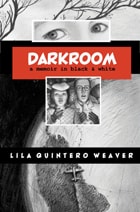
Darkroom
A Memoir in Black and WhiteLila Quintero Weaver
University of Alabama Press, 2012
A Latina girl’s journey through the shadows of the civil rights era.
Darkroom is a deeply moving graphic memoir that chronicles Lila Quintero Weaver’s experience growing up as an Argentine immigrant in 1960s Alabama during the height of the civil rights movement. Through striking black-and-white illustrations and heartfelt narrative, Weaver explores the complexities of race, identity, and belonging in a society divided by segregation. Neither Black nor White, her family occupies a unique position that offers a powerful lens on the struggles for justice and equality. This coming-of-age story blends personal history with pivotal social change, inviting readers to reflect on themes of immigration, cultural assimilation, and moral courage. Darkroom is both an intimate portrait and a universal tale of resilience, making it an essential read for those interested in civil rights, memoirs, and graphic storytelling.
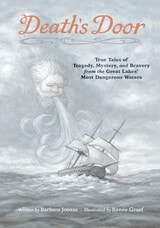
Death's Door
True Tales of Tragedy, Mystery, and Bravery from the Great Lakes' Most Dangerous WatersBarbara Joosse
Wisconsin Historical Society Press, 2023
This beautifully illustrated book for children ages 8–11 relates dramatic moments from Great Lakes maritime history in a graphic-novel style. The book’s five true stories span four centuries but take place in one location: a dangerous stretch of water near Lake Michigan’s western shore that is known as “Death’s Door.”
Young readers will devour these tales of tragic accidents, mysterious disappearances, and heroic moments. The stories feature a 17th-century fur trading crew, an 18th-century Potawatomi trading party, a mail carrier and a shipbuilding family from the 19th century, and an early 20th-century basketball team. The narrator is Death’s Door itself, who wonders why people insist on crossing its treacherous waters, concluding it is “because they are human. Ambitious and restless…but loving too.”
An informative afterword provides insight into the author’s sources and features archival images and additional historical details about each of the stories.
Silver winner of the 2023 Midwest Book Award for Graphic Novels
Decolonizing Media Fandom
Disability, Race, and Marvel Superhero FansDivya Garg
University of Iowa Press, 2025
Decolonizing Media Fandom focuses on the globally diverse fan base of a massively popular Western text: the Marvel superhero universe. Drawing on fanworks from Archive of Our Own, a survey spanning sixteen countries, and one-on-one interviews with Marvel fans who identify as non-white and/or having a disability, Divya Garg examines the strengths and limitations of fandom from the perspective of those who are often relegated to the margins.
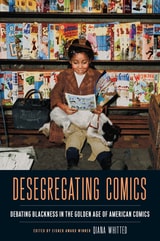
Desegregating Comics
Debating Blackness in the Golden Age of American ComicsQiana Whitted
Rutgers University Press, 2023
Shortlisted for the Best Academic / Scholarly Work Eisner Award
Honorable Mention for the Harry Shaw and Katrina Hazzard-Donald Award for Outstanding Work in African-American Popular Culture Studies from the Popular Culture Association
Some comics fans view the industry’s Golden Age (1930s-1950s) as a challenging time when it comes to representations of race, an era when the few Black characters appeared as brutal savages, devious witch doctors, or unintelligible minstrels. Yet the true portrait is more complex and reveals that even as caricatures predominated, some Golden Age comics creators offered more progressive and nuanced depictions of Black people.
Desegregating Comics assembles a team of leading scholars to explore how debates about the representation of Blackness shaped both the production and reception of Golden Age comics. Some essays showcase rare titles like Negro Romance and consider the formal innovations introduced by Black comics creators like Matt Baker and Alvin Hollingsworth, while others examine the treatment of race in the work of such canonical cartoonists as George Herriman and Will Eisner. The collection also investigates how Black fans read and loved comics, but implored publishers to stop including hurtful stereotypes. As this book shows, Golden Age comics artists, writers, editors, distributors, and readers engaged in heated negotiations over how Blackness should be portrayed, and the outcomes of those debates continue to shape popular culture today.
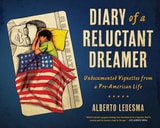
Diary of a Reluctant Dreamer
Undocumented Vignettes from a Pre-American LifeAlberto Ledesma
The Ohio State University Press, 2017
Exploring Ledesma’s experiences from immigrant to student to academic, Diary of a Reluctant Dreamer presents a humorous, gritty, and multilayered portrait of undocumented immigrant life in urban America. Ledesma’s vignettes about life in the midst of ongoing social trauma give voice to a generation that has long been silent about its struggles. Delving into the key moments of cultural transition throughout his childhood and adulthood—police at the back door waiting to deport his family, the ex-girlfriend who threatens to call INS and report him, and the interactions with law enforcement even after he is no longer undocumented—Ledesma, through his art and his words, provides a glimpse into the psychological and philosophical concerns of undocumented immigrant youth who struggle to pinpoint their identity and community.
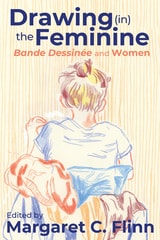
Drawing (in) the Feminine
Bande Dessinée and WomenEdited by Margaret C. Flinn
The Ohio State University Press, 2024
Winner, Eisner Award for Best Academic/Scholarly Work 2025
Finalist, Comics Studies Society Edited Book Prize 2025
Drawing (in) the Feminine celebrates and examines the richness of contemporary women's production in French and Francophone comics art and considers the history of representations made by both dominant and marginalized creators. Bridging historical and contemporary comics output, these essays illuminate the interfaces among genre, gender, and cultural history. Contributors from both sides of the Atlantic, and across a variety of methodologies and disciplinary orientations, challenge prevailing claims about the absence of women creators, characters, and readers in bande dessinée, arguing that women have always been part of its history. While still far from achieving parity with their male counterparts, female creators are occupying an increasingly significant portion of the French-language comics publishing industry, and creators of all genders are putting forth stories that reflect on the diversity and richness of women's and gender-nonconforming people's experiences. In the essays collected here, contributors push back against the ways in which the marginalization of women within bande dessinée history has overshadowed their significant contributions, extending avenues for further exploring the true diversity of a flourishing contemporary production.
Contributors:
Armelle Blin-Rolland, Véronique Bragard, Michelle Bumatay, Benoît Crucifix, Isabelle Delorme, Jacques Dürrenmatt, Margaret C. Flinn, Alexandra Gueydan-Turek, Jennifer Howell, Jessica Kohn, Sylvain Lesage, Catriona MacLeod, Mark McKinney
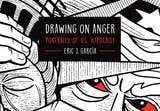
Drawing on Anger
Portraits of U.S. HypocrisyEric J. García
The Ohio State University Press, 2018
For over a decade García has been serving up inked visuals with the sharpest of political critiques through a Chicano lens. If you’re looking for funny punch lines, these aren’t the cartoons for you. But if you want to pull down Uncle Sam’s pants and see what’s really going on, this is your book.
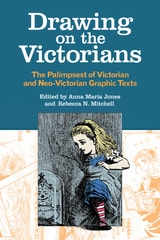
Drawing on the Victorians
The Palimpsest of Victorian and Neo-Victorian Graphic TextsAnna Maria Jones
Ohio University Press, 2017
Late nineteenth-century Britain experienced an unprecedented explosion of visual print culture and a simultaneous rise in literacy across social classes. New printing technologies facilitated quick and cheap dissemination of images—illustrated books, periodicals, cartoons, comics, and ephemera—to a mass readership. This Victorian visual turn prefigured the present-day impact of the Internet on how images are produced and shared, both driving and reflecting the visual culture of its time.
From this starting point, Drawing on the Victorians sets out to explore the relationship between Victorian graphic texts and today’s steampunk, manga, and other neo-Victorian genres that emulate and reinterpret their predecessors. Neo-Victorianism is a flourishing worldwide phenomenon, but one whose relationship with the texts from which it takes its inspiration remains underexplored.
In this collection, scholars from literary studies, cultural studies, and art history consider contemporary works—Alan Moore’s League of Extraordinary Gentlemen, Moto Naoko’s Lady Victorian, and Edward Gorey’s Gashlycrumb Tinies, among others—alongside their antecedents, from Punch’s 1897 Jubilee issue to Alice in Wonderland and more. They build on previous work on neo-Victorianism to affirm that the past not only influences but converses with the present.
Contributors: Christine Ferguson, Kate Flint, Anna Maria Jones, Linda K. Hughes, Heidi Kaufman, Brian Maidment, Rebecca N. Mitchell, Jennifer Phegley, Monika Pietrzak-Franger, Peter W. Sinnema, Jessica Straley
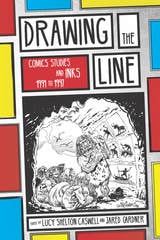
Drawing the Line
Comics Studies and INKS, 1994–1997Lucy Shelton Caswell and Jared Gardner
The Ohio State University Press, 2017
Included in the volume are essays by pioneering comics scholars on newspaper comic strips, Japanese manga, Chinese lianhuanhua, comic books, graphic novels, and editorial cartoons, alongside writings and artwork by celebrated cartoonists such as Will Eisner, Oliver Harrington, Charles Schulz, and Frank Stack. This volume serves as an invaluable resource for anyone interested in the history and study of the comics form, visual culture, or the history of journalism.
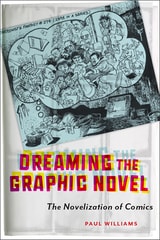
Dreaming the Graphic Novel
The Novelization of ComicsPaul Williams
Rutgers University Press, 2020
Honorable Mention, 2019-2020 Research Society for American Periodicals Book Prize
The term “graphic novel” was first coined in 1964, but it wouldn’t be broadly used until the 1980s, when graphic novels such as Watchmen and Maus achieved commercial success and critical acclaim. What happened in the intervening years, after the graphic novel was conceptualized yet before it was widely recognized?
Dreaming the Graphic Novel examines how notions of the graphic novel began to coalesce in the 1970s, a time of great change for American comics, with declining sales of mainstream periodicals, the arrival of specialty comics stores, and (at least initially) a thriving underground comix scene. Surveying the eclectic array of long comics narratives that emerged from this fertile period, Paul Williams investigates many texts that have fallen out of graphic novel history. As he demonstrates, the question of what makes a text a ‘graphic novel’ was the subject of fierce debate among fans, creators, and publishers, inspiring arguments about the literariness of comics that are still taking place among scholars today.
Unearthing a treasure trove of fanzines, adverts, and unpublished letters, Dreaming the Graphic Novel gives readers an exciting inside look at a pivotal moment in the art form’s development.