Results by title
103 books match the query 'Conservation' and 3 start with d
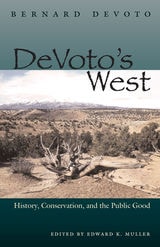
DeVoto’s West
History, Conservation, and the Public GoodBernard DeVoto
Ohio University Press, 2005
Social commentator and preeminent Western historian Bernard DeVoto vigorously defended public lands in the West against commercial interests. At his death in 1955, DeVoto had won both the Pulitzer and Bancroft prizes. But he was most famous for his eloquent writing that advocated conservation of America's prairies, rangeland, forests, mountains, canyons, and deserts.DeVoto's West: Essays on History, Conservation, and the Public Good showcases the complexity, depth, and breadth of DeVoto's thinking. Editor Edward K. Muller introduces these twenty-two essays (many of which originally appeared in Harper's renowned column The Easy Chair) that passionately and coherently advocate federal control for vast tracts of public land. DeVoto addressed many issues, including the plundering of resources by absentee eastern corporations, Westerners' conflicted relationship to exploitation, and the degradation of the national parks. He believed that conservation of natural resources in the West required government control of public lands against livestock associations, timber interests, and their congressional allies who plotted the privatization of the national forests and the extraction of resources in the national parks.DeVoto's West collects the best of DeVoto's conservation pieces for the first time. It will introduce a new generation to prose that has retained its relevance and remains a remarkably current and timely argument for protecting public lands. Bernard DeVoto was born in Ogden, Utah, in 1897. He spent his adult life in the East, first teaching English at Northwestern University, Chicago, then living in New York, and finally settling in Cambridge, Massachusetts. He is the subject of an acclaimed biography, The Uneasy Chair, by Wallace Stegner.
[more]

Defending the Master Race
Conservation, Eugenics, and the Legacy of Madison GrantJonathan Spiro
University Press of New England, 2008
Scholars have labeled Madison Grant everything from the “nation’s most influential racist” to the “greatest conservationist that ever lived.” His life illuminates early twentieth-century America as it was heading toward the American Century, and his legacy is still very much with us today, from the speeches of immigrant-bashing politicians to the international efforts to arrest climate change. This insightful biography shows how Grant worked side-by-side with figures such as Theodore Roosevelt to found the Bronx Zoo, preserve the California redwoods, and save the American bison from extinction. But Grant was also the leader of the eugenics movement in the United States. He popularized the infamous notions that the blond-haired, blue-eyed Nordics were the “master race” and that the state should eliminate members of inferior races who were of no value to the community. Grant’s behind-the-scenes machinations convinced Congress to enact the immigration restriction legislation of the 1920s, and his influence led many states to ban interracial marriage and sterilize thousands of “unworthy” citizens. Although most of the relevant archival materials on Madison Grant have mysteriously disappeared over the decades, Jonathan Spiro has devoted many years to reconstructing the hitherto concealed events of Grant’s life. His astonishing feat of detective work reveals how the founder of the Bronx Zoo wound up writing the book that Adolf Hitler declared was his “bible.”
[more]
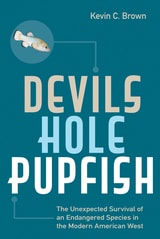
Devils Hole Pupfish
The Unexpected Survival of an Endangered Species in the Modern American WestKevin C. Brown
University of Nevada Press, 2021
The Devils Hole pupfish is one of the rarest vertebrate animals on the planet; its only natural habitat is a ten-by-sixty-foot pool near Death Valley, on the Nevada—California border. Isolation in Devils Hole made the fish different from its close genetic relatives, but as Devils Hole Pupfish explores, what has made the species a survivor is its many surprising connections to the people who have studied, ignored, protested or protected it.
[more]