214 books match the query 'Constitutional' and 9 start with d
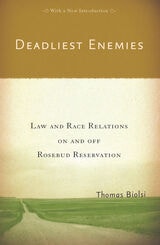
cover of Deadliest Enemies: Law and Race Relations on and off Rosebud Reservation

Deadliest Enemies

Law and Race Relations on and off Rosebud Reservation

Thomas Biolsi

University of Minnesota Press, 2007

Many people living far away from Indian reservations express sympathy for the poverty and misery experienced by Native Americans, yet, Thomas Biolsi argues, the problems faced by Native Americans are the results of white privilege.

In Deadliest Enemies, Biolsi connects the origins of racial tension between Indians and non-Indians on the Rosebud Reservation in South Dakota to federal laws, showing how the courts have created opposing political interests along race lines. Biolsi demonstrates that the court’s definitions of legal rights—both constitutional and treaty rights—make solutions to racial tensions intractable.

This powerful work sheds much-needed light on racial conflicts in South Dakota and in the rest of the United States, and holds white people accountable for the benefits of their racial privilege that come at the expense of Native Americans.

Thomas Biolsi is professor of Native American studies at the University of California at Berkeley.

[more]
cover of Defence and the UK Constitution

Defence and the UK Constitution

Nigel D. White

Haus Publishing, 2025

An overview of the United Kingdom’s constitution and defense policy.

Defense and security policy lies at the heart of the British state but can appear entirely untrammeled by the constitution. In fact, when political and military leaders exercise their executive powers, the UK Parliament and the judiciary have limited oversight, let alone control, over their actions. Defence and the UK Constitution introduces key constitutional issues to a general audience and pinpoints the differences between the “legal constitution” and the “political constitution,” with reference to the lack of accountability within modern British security structures. Nigel White traces this imbalance back to the 1680 Bill of Rights and examines the evolution of war and emergency powers, placing them within the context of international law.

Advocating for a rebalancing of the efficient and democratic, as well as the legal and political, elements of the constitution, this short work aims to address the inherent “defense paradox” in the UK constitution and to indicate which constitutional changes are needed to safeguard Britain’s democratic principles and limit excessive uses of discretionary power.
 
[more]
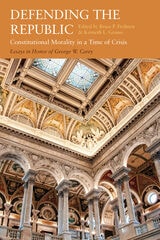
cover of Defending the Republic: Constitutional Monarchy in a Time of Crisis: Essays in Honor of George W. Carey

Defending the Republic

Constitutional Monarchy in a Time of Crisis: Essays in Honor of George W. Carey

Bruce Frohnen

Catholic University of America Press, 2022
In recent years, our constitutional order has increasingly come under attack as irredeemably undemocratic, racist, and oppressive. At the same time, it is increasingly obvious that politic practices in the United States have strayed very far from the founders’ designs and become deeply dysfunctional. The time is thus ripe for renewed reflection about the American political tradition. This volume reintroduces readers to the conservative tradition of political and constitutional discourse. It brings together prominent political scientists and legal scholars, all of whom were deeply influenced by the life and work of the eminent constitutional scholar George W. Carey. For over 40 years, Carey strove mightily to explain the nature and requirements of our political tradition. How it fostered meaningful, virtuous self-government, and how our constitutional tradition has been derailed by progressivist ideology. He is perhaps best known for his concept of “constitutional morality,” the understanding that our republican constitutional order can be sustained only by a combination of formal mechanisms (e.g., separation of powers) and unwritten norms (“standards of behavior”) that act to foster deliberation and consensus, as well as keep political actors within the boundaries of their constitutional offices. Contributors, including Francis Canavan, Claes G. Ryn, Paul Edward Gottfried, and Peter Augustine Lawler, discuss and develop Carey’s key insights, applying them to issues from the nature of majoritarian government to the purposes of constitutionalism to the decline of virtue that has accompanied the expansion of power among national and international elites. Each essay provides penetrating analysis of key aspects of our tradition, its inherent purposes, growth, and subsequent derailment, as well as the resources remaining within that tradition for the rebuilding of our constitutional order and a decent common life.
[more]
cover of Democracy and Dysfunction

Democracy and Dysfunction

Sanford Levinson and Jack M. Balkin

University of Chicago Press, 2019

It is no longer controversial that the American political system has become deeply dysfunctional. Today, only slightly more than a quarter of Americans believe the country is heading in the right direction, while sixty-three percent believe we are on a downward slope. The top twenty words used to describe the past year include “chaotic,” “turbulent,” and “disastrous.” Donald Trump’s improbable rise to power and his 2016 Electoral College victory placed America’s political dysfunction in an especially troubling light, but given the extreme polarization of contemporary politics, the outlook would have been grim even if Hillary Clinton had won. The greatest upset in American presidential history is only a symptom of deeper problems of political culture and constitutional design.      

Democracy and Dysfunction brings together two of the leading constitutional law scholars of our time, Sanford Levinson and Jack M. Balkin, in an urgently needed conversation that seeks to uncover the underlying causes of our current crisis and their meaning for American democracy. In a series of letters exchanged over a period of two years, Levinson and Balkin travel—along with the rest of the country—through the convulsions of the 2016 election and Trump’s first year in office. They disagree about the scope of the crisis and the remedy required. Levinson believes that our Constitution is fundamentally defective and argues for a new constitutional convention, while Balkin, who believes we are suffering from constitutional rot, argues that there are less radical solutions. As it becomes dangerously clear that Americans—and the world—will be living with the consequences of this pivotal period for many years to come, it is imperative that we understand how we got here—and how we might forestall the next demagogue who will seek to beguile the American public.
 
[more]
cover of Democratization and the Politics of Constitution-Making in Turkey

Democratization and the Politics of Constitution-Making in Turkey

Ömer Faruk Gençkaya

Central European University Press, 2009
Explores and illustrates how domestic and international factors shape the direction of democratization process with special reference to constitution making process in Turkey. Describes how all five Turkish constitutions were, by and large, the products of indigenous effort, although borrowing could be felt in certain limited areas. Argues that the constitutional reforms in the post-1983 period were the outco me of broad inter-party negotiations and agree ments as a response to the society's demands for a more democratic and liberal political system. Finally, the constitutional revisions adopted since 1995 were strongly conditioned by Turkey's hope of accession to the European Union. With these reforms, Turkey was successful in meeting the political criteria and started accession negotiations with the EU.
[more]
cover of Desperately Seeking Certainty: The Misguided Quest for Constitutional Foundations

Desperately Seeking Certainty

The Misguided Quest for Constitutional Foundations

Daniel A. Farber and Suzanna Sherry

University of Chicago Press, 2002
Irreverent, provocative, and engaging, Desperately Seeking Certainty attacks the current legal vogue for grand unified theories of constitutional interpretation. On both the Right and the Left, prominent legal scholars are attempting to build all of constitutional law from a single foundational idea. Dan Farber and Suzanna Sherry find that in the end no single, all-encompassing theory can successfully guide judges or provide definitive or even sensible answers to every constitutional question. Their book brilliantly reveals how problematic foundationalism is and shows how the pragmatic, multifaceted common law methods already used by the Court provide a far better means of reaching sound decisions and controlling judicial discretion than do any of the grand theories.
[more]
cover of Documentary History of the Ratification of the Constitution, Volume 23: Ratification of the Constitution by the States: New York, No. 5

Documentary History of the Ratification of the Constitution, Volume 23

Ratification of the Constitution by the States: New York, No. 5

Edited by John P. Kaminski and Gaspare J. Saladino; Senior Associate Editor: Richard Leffler; Associate Editor: Charles H. Schoenleber; Assistant Editor: Margaret A. Hogan

Wisconsin Historical Society Press, 2009
This is the fifth and final volume documenting New York State's ratification of the Constitution. This particular volume includes the complete record of the state ratifying convention. In addition to the official journal and the proceedings and debates of the convention, the volume contains many documents never before published, including the voluminous notes of the secretary of the convention and several of the convention delegates, the correspondence of delegates and spectators at the convention, and the rich newspaper commentaries describing the day-by-day events in the convention. For the first time, historians will be able to see how the New York convention - dominated by a two-thirds majority of Antifederalists - came to adopt the Constitution. This documentary series is a research tool of remarkable power, an unrivaled work for historical and legal scholars, librarians, and students of the Constitution.
[more]
cover of Documentary History of the Ratification of the Constitution, Volume 24: Ratification of the Constitution by the States: Rhode Island, No. 1

Documentary History of the Ratification of the Constitution, Volume 24

Ratification of the Constitution by the States: Rhode Island, No. 1

Kaminski

Wisconsin Historical Society Press, 2011

This is the first of three volumes documenting Rhode Island's public and private debates about the Constitution. This documentary series is a research tool of remarkable power, an unrivaled reference work for historical and legal scholars, librarians, and students of the Constitution. The volumes are encyclopedic, consisting of manuscript and printed documents-contemporary newspapers, broadsides, and pamphlets-compiled from hundreds  of sources, copiously annotated, thoroughly indexed, and often accompanied  by microfiche supplements.  Pulitzer Prize-winning historian Michael Kammen has noted that The Documentary History of the Ratification of the Constitution series "will be of enduring value centuries hence" and described it as "one of the most interesting documentary publications we have ever had."  The American Bar Association Journal has stated, "Each new volume now fills another vital part of the mosaic of national history."

[more]
cover of Drunk Driving: An American Dilemma

Drunk Driving

An American Dilemma

James B. Jacobs

University of Chicago Press, 1989

In this ambitious interdisciplinary study, James B. Jacobs provides the first comprehensive review and analysis of America's drunk driving problem and of America's anti-drunk driving policies and jurisprudence. In a clear and accessible style, he considers what has been learned, what is being done, and what constitutional limits exist to the control and enforcement of drunk driving.

[more]