Results by title
434 books match the query 'Criticism & Theory' and 13 start with d
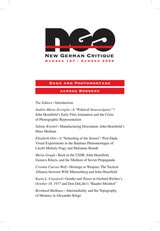
Dada and Photomontage across Borders, Volume 36
David Bathrick, Andreas Huyssen, and Anson Rabinbach, eds.
Duke University Press, 0
The central figure of the issue is John Heartfield, a Dadaist who influenced much of the art world in Europe after World War I. The collection investigates Heartfield’s lesser-known early work with cinema in the service of the German High Command. Believing that photographic cinema was akin to war propaganda, Heartfield rejected live-action war footage in favor of American cinematic animation to promote an honest discussion about the horror and realities of war. One essay explores Heartfield’s photomontages while turning to film theory as a way of interpreting the politics of his work, demonstrating how his photomontages retain the organic and traditional nature of photography even as they produce cognitive dissonance and satire. Another essay on Heartfield’s role in Soviet discussions of the 1930s offers fascinating insights based on new archival research. The issue also looks at the relationship between Heartfield and the illustrated German magazine Arbeiter-Illustrierte-Zeitung and how that magazine influenced photomontage across Europe.
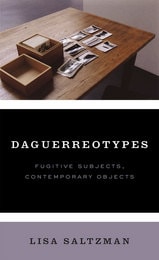
Daguerreotypes
Fugitive Subjects, Contemporary ObjectsLisa Saltzman
University of Chicago Press, 2015
By examining this idea of photography as articulated in literature, film, and the graphic novel, Daguerreotypes demonstrates how photography secures identity for figures with an otherwise unstable sense of self. Lisa Saltzman argues that in many modern works, the photograph asserts itself as a guarantor of identity, whether genuine or fabricated. From Roland Barthes’s Camera Lucida to Ridley Scott’s Blade Runner, W. G. Sebald’s Austerlitz to Alison Bechdel’s Fun Home—we find traces of photography’s “fugitive subjects” throughout contemporary culture. Ultimately, Daguerreotypes reveals how the photograph, at once personal memento and material witness, has inspired a range of modern artistic and critical practices.

Delirium and Resistance
Activist Art and the Crisis of CapitalismGregory Sholette
Pluto Press, 2017
In this follow-up to his influential 2010 book, Dark Matter: Art and Politics in the Age of Enterprise Culture, Sholette engages in critical dialogue with artists’ collectives, counter-institutions, and activist groups to offer an insightful firsthand account of the relationship between politics and art in neoliberal society. Sholette lays out clear examples of art’s deep involvement in capitalism: the dizzying prices achieved by artists who pander to the financial elite, the proliferation of museums that contribute to global competition between cities in order to attract capital, and the strange relationship between art and rampant gentrification that restructures the urban landscape.
With a preface by noted author Lucy R. Lippard and an introduction by theorist Kim Charnley, Delirium and Resistance draws on over thirty years of critical debates and practices both in and beyond the art world to historicize and advocate for the art activist tradition that radically—and, at times, deliriously—entangles the visual arts with political struggles.
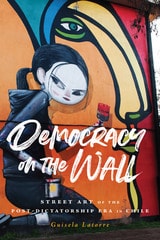
Democracy on the Wall
Street Art of the Post-Dictatorship Era in ChileGuisela Latorre
The Ohio State University Press, 2019
Exploring the resurgence and impact of the muralist brigades, women graffiti artists, the phenomenon of “open-sky museums,” and the transnational impact on the development of Chilean street art, Latorre argues that mural and graffiti artists are enacting a “visual democracy,” a form of artistic praxis that seeks to create alternative images to those produced by institutions of power. Keenly aware of Latin America’s colonial legacy and deeply flawed democratic processes, and distrustful of hegemonic discourses promoted by government and corporate media, the artists in Democracy on the Wall utilize graffiti and muralism as an alternative means of public communication, one that does not serve capitalist or nationalist interests. Latorre posits that through these urban interventions that combine creativity with social action, Chilean street artists formulate visions of what a true democracy looks like.
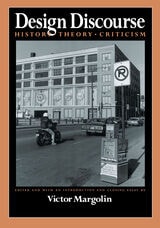
Design Discourse
History, Theory, CriticismEdited by Victor Margolin
University of Chicago Press, 1989
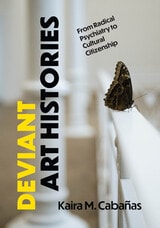
Deviant Art Histories
From Radical Psychiatry to Cultural CitizenshipKaira M. Cabañas
University of Chicago Press, 2027
A groundbreaking examination of the entanglement between psychiatry, art, and art history.
Looking beyond the white walls of art galleries and museums, Kaira M. Cabañas explores art history through the psychiatric wards of the twentieth century, offering a reevaluation of the relationship between madness, making, and the art world and considering the deeply intertwined fields of psychiatry and art.
Putting aside romanticized myths about “outsider art,” Cabañas argues for a radical revisioning that centers artists in psychiatric settings not as deviants and curiosities but rather as skilled, sophisticated innovators and active participants in shared culture. Beginning with the story of legendary art historian Aby Warburg, whose own psychiatric internment and subsequent recovery serve as a point of departure, the narrative then covers the globe, following visionary reformers such as Nise da Silveira in Brazil and Franco and Franca Basaglia in Italy. The book tracks how psychiatrists collaborated with professional artists and patients to turn clinical spaces into laboratories of liberation. By documenting how patient-artists moved from being subjects of clinical study to recognized cultural producers, Deviant Art Histories demonstrates how art was a primary vehicle for reclaiming their agency. Featuring a diverse cast of figures—including Lygia Clark, Ornette Coleman, and Antonin Artaud—the book offers a powerful testament to art’s ability to break the clinical frame and transform the definition of what it means to be a creative citizen in the modern world.
Dewey for Artists
Mary Jane Jacob
University of Chicago Press, 2018
Dewey argued that there is strong social value to be found in art, and it is artists who often most challenge our preconceived notions. Dewey for Artists shows us how Dewey advocated for an “art of democracy.” Identifying the audience as co-creator of a work of art by virtue of their experience, he made space for public participation. Moreover, he believed that societies only become—and remain—truly democratic if its citizens embrace democracy itself as a creative act, and in this he advocated for the social participation of artists.
Throughout the book, Mary Jane Jacob draws on the experiences of contemporary artists who have modeled Dewey’s principles within their practices. We see how their work springs from deeply held values. We see, too, how carefully considered curatorial practice can address the manifold ways in which aesthetic experience happens and, thus, enable viewers to find greater meaning and purpose. And it is this potential of art for self and social realization, Jacob helps us understand, that further ensures Dewey’s legacy—and the culture we live in.
Discourse, Figure
lyotard
University of Minnesota Press, 2019
Choice Outstanding Academic Title
Jean-François Lyotard is recognized as one of the most significant French philosophers of the twentieth century. Although nearly all of his major writing has been translated into English, one important work has until now been unavailable. Discourse, Figure is Lyotard’s thesis. Provoked in part by Lacan’s influential seminars in Paris, Discourse, Figure distinguishes between the meaningfulness of linguistic signs and the meaningfulness of plastic arts such as painting and sculpture. Lyotard argues that because rational thought is discursive and works of art are inherently opaque signs, certain aspects of artistic meaning such as symbols and the pictorial richness of painting will always be beyond reason’s grasp.

Disfiguring
Art, Architecture, ReligionMark C. Taylor
University of Chicago Press, 1992
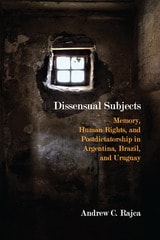
Dissensual Subjects
Memory, Human Rights, and Postdictatorship in Argentina, Brazil, and UruguayAndrew C. Rajca
Northwestern University Press, 2018
Through an engaging exploration of the concept of “never again” (nunca más/nunca mais) and close analysis of photography exhibits, audiovisual installations, and other art forms in spaces of cultural memory, the book explores how aesthetic interventions can suggest alternative ways of framing human rights subjectivity beyond the rhetoric of liberal humanitarianism. The book visits sites of memory, two of which functioned as detention and torture centers during dictatorships, to highlight the tensions between the testimonial tenor of permanent exhibits and the aesthetic interventions of temporary installations there. Rajca thus introduces perspectives that both undo common understandings of authoritarian violence and its effects as well as reconfigure who or what are made visible as subjects of memory and human rights in postdictatorship countries.
Dissensual Subjects offers much to those concerned with numerous interlocking fields: memory, human rights, political subjectivity, aesthetics, cultural studies, visual culture, Southern Cone studies, postdictatorship studies, and sites of memory.
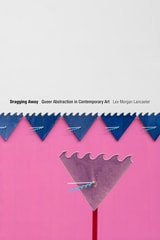
Dragging Away
Queer Abstraction in Contemporary ArtLex Morgan Lancaster
Duke University Press, 2022

Drawing Processes of Life
Molecules, Cells, OrganismsEdited by Gemma Anderson-Tempini and John Dupré
Intellect Books, 2023
An artist sketching cell division faces a problem: what is the best way to visually represent a dynamic process? This anthology, edited by an artist and a philosopher of science, explores drawing as a way of inquiring into living processes at the molecular, cellular, and organismal scale. In doing so, drawing emerges as a tool for relaying and uncovering knowledge—a pathway for research, not an end result.
Incorporating drawing studies and contributions from scholars in the humanities and life sciences, Drawing Processes of Life addresses epigenetics, epistemology, and metamorphosis in insects, proteins, and other ever-shifting biological systems. A foreword by Scott F. Gilbert, a renowned evolutionary biologist and historian of science, affirms the promise of interdisciplinary collaboration between artists and scientists.
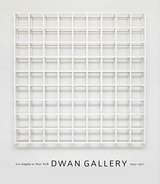
Dwan Gallery
Los Angeles to New York, 1959–1971James Meyer
University of Chicago Press, 2016
Alongside lush full-color images of one hundred leading artworks, the book deepens our understanding of the artistic exchanges Dwan facilitated during this age of mobility, when air travel and the interstate highway system linked the two coasts and transformed the making of art and the sites of its exhibition. James Meyer, the curator of the exhibition and the foremost authority on minimal art, contributes an essay that is a sophisticated and broad-ranging analysis of Dwan’s legacy.
Honoring Dwan’s significant influence and impact on postwar art, Dwan Gallery is a rich and informative collection that will be treasured by fans of contemporary art.