Results by title
161 books match the query 'Cuba' and 9 start with d

Dancing Wisdom
Embodied Knowledge in Haitian Vodou, Cuban Yoruba, and Bahian CandombléYvonne Daniel
University of Illinois Press, 2005
Combining her background in dance and anthropology to parallel the participant/scholar dichotomy inherent to dancing's "embodied knowledge," Daniel examines these misunderstood and oppressed performative dances in terms of physiology, psychology, philosophy, mathematics, ethics, and aesthetics.
"Dancing Wisdom offers the rare opportunity to see into the world of mystical spiritual belief as articulated and manifested in ritual by dance. Whether it is a Cuban Yoruba dance ritual, slave Ring Shout or contemporary Pentecostal Holy Ghost possession dancing shout, we are able to understand the relationship with spirit through dancing with the Divine. Yvonne Daniel's work synthesizes the cognitive empirical objectivity of an anthropologist with the passionate storytelling of a poetic artist in articulating how dance becomes prayer in ritual for Africans of the Diaspora."
--Leon T. Burrows, Protestant Chaplain, Smith College’
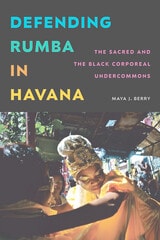
Defending Rumba in Havana
The Sacred and the Black Corporeal UndercommonsMaya J. Berry
Duke University Press, 2025

Democracy and Revolution
Latin America and Socialism TodayD. L. Raby
Pluto Press, 2006
Raby argues passionately that the way forward for progressives is not the dogmatic formulae of the Old Left, nor in the spontaneous autonomism of Antonio Negri. Instead, it is to be found in broad popular movements with bold leadership. Examining key leaders, including Hugo Chávez and the Sandinistas in Nicaragua, Raby shows that it is more necessary than ever to take power, peacefully where possible, but in all cases with the strength that comes from popular unity backed by force where necessary. In this way it is possible to build democratic power, which may or may not be socialist depending on one's definition, but which represent the real anti-capitalist alternative for the twenty-first century.

Development Prospects in Cuba
An Agenda in the MakingEdited by Pedro Monreal
University of London Press, 2002
Contributors include Julio Carranza, Anicia Garcia, Hiram Marquetti, Lazaro Pena, Omar Everleny Perez, and Julio Diaz Vazquez (University of Havana, Cuba), Claes Brundenius (Centre for Development Research, Copenhagen, Denmark), David Dapice (Tufts University and Harvard University, USA), Francisco Leon (United Nations Economic Commission for Latin America and the Caribbean), and Mauricio de Miranda (Pontificia Universidad Javeriana, Colombia).
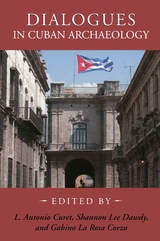
Dialogues in Cuban Archaeology
Edited by L. Antonio Curet, Shannon Lee Dawdy, and Gabino La Rosa Corzo
University of Alabama Press, 2005
A critical, dialogic examination of Cuban and Caribbean archaeology, advancing contemporary interpretations of heritage and identity.
Many Americans are aware of the political, economic, and personal impacts of the U.S. embargo on Cuba. But the communication blockade between scholars has also affected the historical course of academic disciplines and research in general. With the easing of restrictions in the 1990s, academics are now freer to conduct research in Cuba, and the Cuban government has been more receptive to collaborative projects.
This volume provides a forum for the principal Cuban and American archaeologists to update the current state of Cuban archaeological research--from rock art and potsherds to mortuary practices and historical renovation--thereby filling in the information gap created by the political separation. Each group of researchers brings significant new resources to the effort, including strong conservation regulations, innovative studies of lithic and shell assemblages, and transculturation theories. Cuban research on the hacienda system, slavery, and urban processes has in many ways anticipated developments in North American archaeology by a decade or more. Of special interest are the recent renovation projects in Old Havana that fully integrate the work of historians, architects, and archaeologists--a model project conducted by agreement between the Cuban government and UNESCO.
The selection of papers for this collection is based on a desire to answer pressing research questions of interest for North American Caribbeanists and to present a cross-section of Cuban archaeological work. With this volume, then, the principal players present results of recent collaborations and begin a renewed conversation, a dialogue, that can provide a foundation for future coordinated efforts.
Diaspora and Trust
Cuba, Mexico, and the Rise of ChinaAdrian H. Hearn
Duke University Press, 2016
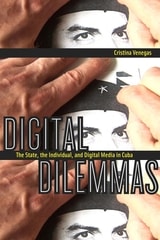
Digital Dilemmas
The State, the Individual, and Digital Media in CubaVenegas, Cristina
Rutgers University Press, 2010
Digital Dilemmas views Cuba from the Soviet Union's demise to the present, to assess how conflicts over media access play out in their both liberating and repressive potential. Drawing on extensive scholarship and interviews, Cristina Venegas questions myths of how Internet use necessarily fosters global democracy and reveals the impact of new technologies on the country's governance and culture. She includes film in the context of broader media history, as well as artistic practices such as digital art and networks of diasporic communities connected by the Web. This book is a model for understanding the geopolitic location of power relations in the age of digital information sharing.
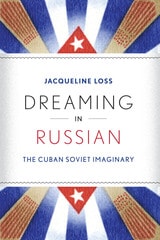
Dreaming in Russian
The Cuban Soviet ImaginaryBy Jacqueline Loss
University of Texas Press, 2013
The specter of the Soviet Union lingers in Cuba, yet until now there has been no book-length work on the ways Cubans process their country’s relationship with the Soviet bloc. Dreaming in Russian at last brings into the light the reality that for nearly three decades, the Soviet Union subsidized the island economically, intervened in military matters, and exported distinct pedagogical and cultural models to Cuba. Drawing on interviews with Cuban artists and intellectuals, as well as treasures from cinematographic and bibliographic archives, Jacqueline Loss delivers the first book to show that Cuba remembers and retains many aspects of the Soviet era, far from shedding those cultural facets as relics of the Cold War.
Weaving together intriguing, seldom-seen images, Dreaming in Russian showcases the ways in which Cuba’s relationship to its Soviet benefactors lingered after the disintegration of the U.S.S.R. in 1991. Analyzing numerous literary texts and works of visual art, Loss also incorporates aspects of architecture, popular culture, the space race, and other strands to create a captivating new perspective on Cuban society. Among the luminaries featured are poet Reina María Rodríguez, writer Antonio José Ponte, visual artist Tonel, and novelist Wendy Guerra. A departure from traditional cultural history, Loss’s approach instead presents a kaleidoscopic series of facets, reflecting the hybrid nature of the self-images that emerged in the aftermath of the Soviet aegis. As speculations about Cuba’s future under Fidel Castro’s heir apparent continue, the portrait that emerges in Dreaming in Russian is both timely and mesmerizing.
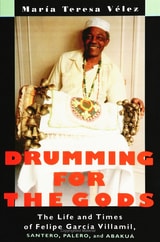
Drumming For The Gods
Maria Velez
Temple University Press, 2000
This book focuses on three periods of Felipe's life, each marked by changes in his personal life and by important historical events. The first period covers his formative years during which he received his initial training. Through Felipe's story, we explore the legacy of slavery in Cuba, the nature of Afro-Cuban religions and their musical traditions, and the history of bata drums. The second period covers the critical years of the Cuban Revolution. Here we see the effect of social turmoil both n music and religious practice (santero, palero, and abakua). The third period covers Felipe's life in New York as a refugee/immigrant, and the role of music in rebuilding his identity. Felipe's story illuminates his cultural practices and beliefs as well as the ways in which an individual musician selects and modifies the elements of his cultural heritage to create a voice that is personal and unique. Felipe not only lives through history but also makes history, shaping an identity that cannot be described as "Cuban immigrant," "Afro-Cuban," "religious drummer," or "santeria initiate," but is composed of all of them.
Through Felipe's experiences, Maria Teresa Velez reveals the interaction between social, political, economic, and cultural forces and an individual's own actions. The professionalization of musicians in Cuba following the Revolution and the plight of Afro-Cuban immigrants in New York are seen as large historical and social problems to which Felipe must personally respond. A noted ethnomusicologist, Velez provides the most insightful and comprehensive English-language study of an individual Cuban religious drummer available.
Drumming for the Gods is a must-read for those interested in ethnomusicology, Caribbean studies, and Afro-Cuban religions and culture.