Results by title
158 books match the query 'Cultural assimilation' and 5 start with d

Deathly Embrace
Orientalism and Asian American IdentitySheng-Mei Ma
University of Minnesota Press, 2000
A polemical analysis of the ways Orientalism speaks through the texts of prominent Asian American writers.
Asian American resistance to Orientalism—the Western tradition dealing with the subject and subjugation of the East—is usually assumed. And yet, as this provocative work demonstrates, in order to refute racist stereotypes they must first be evoked, and in the process the two often become entangled. Sheng-mei Ma shows how the distinguished careers of post-1960s Asian American writers such as Maxine Hong Kingston, Amy Tan, Frank Chin, and David Henry Hwang reveal that while Asian American identity is constructed in reaction to Orientalism, the two cultural forces are not necessarily at odds. The vigor with which these Asian Americans revolt against Orientalism in fact tacitly acknowledges the family lineage of the two.
To identify the multitude of historical forms appropriated by the deathly embrace of Orientalism and Asian American ethnicity, Ma highlights four types of cultural encounters, embodied in four metaphors of physical states: the "clutch of rape" in imperialist adventure narratives of the 1930s and 1940s, as seen in comic strips of Flash Gordon and Terry and the Pirates and in the Disney film Swiss Family Robinson; the "clash of arms" or martial metaphors in the 1970s and beyond, embodied in Bruce Lee, Kingston’s The Woman Warrior, and the video game Mortal Kombat; U.S. multicultural "flaunting" of ethnicity in the work of Amy Tan and in Disney’s Mulan; and global postcolonial "masquerading" of ethnicity in the Anglo-Japanese novelist Kazuo Ishiguro.Broad in scope, penetrating in insight, Ma’s work exposes the myriad ways in which Orientalism, an integral part of American culture, speaks through the texts of Asian Americans and non–Asian Americans alike. The result is a startling lesson in the construction of cultural identity.
Defiance and Deference in Mexico's Colonial North
Indians under Spanish Rule in Nueva VizcayaBy Susan Deeds
University of Texas Press, 2003
Thomas F. McGann Memorial Prize, Rocky Mountain Council on Latin American Studies, 2004
Southwest Book Award, Border Regional Library Association, 2003
In their efforts to impose colonial rule on Nueva Vizcaya from the sixteenth century to the middle of the seventeenth, Spaniards established missions among the principal Indian groups of present-day eastern Sinaloa, northern Durango, and southern Chihuahua, Mexico—the Xiximes, Acaxees, Conchos, Tepehuanes, and Tarahumaras. Yet, when the colonial era ended two centuries later, only the Tepehuanes and Tarahumaras remained as distinct peoples, the other groups having disappeared or blended into the emerging mestizo culture of the northern frontier. Why were these two indigenous peoples able to maintain their group identity under conditions of conquest, while the others could not?
In this book, Susan Deeds constructs authoritative ethnohistories of the Xiximes, Acaxees, Conchos, Tepehuanes, and Tarahumaras to explain why only two of the five groups successfully resisted Spanish conquest and colonization. Drawing on extensive research in colonial-era archives, Deeds provides a multifaceted analysis of each group's past from the time the Spaniards first attempted to settle them in missions up to the middle of the eighteenth century, when secular pressures had wrought momentous changes. Her masterful explanations of how ethnic identities, subsistence patterns, cultural beliefs, and gender relations were forged and changed over time on Mexico's northern frontier offer important new ways of understanding the struggle between resistance and adaptation in which Mexico's indigenous peoples are still engaged, five centuries after the "Spanish Conquest."
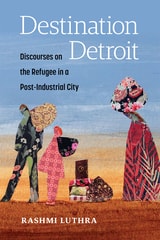
Destination Detroit
Discourses on the Refugee in a Post-Industrial CityRashmi Luthra
University of Michigan Press, 2024
Few U.S. locations provide a more vivid case study of this fight than Metro Detroit, where competing interest groups are waging war over the meaning of the figure of the refugee. This book dives deeply into the discourse on refugees occurring among various institutions in Metro Detroit. The way in which local institutions talk about refugees gives us vital clues as to how they are negotiating competing pressures and how the city overall is negotiating competing imperatives. Indeed, this local discourse gives us a crucial glimpse into how U.S. cities are defining and redefining themselves today. The figure of the refugee becomes a slate on which groups with varied interests write their stories, aspirations, and fears. Consequently, we can figure out from local refugee discourses the ongoing question of what it means to be a Metro Detroiter—and by extension, what it means to be a revitalizing U.S. city in this age.

Diplomas and Thatch Houses
Asserting Tradition in a Changing MicronesiaJuliana Flinn
University of Michigan Press, 1992
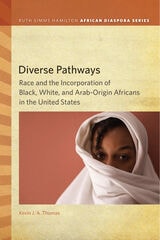
Diverse Pathways
Race and the Incorporation of Black, White, and Arab-Origin Africans in the United StatesKevin J. A. Thomas
Michigan State University Press, 2014