114 books match the query 'Decision Making' and 6 start with d
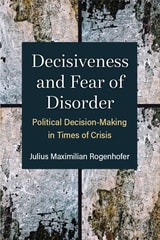
cover of Decisiveness and Fear of Disorder: Political Decision-Making in Times of Crisis

Decisiveness and Fear of Disorder

Political Decision-Making in Times of Crisis

Julius Maximilian Rogenhofer

University of Michigan Press, 2024

Decisiveness and Fear of Disorder examines how democratic representatives make decisions in crisis situations. By analyzing parliamentary asylum debates from Germany’s Asylum Compromise in 1992-1993 and the 2015-2016 refugee crisis, Julius Rogenhofer identifies representatives’ ability to project decisiveness as a crucial determinant for whether the rights and demands of irregular migrants were adequately considered in democratic decision-making. Both crisis situations showcase an emotive dimension to the parliamentary meaning-making process. As politicians confront fears of social and political disorder, they focus on appearing decisive in the eyes of the public and fellow representatives, even at the expense of human rights considerations and inclusive deliberation processes. 

Rogenhofer shows how his theoretical approach allows us to reinterpret a range of crisis situations beyond the irregular migration context, including democracies’ initial responses to Covid-19, the European Sovereign Debt Crisis, and United States climate politics. These additional case studies help position concerns with decisiveness amid the challenges that populism and technocracy increasingly pose to representative democracies.
[more]
cover of Design Thinking

Design Thinking

Rachel Ivy Clarke

American Library Association, 2020

[more]
cover of Difficult Decisions Closing An D Merging Academic Libraries

Difficult Decisions Closing An D Merging Academic Libraries

Sara Holder

Assoc of College & Research Libraries, 2015
[more]
cover of Difficult Decisions: Closing and Merging Academic Libraries

Difficult Decisions

Closing and Merging Academic Libraries

Sara Holder

Assoc of College & Research Libraries, 2015

[more]
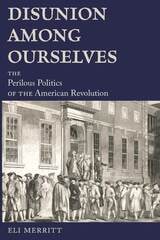
cover of Disunion Among Ourselves: The Perilous Politics of the American Revolution

Disunion Among Ourselves

The Perilous Politics of the American Revolution

Eli Merritt

University of Missouri Press, 2025

Winner of the 2024 Society of the Cincinnati Prize from the American Revolution Institute

Winner of the 2023 American Revolution Round Table of Philadelphia book award

In this eye-opening account, Eli Merritt reveals the deep political divisions that almost tore the Union apart during the American Revolution. So fractious were the founders’ political fights that they feared the War of Independence might end in disunion and civil war.

Instead of disbanding into separate regional confederacies, the founders managed to unite for the sake of liberty and self-preservation. In so doing, they succeeded in holding the young nation together. To achieve this, they forged grueling compromises, in­cluding Declaration of Independence in 1776, the Mississippi-Fisheries Compromise of 1779, and the ratification of the Articles of Confederation in 1781.

In addition to bringing new insights to the history of the American Revolution, Disunion Among Ourselves has inevitable resonances with our present era of political hyperpolarization and serves as a touchstone for contemporary politics, reminding us that the founders overcame far tougher times than our own through commitment to ethical constitutional democracy and compromise.
 

[more]
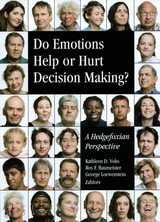
cover of Do Emotions Help or Hurt Decisionmaking?: A Hedgefoxian Perspective

Do Emotions Help or Hurt Decisionmaking?

A Hedgefoxian Perspective

Kathleen D. Vohs

Russell Sage Foundation, 2007

Philosophers have long tussled over whether moral judgments are the products of logical reasoning or simply emotional reactions. From Jane Austen's Sense and Sensibility to the debates of modern psychologists, the question of whether feeling or sober rationality is the better guide to decision making has been a source of controversy. In Do Emotions Help or Hurt Decision Making? Kathleen Vohs, Roy Baumeister, and George Loewenstein lead a group of prominent psychologists and economists in exploring the empirical evidence on how emotions shape judgments and choices. Researchers on emotion and cognition have staked out many extreme positions: viewing emotions as either the driving force behind cognition or its side effect, either an impediment to sound judgment or a guide to wise decisions. The contributors to Do Emotions Help or Hurt Decision Making? provide a richer perspective, exploring the circumstances that shape whether emotions play a harmful or helpful role in decisions. Roy Baumeister, C. Nathan DeWall, and Liqing Zhang show that while an individual's current emotional state can lead to hasty decisions and self-destructive behavior, anticipating future emotional outcomes can be a helpful guide to making sensible decisions. Eduardo Andrade and Joel Cohen find that a positive mood can negatively affect people's willingness to act altruistically. Happy people, when made aware of risks associated with altruistic acts, become wary of jeopardizing their own well-being. Benoît Monin, David Pizarro, and Jennifer Beer find that whether emotion or reason matters more in moral evaluation depends on the specific issue in question. Individual characteristics often mediate the effect of emotions on decisions. Catherine Rawn, Nicole Mead, Peter Kerkhof, and Kathleen Vohs find that whether an individual makes a decision based on emotion depends both on the type of decision in question and the individual's level of self-esteem. And Quinn Kennedy and Mara Mather show that the elderly are better able to regulate their emotions, having learned from experience to anticipate the emotional consequences of their behavior. Do Emotions Help or Hurt Decision Making? represents a significant advance toward a comprehensive theory of emotions and cognition that accounts for the nuances of the mental processes involved. This landmark book will be a stimulus to scholarly debates as well as an informative guide to everyday decisions.
[more]