Results by title
105 books match the query 'Deconstruction' and 14 start with d
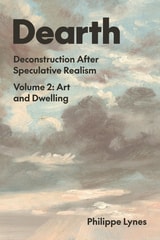
Dearth
Deconstruction After Speculative Realism. Art and DwellingPhilippe Lynes
Northwestern University Press, 2026
Proposing new insight into the legacies of Derridean thought for contemporary philosophy
In Art and Dwelling, the second volume of his Dearth sequence, Philippe Lynes sheds new light on the most enduring offshoot of the speculative realist movement, object-oriented ontology. Through careful readings of Graham Harman and Timothy Morton, Lynes shows how Jacques Derrida’s seminars offer critical insights into the spacing and distancing that precede and exceed all human practices of art and dwelling, with a deep sensitivity to the ecological and ethico-political consequences that follow.
Dearth: Deconstruction After Speculative Realism argues that Derrida’s seminars on Martin Heidegger and Maurice Blanchot, La Chose (The Thing), anticipated many of the philosophical, literary, and aesthetic questions animating speculative realism today: an anti-anthropocentric critique of Kantian correlationism; an overcoming of the apocalyptic nihilism of extinction through a deeper, affirmative habituation to nothingness; and poignant reflections on the literary and poetic aspects of living and dying in impossible worlds. His is an anti-correlationist plea that resounds now more urgently than ever.
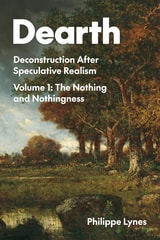
Dearth
Deconstruction After Speculative Realism. The Nothing and NothingnessPhilippe Lynes
Northwestern University Press, 2026
Proposing a radical reconceptualization of deconstruction and nothingness
The first of two volumes exploring Jacques Derrida’s prefiguration of speculative realism, The Nothing and Nothingness examines the transcendental naturalism of Ray Brassier and Iain Hamilton Grant and the speculative materialism of Quentin Meillassoux. Philippe Lynes proposes nothing less than a radical reconceptualization of deconstruction as a call to bear witness to nothingness: let the earth be the earth, let nature be nature, and leave them to their reality, secrecy, and withdrawal without us.
Dearth: Deconstruction After Speculative Realism argues that Derrida’s seminars on Martin Heidegger and Maurice Blanchot, La Chose (The Thing), anticipated many of the philosophical, literary, and aesthetic questions animating speculative realism today: an anti-anthropocentric critique of Kantian correlationism; an overcoming of the apocalyptic nihilism of extinction through a deeper, affirmative habituation to nothingness; and poignant reflections on the literary and poetic aspects of living and dying in impossible worlds. His is an anti-correlationist plea that resounds now more urgently than ever.
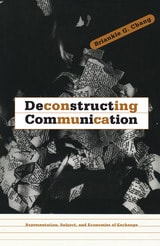
Deconstructing Communication
Representation, Subject, and Economies of ExchangeBriankle Chang
University of Minnesota Press, 1996
A philosophical critique of modern communication theories.
Situated at the intersection of current debates regarding meaning and representation, Deconstructing Communication casts doubt on the seeming innocence of the activity of communication. Using poststructuralist literary theory and philosophy, Briankle G. Chang argues that modern communication theories fail to provide an adequate explanation for how communication is possible.
Through a detailed examination of the basis of the idea of communication-with its semantic core of “commonality” or the transcendence of difference-Chang argues against the tendency of theorists to value understanding over misunderstanding, clarity over ambiguity, order over disorder. To this end the author revisits the thought of Derrida and considers deconstruction in general. Specifically, he uses the critique of the phenomenological tradition emerging from poststructuralism to clarify the commitments and assumptions inherent in models of communication. Chang then discusses the contributions of Husserl, particularly regarding the interconnections between concepts, metaphors, and rhetoric. He develops the strategy of deconstruction through a comparative analysis of Heidegger and Derrida, ultimately linking communication theory to the general question of philosophical reason. Chang concludes with a set of key questions about theory formation in the field, questions that elucidate the future direction for critical reflection in the philosophy of communication. A seminal work in communication theory, Deconstructing Communication will serve as the guiding framework for a constructive debate about the future direction of the field.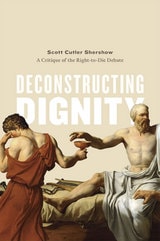
Deconstructing Dignity
A Critique of the Right-to-Die DebateScott Cutler Shershow
University of Chicago Press, 2013
Shershow examines texts from Cicero’s De Officiis to Kant’s Groundwork of the Metaphysics of Morals to court decisions and religious declarations. Through them he reveals how arguments both supporting and denying the right to die undermine their own unconditional concepts of human dignity and the sanctity of life with a hidden conditional logic, one often tied to practical economic concerns and the scarcity or unequal distribution of medical resources. He goes on to examine the exceptional case of self-sacrifice, closing with a vision of a society—one whose conditions we are far from meeting—in which the debate can finally be resolved. A sophisticated analysis of a heated topic, Deconstructing Dignity is also a masterful example of deconstructionist methods at work.
Deconstruction Machines
Writing in the Age of CyberwarJustin Joque
University of Minnesota Press, 2018
A bold new theory of cyberwar argues that militarized hacking is best understood as a form of deconstruction
From shadowy attempts to steal state secrets to the explosive destruction of Iranian centrifuges, cyberwar has been a vital part of statecraft for nearly thirty years. But although computer-based warfare has been with us for decades, it has changed dramatically since its emergence in the 1990s, and the pace of change is accelerating.
In Deconstruction Machines, Justin Joque inquires into the fundamental nature of cyberwar through a detailed investigation of what happens at the crisis points when cybersecurity systems break down and reveal their internal contradictions. He concludes that cyberwar is best envisioned as a series of networks whose constantly shifting connections shape its very possibilities. He ultimately envisions cyberwar as a form of writing, advancing the innovative thesis that cyber attacks should be seen as a militarized form of deconstruction in which computer programs are systems that operate within the broader world of texts.
Throughout, Joque addresses hot-button subjects such as technological social control and cyber-resistance entities like Anonymous and Wikileaks while also providing a rich, detailed history of cyberwar. Deconstruction Machines provides a necessary new interpretation of deconstruction and timely analysis of media, war, and technology.
Deconstruction and Philosophy
The Texts of Jacques DerridaEdited by John Sallis
University of Chicago Press, 1989
Deconstruction in Context
Literature and PhilosophyEdited by Mark C. Taylor
University of Chicago Press, 1986
"This invaluable philosophical sampler brings together many of the threads out of which deconstruction is woven. taylor's anthology does not make deconstruction easy; much more usefully, it provides a meticulous guide to the sources – and significance – of the difficulties. – Barbara E. Johnson
"The book will be of great value as a set of readings with authoritative explanation for all those interested in the current relations of literature and philosophy. It is the best book of its kind I know. – J. Hillis Miller, Yale University
Deconstruction, Feminist Theology, and the Problem of Difference
Subverting the Race/Gender DivideEllen T. Armour
University of Chicago Press, 1999
Armour shows how the writings of Jacques Derrida and Luce Irigaray can be used to uncover feminism's white presumptions so that race and gender can be thought of differently. In clear, concise terms she explores the possibilities and limitations for feminist theology of Derrida's conception of "woman" and Irigaray's "multiple woman," as well as Derrida's thinking on race and Irigaray's work on religion. Armour then points a way beyond the race/gender divide with the help of African-American theorists such as bell hooks, Hortense Spillers, and Patricia Hill Collins.
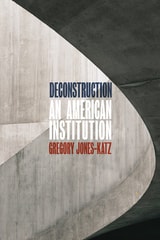
Deconstruction
An American InstitutionGregory Jones-Katz
University of Chicago Press, 2021
Deconstruction begins well before Jacques Derrida’s initial American presentation of his deconstructive work in a famed lecture at Johns Hopkins University in 1966 and continues through several decades of theoretic growth and tumult. While much of the subsequent story remains focused, inevitably, on Yale University and the personalities and curriculum that came to be lumped under the “Yale school” umbrella, Deconstruction makes clear how crucial feminism, queer theory, and gender studies also were to the lifeblood of this mode of thought. Ultimately, Jones-Katz shows that deconstruction in the United States—so often caricatured as a French infection—was truly an American phenomenon, rooted in our preexisting political and intellectual tensions, that eventually came to influence unexpected corners of scholarship, politics, and culture.
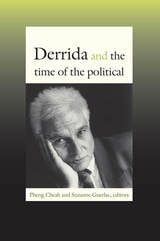
Derrida and the Time of the Political
Pheng Cheah and Suzanne Guerlac, eds.
Duke University Press, 2009
The volume opens with a substantial introduction in which Pheng Cheah and Suzanne Guerlac survey Derrida’s entire corpus and position his later work in relation to it. The remaining essays address the concerns that arise out of Derrida’s analysis of politics and the conditions of the political, such as the meaning and scope of democracy, the limits of sovereignty, the relationship between the ethical and the political, the nature of responsibility, the possibility for committed political action, the implications of deconstructive thought for non-Western politics, and the future of nationalism in an era of globalization and declining state sovereignty. The collection is framed by original contributions from Hélène Cixous and Judith Butler.
Contributors. Étienne Balibar, Geoffrey Bennington, Wendy Brown, Judith Butler, Pheng Cheah, Hélène Cixous, Rodolphe Gasché, Suzanne Guerlac, Marcel Hénaff, Martin Jay, Anne Norton, Jacques Rancière, Soraya Tlatli, Satoshi Ukai
Derrida's Gift, Volume 16
Elizabeth Weed and Ellen Rooney, eds.
Duke University Press, 0
In bringing together major feminist critics whose work has been touched by the writings of Derrida, this issue both pays tribute to and reflects upon Derrida’s ideas. Among the essayists included, Jane Gallop considers Derrida’s writings on Levinas; Judith Butler reads Derrida’s final interview in Le Monde in 2004; Elizabeth Grosz signals Derrida as a rare philosopher for whom sexual difference was crucial; Gayatri Chakravorty Spivak explores the figure of the mother’s child in Derrida, focusing on the critique of reproductive heteronormativity and the question of agency in feminism; and Joan Wallach Scott argues for the importance of critique in the academy. The issue also includes an edited transcription of a vibrant discussion between feminist theorists and Derrida called “Women in the Beehive: A Seminar with Jacques Derrida,” which took place at Brown University’s Pembroke Center for Teaching and Research on Women in 1984.
Contributors. Fran Bartkowski, Anne-Emmanuelle Berger, Susan Bernstein, Judith Butler, Pheng Cheah, Drucilla Cornell, Jane Gallop, Elizabeth Grosz, Peggy Kamuf, Christie McDonald, Joan Wallach Scott, Gayatri Chakravorty Spivak
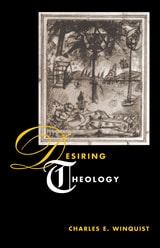
Desiring Theology
Charles E. Winquist
University of Chicago Press, 1994
Winquist's work is tactical as well as theoretical, showing what kind of work theology can do in a postmodern age. He suggests that theology is closely akin to what Gilles Deleuze and Felix Guattari refer to as a minor intensive use of a major language. The minor intensive theological use of language, Winquist argues, pressures the ordinary weave of discourse and opens it to desire. Thus theology becomes a work against "the disappointment of thinking." Deeply engaged with the work of Nietzsche, Derrida, Tillich, Robert P. Scharlemann, and Mark C. Taylor, among others, this book is a significant addition to contemporary theology.
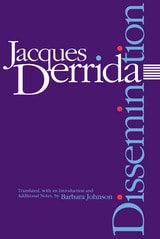
Dissemination
Jacques Derrida
University of Chicago Press, 1981
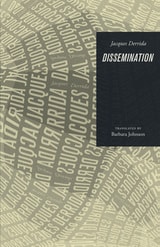
Dissemination
Jacques Derrida
University of Chicago Press, 1981