75 books match the query 'Derrida, Jacques' and 7 start with d
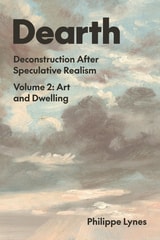
cover of Dearth: Deconstruction After Speculative Realism. Art and Dwelling

Dearth

Deconstruction After Speculative Realism. Art and Dwelling

Philippe Lynes

Northwestern University Press, 2026

Proposing new insight into the legacies of Derridean thought for contemporary philosophy

In Art and Dwelling, the second volume of his Dearth sequence, Philippe Lynes sheds new light on the most enduring offshoot of the speculative realist movement, object-oriented ontology. Through careful readings of Graham Harman and Timothy Morton, Lynes shows how Jacques Derrida’s seminars offer critical insights into the spacing and distancing that precede and exceed all human practices of art and dwelling, with a deep sensitivity to the ecological and ethico-political consequences that follow.

Dearth: Deconstruction After Speculative Realism argues that Derrida’s seminars on Martin Heidegger and Maurice Blanchot, La Chose (The Thing), anticipated many of the philosophical, literary, and aesthetic questions animating speculative realism today: an anti-anthropocentric critique of Kantian correlationism; an overcoming of the apocalyptic nihilism of extinction through a deeper, affirmative habituation to nothingness; and poignant reflections on the literary and poetic aspects of living and dying in impossible worlds. His is an anti-correlationist plea that resounds now more urgently than ever.
[more]
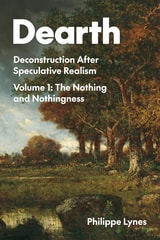
cover of Dearth: Deconstruction After Speculative Realism. The Nothing and Nothingness

Dearth

Deconstruction After Speculative Realism. The Nothing and Nothingness

Philippe Lynes

Northwestern University Press, 2026

Proposing a radical reconceptualization of deconstruction and nothingness
 
The first of two volumes exploring Jacques Derrida’s prefiguration of speculative realism, The Nothing and Nothingness examines the transcendental naturalism of Ray Brassier and Iain Hamilton Grant and the speculative materialism of Quentin Meillassoux. Philippe Lynes proposes nothing less than a radical reconceptualization of deconstruction as a call to bear witness to nothingness: let the earth be the earth, let nature be nature, and leave them to their reality, secrecy, and withdrawal without us.
 
Dearth: Deconstruction After Speculative Realism argues that Derrida’s seminars on Martin Heidegger and Maurice Blanchot, La Chose (The Thing), anticipated many of the philosophical, literary, and aesthetic questions animating speculative realism today: an anti-anthropocentric critique of Kantian correlationism; an overcoming of the apocalyptic nihilism of extinction through a deeper, affirmative habituation to nothingness; and poignant reflections on the literary and poetic aspects of living and dying in impossible worlds. His is an anti-correlationist plea that resounds now more urgently than ever.
[more]
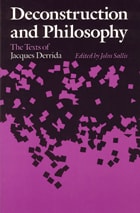
cover of Deconstruction and Philosophy: The Texts of Jacques Derrida

Deconstruction and Philosophy

The Texts of Jacques Derrida

Edited by John Sallis

University of Chicago Press, 1989
This volume represents the first sustained effort to relate Derrida's work to the Western philosophical tradition from Plato to Heidegger. Bringing together twelve essays by twelve leading Derridean philosophers and an important paper by Derrida previously unpublished in English, the collection retrieves the significance of deconstruction for philosophy.
[more]
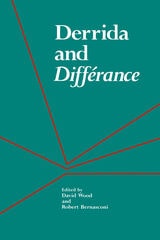
cover of Derrida and Differance

Derrida and Differance

David Wood and Robert Bernasconi

Northwestern University Press, 1988
A collection of six essays by British and American philosophers, Derrida and Différance represents recent appropriations of Derrida's thought at the Warwick Workshops on Continental Philosophy. With an introductory letter by and interview with Derrida, Derrida and Différance focuses on the celebrated term "différance," a neologism devised by Derrida to denote the influence of differentiation in the structuring of all signification.
[more]
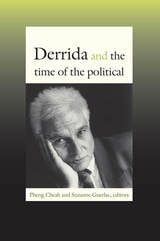
cover of Derrida and the Time of the Political

Derrida and the Time of the Political

Pheng Cheah and Suzanne Guerlac, eds.

Duke University Press, 2009

An intellectual event, Derrida and the Time of the Political marks the first time since Jacques Derrida’s death in 2004 that leading scholars have come together to critically assess the philosopher’s political and ethical writings. Skepticism about the import of deconstruction for political thought has been widespread among American critics since Derrida’s work became widely available in English in the late 1970s. While Derrida expounded political and ethical themes from the late 1980s on, there has been relatively little Anglo-American analysis of that later work or its relation to the philosopher’s entire corpus. Filling a critical gap, this volume provides multiple perspectives on the political turn in Derrida’s work, showing how deconstruction bears on political theory and real-world politics. The contributors include distinguished scholars of deconstruction whose thinking developed in close proximity to Derrida’s, as well as leading political theorists and philosophers who engage Derrida’s thought from further afield.

The volume opens with a substantial introduction in which Pheng Cheah and Suzanne Guerlac survey Derrida’s entire corpus and position his later work in relation to it. The remaining essays address the concerns that arise out of Derrida’s analysis of politics and the conditions of the political, such as the meaning and scope of democracy, the limits of sovereignty, the relationship between the ethical and the political, the nature of responsibility, the possibility for committed political action, the implications of deconstructive thought for non-Western politics, and the future of nationalism in an era of globalization and declining state sovereignty. The collection is framed by original contributions from Hélène Cixous and Judith Butler.

Contributors. Étienne Balibar, Geoffrey Bennington, Wendy Brown, Judith Butler, Pheng Cheah, Hélène Cixous, Rodolphe Gasché, Suzanne Guerlac, Marcel Hénaff, Martin Jay, Anne Norton, Jacques Rancière, Soraya Tlatli, Satoshi Ukai
[more]
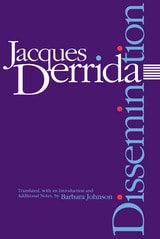
cover of Dissemination

Dissemination

Jacques Derrida

University of Chicago Press, 1981
"The English version of Dissemination [is] an able translation by Barbara Johnson . . . . Derrida's central contention is that language is haunted by dispersal, absence, loss, the risk of unmeaning, a risk which is starkly embodied in all writing. The distinction between philosophy and literature therefore becomes of secondary importance. Philosophy vainly attempts to control the irrecoverable dissemination of its own meaning, it strives—against the grain of language—to offer a sober revelation of truth. Literature—on the other hand—flaunts its own meretriciousness, abandons itself to the Dionysiac play of language. In Dissemination—more than any previous work—Derrida joins in the revelry, weaving a complex pattern of puns, verbal echoes and allusions, intended to 'deconstruct' both the pretension of criticism to tell the truth about literature, and the pretension of philosophy to the literature of truth."—Peter Dews, New Statesman
[more]
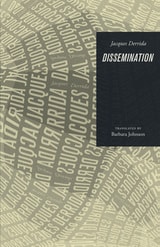
cover of Dissemination

Dissemination

Jacques Derrida

University of Chicago Press, 1981

"The English version of Dissemination [is] an able translation by Barbara Johnson . . . . Derrida's central contention is that language is haunted by dispersal, absence, loss, the risk of unmeaning, a risk which is starkly embodied in all writing. The distinction between philosophy and literature therefore becomes of secondary importance. Philosophy vainly attempts to control the irrecoverable dissemination of its own meaning, it strives—against the grain of language—to offer a sober revelation of truth. Literature—on the other hand—flaunts its own meretriciousness, abandons itself to the Dionysiac play of language. In Dissemination—more than any previous work—Derrida joins in the revelry, weaving a complex pattern of puns, verbal echoes and allusions, intended to 'deconstruct' both the pretension of criticism to tell the truth about literature, and the pretension of philosophy to the literature of truth."—Peter Dews, New Statesman
[more]