Results by title
204 books match the query 'Direction & Production' and 16 start with d
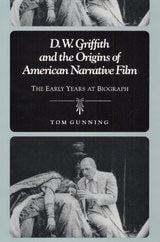
D.W. Griffith and the Origins of American Narrative Film
The Early Years at BiographTom Gunning
University of Illinois Press, 1991
In this comprehensive historical investigation, drawing on films preserved by the Library of Congress and the Museum of Modern Art, Tom Gunning reveals that the remarkable cinematic changes between 1900 and 1915 were a response to the radical reorganization within the film industry and the evolving role of film in American society. The Motion Picture Patents Company, the newly formed Film Trust, had major economic aspirations. The newly emerging industry's quest for a middle-class audience triggered Griffith's early experiments in film editing and imagery. His unique solutions permanently shaped American narrative film.
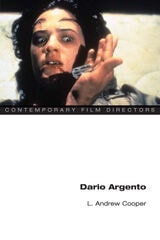
Dario Argento
L. Andrew Cooper
University of Illinois Press, 2012
Commanding a cult following among horror fans, Italian film director Dario Argento is best known for his work in two closely related genres, the crime thriller and supernatural horror, as well as his influence on modern horror and slasher movies. In his four decades of filmmaking, Argento has displayed a commitment to innovation, from his directorial debut with 1970's suspense thriller The Bird with the Crystal Plumage to 2009's Giallo. His films, like the lurid yellow-covered murder-mystery novels they are inspired by, follow the suspense tradition of hard-boiled American detective fiction while incorporating baroque scenes of violence and excess.
While considerations of Argento's films often describe them as irrational nightmares, L. Andrew Cooper uses controversies and theories about the films' reflections on sadism, gender, sexuality, psychoanalysis, aestheticism, and genre to declare the anti-rational logic of Argento's oeuvre. Approaching the films as rhetorical statements made through extremes of sound and vision, Cooper places Argento in a tradition of aestheticized horror that includes De Sade, De Quincey, Poe, and Hitchcock. Analyzing individual images and sequences as well as larger narrative structures, he reveals how the director's stylistic excesses, often condemned for glorifying misogyny and other forms of violence, offer productive resistance to the cinema's visual, narrative, and political norms.
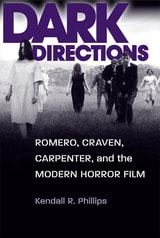
Dark Directions
Romero, Craven, Carpenter, and the Modern Horror FilmKendall R. Phillips
Southern Illinois University Press, 2012
A Nightmare on Elm Street. Halloween. Night of the Living Dead. These films have been indelibly stamped on moviegoers’ psyches and are now considered seminal works of horror. Guiding readers along the twisted paths between audience, auteur, and cultural history, author Kendall R. Phillips reveals the macabre visions of these films’ directors in Dark Directions: Romero, Craven, Carpenter, and the Modern Horror Film.
Phillips begins by analyzing the works of George Romero, focusing on how the body is used cinematically to reflect the duality between society and chaos, concluding that the unconstrained bodies of the Living Dead films act as a critical intervention into social norms. Phillips then explores the shadowy worlds of director Wes Craven. In his study of the films The Serpent and the Rainbow, Deadly Friend, Swamp Thing, Red Eye, and Shocker, Phillips reveals Craven’s vision of technology as inherently dangerous in its ability to cross the gossamer thresholds of the gothic. Finally, the volume traverses the desolate frontiers of iconic director John Carpenter. Through an exploration of such works as Halloween, The Fog, and In the Mouth of Madness, Phillips delves into the director’s representations of boundaries—and the haunting consequences for those who cross them.
The first volume ever to address these three artists together, Dark Directions is a spine-tingling and thought-provoking study of the horror genre. In analyzing the individual works of Romero, Craven, and Carpenter, Phillips illuminates some of the darkest minds in horror cinema.

David Cronenberg
Author or Filmmaker?Mark Browning
Intellect Books, 2007
Film scholar Mark Browning examines Cronenberg’s literary aesthetic not only in relation to his films’ obvious source material, but by comparing his movies to the writings of Vladimir Nabokov, Angela Carter, and Bret Easton Ellis. This groundbreaking volume addresses Cronenberg’s narrative structures and his unique conception of auteurism, as well as his films’ shocking psychological frameworks, all in the broader context of film adaptation studies. David Cronenberg is an essential read for anyone interested in the symbiotic relationship between literature and filmmaking.
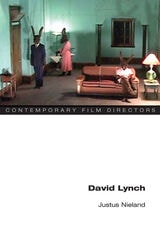
David Lynch
Justus Nieland
University of Illinois Press, 2012
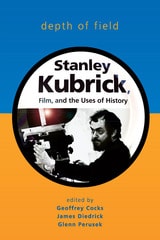
Depth of Field
Stanley Kubrick, Film, and the Uses of HistoryEdited by Geoffrey Cocks, James Diedrick, and Glenn Perusek
University of Wisconsin Press, 2006
Director of some of the most controversial films of the twentieth century, Stanley Kubrick created a reputation as a Hollywood outsider as well as a cinematic genius. His diverse yet relatively small oeuvre—he directed only thirteen films during a career that spanned more than four decades—covers a broad range of the themes that shaped his century and continues to shape the twenty-first: war and crime, gender relations and class conflict, racism, and the fate of individual agency in a world of increasing social surveillance and control.
In Depth of Field, leading screenwriters and scholars analyze Kubrick's films from a variety of perspectives. They examine such groundbreaking classics as Dr. Strangelove and 2001: A Space Odyssey and later films whose critical reputations are still in flux. Depth of Field ends with three viewpoints on Kubrick's final film, Eyes Wide Shut, placing it in the contexts of film history, the history and theory of psychoanalysis, and the sociology of sex and power. Probing Kubrick's whole body of work, Depth of Field is the first truly multidisciplinary study of one of the most innovative and controversial filmmakers of the twentieth century.
Designing Sound
Audiovisual Aesthetics in 1970s American CinemaBeck, Jay
Rutgers University Press, 2016
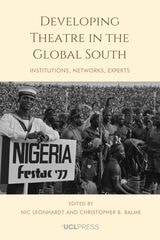
Developing Theatre in the Global South
Institutions, Networks, ExpertsEdited by Nic Leonhardt and Christopher B. Balme
University College London, 2024
This collection presents innovative institutional approaches to the theatre historiography of the Global South, proposing a fundamental reexamination of the historiography of theater in emerging countries since 1945. Covering perspectives from Africa, Asia, the Middle East, Latin America, and Eastern Europe, the chapters explore how US philanthropy, international organizations, and pan-African festivals all contributed to the globalization and institutionalization of the performing arts in the Global South.
During the Cultural Cold War, the Global North intervened in and promoted forms of cultural infrastructure that were deemed adaptable to any environment. This form of politics impacted the construction of national theaters, the introduction of new pedagogical tools, and the invention of the workshop as a format. The networks of experts responsible for this foreground seminal figures, both celebrated (Augusto Boal, Efua Sutherland) but also lesser-known (Albert Botbol, Severino Montano, Metin And), who contributed to the worldwide theatrical epistemic community of the postwar years.
Developing Theatre in the Global South investigates the institutional factors that led to the emergence of professional theatre in the postwar period throughout the decolonizing world. The book’s institutional and transnational approach enables theatre studies to overcome its commonly strong national and local focus on plays and productions and to connect it to current discourses in transnational and global history.
Digital Cinema
Stephen Prince
Rutgers University Press, 2019
Stephen Prince offers a clear, concise account of how digital cinema both extends longstanding traditions of filmmaking and challenges some fundamental assumptions about film. It is essential reading for anyone interested in understanding how movies are shot, produced, distributed, and consumed in the twenty-first century.
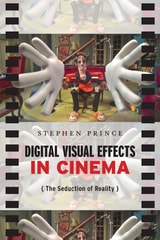
Digital Visual Effects in Cinema
The Seduction of RealityPrince, Stephen
Rutgers University Press, 2012
Avatar. Inception. Jurassic Park. Lord of the Rings. Ratatouille. Not only are these some of the highest-grossing films of all time, they are also prime examples of how digital visual effects have transformed Hollywood filmmaking. Some critics, however, fear that this digital revolution marks a radical break with cinematic tradition, heralding the death of serious realistic movies in favor of computer-generated pure spectacle.
Digital Visual Effects in Cinema counters this alarmist reading, by showing how digital effects–driven films should be understood as a continuation of the narrative and stylistic traditions that have defined American cinema for decades. Stephen Prince argues for an understanding of digital technologies as an expanded toolbox, available to enhance both realist films and cinematic fantasies. He offers a detailed exploration of each of these tools, from lighting technologies to image capture to stereoscopic 3D. Integrating aesthetic, historical, and theoretical analyses of digital visual effects, Digital Visual Effects in Cinema is an essential guide for understanding movie-making today.
Directed By Allen Smithee
Jeremy Braddock
University of Minnesota Press, 2001
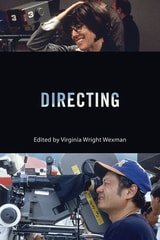
Directing
Virginia Wright Wexman
Rutgers University Press, 2017
The latest volume in the Behind the Silver Screen series, this collection provides the first comprehensive overview of how directing, as both an art and profession, has evolved in tandem with changing film industry practices. Each chapter is written by an expert on a different period of Hollywood, from the silent film era to today’s digital filmmaking, providing in-depth examinations of key trends like the emergence of independent production after World War II and the rise of auteurism in the 1970s. Challenging the myth of the lone director, these studies demonstrate how directors work with a multitude of other talented creative professionals, including actors, writers, producers, editors, and cinematographers.
Directing examines a diverse range of classic and contemporary directors, including Orson Welles, Tim Burton, Cecil B. DeMille, Steven Soderbergh, Spike Lee, and Ida Lupino, offering a rich composite picture of how they have negotiated industry constraints, utilized new technologies, and harnessed the creative contributions of their many collaborators throughout a century of Hollywood filmmaking.

Directing Shakespeare
A Scholar OnstageSidney Homan
Ohio University Press, 2004
An impossible question from a Chinese actor—“Why is Shakespeare eternal?”—drove Sidney Homan after fifty years in the theater to ponder just what makes Shakespeare…well, Shakespeare. The result, Directing Shakespeare, reflects the two worlds in which Homan operates—as a scholar and teacher on campus, and as a director and actor in professional and university theaters. His concern is the entire process, beginning in the lonely period when the director develops a concept, and moving into increasingly larger realms: interaction with stage designers; rehearsals; and performances in which the audience’s response further shapes the play.
Homan recounts the experience of staging King Lear accompanied by a musical score for piano, violin, and cello played live onstage. He discusses the challenge of making and trying to justify cuts in Hamlet. A casual remark from an actress leads to a feminist production of A Midsummer Night’s Dream. He describes the delicate collaboration between director and performer as he works with actors preparing for The Merchant of Venice, King Lear, and Hamlet. Other chapters treat a set designer’s bold red drapes that influenced the director’s concept for Julius Caesar, and the cross-influence of back-to-back runs of Stoppard’s Rosencrantz and Guildenstsern Are Dead and Hamlet.
In a highly personal concluding chapter, Homan tells of joyously working with a spontaneous young actor playing Puck and with an audience of unruly teenagers who wept at a performance of Lear.
Delightfully written, and filled with practical insights, Directing Shakespeare draws together scholars, critics, and those who work in the theater to bring the written word to life.
Directors & Designers
Edited by Christine White
Intellect Books, 2009
Directors and Designers explores the practice of scenography—the creation of perspective in the design and painting of stage scenery—and offers new insight into the working relationships of the people responsible for these theatrical transformations. With contributions from leading practitioners and theorists, editor Christine White describes the way in which the roles of director and designer have developed over time. Featuring chapters on theater and site-specific performance, theatrical communication and aesthetics, and the cognitive reception of design by the audience, this volume provides a valuable resource on current approaches to scenography for professionals and students.
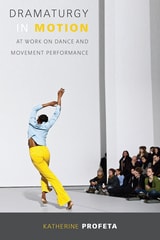
Dramaturgy in Motion
At Work on Dance and Movement PerformanceKatherine Profeta
University of Wisconsin Press, 2015
Profeta explores five arenas for the dramaturg’s attention—text and language, research, audience, movement, and interculturalism. Drawing on her extended collaboration with choreographer and visual artist Ralph Lemon, she grounds her thinking in actual rehearsal-room examples and situates practice within theoretical discourse about contemporary dramaturgy. Moving between theory and practice, word and movement, question and answer until these distinctions blur, she develops the foundational concept of dramaturgical labor as a quality of motion.
Dramaturgy in Motion will be invaluable to practitioners and scholars interested in the processes of creating contemporary dance and movement performance—particularly artists wondering what it might be like to collaborate with a dramaturg and dramaturgs wondering what it might be like to collaborate on movement performance. The book will also appeal to those intrigued by the work of Lemon and his collaborators, to which Profeta turns repeatedly to unfold the thorny questions and rich benefits of dramaturgical labor.
Dreams Within a Dream
The Films of Peter WeirMichael Bliss
Southern Illinois University Press, 2000
"What we see, and what we seem, are but a dream, a dream within a dream." Michael Bliss views Miranda's voice-over at the beginning of Picnic at Hanging Rock as so pivotal in explaining the films of Peter Weir that he borrows her words to create the title of his own study of the Australian filmmaker's work.
Bliss views Weir as an artist whose values are rooted in the realm of the dream, of the unconscious. Surrealistic in technique, Weir avoids the pedestrian assurances of a material realm in favor of an irresolution that, while potentially frustrating, is nonetheless for him a more truthful representation of what he considers reality. For Weir, as for Plato, Bliss demonstrates, "empirical reality is nothing more than a shadow of what is real."
Bliss also considers Weir's heritage. Australian cinema, Bliss explains, is characterized by melodramatic narratives born of a desire to see good and evil portrayed in striking opposition. Weir, for example, dramatizes the contradictory forces of light versus darkness, reason versus mystery, and rationality versus magic in such films as Picnic at Hanging Rock and The Last Wave. This melodramatic emphasis is evident as well in the polarized characterizations in such films as Witness, Dead Poets Society, and The Truman Show.
Bliss also discusses Weir's use of another staple of Australian cinema— "mateship," the celebration of the bond between male companions. But by making self-knowledge dependent on action involving one's friends, Weir gives mateship a new meaning. Moreover, like other Australian filmmakers, Weir emphasizes the starkness of the Australian landscape, which functions either as a hazard or a deadly challenge, at least until American mythology caused him to see nature in a more positive light. Also prominent in Weir's films is an Australian spirit of rebellion coupled with the Aussie ambivalence toward all aspects of British culture.
To help explain Weir's films, Bliss looks to Freud and Jung, whom Weir has studied, and also to two other prominent purveyors of myth and archetype, Northrop Frye and Joseph Campbell. Virtually all Weir characters struggle toward a new mode of awareness, a psychological awareness based on archetypal truths. Many of his films involve archetypal journeys heading through conflict to spiritual unity. Weir's quest is to find out what we really know and how we know what we know.