Results by title
62 books match the query 'Discrimination' and 4 start with d
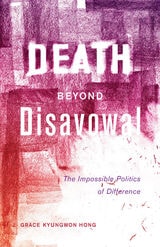
Death beyond Disavowal
The Impossible Politics of DifferenceGrace Kyungwon Hong
University of Minnesota Press, 2015
Death beyond Disavowal utilizes “difference” as theorized by women of color feminists to analyze works of cultural production by people of color as expressing a powerful antidote to the erasures of contemporary neoliberalism.
According to Grace Kyungwon Hong, neoliberalism is first and foremost a structure of disavowal enacted as a reaction to the successes of the movements for decolonization, desegregation, and liberation of the post–World War II era. It emphasizes the selective and uneven affirmation and incorporation of subjects and ideas that were formerly categorically marginalized, particularly through invitation into reproductive respectability. It does so in order to suggest that racial, gendered, and sexualized violence and inequity are conditions of the past, rather than the foundations of contemporary neoliberalism’s exacerbation of premature death. Neoliberal ideologies hold out the promise of protection from premature death in exchange for complicity with this pretense.
In Audre Lorde’s Sister Outsider, Cherríe Moraga’s The Last Generation and Waiting in the Wings, Oscar Zeta Acosta’s The Revolt of the Cockroach People, Ana Castillo’s So Far from God, Gayl Jones’s Corregidora, Isaac Julien’s Looking for Langston, Inge Blackman’s B. D. Women, Rodney Evans’s Brother to Brother, and the work of the late Barbara Christian, Death beyond Disavowal finds the memories of death and precarity that neoliberal ideologies attempt to erase.
Hong posits cultural production as a compelling rejoinder to neoliberalism’s violences. She situates women of color feminism, often dismissed as narrow or limited in its effect, as a potent diagnosis of and alternative to such violences. And she argues for the importance of women of color feminism to any critical engagement with contemporary neoliberalism.
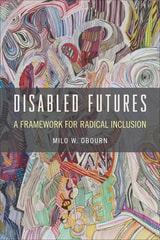
Disabled Futures
A Framework for Radical InclusionMilo W. Obourn
Temple University Press, 2020
Disabled Futures makes an important intervention in disability studies by taking an intersectional approach to race, gender, and disability. Milo Obourn reads disability studies, gender and sexuality studies, and critical race studies to develop a framework for addressing inequity. They theorize the concept of “racialized disgender”—to describe the ways in which racialization and gendering are social processes with disabling effects—thereby offering a new avenue for understanding race, gender, and disability as mutually constitutive.
Obourn uses readings of literature and popular culture from Lost and Avatar to Octavia Butler’s Xenogenesis trilogy to explore and unpack specific ways that race and gender construct—and are constructed by—historical notions of ability and disability, sickness and health, and successful recovery versus damaged lives. What emerges is not only a more complex and deeper understanding of the intersections between ableism, racism, and (cis)sexism, but also possibilities for imagining alternate and more radically inclusive futures in which all of our identities, experiences, freedoms, and oppressions are understood as interdependent and intertwined.
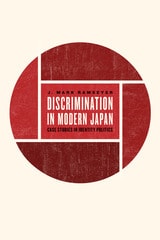
Discrimination in Modern Japan
Case Studies in Identity PoliticsJ. Mark Ramseyer
University of Chicago Press, 2023
In this book, J. Mark Ramseyer, a noted authority on Japan looks at discrimination against groups in Japanese society, focusing on the Korean, Okinawan, and Burakumin groups. Ramseyer asks why they experience discrimination in Japan, an unusually homogeneous society. Is it because of some prejudice on the part of the majority that prevents their integration into mainstream Japanese society? Or is it because some of the dynamics within the group create incentives for the group to stay together and to be on the fringes of society?
Ramseyer argues that the real explanation is the latter, and each of these three groups has been victimized by its own leadership. Precisely because the groups are dysfunctional, members of the group cannot control members who would appoint themselves group leaders. The result has been the capture of leadership positions by people who manipulate the group to their own private advantage and to the detriment of the group as a whole.
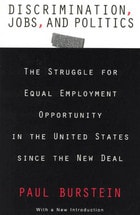
Discrimination, Jobs, and Politics
The Struggle for Equal Employment Opportunity in the United States since the New DealPaul Burstein
University of Chicago Press, 1985
"This is an important, well-researched book. . . . Burstein has had the courage to break through narrow specializations within sociology . . . and even to address the types of acceptable questions usually associated with three different disciplines (political science, sociology, and economics). . . . This book should be read by all professionals interested in political sociology and social movements."—Donald Tomaskovic-Devey, Social Forces
"Discrimination, Jobs and Politics [is] satisfying because it tells a more complete story . . . than does most sociological research. . . . I find myself returning to it when I'm studying the U.S. women's movement and recommending it to students struggling to do coherent research."—Rachel Rosenfeld, Contemporary Sociology