Results by title
14 books match the query 'Protestantism'
A Peaceful Conquest
Woodrow Wilson, Religion, and the New World OrderCara Lea Burnidge
University of Chicago Press, 2016
With A Peaceful Conquest, Cara Lea Burnidge presents the most detailed analysis yet of how Wilson’s religious beliefs affected his vision of American foreign policy, with repercussions that lasted into the Cold War and beyond. Framing Wilson’s intellectual development in relationship to the national religious landscape, and paying greater attention to the role of religion than in previous scholarship, Burnidge shows how Wilson’s blend of Southern evangelicalism and social Christianity became a central part of how America saw itself in the world, influencing seemingly secular policy decisions in subtle, lasting ways. Ultimately, Burnidge makes a case for Wilson’s religiosity as one of the key drivers of the emergence of the public conception of America’s unique, indispensable role in international relations.
As the presidential election cycle once again raises questions of America’s place in the world, A Peaceful Conquest offers a fascinating excavation of its little-known roots.
My Brother's Keeper
George McGovern and Progressive ChristianityMark A. Lempke
University of Massachusetts Press, 2017
George McGovern is chiefly remembered for his landslide loss to Richard Nixon in 1972. Yet at the time, his candidacy raised eyebrows by invoking the prophetic tradition, an element of his legacy that is little studied. In My Brother's Keeper, Mark A. Lempke explores the influence of McGovern's evangelical childhood, Social Gospel worldview, and conscientious Methodism on a campaign that brought antiwar activism into the mainstream.
McGovern's candidacy signified a passing of the torch within Christian social justice. He initially allied with the ecumenical movement and the mainline Protestant churches during a time when these institutions worked easily with liberal statesmen. But the senator also galvanized a dynamic movement of evangelicals rooted in the New Left, who would dominate subsequent progressive religious activism as the mainline entered a period of decline. My Brother's Keeper argues for the influential, and often unwitting, role McGovern played in fomenting a “Religious Left” in 1970s America, a movement that continues to this day. It joins a growing body of scholarship that complicates the dominant narrative of that era's conservative Christianity.
Protestant Nation
The Fragile Christian Roots of America's GreatnessAlain Besançon
St. Augustine's Press, 2017
Protestantism and Political Conflict in the Ninteenth-Century Hispanic Caribbean
Martínez-Fernández, Luis
Rutgers University Press, 2001
Catholicism has long been recognized as one of the major forces shaping the Hispanic Caribbean (Cuba, Puerto Rico, and the Dominican Republic) during the nineteenth century, but the role of Protestantism has not been fully explored. Protestantism and Political Conflict in the Nineteenth-Century Hispanic Caribbean traces the emergence of Protestantism in Cuba and Puerto Rico during a crucial period of national consolidation involving both social and political struggle. Using a comparative framework, Martínez-Fernández looks at the ways in which Protestantism, though officially “illegal” for most of the century, established itself, competed with Catholicism, and took differing paths in Cuba and Puerto Rico.
One of the book’s main goals is to trace the links between religion and politics, particularly with regard to early Protestant activities. Protestants encountered a complex social, economic, and political landscape both in Cuba and in Puerto Rico and soon found that their very presence, coupled with their demands for freedom of worship and burial rights, involved them in a series of interrelated struggles in which the Catholic Church was embroiled along with the other main forces of the period—the peasantry, the agrarian bourgeoisie, the mercantile bourgeoisie, and the colonial state. While the established Catholic Church increasingly identified with the conservative, pro-slavery, and colonialist causes, newly arrived Protestants tended to be nationalistic and to pursue particular economic activities—such as cigar exportation in Cuba and the sugar industry in Puerto Rico. The author argues that the early Protestant communities reflected the socio-cultural milieus from which they emerged and were profoundly shaped by the economic activities of their congregants. This influence, in turn, shaped not only the congregations’ composition, but also their political and social orientations.

Protestantism and Politics in Eastern Europe and Russia
The Communist and Post-Communist ErasSabrina P. Ramet, ed.
Duke University Press, 1993
Based on extensive field research, including interviews with notable figures in the Protestant churches in the region, the essays in this volume address broad topics such as the church's involvment in environmentalism, pacifism, and other dissident movements, as well as issues particular to Russia, Poland, Czechoslovakia, East Germany, (1949–1989), Hungary, Yugoslavia (1945-1991), Bulgaria, and Romania. The final volume in the three-volume work "Christianity Under Stress," Protestantism and Politics in Eastern Europe and Russia will prove invaluable to anyone hoping to understand not only the workings of religion under Communism, but the historical and contemporary interactions of church and state in general.
Contributors. Paul Bock, Lawrence Klippenstein, Paul Mojzes, Earl A. Pope, Joseph Pungur, Sabrina Petra Ramet, Walter Sawatsky, N. Gerald Shenk, Gerd Stricker, Sape A. Zylstra
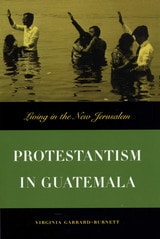
Protestantism in Guatemala
Living in the New JerusalemBy Virginia Garrard-Burnett
University of Texas Press, 1998
Guatemala has undergone an unprecedented conversion to Protestantism since the 1970s, so that thirty percent of its people now belong to Protestant churches, more than in any other Latin American nation. To illuminate some of the causes of this phenomenon, Virginia Garrard-Burnett here offers the first history of Protestantism in a Latin American country, focusing specifically on the rise of Protestantism within the ethnic and political history of Guatemala.
Garrard-Burnett finds that while Protestant missionaries were early valued for their medical clinics, schools, translation projects, and especially for the counterbalance they provided against Roman Catholicism, Protestantism itself attracted few converts in Guatemala until the 1960s. Since then, however, the militarization of the state, increasing public violence, and the "globalization" of Guatemalan national politics have undermined the traditional ties of kinship, custom, and belief that gave Guatemalans a sense of identity, and many are turning to Protestantism to recreate a sense of order, identity, and belonging.
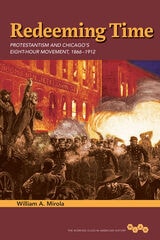
Redeeming Time
Protestantism and Chicago's Eight-Hour Movement, 1866-1912William A. Mirola
University of Illinois Press, 2015
William A. Mirola explores how the city's eight-hour movement intersected with a Protestant religious culture that supported long hours to keep workers from idleness, intemperance, and secular leisure activities. Analyzing how both workers and clergy rewove working-class religious cultures and ideologies into strategic and rhetorical frames, Mirola shows how every faith-based appeal contested whose religious meanings would define labor conditions and conflicts. As he notes, the ongoing worker-employer tension transformed both how clergy spoke about the eight-hour movement and what they were willing to do, until intensified worker protest and employer intransigence spurred Protestant clergy to support the eight-hour movement even as political and economic arguments eclipsed religious framing.
A revealing study of an era and a movement, Redeeming Time illustrates the potential--and the limitations--of religious culture and religious leaders as forces in industrial reform.
Renewal
Liberal Protestants and the American City after World War IIMark Wild
University of Chicago Press, 2019
Renewal explores the rise and fall of this movement, which began as an effort to restore the church’s standing but wound up as nothing less than an openhearted crusade to remake our nation’s cities. These campaigns reached beyond church walls to build or lend a hand to scores of organizations fighting for welfare, social justice, and community empowerment among the increasingly nonwhite urban working class. Church leaders extended their efforts far beyond traditional evangelicalism, often dovetailing with many of the contemporaneous social currents coursing through the nation, including black freedom movements and the War on Poverty.
Renewal illuminates the overlooked story of how religious institutions both shaped and were shaped by postwar urban America.
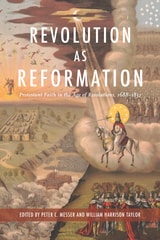
Revolution as Reformation
Protestant Faith in the Age of Revolutions, 1688–1832Edited by Peter C. Messer and William Harrison Taylor
University of Alabama Press, 2021
Essays that explore how Protestants responded to the opportunities and perils of revolution in the transatlantic age
Revolution as Reformation: Protestant Faith in the Age of Revolutions, 1688–1832 highlights the role that Protestantism played in shaping both individual and collective responses to revolution. These essays explore the various ways that the Protestant tradition, rooted in a perpetual process of recalibration and reformulation, provided the lens through which Protestants experienced and understood social and political change in the Age of Revolutions. In particular, they call attention to how Protestants used those changes to continue or accelerate the Protestant imperative of refining their faith toward an improved vision of reformed religion.
The editors and contributors define faith broadly: they incorporate individuals as well as specific sects and denominations, and as much of “life experience” as possible, not just life within a given church. In this way, the volume reveals how believers combined the practical demands of secular society with their personal faith and how, in turn, their attempts to reform religion shaped secular society.
The wide-ranging essays highlight the exchange of Protestant thinkers, traditions, and ideas across the Atlantic during this period. These perspectives reveal similarities between revolutionary movements across and around the Atlantic. The essays also emphasize the foundational role that religion played in people’s attempts to make sense of their world, and the importance they placed on harmonizing their ideas about religion and politics. These efforts produced novel theories of government, encouraged both revolution and counterrevolution, and refined both personal and collective understandings of faith and its relationship to society.
Secularism in Antebellum America
John Lardas Modern
University of Chicago Press, 2011
Ghosts. Railroads. Sing Sing. Sex machines. These are just a few of the phenomena that appear in John Lardas Modern’s pioneering account of religion and society in nineteenth-century America. This book uncovers surprising connections between secular ideology and the rise of technologies that opened up new ways of being religious. Exploring the eruptions of religion in New York’s penny presses, the budding fields of anthropology and phrenology, and Moby-Dick, Modern challenges the strict separation between the religious and the secular that remains integral to discussions about religion today.
Modern frames his study around the dread, wonder, paranoia, and manic confidence of being haunted, arguing that experiences and explanations of enchantment fueled secularism’s emergence. The awareness of spectral energies coincided with attempts to tame the unruly fruits of secularism—in the cultivation of a spiritual self among Unitarians, for instance, or in John Murray Spear’s erotic longings for a perpetual motion machine. Combining rigorous theoretical inquiry with beguiling historical arcana, Modern unsettles long-held views of religion and the methods of narrating its past.

Sir Philip Sidney and the Poetics of Protestantism
A Study of ContextsAndrew Weiner
University of Minnesota Press, 1978
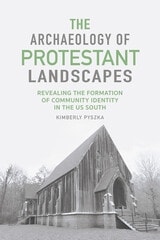
The Archaeology of Protestant Landscapes
Revealing the Formation of Community Identity in the US SouthKimberly Pyszka
University of Alabama Press, 2023
How religious institutions used landscapes and architecture to express their religious and social ideologies
The Archaeology of Protestant Landscapes focuses on three religious institutions in the US South in the eighteenth and nineteenth centuries: St. Paul’s Parish Church in coastal South Carolina, St. Luke’s Episcopal Church in central Alabama, and Cane Hill College in Northwest Arkansas. Drawing from archaeological surveys and excavations, artifact analysis, archival research, geophysical testing, and architectural information on religious structures, Kimberly Pyszka offers case studies of these institutions, which were located in developing communities that varied socially, politically, and economically.
Pyszka uses these case studies to demonstrate that select religious institutions used and modified natural landscape features to create cultural landscapes to express their ideology, identity, goals, and social, religious, and political power. She notes that where those structures were constructed, how they sat on the landscape, their architectural style, and their overall visual appearance were well-considered decisions made by religious leaders to benefit their organizations, communities, and, sometimes, themselves.
Pyszka also uses these case studies to highlight the social roles that religious organizations played in the development of communities. She points to landscape decisions—specifically to how the architectural design of religious structures was used, intentionally or not, to unite people, often those of differing religious backgrounds—as contributing to the creation of a common identity among people living in new and still-growing settlements, aiding in community development. This book contributes to the growing body of work within historical archaeology on churches, churchyards, and cemeteries and to the increasing awareness among archaeologists of how these sites contribute to questions of identity, consumerism, trade, and colonialism.
The Protestant Temperament
Patterns of Child-Rearing, Religious Experience, and the Self in Early AmericaPhilip Greven
University of Chicago Press, 1988

Who Are 'The People'?
Unionism, Protestantism & Loyalism in Northern IrelandPeter Shirlow
Pluto Press, 1997