Results by title
733 books match the query 'Environmental Conservation & Protection' and 21 start with d
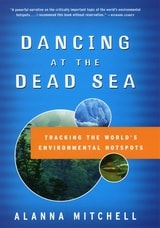
Dancing at the Dead Sea
Tracking the World's Environmental HotspotsAlanna Mitchell
University of Chicago Press, 2005
Combining scientific curiosity with travel and adventure, Dancing at the Dead Sea takes the reader on an intimate tour through the world's environmental hotspots. Readers join Mitchell as she tracks the spectacular biodiversity of regions as extraordinary as the island of Madagascar, the rain forests of Suriname, the parched oases of Jordan, the Arctic desert of Banks Island, the volcanic crests of Iceland, and, ultimately, the Galapagos archipelago, where Darwin conducted his famous research. Along the way, Mitchell introduces us to the numerous scientists and conservationists who are working to protect these endangered places. She also chronicles the courageous efforts of everyday men and women in these regions as they try to convince governments to turn the world's hotspots into environmentally protected areas.
Ultimately, Mitchell's travels around the world compel her to ponder our shelf life as a species in the grand evolutionary scheme of the planet. She wonders what Darwin would make of the profound ecological destruction she witnesses. Is the human race suicidal? What can help our species avert extinction? Posing tough and cutting questions such as these, Dancing at the Dead Sea is a must-read for aficionados of good science writing and travel literature alike.
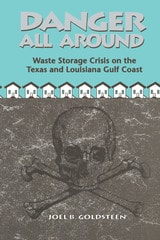
Danger All Around
Waste Storage Crisis on the Texas and Louisiana Gulf CoastBy Joel B. Goldsteen
University of Texas Press, 1993
The problem of where to store waste has grabbed a lot of headlines, but people have been slow to realize that the environmental damage caused by storage sites is an even greater menace. This book makes the danger clear, as Joel Goldsteen offers the first comprehensive look at the selection and environmental impact of municipal and petrochemical waste storage sites along the Texas and Louisiana coasts.
Goldsteen has distilled a large landfill-worth of data into a highly readable account of the creation and regulation of waste disposal sites, the health issues that surround them, and the human and natural factors that affect how safe or dangerous they become. Chapters that describe industrial development along the Gulf Coast and the concurrent challenges of wastewater treatment, solid waste management, and hazardous waste control are followed by in-depth descriptions of nine Texas and four Louisiana sites, all representative of problems far beyond the Texas-Louisiana coast.

Dangerous Trade
Histories of Industrial Hazard across a Globalizing WorldChristopher Sellers
Temple University Press, 2011
From anthrax to asbestos to pesticides, industrial toxins and pollutants have troubled the world for the past century and longer. Environmental hazards from industry remain one of the world's foremost killers.Dangerous Trade establishes historical groundwork for a better understanding of how and why these hazards continue to threaten our shrinking world.
In this timely collection, an international group of scholars casts a rigorous eye towards efforts to combat these ailments. Dangerous Trade contains a wide range of case studies that illuminate transnational movements of risk—from the colonial plantations of Indonesia to compensation laws in late 19th century Britain, and from the occupational medicine clinics of 1960s New York City to the burning of electronic waste in early twenty-first century Uruguay.
The essays in Dangerous Trade provide an unprecedented broad perspective of the dangers stirred up by industrial activity across the globe, as well as the voices rasied to remedy them.
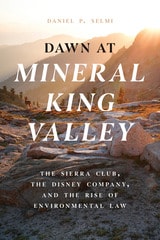
Dawn at Mineral King Valley
The Sierra Club, the Disney Company, and the Rise of Environmental LawDaniel P. Selmi
University of Chicago Press, 2022
In our current age of climate change–induced panic, it’s hard to imagine a time when private groups were not actively enforcing environmental protection laws in the courts. It wasn’t until 1972, however, that a David and Goliath–esque Supreme Court showdown involving the Sierra Club and Disney set a revolutionary legal precedent for the era of environmental activism we live in today.
Set against the backdrop of the environmental movement that swept the country in the late 1960s and early 1970s, Dawn at Mineral King Valley tells the surprising story of how the US Forest Service, the Disney company, and the Sierra Club each struggled to adapt to the new, rapidly changing political landscape of environmental consciousness in postwar America. Proposed in 1965 and approved by the federal government in 1969, Disney’s vast development plan would have irreversibly altered the practically untouched Mineral King Valley, a magnificently beautiful alpine area in the Sierra Nevada mountains. At first, the plan met with unanimous approval from elected officials, government administrators, and the press—it seemed inevitable that this expanse of wild natural land would be radically changed and turned over to a private corporation. Then the scrappy Sierra Club forcefully pushed back with a lawsuit that ultimately propelled the modern environmental era by allowing interest groups to bring litigation against environmentally destructive projects.
An expert on environmental law and appellate advocacy, Daniel P. Selmi uses his authoritative narrative voice to recount the complete history of this revolutionary legal battle and the ramifications that continue today, almost 50 years later.
Dawn at Mineral King Valley
The Sierra Club, the Disney Company, and the Rise of Environmental LawDaniel P. Selmi
University of Chicago Press, 2022
This is an auto-narrated audiobook edition of this book.
The story behind the historic Mineral King Valley case, which reveals how the Sierra Club battled Disney’s ski resort development and launched a new environmental era in America.
In our current age of climate change–induced panic, it’s hard to imagine a time when private groups were not actively enforcing environmental protection laws in the courts. It wasn’t until 1972, however, that a David and Goliath–esque Supreme Court showdown involving the Sierra Club and Disney set a revolutionary legal precedent for the era of environmental activism we live in today.
Set against the backdrop of the environmental movement that swept the country in the late 1960s and early 1970s, Dawn at Mineral King Valley tells the surprising story of how the US Forest Service, the Disney company, and the Sierra Club each struggled to adapt to the new, rapidly changing political landscape of environmental consciousness in postwar America. Proposed in 1965 and approved by the federal government in 1969, Disney’s vast development plan would have irreversibly altered the practically untouched Mineral King Valley, a magnificently beautiful alpine area in the Sierra Nevada mountains. At first, the plan met with unanimous approval from elected officials, government administrators, and the press—it seemed inevitable that this expanse of wild natural land would be radically changed and turned over to a private corporation. Then the scrappy Sierra Club forcefully pushed back with a lawsuit that ultimately propelled the modern environmental era by allowing interest groups to bring litigation against environmentally destructive projects.
An expert on environmental law and appellate advocacy, Daniel P. Selmi uses his authoritative narrative voice to recount the complete history of this revolutionary legal battle and the ramifications that continue today, almost 50 years later.
DeVoto’s West
History, Conservation, and the Public GoodBernard DeVoto
Ohio University Press, 2005
Dealing with Risk
Why the Public and the Experts Disagree on Environmental IssuesHoward Margolis
University of Chicago Press, 1997
In Dealing with Risk, Howard Margolis moves beyond the usual "rival rationalities" explanation proffered by risk analysts for the rift between expert and lay opinion. He reveals the conflicts of intuition that undergird those concerns, and proposes a new approach to the psychology of persuasion and belief. Examining the role of intuition, mental habits, and cognitive frameworks in the construction of public opinion, this compelling account bridges the public policy impasse that has plagued controversial environmental issues.
Debunking Creation Myths about America's Public Lands
John D. Leshy
University of Utah Press, 2018
This lecture was presented on March 14, 2018, at the 23rd annual symposium of the Wallace Stegner Center for Land, Resources and the Environment at the S.J. Quinney College of Law, University of Utah
Decolonial Environmentalisms
Climate Justice and Speculative Futures in Latinx Cultural ProductionDavid J. Vázquez
University of Texas Press, 2025
A critical examination of the environmental movement and the Latinx voices that are shifting how to think about a future shaped by climate change.
In Decolonial Environmentalisms, David Vázquez argues that the mainstream environmental movement is implicated in racial capitalism, not least through its ignorance of environmental justice as it pertains to Latinx people. Through close readings of eco-minded novels, films, visual art, and short stories by Chicanx, Puerto Rican, Dominican, Cuban American, Peruvian, and Central American culture makers, Vázquez surfaces diverse Latinx visions for an equitable and sustainable humanity.
In the creations of Helena María Viramontes, Ester Hernández, Salvador Plascencia, the printmaking collective Dominican York Proyecto GRAFICA, and others, Vázquez locates a bracing critique of racist elisions and assumptions in hegemonic environmentalist thought. At the same time, he shows that the roles of Latinx people in the exploitation of the US West and the ruin of Indigenous communities are ripe for self-examination, in hopes of sparking reform. Indeed, Decolonial Environmentalisms is a work of guarded optimism, finding glimmers of possibility even in dystopic science fiction. The overlooked experiences of Latinx people, Vázquez suggests, can inspire environmental movements capable of transformative advocacy.
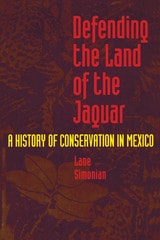
Defending the Land of the Jaguar
A History of Conservation in MexicoBy Lane Simonian
University of Texas Press, 1995
Mexican conservationists have sometimes observed that it is difficult to find a country less interested in the conservation of its natural resources than is Mexico. Yet, despite a long history dedicated to the pursuit of development regardless of its environmental consequences, Mexico has an equally long, though much less developed and appreciated, tradition of environmental conservation.
Lane Simonian here offers the first panoramic history of conservation in Mexico from pre-contact times to the current Mexican environmental movement. He explores the origins of conservation and environmental concerns in Mexico, the philosophies and endeavors of Mexican conservationists, and the enactment of important conservation laws and programs. This heretofore untold story, drawn from interviews with leading Mexican conservationists as well as archival research, will be important reading throughout the international community of activists, researchers, and concerned citizens interested in the intertwined issues of conservation and development.
Defining Sustainability
Special Issue of Land Economics 73:4 (November 1997)Edited by Richard B. Howarth
University of Wisconsin Press, 2010
The rising stature of sustainable development constitutes an important and evolving challenge for natural resource and environmental economics. Is sustainability best achieved through the use and extension of conventional criteria for optimal resource allocation? Or does the concept involve a more substantial shift beyond methods such as present-value maximization and nonmarket valuation? At the heart of this challenge lie questions concerning the precise meaning that should be attached to the phrase “sustainable development,” and how this concept may be operationalized in economic theory and applied policy analysis.
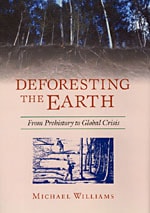
Deforesting the Earth
From Prehistory to Global CrisisMichael Williams
University of Chicago Press, 2002
Michael Williams surveys ten thousand years of history to trace how, why, and when human-induced deforestation has shaped economies, societies, and landscapes around the world. Beginning with the return of the forests to Europe, North America, and the tropics after the Ice Ages, Williams traces the impact of human-set fires for gathering and hunting, land clearing for agriculture, and other activities from the Paleolithic through the classical world and the Middle Ages. He then continues the story from the 1500s to the early 1900s, focusing on forest clearing both within Europe and by European imperialists and industrialists abroad, in such places as the New World and India, China, Japan, and Latin America. Finally, he covers the present-day and alarming escalation of deforestation, with the ever-increasing human population placing a possibly unsupportable burden on the world's forests.
Accessible and nonsensationalist, Deforesting the Earth provides the historical and geographical background we need for a deeper understanding of deforestation's tremendous impact on the environment and the people who inhabit it.
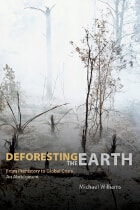
Deforesting the Earth
From Prehistory to Global Crisis, An AbridgmentMichael Williams
University of Chicago Press, 2006
Published in 2002, Deforesting the Earth was a landmark study of the history and geography of deforestation. Now available as an abridgment, this edition retains the breadth of the original while rendering its arguments accessible to a general readership.
Deforestation—the thinning, changing, and wholesale clearing of forests for fuel, shelter, and agriculture—is among the most important ways humans have transformed the environment. Surveying ten thousand years to trace human-induced deforestation’s effect on economies, societies, and landscapes around the world, Deforesting the Earth is the preeminent history of this process and its consequences.
Beginning with the return of the forests after the ice age to Europe, North America, and the tropics, Michael Williams traces the impact of human-set fires for gathering and hunting, land clearing for agriculture, and other activities from the Paleolithic age through the classical world and the medieval period. He then focuses on forest clearing both within Europe and by European imperialists and industrialists abroad, from the 1500s to the early 1900s, in such places as the New World, India, and Latin America, and considers indigenous clearing in India, China, and Japan. Finally, he covers the current alarming escalation of deforestation, with our ever-increasing human population placing a potentially unsupportable burden on the world’s forests.
Delaware Naturalist Handbook
McKay Jenkins
University of Delaware Press, 2011
Published by University of Delaware Press. Distributed worldwide by Rutgers University Press.
Democratic Spaces
Land Preservation in New England, 1850–2010Richard W. Judd
University of Massachusetts Press, 2023
Winner of the 2024 Forest History Society Charles A. Weyerhaeuser Book Award
A contemporary map of New England, scaled to the township level, brings to light a dense pattern of protected areas ringing almost every town and city in the region. Big and small, rural and urban, these green spaces represent more than a century of preservation efforts on the part of philanthropic foundations, planning professionals, state agencies, and most importantly, community-based conservation organizations. Taken together, they highlight one of the most significant advances in land stewardship in US history.
Democratic Spaces explains how these protected places came into being and what they represent for New Englanders and the nation at large. While early New Englanders worked to save local fish, timber, and game resources from outside exploitation, no land-stewardship organizations existed before the founding of the Trustees of Public Reservations in Boston in 1891. Across a century of dramatic change, New England preservationists through this and other, smaller community-based land trusts preserved open spaces for an ever-widening circle of citizens.
Demons in Eden
The Paradox of Plant DiversityJonathan Silvertown
University of Chicago Press, 2005
Demons in Eden considers these questions using the latest scientific discoveries from the plant world. Readers join Silvertown as he explores the astonishing diversity of plant life in regions as spectacular as the verdant climes of Japan, the lush grounds of the Royal Botanical Gardens at Kew, the shallow wetlands and teeming freshwaters of Florida, the tropical rainforests of southeast Mexico, and the Canary Islands archipelago, whose evolutionary novelties—and exotic plant life—have earned it the sobriquet "the Galapagos of botany." Along the way, Silvertown looks closely at the evolution of plant diversity in these locales and explains why such variety persists in light of ecological patterns and evolutionary processes. In novel and useful ways, he also investigates the current state of plant diversity on the planet to show the ever-challenging threats posed by invasive species and humans.
Bringing the secret life of plants into more colorful and vivid focus than ever before, Demons in Eden is an empathic and impassioned exploration of modern plant ecology that unlocks evolutionary mysteries of the natural world.
Design with Nature on Cape Cod and the Islands
Jack Ahern
University of Massachusetts Press, 2022
Design with Nature on Cape Cod and the Islands seeks to reverse this damaging trend by offering landscape professionals, local officials, and homeowners a sustainable approach to landscape design based on the ecoregion’s native plants and plant communities. Presenting detailed discussions of Cape Cod’s natural history, Jack Ahern focuses on the principal plant communities that define its landscape character and that are well adapted to local soils and growing conditions, including climate change. The book also includes strategies for ecological planting design and a portfolio of photographs of active ecologically designed landscapes.
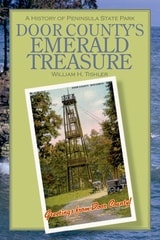
Door County's Emerald Treasure
A History of Peninsula State ParkWilliam H. Tishler
University of Wisconsin Press, 2006
With its magnificent forests, bluffs, and shoreline and its breathtaking views of Green Bay and Lake Michigan, Door County’s Peninsula State Park is one of the Midwest’s most popular attractions. Established in 1909, it was Wisconsin’s second state park and a key to pioneering efforts to build a state park system that would be the envy of the nation.
Door County’s Emerald Treasure explores the rich history of the park land, from its importance to Native Americans and early European settlers through the twentieth century. Bill Tishler engagingly relates the role of conservationists and progressives in establishing the state park, its growing popularity for tourism and recreation, and efforts to protect the park’s resources from a variety of threats. Tishler also tells a larger story of Americans’ intimate relationship with the land around them and the challenge to create accessible public spaces that preserve the natural environment.
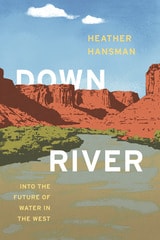
Downriver
Into the Future of Water in the WestHeather Hansman
University of Chicago Press, 2019
The Green River, the most significant tributary of the Colorado River, runs 730 miles from the glaciers of Wyoming to the desert canyons of Utah. Over its course, it meanders through ranches, cities, national parks, endangered fish habitats, and some of the most significant natural gas fields in the country, as it provides water for 33 million people. Stopped up by dams, slaked off by irrigation, and dried up by cities, the Green is crucial, overused, and at-risk, now more than ever.
Fights over the river’s water, and what’s going to happen to it in the future, are longstanding, intractable, and only getting worse as the West gets hotter and drier and more people depend on the river with each passing year. As a former raft guide and an environmental reporter, Heather Hansman knew these fights were happening, but she felt driven to see them from a different perspective—from the river itself. So she set out on a journey, in a one-person inflatable pack raft, to paddle the river from source to confluence and see what the experience might teach her. Mixing lyrical accounts of quiet paddling through breathtaking beauty with nights spent camping solo and lively discussions with farmers, city officials, and other people met along the way, Downriver is the story of that journey, a foray into the present—and future—of water in the West.
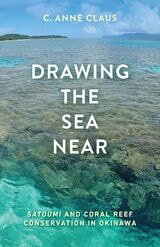
Drawing the Sea Near
Satoumi and Coral Reef Conservation in OkinawaC. Anne Claus
University of Minnesota Press, 2020
How Japanese coastal residents and transnational conservationists collaborated to foster relationships between humans and sea life
Drawing the Sea Near opens a new window to our understanding of transnational conservation by investigating projects in Okinawa shaped by a “conservation-near” approach—which draws on the senses, the body, and memory to collapse the distance between people and their surroundings and to foster collaboration and equity between coastal residents and transnational conservation organizations. This approach contrasts with the traditional Western “conservation-far” model premised on the separation of humans from the environment.
Based on twenty months of participant observation and interviews, this richly detailed, engagingly written ethnography focuses on Okinawa’s coral reefs to explore an unusually inclusive, experiential, and socially just approach to conservation. In doing so, C. Anne Claus challenges orthodox assumptions about nature, wilderness, and the future of environmentalism within transnational organizations. She provides a compelling look at how transnational conservation organizations—in this case a field office of the World Wide Fund for Nature in Okinawa—negotiate institutional expectations for conservation with localized approaches to caring for ocean life.
In pursuing how particular projects off the coast of Japan unfolded, Drawing the Sea Near illuminates the real challenges and possibilities of work within the multifaceted transnational structures of global conservation organizations. Uniquely, it focuses on the conservationists themselves: why and how has their approach to project work changed, and how have they themselves been transformed in the process?
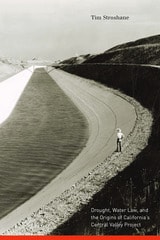
Drought, Water Law, and the Origins of California's Central Valley Project
Tim Stroshane
University of Nevada Press, 2016