251 books match the query 'Environmental conditions' and 5 start with d
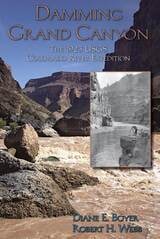
cover of Damming Grand Canyon: The 1923 USGS Colorado River Expedition

Damming Grand Canyon

The 1923 USGS Colorado River Expedition

Diane E Boyer and Robert H. Webb

Utah State University Press, 2007

In 1923, America paid close attention, via special radio broadcasts, newspaper headlines, and cover stories in popular magazines, as a government party descended the Colorado to survey Grand Canyon. Fifty years after John Wesley Powell's journey, the canyon still had an aura of mystery and extreme danger. At one point, the party was thought lost in a flood.

Something important besides adventure was going on. Led by Claude Birdseye and including colorful characters such as early river-runner Emery Kolb, popular writer Lewis Freeman, and hydraulic engineer Eugene La Rue, the expedition not only made the first accurate survey of the river gorge but sought to decide the canyon's fate. The primary goal was to determine the best places to dam the Grand. With Boulder Dam not yet built, the USGS, especially La Rue, contested with the Bureau of Reclamation over how best to develop the Colorado River. The survey party played a major role in what was known and thought about Grand Canyon.

The authors weave a narrative from the party's firsthand accounts and frame it with a thorough history of water politics and development and the Colorado River. The recommended dams were not built, but the survey both provided base data that stood the test of time and helped define Grand Canyon in the popular imagination.

Also by Robert Webb:   Lee's Ferry
[more]
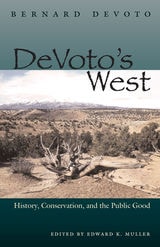
cover of DeVoto’s West: History, Conservation, and the Public Good

DeVoto’s West

History, Conservation, and the Public Good

Bernard DeVoto

Ohio University Press, 2005
Social commentator and preeminent Western historian Bernard DeVoto vigorously defended public lands in the West against commercial interests. At his death in 1955, DeVoto had won both the Pulitzer and Bancroft prizes. But he was most famous for his eloquent writing that advocated conservation of America's prairies, rangeland, forests, mountains, canyons, and deserts.DeVoto's West: Essays on History, Conservation, and the Public Good showcases the complexity, depth, and breadth of DeVoto's thinking. Editor Edward K. Muller introduces these twenty-two essays (many of which originally appeared in Harper's renowned column The Easy Chair) that passionately and coherently advocate federal control for vast tracts of public land. DeVoto addressed many issues, including the plundering of resources by absentee eastern corporations, Westerners' conflicted relationship to exploitation, and the degradation of the national parks. He believed that conservation of natural resources in the West required government control of public lands against livestock associations, timber interests, and their congressional allies who plotted the privatization of the national forests and the extraction of resources in the national parks.DeVoto's West collects the best of DeVoto's conservation pieces for the first time. It will introduce a new generation to prose that has retained its relevance and remains a remarkably current and timely argument for protecting public lands. Bernard DeVoto was born in Ogden, Utah, in 1897. He spent his adult life in the East, first teaching English at Northwestern University, Chicago, then living in New York, and finally settling in Cambridge, Massachusetts. He is the subject of an acclaimed biography, The Uneasy Chair, by Wallace Stegner.
[more]
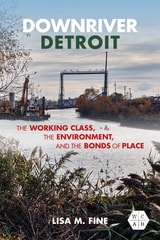
cover of Downriver Detroit: The Working Class, the Environment, and the Bonds of Place

Downriver Detroit

The Working Class, the Environment, and the Bonds of Place

Lisa M. Fine

University of Illinois Press, 2026

Since the beginning of the twentieth century, communities in the Downriver region of the Detroit River have forged an enduring claim to the well-being of waterways that are central to where they live, work, and play.

Lisa M. Fine examines important moments in the ongoing efforts of the area’s citizens to create a humane and habitable environment. Her analysis shows how people preserved wetlands and the river by working through sportsmen’s organizations, appealing to state agencies, and forming grassroots movements. Fueled by enduring connections to place, local unions fought a proposed nuclear power plant in the 1950s. Years later, steel workers facing the steamroller of deindustrialization tried to preserve their communities by purchasing their own company. The ties that bind gave a unique character to activism in the Downriver region, challenging stereotypes of working-class attitudes toward the environment.

A creative merger of labor and environmental history, Downriver Detroit shows that working people have a right to live in and protect the places they love.
[more]
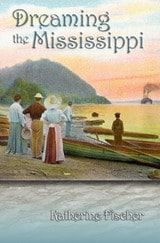
cover of Dreaming the Mississippi

Dreaming the Mississippi

Katherine Fischer

University of Missouri Press, 2006
Offering a fresh perspective on the river’s environment, industry, and recreation, Dreaming the Mississippi challenges old stereotypes through the experiences of modern Americans who work the barges, rope-swing into muddy bottoms, struggle against hurricane floodwaters, and otherwise find new meaning on this great watery corridor. In an engaging voice, earnest and energetic, Katherine Fischer describes how the river’s natural and human histories overlap and interweave as she tells of her own gradual immersion in its life—which led her to buy a house so close to its banks that each spring she must open her basement doors to accept its inevitable floods.
            Fischer blends stories of people living along the river with accounts of national and global consequence. She weaves humorous accounts of river rats and towboat pilots with stories of sandbagging against a flood tide that refuses to be contained. She tells of river hangouts—“joints” that literally join segments of humanity along the river—as she revels in the colorful clientele of her favorite waterfront taverns. Some chapters connect the wildness of this mythical river to outside regions such as the Great Salt Lake and Florida, taking the lure of the mighty Mississippi as far as Japan. Another chapter, about the river’s mouth, “Gulf,” considers the gulf between engineers and naturalists—and between America’s haves and have-nots—as it offers heartfelt reflections on Katrina’s wrath.
            Through compelling words and photographs, Dreaming the Mississippi invites readers to taste life on today’s Mississippi, as sweet, tangy, and wildly cantankerous as it gets. In conveying her understanding of contemporary life along the river’s length, Katherine Fischer has much to teach us not only about reverence for this glorious American waterway but also about our eternal connections to the natural world.
[more]
cover of Dust Bowl, USA: Depression America and the Ecological Imagination, 1929–1941

Dust Bowl, USA

Depression America and the Ecological Imagination, 1929–1941

Brad D. Lookingbill

Ohio University Press, 2001

Whether romantic or tragic, accounts of the dramatic events surrounding the North American Dust Bowl of the “dirty thirties” unearthed anxieties buried deep in America’s ecological imagination. Moreover, the images of a landscape of fear remain embedded in the national consciousness today. In vivid form, the aesthetic of suffering captured in Dorothea Lange’s photographs and Woody Guthrie’s folk songs created the myths and memories of the Depression generation.

Dust Bowl, USA is a critical examination of the stories that grew out of the Dust Bowl experience. Across the nation, newspapers, magazines, books, films, and songs produced imagery of blight for local and mass audiences. As new technology, irrigation innovations, and conservation programs were introduced on a wide scale during the 1930s, the saga of the frontier continued to unfold through accounts of dust, drought, and desertification.

In piercing the myths brought forth in legends, lore, allegories, and anecdotes, Brad Lookingbill provides a revelatory insight into the history of the cultural narratives that have come to define an era.

[more]